
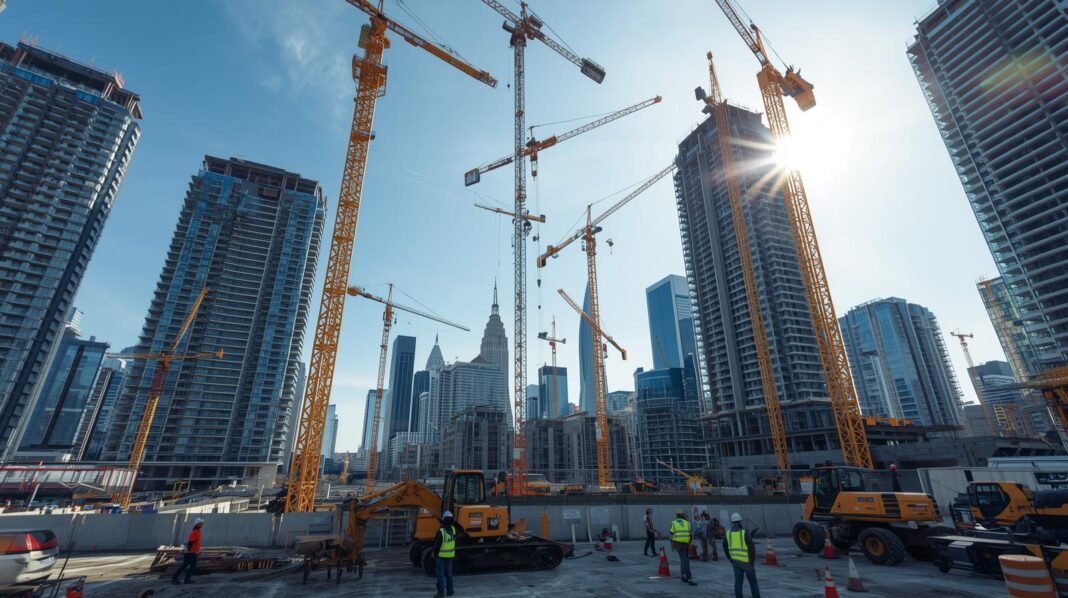
The American construction industry is in the midst of a defining era.
Fueled by federal infrastructure legislation, a historic surge in data center investment, and the ongoing reshaping of the nation’s energy grid, the sector generated a combined $600.6 billion in revenue among ENR’s Top 400 Contractors in 2024 — a 7.9% year-over-year increase.
Yet behind that headline figure, the landscape is anything but uniform.
A narrow group of mega-firms is capturing an outsized share of the growth, while smaller contractors navigate tighter margins, persistent labor shortages, and the disrupting force of tariff-driven material costs.
This guide profiles the market leaders defining American construction in 2026, their core specializations, and the trends that will shape competition through the decade.
Revenue Rankings: Who Leads the U.S. Construction Market?
Engineering News-Record’s (ENR) 2025 Top 400 Contractors list, which ranks firms by 2024 revenue, confirms a clear hierarchy at the top. The top 10 firms alone account for 21.2% of the list’s total reported revenue, illustrating just how concentrated market leadership has become.
1. Turner Construction — $20.2 billion (2024 revenue) Founded in New York City in 1902, Turner Construction has retained the No. 1 contractor spot in the country for multiple consecutive years.
The company posted a remarkable revenue jump from $17.1 billion in 2023 to $20.2 billion in 2024 — nearly 18% growth in a single year. A subsidiary of Germany’s Hochtief, Turner operates across healthcare, education, sports venues, commercial towers, and data centers.
The firm has built 20 of the world’s 100 tallest buildings, including the Burj Khalifa and Willis Tower.
In early 2026, Turner and Mortenson were jointly awarded a $10 billion Meta data center contract in Indiana, underscoring the company’s dominant position in the AI infrastructure buildout.
2. Bechtel — $15.9 billion Reston, Virginia-based Bechtel is one of the largest privately held engineering and construction companies in the world.
Founded in 1898 and employing approximately 55,000 people across nearly 50 countries, Bechtel reclaimed second place on ENR’s 2025 list after a year in third.
Its 2024 revenue grew from $12.9 billion — a 23% jump driven primarily by massive liquefied natural gas (LNG) construction contracts. In 2024, Bechtel signed a fixed-price EPC contract for the Port Arthur LNG Phase 2 project in Texas and secured a $4.2 billion EPC agreement for Train 4 at the Rio Grande LNG Facility.
The company also achieved substantial completion of Train 2 at Cheniere’s Corpus Christi Stage 3 project ahead of schedule. Its diversified portfolio spans nuclear facilities, highways, railways, airports, and defense infrastructure.
3. Kiewit — $14 billion Omaha, Nebraska-based Kiewit is one of the largest employee-owned construction and engineering organizations in North America.
With approximately 28,000 employees, Kiewit specializes in transportation, water, power, oil and gas, and building construction.
Revenue held relatively steady from $13.8 billion in 2023 to $14 billion in 2024, though the firm had previously surged to second place in 2023 on the back of a 23% revenue spike.
Kiewit’s civil engineering expertise makes it a primary beneficiary of IIJA highway and bridge funding, with major projects spanning multiple U.S. states and Canadian provinces.
4. MasTec — ~$11.6 billion Coral Gables, Florida-based MasTec operates differently from traditional general contractors, focusing almost exclusively on infrastructure construction across energy, communications, transportation, and water sectors.
Its portfolio includes large-scale pipeline construction, wind farm projects, and telecommunications network buildouts.
With nearly 22,000 skilled professionals, MasTec has positioned itself as a leading contractor for the clean energy transition — though policy headwinds around Inflation Reduction Act incentives present some uncertainty heading into 2026.
5. Fluor Corporation — ~$15.5 billion (total revenue) Headquartered in Irving, Texas, Fluor is a publicly traded multinational engineering and construction firm.
It delivers engineering, procurement, and construction (EPC) services for complex energy, industrial, and government projects globally.
Fluor’s 2024 work on the Gordie Howe International Bridge and its ongoing role on the Reko Diq copper-gold mining project in Pakistan demonstrate its breadth.
In July 2025, Fluor received final notice to proceed on the Reko Diq project, with construction scheduled to begin later in the year and first production targeted for 2028.
Other Top-10 Firms Worth Noting
STO Building Group (formerly Structure Tone), with approximately $10.4 billion in revenue, ranks as a leading commercial interior and base-building contractor focused on cultural institutions, healthcare, and technology campuses.
DPR Construction ($9.6 billion) has carved out a leading niche in complex, mission-critical, and life sciences facilities, partnering with clients including Google and Meta.
HITT Contracting made the most dramatic move in the 2025 ENR rankings, jumping from No. 26 to No. 10 on the back of roughly $3 billion in additional revenue — a surge fueled by its aggressive expansion into government, mission-critical, and healthcare projects.
Key Sectors Driving U.S. Construction
Infrastructure
Public infrastructure remains the backbone of the U.S. construction market. The Infrastructure Investment and Jobs Act (IIJA), signed in 2021, allocated approximately $350 billion for federal highway programs across fiscal years 2022 through 2026.
Highway and bridge work has been the strongest performing segment within non-building construction, continuing to grow even as other sectors fluctuated.
Kiewit, Granite Construction, and Walsh Group are among the firms most heavily concentrated in this space.
However, the IIJA authorization expires in 2026, and congressional negotiations over reauthorization carry some political risk. Industry analysts warn that delays in a successor bill could slow new infrastructure awards and compress margins for civil contractors later in the year.
Water infrastructure is a second emerging priority. With nearly 30 million Americans living in areas facing limited water supplies, investment in modernization of treatment plants and pipeline systems — supported by IIJA and EPA programs — is accelerating.
More than 600 water reuse projects are currently in planning or development nationwide.
Energy
Energy construction is bifurcated in 2026. LNG export facility construction remains one of the most active large-scale project categories, with Bechtel and Fluor holding dominant market positions through multi-billion-dollar EPC contracts on the Gulf Coast.
Natural gas power generation is also seeing renewed investment as utilities scramble to provide reliable “on-demand” electricity for power-hungry data centers and AI workloads.
Clean energy construction, however, faces headwinds. The “One Big Beautiful Bill Act” introduced mid-2026 sunset dates for several Inflation Reduction Act incentives, creating uncertainty for wind and solar project pipelines.
Electric vehicle manufacturing construction — which saw extraordinary growth in 2022 and 2023 — has cooled as automakers reassess capital allocation. Nonetheless, sectors like semiconductors, defense manufacturing, and biomanufacturing are expanding investment and picking up some of the slack.
Commercial and Data Centers
If there is one sector defining construction in 2026, it is data centers. After rising more than 33% in 2025, data center construction spending is expected to grow by another 20% in 2026.
Credit rating agency Moody’s projects $3 trillion in global spending over the next five years to support AI infrastructure expansion.
Tech hyperscalers — Meta, Microsoft, Google, Amazon, and Oracle — have pledged hundreds of billions in capital investment, and general contractors with the scale and technical expertise to execute these complex builds are thriving.
Turner and Mortenson’s $10 billion Meta contract in Indiana is the largest recent example, but data center construction is reshaping entire regional markets — from Northern Virginia to the Texas Hill Country.
The challenge is no longer finding work; it is staffing the projects fast enough. Grid connection wait times for large data centers have stretched to as long as three years in some regions, according to the U.S. Department of Energy, and contractors are increasingly building dedicated power generation capacity to bridge the gap.
Traditional commercial office construction remains weak, a hangover from remote-work trends that has yet to fully reverse.
Retail construction is similarly restrained. The strongest commercial growth is concentrated in healthcare, higher education, and the growing market for office-to-residential conversion projects, particularly in gateway cities.
Residential
The residential market remains structurally constrained by affordability pressures and elevated mortgage rates, although gradual interest rate easing is expected to support a modest rebound through 2026. D.R. Horton and Lennar remain the dominant homebuilders by revenue.
Multifamily construction, after a period of overbuilding in Sun Belt markets, is normalizing. Analysts expect residential construction to respond more quickly than commercial or industrial sectors to rate cuts, though the pace of recovery will vary sharply by region.
Growth Trends and Mega-Projects Shaping 2026 and Beyond
AI Infrastructure as a Construction Category. The AI data center buildout is creating an entirely new project typology.
These aren’t just large buildings — they are power-dependent, cooling-intensive, and schedule-critical facilities requiring specialized expertise in electrical, mechanical, and structural systems.
Large public builders including Turner, Skanska USA, Mortenson, and DPR have all identified data centers as a strategic priority.
Smaller specialty contractors are also finding opportunity in the ancillary work: substations, transmission lines, roads, and supporting civil infrastructure surrounding each major campus.
CHIPS Act Manufacturing. The CHIPS and Science Act continues to funnel investment into domestic semiconductor fabrication. Major plants under development in Ohio (Intel), Arizona (TSMC), and New York (Micron) represent some of the largest individual construction projects in U.S. history.
Firms like Barton Malow, Turner, and international EPC players are executing on these builds, which involve clean room construction, ultra-precision MEP systems, and extraordinarily complex logistics.
Stadium and Sports Venue Renaissance. Several major professional sports venues are currently under construction or in planning. Turner is building the new Tennessee Titans stadium in Nashville.
The Las Vegas Athletics ballpark is advancing. Washington, D.C. has selected an architect for the new Commanders stadium. These projects, typically in the $1–4 billion range, remain a competitive niche dominated by Turner and PCL Construction.
Digital Transformation as a Competitive Differentiator. Across all sectors, the adoption of Building Information Modeling (BIM), digital twins, AI-assisted scheduling, and automated quality control is accelerating.
Firms that invest in these capabilities gain measurable advantages in project delivery, claims management, and client confidence.
Deloitte’s 2026 Engineering and Construction Outlook identifies digital transformation as one of the four key strategies E&C firms should prioritize to navigate the current environment.
2026 Outlook: Opportunities and Headwinds
The U.S. construction market is projected to grow 5.6% in 2026, reaching approximately $1.27 trillion according to industry forecasts.
The sector is expected to compound at roughly 4.4% annually through 2030, reaching approximately $1.59 trillion by decade’s end.
The firms best positioned for 2026 are those with deep exposure to data centers, power infrastructure, and public civil work — and the scale to absorb rising material costs driven by steel and aluminum tariffs that reached a 40-year effective high in 2025.
Construction backlog rose in April 2025 to its highest level since September 2023 among larger contractors (those with over $100 million in revenue), a leading indicator of sustained activity.
Labor, however, remains the defining constraint. Electrical, controls, and instrumentation trades are in highest demand, and contractors with national labor access, prefabrication capacity, and strong training pipelines hold a structural advantage over competitors that cannot reliably staff complex projects.
The macro backdrop — tariff policy, IIJA reauthorization, and the trajectory of interest rates — introduces genuine uncertainty.
But for the largest U.S. construction companies, the fundamental story is one of durable, diversified demand across infrastructure, energy, and the AI economy.
The contractors that adapt to this bifurcated environment, winning in high-growth niches while managing cost and workforce volatility in traditional sectors, are likely to define the industry’s next decade.
Also Read
Top US Construction Equipment Brands You Should Know
Top 10 Mega Construction Projects in the United States 2026

- South Africa Fuel Restrictions Are Squeezing Construction Sites — Here’s What Contractors Need to Know - March 13, 2026
- The $104 Billion Question: Why Africa’s Hotel Pipeline Keeps Missing Opening Deadlines - March 12, 2026
- What FlySafair’s First-Ever Fuel Surcharge Tells Us About Construction Costs Ahead - March 12, 2026
