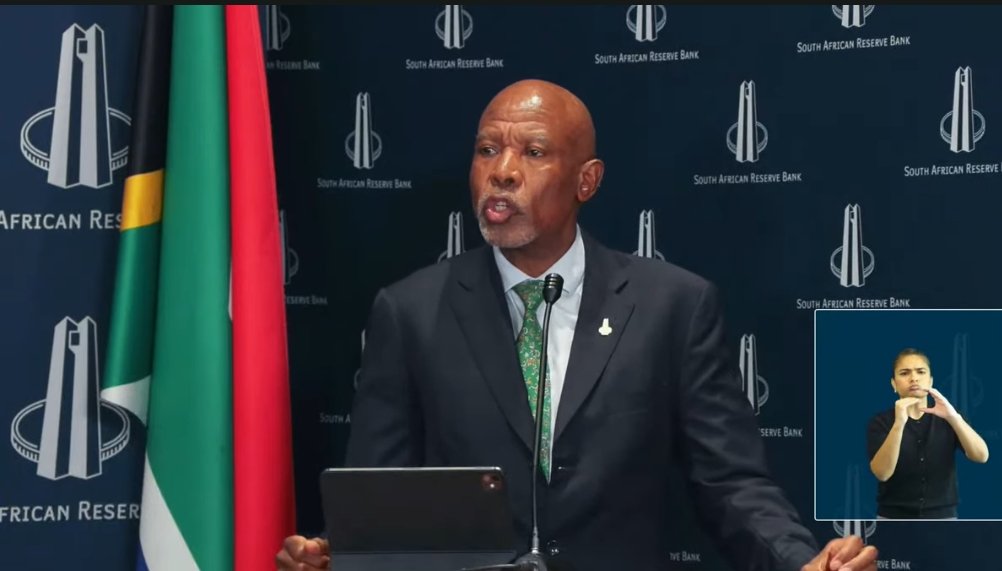
The South African Reserve Bank (SARB) has reduced the repurchase (repo) rate by 25 basis points, bringing it down to 6.75% with effect from 20 November 2025.
The decision, announced by Governor Lesetja Kganyago, reflects the Monetary Policy Committee’s (MPC) assessment of a more favorable inflation environment and stronger economic growth.
Governor Kganyago said, “Growth is looking steadier than last year. Our second-quarter outcome surprised on the upside, and third-quarter indicators are broadly positive. We continue to see growth nearing 2% over the forecast horizon.” He added that rising employment and robust household spending are supporting the economy.
Inflation Update
Headline inflation reached 3.6% in October, above the 3% average for the first half of the year. “The uptick is mainly due to non-core items: meat, vegetables, and fuel,” Governor Kganyago noted, adding that these pressures are expected to be temporary.
“Recent outcomes have undershot our forecasts slightly, and we remain on track to deliver 3% inflation over the medium term.”
Food price inflation appears to have peaked, though minor upward revisions were made for beef prices. Services inflation remains stable, with housing costs requiring ongoing scrutiny.
“We want it understood that inflation will not always be precisely 3%, but most of the time it should stay within the tolerance band,” the Governor explained.
Policy Decision and Forward Guidance
The MPC’s unanimous decision to lower the policy rate reflects an improved inflation outlook.
“There is scope now to make the policy stance less restrictive, in the context of an improved inflation outlook,” Kganyago said.
The SARB’s Quarterly Projection Model indicates gradual rate cuts as inflation continues to subside, with all future decisions being data-dependent.
New Inflation Target
SARB has moved from a 3–6% inflation target range to a point target of 3% with a tolerance band of ±1 percentage point.
“The tolerance band does not mean we will be indifferent to inflation anywhere between 2% and 4%.
We want to be at 3%,” Kganyago clarified. He emphasized that deviations caused by shocks will be addressed, and monetary policy will aim to return inflation to the target over time.
Economic Outlook and Structural Reform
While domestic growth is improving, the Governor highlighted global uncertainties, including volatility in major economies and emerging AI investment bubbles.
“There has been significant progress on reform this year, as underscored by the recent credit rating upgrade from Standard & Poor’s, as well as South Africa’s exit from the Financial Action Task Force grey list.
The global environment nonetheless remains challenging, so it is urgent to sustain domestic reform efforts,” he said.
Also Read
The Ultimate Low-Cost ETF Portfolio for 2025: Maximize Returns While Minimizing Fees
SASSA Grants at Risk: How Social Support Funds Are Feeding Gambling Addiction

