
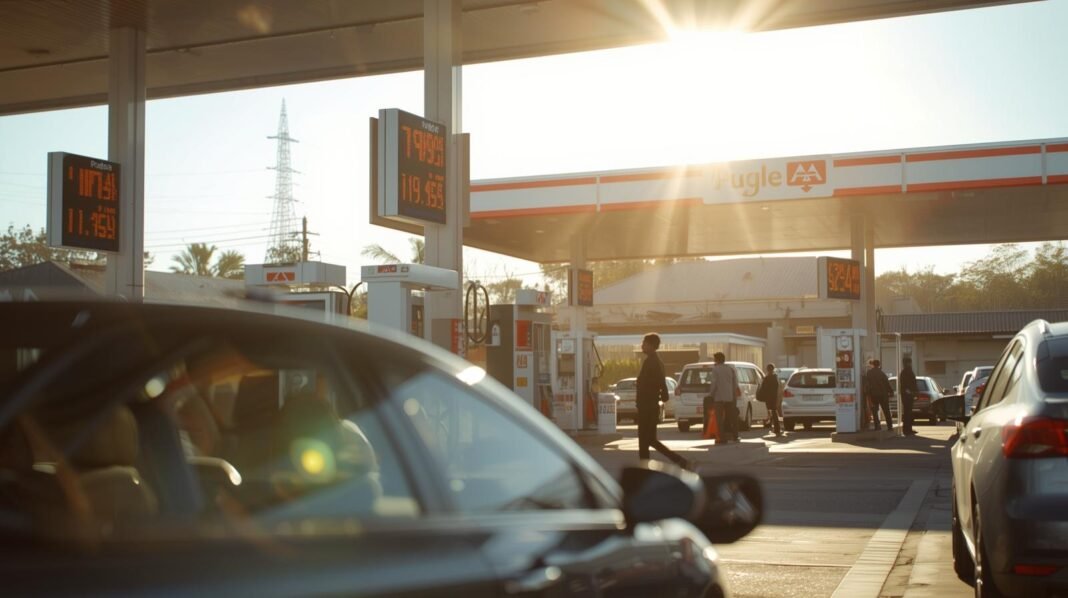
South African drivers will wake up to welcome news this week as fuel prices are set for their biggest drop in months, bringing petrol to its lowest level since early 2022.
But economists warn the rand’s recent strength – a key driver of the reduction – sits on shakier foundations than many realize.
The Department of Mineral Resources and Energy (DMRE) will announce the official fuel price adjustment on Wednesday, February 4, with new prices taking effect at midnight.
According to provisional data from the Central Energy Fund (CEF), motorists can expect substantial relief: 95-octane petrol is projected to drop by approximately 64-67 cents per litre, while diesel prices will fall between 50 and 56 cents per litre.
For cash-strapped South Africans still reeling from years of inflation and economic stagnation, the timing couldn’t be better.
The reduction will bring petrol prices to their lowest point since January 2022, offering tangible relief at the pump.
The Double Blessing: Strong Rand, Weak Oil
Two powerful forces have conspired to deliver this windfall. First, the rand has been on a remarkable run, recently trading at its strongest level against the US dollar in four years – hovering around R15.70 to the greenback.
Second, Brent crude oil prices remain subdued at roughly $64 per barrel, well below the levels that sent fuel prices soaring in recent years.
The rand’s performance has been nothing short of extraordinary. The currency has appreciated nearly 5% against the dollar since the start of 2026, building on strong gains from 2025.
South Africa’s removal from the Financial Action Task Force (FATF) grey list, an S&P Global credit rating upgrade – the first in nearly two decades – and record prices for key commodity exports like gold, platinum, and palladium have all buoyed investor confidence.
But here’s where the story gets complicated.
The Fragile Foundation
While South Africans celebrate cheaper fuel, currency analysts are sounding notes of caution about the rand’s sustainability.
Despite the improved risk perception and fiscal discipline from the Government of National Unity, fundamental economic weaknesses remain deeply entrenched.
The economy is barely growing, with GDP expansion projected at just 1.2-1.7% for 2026 – far too weak to create the jobs needed in a country where unemployment affects a third of the workforce.
The current account deficit persists at around 1-1.5% of GDP, meaning South Africa still relies on foreign capital inflows to fund imports – capital that could evaporate if global sentiment shifts.
Economists also note that on a purchasing power parity basis, the rand should theoretically trade closer to R13 to the dollar, but structural problems keep it far weaker.
The “fair value” estimate sits around R16 to the dollar, suggesting the current strength may be somewhat inflated by temporary factors.
Walking a Tightrope
The currency’s gains have been driven significantly by external factors largely beyond South Africa’s control: US dollar weakness, soaring precious metals prices, and geopolitical tensions in the northern hemisphere that have made South Africa’s geographic remoteness attractive to nervous investors.
If any of these conditions reverse – particularly if the US Federal Reserve shifts course on interest rate cuts or commodity prices tumble – the rand could retreat rapidly.
Currency strategists warn that the rand remains a high-beta, sentiment-driven currency that can turn “far faster than fundamentals.” Range-bound stability between R16 and R16.50 to the dollar appears more realistic for the medium term than sustained appreciation.
A Temporary Reprieve?
For now, South Africans should enjoy the fuel price relief while it lasts. But the broader lesson is clear: the country cannot fuel long-term prosperity on currency strength alone.
Without structural reforms to boost growth, improve infrastructure, and create jobs, the rand’s current performance may prove to be less a turning point than a temporary respite in a longer struggle.
The DMRE’s official announcement on Wednesday will confirm the exact figures, but one thing is certain – South Africa’s economic journey remains as volatile as ever.
Also Read
SASSA Announces February 2026 Grant Payment Dates
Gold Surges Past $5,300: Analysts Debate Whether Historic Rally Signals New Supercycle

