
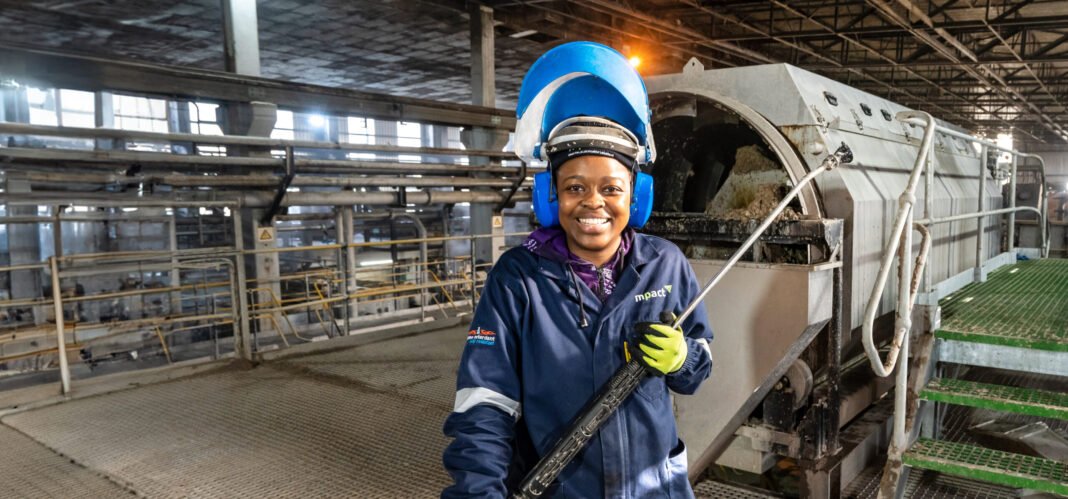
SPRINGS, GAUTENG — Every time a South African tore open a KFC bucket, snapped open a box of Blitz firelighters, or brewed a mug of Freshpak rooibos, the packaging almost certainly came from one place: a vast, rumbling factory in Springs, east of Johannesburg, that has been quietly underpinning daily South African life for decades. That factory is about to go dark — forever.
Mpact Limited, JSE-listed South Africa’s largest paper and plastics packaging group, has confirmed it will shut down its Springs Mill by end of May 2026 — closing what is the country’s only domestic producer of cartonboard.
The decision, announced alongside the group’s 2025 financial results, sets in motion a Section 189A retrenchment process that puts 377 workers at risk of losing their livelihoods.
The closure is more than the end of a single factory. It is the latest — and perhaps most symbolic — chapter in the long, painful deindustrialisation of South Africa.
Priced Out by the World
The economics were brutal. A global glut of cartonboard — driven by aggressive overproduction in Asia and Europe — flooded international markets, sending prices into freefall.
Simultaneously, a strengthening rand made it increasingly attractive for South African companies to simply import their packaging rather than buy locally.
By early 2026, Mpact’s customers could source cartonboard from overseas suppliers at prices approximately 20% below what the Springs mill could produce it for.
The killing blow came in January 2026, when the mill’s largest customer — whose identity Mpact has not disclosed — formally notified the company that it would no longer purchase domestically produced cartonboard and would turn entirely to imports.
Despite months of effort, Mpact was unable to close the cost gap or find sufficient replacement demand at sustainable prices.
“Despite extensive efforts, Mpact is unable to bridge the cost gap and is unlikely to secure sufficient demand from other customers at sustainable prices,” the company stated in its SENS announcement to shareholders.
A Mill Sabotaged From Within and Without
The import pressure alone does not tell the full story. Mpact’s own financial reports have repeatedly flagged an equally corrosive problem: South Africa’s collapsing municipal infrastructure.
In its most recent annual report, the company disclosed that the Springs mill suffered nearly 30 days of unplanned downtime in a single year — more than a full working month — due to electricity and water supply disruptions from the Ekurhuleni municipality.
Load-shedding and load reduction repeatedly halted production.
Water shortages compounded the problem. For a high-volume industrial operation running on tight margins, a month of lost production is devastating.
The result was a business left exposed and vulnerable: over-reliant on a handful of large customers, unable to self-generate sufficient alternative power like some of Mpact’s other mills, and squeezed between rising operational costs and plummeting market prices.
In the year to December 2024, the Springs operation generated revenue of R1.74 billion — but operating profit of only R32 million.
Thin margins on a massive turnover. No room for error. And then the largest customer walked out the door.
377 Jobs, One Community
For the 377 workers at the Springs mill, the boardroom calculations translate into something far more personal. The mill, comprehensively rebuilt in the 1980s, has been a source of employment in the Springs area for generations.
The Section 189A consultation process — South Africa’s legal mechanism for large-scale retrenchments — is now underway, with labour unions expected to participate in negotiations over possible alternatives or severance terms.
Mpact CEO Bruce Strong acknowledged the severity of conditions facing South African manufacturers. “2025 was a demanding year, marked by sustained economic pressure and difficult trading conditions across several of our markets,” Strong said in the group’s results statement.
He pointed to intense financial pressure on consumers affecting demand, widespread municipal infrastructure failures driving additional costs, and an influx of imported products placing strain on domestic industries.
The Bigger Picture: South Africa’s Deindustrialisation Crisis
Mpact’s Springs closure does not stand alone. It arrives weeks after British American Tobacco announced the shutdown of its Heidelberg plant — once the largest cigarette manufacturing facility in Southern Africa, producing 26 billion cigarettes a year at its peak and employing more than 1,000 staff. Two landmark manufacturers.
Two communities hollowed out. Two more lines on the quiet ledger of South Africa’s industrial retreat.
South Africa’s manufacturing output has been stagnant since roughly 2004 — a two-decade flatline that predates load-shedding and points to something more fundamental: a persistent erosion of business confidence, rising input costs, deteriorating public infrastructure, and an inability to compete with low-cost Asian producers who enjoy scale advantages, lower labour costs, and far more reliable utilities.
Statistics South Africa reported in 2025 that unemployment had climbed to 33.2% — with 8.4 million South Africans jobless. The Springs closure adds 377 names to that growing ledger.
What Comes Next?
For Mpact as a group, the closure is framed as a strategic pruning. The company says it will be “cash positive and margin accretive over time” — cold comfort for the workers facing redundancy, but a signal to investors that management is willing to make hard choices.
The group, which operates across 38 sites including 21 manufacturing facilities, is pivoting toward export-oriented growth areas such as fruit packaging — record citrus export volumes in 2025 validated that strategy.
For South Africa’s broader packaging industry, the closure creates an immediate dependency on imports for all domestically consumed cartonboard — a strategic vulnerability that policymakers have barely begun to reckon with.
Once a mill of this kind closes, the expertise, equipment, and industrial base rarely return.
The Springs mill has been a quiet workhorse of South African industry — unnoticed until now precisely because it worked.
The boxes that carried your takeaway chicken, the packaging around your morning tea, the lighting of a winter braai: all of it, born in a factory that will soon fall silent.
In that silence, South Africa loses something harder to quantify than 137,000 tonnes of annual production capacity. It loses another piece of its industrial identity.
Also Read
Capitec Brings Smart ID Applications to Bank Branches in Partnership with Home Affairs
SASSA Payment Dates for April 2026: What Every Beneficiary Needs to Know

- U.S. Senators Push for Tariff Probe into Construction Equipment Imports from Mexico - March 30, 2026
- Top Smart Safety Shoes to Watch in 2026 - March 29, 2026
- SASSA Payment Dates for April 2026: What Every Beneficiary Needs to Know - March 29, 2026
