
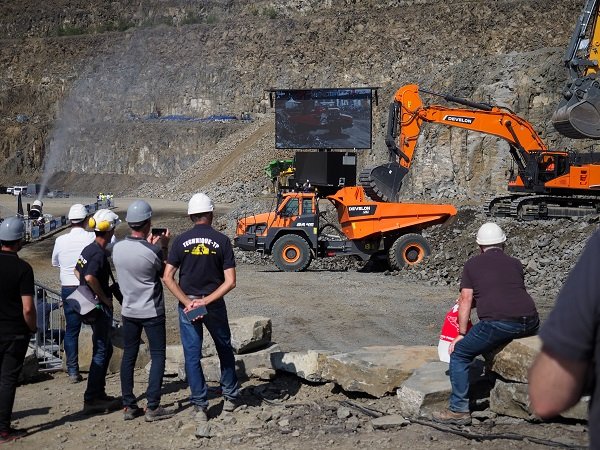
When the world’s biggest excavator manufacturers roll their machines into Europe’s largest basalt quarry this September, they will not simply be showcasing bigger buckets and louder engines.
They will be demonstrating a transformation that has been quietly accelerating for years — a wholesale reinvention of how an excavator thinks, moves, senses its environment, and burns its fuel.
Steinexpo 2026, set for September 2–5 in Homberg/Nieder-Ofleiden, Germany, is the industry’s grand proving ground, and for excavators, the timing has rarely felt so charged.
The show arrives at an inflection point. In the past six months alone, brands including DEVELON, Hyundai Construction Equipment, Volvo CE, Liebherr, and Komatsu have unveiled generation-defining excavator platforms, many of them debuted at ConExpo-Con/Agg 2026 in Las Vegas.
The machines were met with genuine excitement — not because they were bigger, but because they were fundamentally smarter.
By September, those same platforms, and others refined for the European quarrying market, will tear into the volcanic rock of Nieder-Ofleiden in front of buyers, operators, and dealers from over 90 countries.
This is the second instalment of our Road to Steinexpo 2026 series. Here, we examine exactly what is coming on the excavation front: the technology shifts driving the next generation, the specific machines and brands to watch, and why the quarry environment of Steinexpo makes it uniquely suited to separating genuine innovation from showroom polish.
Why Steinexpo Is Different — and Why It Matters
Most trade shows are held in halls. Steinexpo is held in a hole in the ground — a spectacular, operational one. The quarry operated by Mitteldeutsche Hartstein-Industrie AG transforms what might otherwise be a static display into a genuine performance arena.
Excavators do not pose beside brochures here. They dig into hard basalt, swing loaded buckets, and cycle relentlessly through the demonstration schedule in conditions that closely replicate what quarry operators face every day.
This distinction matters enormously when evaluating next-generation claims. It is relatively easy to demonstrate smooth electrohydraulic controls in a car park.
It is another matter entirely to demonstrate cycle-time improvements, fuel efficiency gains, and semi-autonomous grade control while working a rock face in front of an audience of operators who have spent decades behind a joystick. Steinexpo is, in this sense, the industry’s most honest courtroom.
The high level of interest in the 12th edition of steinexpo is very encouraging. Together with our exhibitors, we’re creating an event that delivers exceptional value.
Show Director, GEOPLAN GmbH
The 2026 edition introduces a flagship concept called “Quarry Vision 2.6,” themed “Quarry Next Gen — We’re In.”
Under this initiative, exhibitors are explicitly invited to display not just market-ready products, but forward-looking prototypes and smart technologies that may still be in development.
Clearly marked Quarry Vision booths will allow visitors to follow a dedicated innovation trail across the grounds, offering a rare window into the industry’s technology pipeline.
The Four Technology Pillars Reshaping Excavators in 2026
1. Fully Electrohydraulic Control Systems
The single most consequential shift in excavator architecture over the past year has been the industry-wide migration from traditional pilot-operated hydraulic controls to fully electronic hydraulic (EH) systems.
The difference is not merely incremental. Traditional pilot systems use hydraulic pressure to communicate the operator’s joystick movement to the machine’s pumps and valves.
EH systems replace that physical linkage with electronic signals, giving manufacturers — and operators — a dramatically expanded canvas for software-driven customisation and automation.
DEVELON’s -9 Series, unveiled at ConExpo 2026, made this shift its centrepiece. The platform, which includes the DX230LC-9, DX260LC-9, DX360LC-9, and DX400LC-9, was described by the brand’s heavy excavator product manager Brian Kim as representing “a fundamental shift in how operators interact with heavy machines.”
With EH controls, operators can tune joystick sensitivity, response time, and button layout to their preferences.
More significantly, every -9 Series machine ships from the factory with a 2D grading system already installed and is physically ready for plug-and-play 3D machine control via Trimble and Leica interfaces — no retrofitting required.
Hyundai Construction Equipment’s new Next Generation HX Series takes a similar path with what the company calls Fully ElectroHydraulic, or FEH, controls.
According to Hyundai, the FEH system eliminates the hydraulic losses inherent in conventional pilot circuits, producing at least a 22 percent increase in productivity and making the machines at least 9 percent more fuel efficient than the models they replace.
The HX230, HX260, HX300, HX360, and HX400 — rated between 186 and 336 net horsepower — debuted at ConExpo and are expected to have European market variants prepared well ahead of Steinexpo’s September dates.
Why EH Controls Matter for Quarry Operators
In quarry excavation, consistency is productivity. A skilled operator using EH controls can programme and repeat precise swing angles, digging depths, and bucket trajectories with far less fatigue than traditional pilot systems allow.
For fleet managers training new operators — a persistent industry challenge — EH machines shorten the skill acquisition curve significantly by allowing per-operator control profiles and software-assisted guidance modes.
2. AI-Powered Situational Awareness and Safety
The second pillar is perhaps the most visually dramatic: the integration of artificial intelligence into the machine’s sense of its surroundings.
Quarry environments are inherently hazardous, with ground crews, trucks, and multiple machines operating in proximity. The new generation of excavators does not merely warn operators of nearby personnel — it can intervene autonomously.
DEVELON’s -9 Series carries the most comprehensive implementation seen to date in a production excavator.
The Smart Around View Monitor system uses six cameras and radar sensors to provide a 360-degree view around the machine, with AI-powered algorithms that distinguish between humans and inanimate objects.
When a person is detected within 13 feet of the machine’s swing radius or travel path, the excavator automatically decelerates. If the person continues to approach within 6.5 feet, the machine performs a full, intelligent stop.
DEVELON has also introduced a “Virtual Wall” feature that allows operators or site managers to define geofenced safety zones.
Hyundai’s Next Gen HX Series offers similar 330-degree advanced detection, with visual and audible warnings and the option to slow or halt swing and travel automatically.
Liebherr’s Generation 8 updates, also previewed at ConExpo, introduce a “strategic sensor chain” factory-installed across the boom, stick, and upper carriage.
This enables features including 2D Grade Assist, an automated Bucket Fill Assistant that triggers a fully automated, consistent digging cycle from a single joystick command, and a real-time payload weighing system accurate to plus or minus two percent throughout the loading cycle.
The Bucket Fill Assistant includes an anti-stall function that prevents bucket blockage and guarantees maximum bucket fill — a critical productivity factor in hard-rock quarry applications.
3. Fuel Efficiency and the Path to Alternative Power
Steinexpo 2026 arrives at a moment when the European quarrying industry faces tightening emissions regulations alongside persistently elevated fuel costs.
The show is expected to be among the first major demonstrations of how manufacturers are responding to both pressures simultaneously.
On the efficiency side, gains are being delivered through EH architecture itself — eliminating pilot circuit losses — as well as through intelligent engine and pump management.
Liebherr’s patented LPE Mode (Liebherr Power Efficiency), now standard across the entire R 922 to R 945 G8 range, continuously optimises the interaction between the hydraulic system and the diesel engine, reducing fuel consumption by up to 10 percent without sacrificing output.
The system stores operator preferences and includes a temporary performance boost mode for demanding digging cycles.
DEVELON’s -9 Series engines, meanwhile, deliver up to 20 percent more power than their predecessors while burning 8 percent less fuel — a combination that previously would have seemed contradictory.
For the longer term, the electric direction is accelerating. Volvo CE brought its 23-tonne EC230 Electric excavator to ConExpo and allowed attendees to operate it — and the verdict from those operators was consistent: the electric machine’s performance was indistinguishable from diesel in demanding applications, without the noise and emissions.
At the previous Steinexpo edition in 2023, Volvo CE showcased the EC230 Electric and the EC550E crawler at the quarry, establishing a precedent for full-scale electric demonstration in live rock.
The 2026 show is expected to build substantially on that, with electric and HVO (hydrotreated vegetable oil) compatible machinery across multiple exhibitor stands.
Liebherr’s longer-range roadmap includes a partnership with Australian miner Fortescue to develop autonomous battery-electric haulers at scale — a $2.8 billion USD commitment covering 360 autonomous battery-electric trucks, 55 electric excavators, and 60 battery-powered dozers.
While those machines are designed for large-scale surface mining, the technology direction they represent will inevitably filter into the quarry-class machines on show in Nieder-Ofleiden.
4. Semi-Autonomous Grade Control and Machine Intelligence
Perhaps the most transformative capability arriving in this generation is the democratisation of semi-autonomous grade control.
Until recently, 3D machine control on an excavator required expensive aftermarket retrofitting and specialist calibration. The new platforms are making it factory standard — or, at minimum, factory ready.
Komatsu’s PC158USLCi-12, unveiled at ConExpo 2026, brings the company’s IMC 3.0 system to the tight-tail compact class for the first time.
IMC 3.0 includes 3D machine control that semi-autonomously guides movements across complex terrain in real time, 3D boundary control that maintains defined exclusion surfaces even as the machine travels and changes elevation, swing-to-line functionality that stops the excavator on the centre line of a trench, and travel-along-line capability that keeps the machine tracking on the correct path without constant operator correction.
For quarry operations, where bench heights, slope angles, and drainage gradients must be maintained precisely, this level of machine intelligence represents a significant productivity and quality-of-work upgrade.
Volvo CE’s new EC560, debuted at ConExpo and scheduled for commercial availability in early 2027, brings optimised electro-hydraulics to the 56-tonne class with a focus on what the company describes as “market-leading cycle time and production potential.”
The machine targets a 6 cubic yard bucket capacity, 3 percent more digging force, and 10 percent more swing torque than current models in its range, along with a completely reimagined operator cab and Human Machine Interface.
The EC560 is explicitly designed for heavy infrastructure, quarry, and aggregates applications — it is a machine built for exactly the kind of work being demonstrated at Steinexpo.
The Machines to Watch at Steinexpo 2026
While exhibitor lists for September have not yet been fully confirmed, the combination of historically consistent Steinexpo participants and the wave of new platform launches makes the following machines and brands the strongest candidates for headline demonstrations.
-9 Series Heavy Excavators
The most comprehensively reimagined excavator platform of the current cycle. Full EH controls, AI-powered human detection with intelligent E-Stop, factory 2D grade control, 12-inch tablet-style dual-monitor display, smartphone digital key, and up to 20% more power with 8% less fuel than the -7 Series it replaces.
AI E-Stop
3D Ready
23–40 tonnes
Next Generation HX Series
Five models from HX230 to HX400 (186–336 hp) built on fully electrohydraulic FEH architecture delivering 22%+ productivity gains and up to 10% fuel reduction.
Strengthened structures, extended service intervals (now 1,000-hour engine oil cycles), and five years of Hyundai Connect telematics included as standard.
+22% Productivity
186–336 hp
EC560 & EC230 Electric
The EC560 (56 tonnes, 6 yd³ bucket, +10% swing torque) bridges a critical gap in Volvo’s quarry lineup. The EC230 Electric, already proven in live Canadian quarry operations, continues as the electric benchmark. Volvo has also launched 14 new models in 2026 across compact to heavy classes.
Electric Option
Next-Gen HMI
R 945 G8 — Quarry Specialist
The 45-tonne R 945 G8 is Liebherr’s cornerstone quarry excavator, powered by a 220 kW / 299 HP Tier 4 Final engine.
New additions include LPE Mode (up to 10% fuel reduction), automated Bucket Fill Assist, real-time payload weighing to ±2%, and MyLiebherr fleet management telematics. The 6.45 m mono boom and 3 m³ bucket are purpose-built for hard-rock loading.
Bucket Fill Assist
299 HP / 45T
PC220LCi-12 & PC365LC-11
Komatsu brings its strongest recent excavator lineup to the European market, with the PC220LCi-12 featuring full IMC 3.0 machine control and the PC365LC-11 introducing an electric swing system alongside multifunction capabilities. Both models combine advanced automation with redesigned cabs and EH controls.
Electric Swing
3D Control
Intelligent Excavator Range
Caterpillar enters 2026 with autonomous-ready excavators across its range, with electrohydraulic pilot control delivering fuel savings of up to 25% on models such as the Cat 374 large excavator — a figure demonstrated in live quarry conditions at the 2023 edition. The full Cat line is expected at Steinexpo.
Up to –25% Fuel
EH Controls
The Quarry Vision 2.6 — Where the Future Will Be On Display
Beyond the production machines, Steinexpo 2026’s Quarry Vision 2.6 trail may be where the most consequential technology is visible.
Under the “Quarry Next Gen — We’re In” theme, exhibitors are encouraged to show prototypes and pre-production systems that represent their technology direction — equipment that may not yet be available for order but will define what quarry excavation looks like in 2030 and beyond.
What might appear on the Quarry Vision trail? Based on the technology trajectories announced by major OEMs, credible candidates include: remote-operator excavator cabs that allow a single human operator to supervise multiple machines from a control room; hydrogen-powered or hydrogen-hybrid excavator prototypes, given the quarrying industry’s particular receptiveness to the fuel due to the sector’s high energy intensity; excavator systems with real-time AI bucket fill optimisation that automatically adjusts swing arc and digging depth based on material density feedback; and tethered or cabled electric excavator systems designed for the deepest quarry benches where battery range would otherwise constrain operations.
“A wealth of ideas and inventiveness should show what we can expect in the future and encourage exchange.”
GEOPLAN GmbH, on the Quarry Vision 2.6 concept
The Quarry Vision trail is connected to an interactive contest — “Collect Points, Discover Visions” — that gamifies engagement with the innovation showcases, ensuring that visitors actually spend time with the forward-looking exhibits rather than defaulting to the familiar brands in the main demo area.
What Buyers Should Be Watching For
For quarry operators and procurement managers attending Steinexpo, the next-generation excavator market presents both opportunity and complexity.
The number of platforms simultaneously transitioning to EH architecture, AI safety systems, and factory-integrated machine control is unprecedented. Evaluating them in a hall or on a static display is genuinely difficult. In a live quarry, the differences become legible.
Cycle time is the metric that matters most in high-production quarrying, and it is exactly what Steinexpo’s Demo Area A — at the deepest level of the quarry — will reveal.
A machine that delivers faster bucket-to-truck times while using less fuel is the central value proposition of this entire generation.
Watch also for how each manufacturer handles the transition from hard digging to swing: the EH platforms should show noticeably smoother, quicker responses at the transition point than their predecessors, because that transition is where traditional hydraulic systems lose energy and time.
Operator fatigue is a secondary metric that is difficult to quantify but enormous in its practical significance. Quarry excavators operate for multiple shifts.
An operator who is less fatigued at the end of an eight-hour shift makes fewer errors, maintains higher cycle consistency, and extends machine life through gentler technique.
The improved cab ergonomics, reduced noise and vibration levels, and customisable control profiles of the new EH platforms are not luxury features — they are productivity investments.
Finally, the telematics and fleet management integrations deserve attention. DEVELON’s MY DEVELON system, Hyundai Connect, Liebherr Connect, and Komatsu’s Komtrax all provide real-time health monitoring, predictive maintenance alerts, and productivity tracking.
At Steinexpo, ask exhibitors specifically about how their telematics data integrates with third-party fleet management systems — because quarry operators rarely run a single-brand fleet, and data interoperability is increasingly the deciding factor in procurement decisions.
Looking Ahead to September
Steinexpo 2026 takes place against a construction equipment market that is, by industry analyst consensus, navigating headwinds. Rising fuel prices, tighter emissions regulations, and persistent pressure on project margins are real.
But they are also, counterintuitively, exactly the conditions under which next-generation excavators make their strongest case. A machine that burns 10 percent less fuel, produces 20 percent more per shift, and keeps operators safer is not a luxury in that environment — it is an economic imperative.
The manufacturers arriving in Nieder-Ofleiden this September know this. The platforms they have built represent years of investment, and they are designed to win the argument not in a press release but in basalt.
For the global quarrying and earthmoving industry, that is exactly the right place to have it.
About the Road to Steinexpo 2026 Series
This is the second article in our ongoing Road to Steinexpo 2026 editorial series, covering the technologies, companies, and trends shaping the most important demonstration show in the global raw materials and construction industry.
Steinexpo 2026 runs September 2–5 at the MHI basalt quarry in Homberg/Nieder-Ofleiden, Hessen, Germany. Further instalments will cover crushing and screening innovation, alternative powertrains, fleet management and telematics, and the Quarry Vision 2.6 trail.
Also Read
What to Expect at Steinexpo 2026: New Machinery, Demonstrations & Innovations
steinexpo 2026 Preview: The Big Innovations Expected at Quarry Vision 2.6

- Next-Gen Excavators Heading to Steinexpo: Efficiency, Automation & Power - March 24, 2026
- Concrete Pump Rental Cost in the US (2026 Guide) - March 23, 2026
- ScotPlant 2026: The Ultimate Visitor Planning Guide - March 23, 2026
