
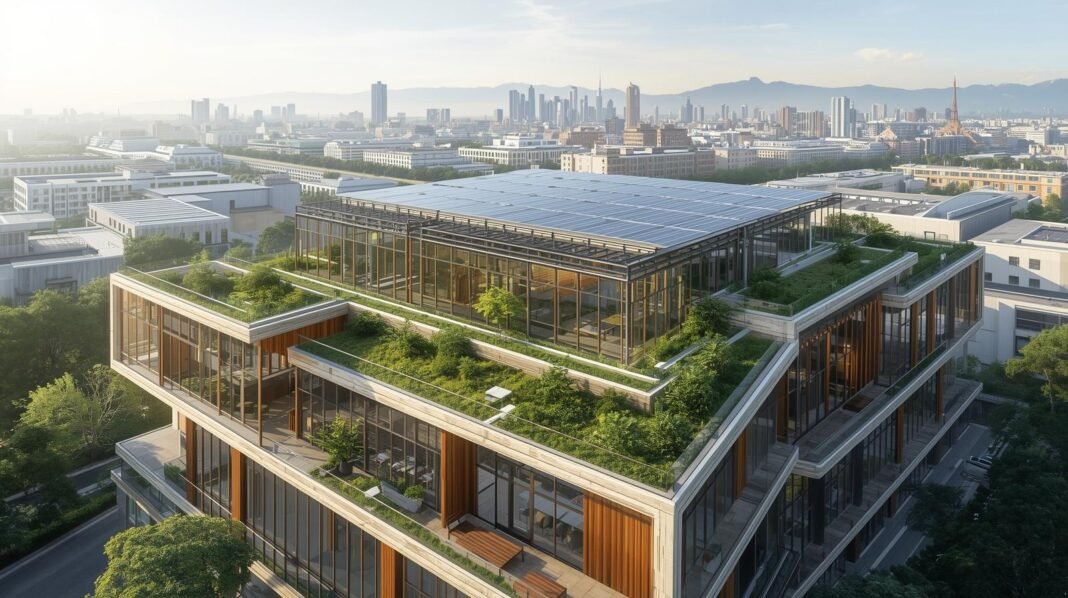
The construction industry stands at a critical crossroads. With buildings responsible for approximately 40% of global carbon emissions, the pressure to transform how we design, build, and operate structures has never been more urgent.
Yet this challenge has sparked remarkable innovation, giving rise to materials and technologies that promise to reshape the built environment fundamentally.
Welcome to the age of sustainable architecture—where buildings don’t just shelter us, but actively heal the planet, optimize resource use, and enhance human wellbeing.
This transformation isn’t coming; it’s already here, driven by breakthrough materials and intelligent technologies that are redefining what’s possible in construction.
The Market Forces Driving Change
The numbers tell a compelling story. The global green building materials market stands at $374.67 billion and is projected to reach $894.74 billion by 2032, reflecting explosive growth fueled by policy mandates, corporate climate commitments, and investor scrutiny. This isn’t a niche trend—it’s a wholesale market transformation.
Regulatory frameworks are accelerating adoption. In the United States, the General Services Administration now requires low-embodied-carbon concrete, steel, asphalt, and glass for federal projects.
European Union directives push even stricter standards. Meanwhile, BuildingTransparency’s EC3 platform hosts more than 157,000 Environmental Product Declarations used by over 52,000 professionals across 76 countries, signaling that verified carbon data is becoming as important as cost and performance in procurement decisions.
Revolutionary Materials Redefining Construction
Bio-Based Materials: Nature’s Answer to Concrete
The shift toward bio-based construction materials represents one of the most profound changes in building practices.
Materials like timber, bamboo, cork, and hemp are emerging as renewable alternatives to steel and concrete, with mass timber construction using engineered wood such as cross-laminated timber gaining traction for multi-story residential and commercial buildings.
Hempcrete stands out as particularly transformative. A mixture of hemp hurds, lime, and water creates a lightweight material with efficient insulating properties that can sequester carbon dioxide, absorbing more CO₂ during production and curing than it emits.
Unlike traditional concrete that contributes to emissions, hempcrete offers a carbon-negative alternative. Hemp construction products can cut carbon emissions by up to 80% compared to traditional materials, while providing excellent fire resistance and superior insulation.
Mycelium-based materials push innovation even further. Mycelium, the root structure of fungi, grows rapidly and creates a renewable, low-impact building material that is lightweight and fireproof.
Its adaptability allows builders creative freedom while meeting strict environmental criteria, opening possibilities for entirely new building components grown rather than manufactured.
Straw: Ancient Material, Modern Applications
Don’t dismiss straw as primitive. Straw construction boards like the E60/1200 and E40 achieve Global Warming Potentials of -47.600 and -33.900 kg CO₂ per square meter respectively, meaning they actively remove carbon from the atmosphere.
Modern straw panels combine prefabricated timber frames with compressed straw infill containing 98% natural materials, providing exceptional thermal insulation with lambda values of 0.059 W/mK and superior acoustic performance, with reference service lives of 50 years.
Fire resistance presents a pleasant surprise—tightly compacted straw bales resist fire damage exceptionally well due to their density, making them viable even in high-risk zones.
Advanced Engineered Materials
Carbon-capturing concrete transforms one of construction’s biggest carbon culprits into a solution. This innovative concrete absorbs CO₂ during the curing process, helping reduce emissions while maintaining the strength needed for structural applications.
Graphene-enhanced materials represent the cutting edge. Graphene-enhanced concrete offers twice the strength and four times the water resistance of traditional concrete while cutting carbon emissions by up to 50%. Research at the University of Exeter demonstrates graphene’s potential to create building components that are both high-performance and eco-friendly. The global graphene market is expected to reach $1.4 billion by 2027, growing at 38.7% annually, reflecting construction’s escalating interest in sustainable materials.
Self-healing concrete addresses one of infrastructure’s costliest challenges. This material uses bacteria to automatically seal cracks, reducing maintenance requirements for roads, bridges, and buildings while lowering environmental impact by extending structure lifespans and reducing resource consumption and waste.
Ferrock offers another innovative alternative. Made from industrial byproducts like steel dust and glass shards, Ferrock absorbs five times more CO₂ than it emits during production, though only 12 factories produce it globally as of 2024. Its flexibility and crack-resistance make it ideal for high-strength applications like load-bearing walls and foundations.
Smart Building Technologies: The Digital Revolution
While materials provide the physical foundation, intelligent technologies are creating buildings that think, learn, and optimize themselves.
The integration represents as significant a leap as the shift from manual to mechanical systems in the 20th century.
The IoT Revolution in Buildings
The number of IoT devices deployed in commercial buildings is expected to reach 4.12 billion by 2030, creating vast networks of sensors that continuously monitor and adjust building performance.
The global smart building market was valued at $126.35 billion in 2024 and is projected to grow at 28.5% annually through 2030, driven by IoT, artificial intelligence, and cloud computing adoption.
IoT sensors form the nervous system of smart buildings, continuously collecting data about various aspects of operation and environment, including temperature, humidity, air quality, and energy use.
Unlike traditional scheduled systems, these sensors enable real-time, responsive building management.
Energy Optimization Through Intelligence
The energy savings potential is substantial. Smart HVAC systems can cut waste by up to 30% by syncing with occupancy and temperature data, while smart lighting tracks sunlight and presence to save up to 40% on lighting energy.
One case study showed a 15.8% reduction in energy consumption over 11 months in a 32-story office building through AI-enabled HVAC optimization, cutting $46,000 in yearly energy costs while extending system lifespans.
IoT sensors working with edge AI can automatically adjust heating, cooling, and ventilation based on actual demand rather than fixed schedules, such as changing temperatures in unoccupied zones or pre-cooling areas during off-peak hours when electricity rates are lower. This shift from reactive to predictive management fundamentally transforms facility operations.
Predictive Maintenance and Beyond
Smart sensors enable predictive maintenance, identifying potential failures before they occur.
By continuously monitoring equipment like HVAC systems, IoT devices can predict potential failures, allowing building managers to perform maintenance only when necessary, saving on both labor and replacement costs.
AI systems process real-time data to enable buildings to learn patterns, predict needs, and trigger automated actions, while machine learning identifies patterns so systems get smarter over time. This creates self-sustaining ecosystems that continuously improve performance.
Certification Systems: Measuring Success
As sustainable building becomes standard practice, certification systems provide crucial frameworks for verification and comparison. Two dominant systems—LEED and BREEAM—set global benchmarks.
LEED: The American Standard
LEED (Leadership in Energy and Environmental Design) is the most widely recognized green building rating system in the world, offering a framework for healthy, efficient, and cost-effective green buildings.
Projects earn points corresponding to certification levels: Certified, Silver, Gold, and Platinum, based on categories including sustainable sites, water efficiency, energy and atmosphere, materials and resources, and indoor environmental quality.
LEED has certified over 190,000 buildings worldwide, with particularly strong adoption in North America, Canada, Asia, and the Middle East. The system’s performance-based approach focuses on measurable outcomes across energy, water, and material usage.
BREEAM: The European Pioneer
BREEAM, launched by BRE (Building Research Establishment), was the world’s first environmental assessment method for buildings and has served as the basis for many green building certification systems including LEED and Green Globes. BREEAM is used in 93 countries with more than 2,326,200 projects registered and 565,000+ certificates issued.
BREEAM assesses sustainability performance across nine categories: energy, water, materials, management, health and wellbeing, pollution, transport, waste, and land use and ecology.
BREEAM offers pre-assessment options, making it easier to adjust and improve during early design phases, while LEED typically conducts most assessment after construction.
Strategic Differences
LEED bases its thresholds on percentages whereas BREEAM relies on quantitative standards, with LEED having very strict mandatory requirements while BREEAM offers more flexibility.
Regional policies often influence adoption, with LEED predominating in North America due to alignment with local regulations, while BREEAM proves more prevalent in Europe through EU environmental policy alignment.
The Circular Economy in Construction
The construction industry historically operated linearly—extract, build, dispose—but 2025 trends increasingly embrace circular economy models aiming to eliminate waste and keep materials in use for as long as possible through sustainable materials, recycled content, and designing buildings for disassembly or reuse.
This shift manifests in multiple ways. Projects increasingly incorporate cradle-to-cradle certified products designed to be safely reused or composted at end-of-life.
BREEAM and LEED both include criteria for construction waste reduction, use of recycled content, and lifecycle impacts of materials, with many European projects in 2025 achieving near-zero construction waste by planning precise material quantities and recycling off-cuts on-site.
Cork insulation from Amorim demonstrates circular principles perfectly—renewable, recyclable, and providing superior insulation while sequestering carbon throughout its lifecycle.
Net-Zero Buildings: The Ultimate Goal
One of the most impactful sustainability trends in architecture is the pursuit of net-zero energy buildings designed to produce as much energy as they consume, typically through extreme energy efficiency combined with on-site renewable energy generation.
Achieving net-zero requires integration of all the technologies discussed: superior insulation from bio-based materials, smart systems optimizing every watt of energy, photovoltaic facades generating power, and advanced building envelopes minimizing thermal transfer.
Europe leads this movement, with stringent regulations pushing new construction toward net-zero standards.
Indoor Environmental Quality: Buildings for Human Health
Sustainable architecture increasingly recognizes that environmental performance and human wellbeing are inseparable.
The EPA reports indoor air can be 2–5 times more polluted than outdoor air, with people spending up to 90% of their time indoors, making materials that avoid VOCs, formaldehyde, and toxic adhesives essential to meet wellness standards.
The WELL Building Standard exemplifies this holistic approach, evaluating buildings on air quality, water quality, lighting, comfort, and mental wellbeing.
Natural materials like wood improve users’ health and wellbeing by promoting calmness, accelerating recovery, and improving indoor air quality, with wood homes shown to reduce stress and improve concentration.
Implementation Challenges and Solutions
Despite compelling advantages, obstacles remain. High initial costs for some sustainable materials and smart systems can deter adoption, particularly in organizations focused on short-term financial metrics.
Success requires educating stakeholders on lifecycle economics and demonstrating clear payback periods.
Integration challenges exist when implementing new technologies alongside existing infrastructure.
However, solutions are emerging. Systems like adaptable surveillance platforms allow businesses to upgrade existing camera systems rather than starting from scratch, offering cost-effective paths to smart building capabilities.
Manufacturing capacity expansions, particularly from producers in China and other emerging markets, have progressively reduced sustainable material prices, narrowing cost gaps with traditional systems. As production volumes increase to meet surging demand, further price reductions appear likely.
The Path Forward
The convergence of innovative materials and intelligent technologies creates unprecedented opportunities for transformative change in how we build.
Projects like mass timber towers reaching 18 stories, net-zero energy schools, and office buildings that generate more energy than they consume demonstrate that sustainable architecture has moved from aspiration to reality.
The trajectory is clear: buildings will increasingly function as active participants in environmental restoration rather than passive consumers of resources.
Advanced manufacturing techniques such as 3D printing and automated fabrication significantly boost efficiency and minimize waste in the construction industry, enabling even more sustainable approaches.
For architects, engineers, contractors, and developers, the question is no longer whether to embrace sustainable architecture, but how quickly to adapt.
Early adopters gain competitive advantages through reduced operating costs, enhanced property values, improved tenant satisfaction, and positioning for increasingly stringent regulations.
Conclusion
The materials and technologies shaping tomorrow’s buildings represent more than incremental improvements—they signal a fundamental reimagining of architecture’s relationship with the environment.
From carbon-sequestering hempcrete to AI-driven building management systems, from mycelium composites to predictive maintenance algorithms, innovation is accelerating across every dimension of sustainable construction.
The global smart building market is forecast to exceed $50 billion by 2028 with a CAGR of over 26 percent, while bio-based materials markets show similar explosive growth.
This momentum reflects recognition that sustainable buildings deliver superior performance across environmental, economic, and social metrics.
The next generation of buildings won’t just be places where we live and work—they’ll be regenerative systems that actively contribute to planetary health while providing unprecedented comfort, efficiency, and functionality.
For those willing to embrace this transformation, the future of sustainable architecture offers extraordinary opportunities to create built environments worthy of the challenges ahead.
The revolution in sustainable architecture is here. The only question is: will you help build it?
Also Read
The ultimate guide to registering with CIA Mauritius as contractor
Top 10 Best Registered Construction Companies in Uganda

