
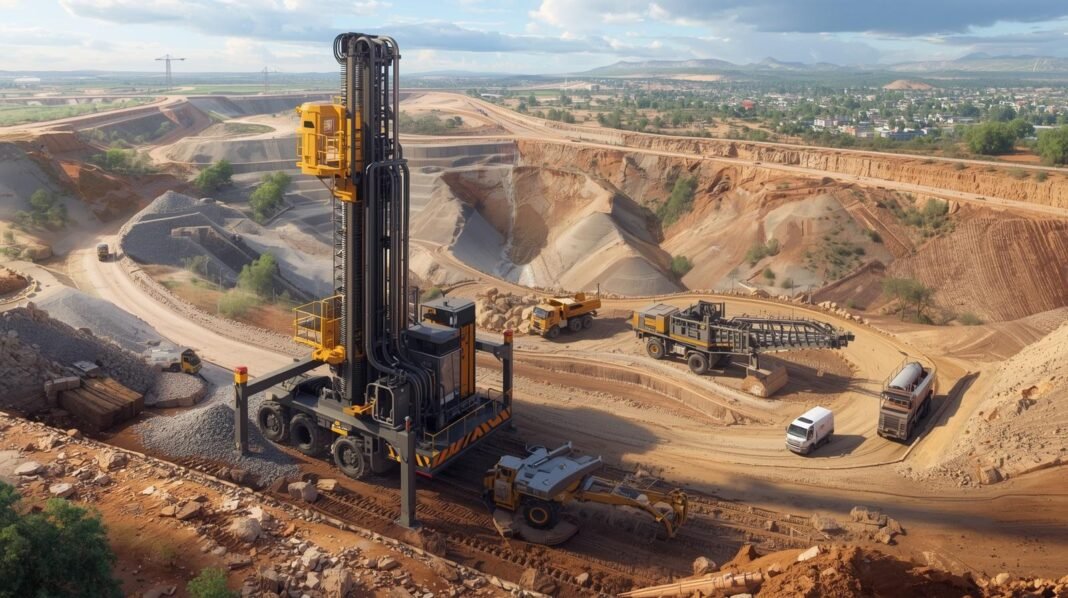
Africa stands at the crossroads of a defining infrastructure moment. As the continent’s urban population is projected to double to over 1.3 billion by 2050, demand for roads, bridges, dams, housing, and energy networks has accelerated sharply.
At the foundation of this construction surge lies one of the oldest and most powerful industrial processes known to engineering: rock blasting.
Quarry operations across sub-Saharan and North Africa are expanding at a pace rarely seen in the continent’s modern history — and underpinning that expansion, often invisibly, is a diverse and increasingly sophisticated ecosystem of pump technologies.
From dewatering flooded blast sites in the tropical rains of West Africa, to safely transferring viscous emulsion explosives in South African underground mines, pumps have become indispensable to the full blasting cycle.
Their role goes well beyond moving water. In 2025, pump systems actively support explosives charging, dust suppression, slurry management, slope stability, and post-blast cleanup — effectively linking the mechanical act of rock fragmentation to the broader logic of quarry productivity and environmental compliance.
Africa’s Quarrying Boom: The Numbers Driving Demand
The scale of Africa’s construction aggregates market makes the case for quarry expansion impossible to ignore.
Industry analysts valued the continent’s construction aggregates sector at approximately USD 16.5 billion in 2024, with projections pointing to growth toward USD 24.8 billion by 2031 — a compound annual growth rate of around 6 percent.
Another research body pegged the 2024 market value higher still, at nearly USD 24 billion, forecasting it would reach USD 32.5 billion by 2032.
Whatever the exact figure, the directional consensus is unambiguous: demand for crushed stone, sand, and gravel across the continent is climbing steeply and shows no sign of plateauing.
The drivers are well understood. More than 40 African governments are actively investing in transport corridor upgrades, urban road rehabilitation, and port expansion projects.
East Africa in particular has emerged as a high-growth construction hub, fuelled by transport megaprojects linking landlocked countries to Indian Ocean ports and a wave of new satellite cities around Nairobi, Dar es Salaam, and Kampala.
In West Africa, Nigeria’s road rehabilitation agenda and Ghana’s housing deficit have created substantial demand for locally quarried aggregates.
Southern Africa, meanwhile, maintains a mature but steadily expanding quarrying base, with South Africa, Zambia, and Zimbabwe all expanding open-pit operations.
To supply this demand, quarry operators across Africa are facing a common imperative: blast more rock, more efficiently, while managing increasingly strict environmental and safety expectations.
That is precisely where advanced pump technologies are reshaping operations at every level of the value chain.
The Blasting Cycle and Pump Integration
Dewatering: Enabling the Blast
Perhaps the most direct relationship between pumps and rock blasting lies in dewatering. Open-pit quarrying in many parts of Africa — particularly in equatorial and tropical zones — faces seasonal and permanent groundwater challenges that can halt or complicate blasting entirely.
Waterlogged blast holes compromise explosive performance, dilute ANFO (ammonium nitrate fuel oil) charges, and force operators to switch to more expensive emulsion-based explosives resistant to water ingress.
Effective dewatering before a blast sequence is, therefore, both a safety imperative and a direct cost management strategy.
Industry research confirms the financial logic: lowering groundwater levels in advance of working provides dry blast holes, reducing the need for costlier emulsion explosives, while simultaneously reducing haulage costs because dry rock and waste material weighs significantly less than saturated material.
For quarry operators in Africa running tight margins against imported equipment costs, this efficiency dividend is meaningful.
The technology response to these challenges has evolved considerably. Submersible dewatering pumps — including heavy-duty models capable of handling abrasive, solids-laden water — are now routinely deployed in open-pit quarry operations across the continent.
Integrated Pump Technology, a Southern Africa-focused pump specialist, has built much of its market presence on rapid-response dewatering solutions, combining Grindex submersible pumps with diesel-powered Godwin units to address both planned and emergency water ingress scenarios.
Sykes Group’s Extra High Head (XH) pump series, distributed globally and increasingly deployed in African mining, pushes total dynamic head capabilities to 220 metres — enabling dewatering in progressively deeper quarry benches as operators follow the resource downward.
Emulsion Explosives Handling: Safety Through Pump Innovation
A less visible but equally critical pump application in African rock blasting is the safe transfer and charging of bulk emulsion explosives.
Emulsion explosives — mixtures of ammonium nitrate solution and fuel oil, sensitised on-site — have largely replaced conventional ANFO in large-scale quarry blasting because of their superior water resistance, controllable detonation characteristics, and improved fragmentation outcomes.
However, these viscous, chemically sensitive materials present demanding handling challenges.
Progressive cavity (PC) pumps have emerged as the technology of choice for safe emulsion transfer in African quarry and mining environments.
Their operating principle — a helical rotor turning inside a stator to create a continuous, sealed cavity — is inherently suited to the smooth, low-shear handling that emulsion explosives require.
Unlike centrifugal pumps, PC pumps maintain a constant flow regardless of backpressure and require no gland seal water, eliminating a potential source of chemical contamination.
SEEPEX, a leading manufacturer in this space, specifically markets its PC pump range for explosive emulsion transfer in African mining, alongside wastewater applications in remote mining camps.
AEL Mining Services, one of Africa’s largest commercial explosives manufacturers, has developed dedicated portable charging units for underground emulsion deployment — essentially small, self-contained pump systems that mix emulsion and sensitiser in fixed ratios at the blasthole outlet, meaning explosive material is only created at the point of use.
system, tested extensively at South African mining sites before continental rollout, reduces shaft transport risk and improves blasting consistency.
Bulk emulsions from AEL are now routinely supplied to remote sites across East, West, and Central Africa, with packaging and logistics engineered for cross-border transport compliance.
Slurry and Dust Management: The Post-Blast Pump Challenge
After detonation, a quarry blast leaves behind a fragmented rock pile, suspended particulates, and — where dewatering was imperfect — a slurry of water, rock dust, and fine material.
Managing this effectively matters both operationally and regulatorily. In many African jurisdictions, environmental authorities are imposing stricter requirements on quarry effluent management, dust suppression, and land rehabilitation, particularly as quarry operations edge closer to expanding urban areas.
Slurry pumps designed for high-abrasion applications handle the suspended solids generated during drilling and post-blast cleanup.
South African engineering firm Weir, operating globally from its African base, supplies horizontal and vertical slurry pump ranges specifically engineered for quarrying environments where fine rock particles in suspension would rapidly destroy conventional pump internals.
Multotec, another South African company with operations across the continent, provides complementary screen and classification equipment that interfaces directly with pump-driven slurry circuits.
Dust suppression in blasting operations, meanwhile, relies on high-pressure water cannon systems and misting arrays — both pump-driven technologies.
As African cities grow outward and quarry buffer zones shrink, the importance of effective airborne dust control has increased sharply. Centrifugal pump systems feeding water cannons positioned upwind of blast patterns are now standard practice at quarries operating near residential areas across South Africa, Kenya, and Nigeria.
Digital Integration: Smart Pumping in Modern Quarry Operations
The broader shift toward digital quarry management is creating new integration points between pump systems and blast planning technology. In 2024, Orica introduced Next Gen SHOTPlus, a blast design and modelling platform integrating real-time predictive modelling, cloud-based collaboration, and fragmentation analysis tools.
As blast design becomes data-driven — with engineers quantifying in near-real time the downstream effects of design decisions on muck pile movement and environmental constraints — the pump systems managing site water, explosive transfer, and dust suppression are increasingly expected to integrate with the same operational intelligence layer.
Remote monitoring and automated control of quarry pumping systems, already standard in other industrial sectors, are beginning to penetrate African quarry operations.
IoT-enabled pump monitoring allows operators to track flow rates, pressure curves, and motor performance from mobile devices — a capability with particular value in remote African quarry sites where qualified maintenance personnel may be hours away.
Automated level controllers that manage pump arrays according to measured sump depth are reducing both energy consumption and equipment wear in open-pit dewatering applications.
The integration of satellite and aerial survey data — providing topographic and geological context for both blast design and water management — is beginning to link these operational loops more tightly.
Companies like Farmonaut are exploring satellite-derived insights for mining operations, offering real-time environmental monitoring and carbon footprint tracking that could eventually connect blast performance data with pump operational records within a unified site management system.
Infrastructure Context: Why the Stakes Are So High
Understanding why pump technology innovation matters to African quarrying requires holding in mind the scale of what is being built on the other side of the blast.
Every kilometre of paved road in rural Mozambique, every new bridge across a Kenyan river, every runway extension at a West African airport, every housing block in a new Ethiopian urban development — all consume aggregates produced in quarries where pump systems are quietly enabling the blasting that makes the stone available.
Africa’s construction aggregates market is not merely growing; it is industrialising, moving from artisanal and semi-mechanised operations toward capital-intensive, technically sophisticated quarrying that demands reliable, high-performance pump infrastructure throughout the blasting cycle.
The challenge is not only technical. Many African quarry operators face simultaneous pressure from energy costs, import-dependent equipment supply chains, skills shortages in pump maintenance, and tightening environmental regulation.
The pump technologies gaining traction in this market are those that can navigate these constraints: diesel-independent where grid power is unreliable, locally serviceable with available spares, capable of extended operation with minimal skilled oversight, and configured to support regulatory compliance rather than circumvent it.
An Invisible Infrastructure Layer
Rock blasting is visceral and visible — a controlled thunder that reshapes geology in seconds.
Pump technology is the opposite: quiet, continuous, and largely invisible to everyone except the engineers who know that without it, the blast could not happen safely, the quarry could not expand reliably, and the infrastructure projects that depend on a steady flow of aggregates could not be built.
As Africa’s construction ambitions intensify through the late 2020s, the pump technologies supporting its quarrying sector will be asked to perform at higher volumes, in more challenging environments, with greater digital integration and lower environmental tolerance for failure.
The industry response — from progressive cavity units handling explosive emulsions, to high-head submersibles managing tropical groundwater, to IoT-enabled monitoring systems tracking pump performance across remote sites — reflects a maturing recognition that blasting performance and pump performance are inseparable variables in the equation of African infrastructure growth.
The continent’s next generation of roads, bridges, and cities will be built, in no small part, on the foundation of this invisible technology.
Also Read
Top Pump Technologies Powering Modern Rock Blasting Operations
Inside a Modern Quarry Crushing Plant: Where Rock Meets Precision Engineering

- How Much Does Emergency AC Repair Cost in the US IN 2026? - March 26, 2026
- Top AC Repair Companies in the U.S - March 26, 2026
- Top HVAC Companies In The U.S. To Watch In 2026 - March 26, 2026
