
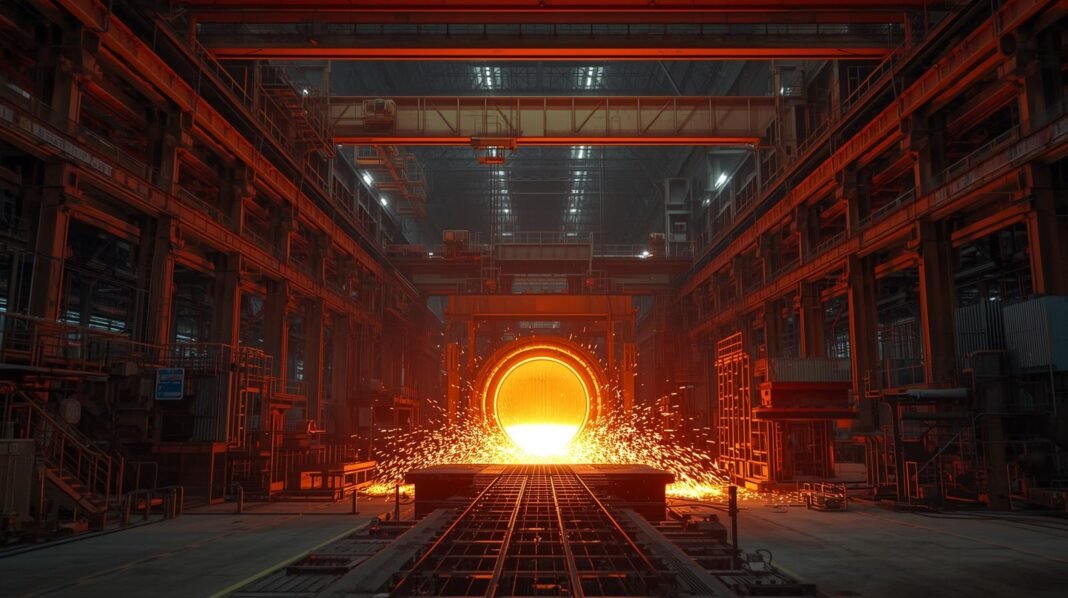
The air shimmers with heat as a glowing billet, heated to over 1,200 degrees Celsius, emerges from the reheating furnace.
Within seconds, it passes through the first set of massive rollers, which compress and elongate the steel with forces exceeding thousands of tons. What enters as a rough, squared block exits as a precisely dimensioned beam, its molecular structure transformed, its surface quality controlled to micron-level tolerances.
This is the daily reality inside a modern steel rolling mill—where raw steel transforms into the structural backbones of bridges, the reinforcement in skyscrapers, and the sheets that form automobile bodies.
Steel rolling mills represent one of the most critical yet least visible links in the global infrastructure chain. Every steel-framed building, every railway track, and every major pipeline depends on the precision and consistency these facilities deliver.
Understanding what happens inside these operations reveals how modern engineering has transformed an ancient metallurgical process into a technology-driven system capable of producing millions of tons of standardized steel products annually.
What Is a Steel Rolling Mill?
A steel rolling mill is an industrial facility that reduces the cross-sectional area of steel through compression between rotating rolls, simultaneously elongating and shaping the material into specific profiles.
Unlike casting, which creates shape through solidification, or forging, which uses intermittent hammer blows, the steel rolling process applies continuous pressure to plastically deform steel while controlling its dimensions, surface quality, and mechanical properties.
Within the steel value chain, rolling mills occupy the space between primary steelmaking and end-use fabrication.
They receive semi-finished products—billets, blooms, or slabs—from continuous casting operations or reheated ingots, then transform these intermediate forms into the merchant products specified by construction firms, automotive manufacturers, and equipment fabricators.
This transformation requires not just mechanical force but precise temperature control, accurate dimensional adjustment, and continuous quality monitoring.
From Raw Steel to Finished Product: The Rolling Process Explained
The journey through a modern steel rolling mill follows a carefully orchestrated sequence designed to achieve specific metallurgical and dimensional outcomes.
Reheating furnaces mark the starting point for most hot rolling operations. Semi-finished steel arrives at ambient temperature and must be brought to its plastic deformation range—typically between 1,100 and 1,300 degrees Celsius depending on the steel grade.
Walking beam furnaces or pusher furnaces accomplish this heating while minimizing surface oxidation and ensuring temperature uniformity across the steel’s cross-section. The furnace residence time, heating curve, and extraction temperature directly influence how the steel behaves during subsequent rolling and what mechanical properties it ultimately develops.
Roughing stands perform the initial breakdown work. These robust mill stands, equipped with large-diameter rolls and powerful drive systems, reduce the cross-sectional area significantly—often by 50 percent or more in a single pass.
The steel may reverse through the same stand multiple times, with roll gap adjustments between passes, or proceed through a series of roughing stands in tandem. During this phase, the steel’s internal grain structure begins to refine, initial scale breaks away, and the material starts assuming its target profile.
Intermediate and finishing stands continue the dimensional reduction while progressively improving surface quality and dimensional accuracy. In a continuous mill configuration, the steel moves simultaneously through multiple stands, each removing a calculated amount of material.
Speed synchronization between stands becomes critical—if downstream rolls turn faster than the incoming steel speed dictates, excessive tension develops, potentially causing fractures. Modern control systems adjust roll speeds thousands of times per second to maintain optimal tension and prevent dimensional defects.
Controlled cooling beds or cooling systems manage the final thermal treatment. How quickly steel cools after its final pass influences its microstructure and mechanical properties.
Some products cool naturally on roller beds, while others receive accelerated cooling through water sprays or forced air.
For certain steel grades, controlled cooling sequences can eliminate the need for subsequent heat treatment, reducing both cost and energy consumption while achieving specified strength levels.
Hot Rolling vs Cold Rolling: Key Differences
The distinction between hot rolling and cold rolling fundamentally shapes what products a facility can produce and what characteristics those products possess.
A hot rolling mill operates above the steel’s recrystallization temperature, typically processing material between 900 and 1,300 degrees Celsius. At these temperatures, steel remains relatively soft and deformable, allowing large reductions in cross-section with manageable forces.
Hot rolling produces structural shapes like I-beams, channels, and angles; long products including reinforcing bars and rails; and flat products such as hot-rolled coil and plate. The surface finish shows slight scaling and roughness—acceptable for structural applications but unsuitable where appearance matters.
Dimensional tolerances, while controlled, reflect the challenges of working with material that’s thermally expanding and contracting. Hot rolling remains the workhorse of steel production technology, delivering the volume and variety that construction and heavy manufacturing demand.
Cold rolling mill operations work with steel at or near room temperature, processing previously hot-rolled material that has been descaled and prepared. Because the steel doesn’t soften through heat, cold rolling requires substantially greater forces to achieve deformation—a reason why cold mills tend to process thinner gauges rather than heavy sections.
The payoff comes in superior surface finish, tighter dimensional tolerances, and controlled mechanical properties. Cold-rolled sheet and strip supply automotive body panels, appliance housings, and any application where appearance and precision matter.
The process work-hardens the steel, increasing strength but reducing ductility—an effect sometimes reversed through subsequent annealing.
Understanding which process creates which product prevents specification errors. Structural steel manufacturing relies almost exclusively on hot rolling, while precision sheet metal components demand cold rolling’s accuracy.
Key Equipment Inside a Modern Steel Rolling Mill
Walk through a contemporary rolling facility and you encounter specialized equipment designed for extreme service conditions.
Reheating furnaces have evolved beyond simple combustion chambers. Modern designs incorporate regenerative burners that capture waste heat from exhaust gases and use it to preheat combustion air, reducing fuel consumption by 30 percent or more.
Zone control allows different furnace sections to maintain different temperatures, accommodating various steel grades simultaneously. Automated extraction systems remove billets at precise intervals, feeding the mill with consistent timing that maximizes throughput.
Rolling stands and rollers constitute the mill’s mechanical heart. Each stand comprises a massive frame—often weighing hundreds of tons—that houses the work rolls, backup rolls, and bearing systems.
Work rolls contact the steel directly, while backup rolls support them against the enormous separating forces that develop during rolling.
Roll materials and designs vary by application: some mills use indefinitely chill cast iron rolls for their wear resistance, while others employ high-speed steel or carbide rolls where surface finish matters most. Roll changing systems allow quick replacement when wear or product changes demand different roll profiles, minimizing downtime.
Automation systems coordinate the entire operation. Programmable logic controllers receive inputs from hundreds of sensors measuring temperature, position, speed, force, and thickness.
These systems adjust roll gaps, modify roll speeds, control cooling water flows, and trigger alarms when parameters drift outside acceptable ranges. The sophistication involved rivals that found in semiconductor fabrication—except here, the environment includes 1,200-degree steel moving at speeds exceeding 20 meters per second.
Cooling systems manage the thermal aftermath. Water sprays, air jets, or combinations thereof control cooling rates across the product’s length and cross-section.
Uneven cooling produces warping, residual stresses, and property variations—defects that sophisticated cooling strategies prevent. Some mills incorporate laminar flow cooling, where uniform water sheets cover the entire product width, ensuring consistent heat extraction.
Material handling equipment moves steel through the facility. Walking beam conveyors, roller tables, chain transfers, and coil handling cranes work in choreographed sequence. Automation has reduced manual intervention, but the physical demands of moving objects weighing multiple tons at elevated temperatures still require robust, specialized equipment.
Automation, Sensors, and Digital Control Systems
The modern steel rolling mill operates as a cyber-physical system where digital intelligence governs physical processes.
Thickness control systems exemplify this integration. Laser or X-ray gauges measure product thickness continuously as it exits the final stand. Control algorithms compare actual thickness against the target specification, calculating the required roll gap adjustment.
Hydraulic or electromechanical actuators reposition the rolls—often making corrections within milliseconds. This closed-loop control achieves thickness tolerances previously impossible with mechanical setup alone.
Temperature monitoring occurs at multiple points. Pyrometers track steel temperature as it leaves the furnace, between mill stands, and during cooling.
If temperature drops below optimal levels, the control system can adjust rolling speeds, modify cooling water flows, or even divert the piece for reheating. Temperature history influences mechanical properties, making this monitoring essential for quality assurance.
Force and torque sensors provide real-time feedback on rolling conditions. Unexpected force spikes might indicate excessive friction, roll wear, or scale buildup. Torque variations reveal changes in steel hardness or composition.
Advanced systems use this data not just for immediate control but for predictive maintenance, identifying equipment degradation before failures occur.
The integration of these systems improves consistency—every piece receives the same treatment, producing steel with predictable properties. Efficiency increases as automated optimization reduces material loss and energy waste.
Safety improves because fewer operators work near the hazardous rolling area, and automated shutdown systems respond faster than human operators could when dangerous conditions develop.
Quality Control and Precision Engineering
Quality in rolling mill equipment extends beyond basic dimensional checking to comprehensive verification of mechanical and surface characteristics.
Thickness control employs both feed-forward and feedback mechanisms. Feed-forward control uses mathematical models of the rolling process, along with measurements of incoming material dimensions and properties, to calculate optimal roll gaps before the steel arrives.
Feedback control uses downstream measurements to correct any deviations. Together, these approaches maintain thickness within fractions of a millimeter even at high production speeds.
Dimensional accuracy encompasses more than thickness. Width control matters for flat products, while profile accuracy—the precise cross-sectional shape—determines whether structural shapes meet specification.
Online measurement systems using laser scanners or camera-based inspection capture full three-dimensional profiles, comparing actual geometry against design targets. Deviations trigger either automatic corrections or operator alerts, depending on severity.
Surface inspection detects cracks, seams, scale defects, and surface contamination. Traditional visual inspection has given way to automated systems using high-resolution cameras, edge detection algorithms, and machine learning classifiers.
These systems inspect 100 percent of the surface at speeds exceeding human capability, marking defective sections for subsequent removal or downgrading.
Mechanical property testing verifies that the steel possesses specified strength, ductility, and toughness. Sample coupons cut from production undergo tensile testing, hardness measurement, and sometimes impact testing.
For critical applications, ultrasonic or magnetic inspection checks internal soundness. Modern mills maintain statistical process control systems that track property trends, alerting metallurgists to shifts that might indicate process drift.
This multilayered quality framework ensures structural steel manufacturing delivers material that performs reliably under load, weathers environmental exposure, and welds without cracking—requirements that govern product acceptability in regulated construction applications.
Energy Efficiency and Sustainability in Modern Rolling Mills
Energy represents a significant operating cost and environmental impact for rolling mills, driving continuous improvement in thermal and electrical efficiency.
Waste heat recovery captures energy that older facilities simply exhausted. Modern reheating furnaces include recuperators or regenerators that transfer heat from flue gases to incoming combustion air, reducing fuel consumption proportionally.
Some mills recover waste heat from cooling systems, using it for facility heating or converting it to electricity through organic Rankine cycle generators. While these systems require capital investment, fuel savings often justify implementation within a few years.
Efficient motors and drives reduce electrical consumption. Variable frequency drives adjust motor speed to match actual load requirements rather than running continuously at full speed. High-efficiency motor designs minimize resistive and magnetic losses. For large mills, electrical consumption for rolling can exceed several megawatts, making even small percentage improvements substantial.
Reduced material waste contributes to both economic and environmental performance. Improved process control reduces off-specification production that must be scrapped and remelted.
Optimized cutting patterns maximize yield from each billet or slab. Better roll designs extend roll life, reducing material consumed in roll manufacturing and disposal.
Environmental considerations extend to emissions control and water management. Modern mills incorporate dust collection systems, combustion optimization to minimize nitrogen oxide formation, and closed-loop water systems that reduce both consumption and thermal discharge.
While steel production remains energy-intensive, technological advancement has substantially reduced the environmental footprint per ton of steel produced.
Steel Products Made in Rolling Mills
The diversity of products emerging from rolling mills reflects the material’s versatility across industrial sectors.
Structural shapes—including wide-flange beams, channels, angles, and tees—provide the framing elements for steel construction. These sections offer high strength-to-weight ratios and standardized dimensions that simplify design and fabrication.
Rolling mills produce these shapes in lengths up to 80 feet, with section moduli ranging from small angles suitable for light framing to massive columns capable of supporting skyscraper loads.
Long products encompass reinforcing bars that provide tensile strength in concrete structures, rails that guide trains across continents, and wire rod that becomes fencing, fasteners, and tire reinforcement after subsequent processing.
Each product category requires specific rolling sequences and finishing operations to achieve necessary properties.
Flat products include plate for pressure vessels and shipbuilding, hot-rolled coil for pipe manufacture and general fabrication, and cold-rolled sheet for automotive and appliance applications.
Plate mills roll individual pieces up to several inches thick, while coil mills produce continuous lengths wound into coils weighing 25 tons or more. The transition from discrete pieces to continuous rolling dramatically improved productivity when introduced decades ago.
These products form the raw materials for construction contractors building infrastructure, automotive manufacturers stamping body panels, and equipment fabricators creating everything from agricultural machinery to offshore platforms.
The standardization and consistency that modern rolling mills provide enable the modular, efficient construction methods contemporary projects demand.
Why Modern Rolling Mills Matter for Infrastructure Development
Infrastructure development at the scale modern economies require depends on reliable access to quality steel products.
Reliability of supply ensures construction projects proceed on schedule. A modern steel rolling mill operating continuously can produce several thousand tons daily, feeding regional markets with consistent availability.
This predictability allows contractors to plan confidently, knowing material will arrive when needed rather than facing the delays that plague projects dependent on inconsistent suppliers.
Standardized steel quality simplifies engineering and ensures safety. When structural engineers specify steel meeting ASTM A992 or similar standards, they rely on the material possessing known mechanical properties—yield strength, tensile strength, ductility—that rolling mills consistently deliver through controlled processes.
This standardization, enabled by modern production technology, allows engineers to design structures with confidence in how the steel will perform under load.
Support for large-scale projects requires production capacity and technical capability. Major bridges, stadium roofs, and industrial facilities consume thousands of tons of steel products in specific configurations.
Modern rolling mills can produce the wide-flange sections, heavy plates, and specialty shapes these projects demand, often customizing rolling schedules to meet project timelines.
The economic impact extends beyond construction. Reliable steel supply enables manufacturing investment, as producers of machinery, vehicles, and equipment need confidence in material availability and quality.
Energy infrastructure, from wind towers to pipelines, depends on steel products meeting demanding specifications that only technologically advanced mills consistently achieve.
Conclusion
The modern steel rolling mill represents a remarkable fusion of metallurgical science, mechanical engineering, and digital control technology.
What appears as brute-force metal deformation actually involves precisely orchestrated heating, carefully calculated reductions, and continuously adjusted processing parameters—all designed to transform semi-finished steel into products meeting exacting specifications.
From the reheating furnaces that prepare steel for deformation to the automated inspection systems verifying final quality, every element contributes to producing the consistent, reliable material that construction, manufacturing, and infrastructure depend upon.
The distinction between hot rolling and cold rolling reflects fundamentally different approaches to achieving different outcomes—structural capacity versus surface finish, heavy sections versus precision sheet.
As urbanization accelerates and infrastructure renewal becomes urgent, the capability of these facilities to supply standardized, quality-controlled steel products efficiently and sustainably becomes increasingly critical.
The precision engineering inside modern rolling mills may remain invisible to most, but its outputs form the literal framework of contemporary civilization—the beams supporting our buildings, the rails carrying our commerce, and the sheets forming countless manufactured products.
Understanding how these facilities operate reveals not just an industrial process but a foundational technology enabling the built environment we inhabit.
Also Read
Inside a Modern Concrete Batching Plant

