
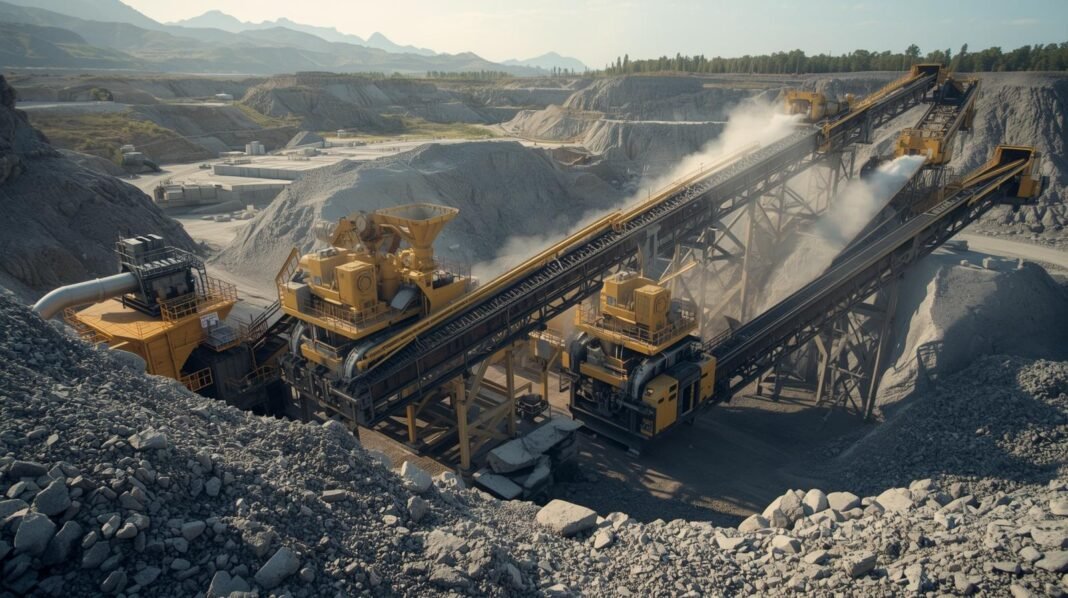
The ground trembles with a deep, rhythmic pulse. Conveyor belts snake across the landscape, carrying rivers of broken stone toward towering machinery.
A massive jaw crusher opens and closes with mechanical precision, reducing boulders the size of compact cars into fragments small enough to fit in your hand.
This is the heart of a modern quarry crushing plant—a choreographed symphony of heavy equipment, advanced automation, and exacting quality control that transforms solid bedrock into the aggregates that build our world.
Every road, bridge, building, and runway depends on aggregates produced in facilities like this. Without quarry crushing plants, construction as we know it would grind to a halt.
These industrial powerhouses don’t just break rock—they engineer materials to precise specifications, ensuring that every load delivered to a construction site meets stringent standards for size, shape, strength, and consistency.
Understanding how these plants operate reveals the often-invisible infrastructure behind modern civilization.
What Is a Quarry Crushing Plant?
A quarry crushing plant is a fixed or semi-mobile industrial facility designed to process extracted rock into various sizes of construction aggregates.
Located within or adjacent to quarry operations, these plants receive raw material blasted or excavated from rock faces and systematically reduce it through multiple stages of crushing and screening.
The crushing plant serves as the critical link between extraction and application. While quarries provide the raw geological material, the crushing plant transforms that material into commercially valuable products.
An aggregate crushing plant must deliver consistent gradations that meet technical specifications for different applications—from highway base courses requiring angular, interlocking particles to concrete production demanding specific size distributions and minimal fines.
Modern stone crushing plant operations integrate mechanical crushing equipment with sophisticated control systems, dust suppression technology, and quality monitoring instrumentation.
The result is a highly efficient production system capable of processing thousands of tons per hour while maintaining tight quality parameters and minimizing environmental impact.
From Rock Face to Stockpile: The Quarry Crushing Process Explained
The quarry crushing process begins long before material reaches the first crusher. Understanding the complete workflow illuminates how raw geology becomes precision-engineered construction material.
Extraction and Hauling
Rock extraction typically involves drilling and controlled blasting to fracture in-place bedrock.
Blast engineers design detonation patterns to produce material sized appropriately for the crushing plant’s primary crusher, typically ranging from small fragments up to boulders exceeding one meter in diameter.
Oversized material requires secondary blasting or hydraulic breaking before it can enter the crushing circuit.
Heavy haul trucks or wheel loaders transport blasted material from the quarry face to the crushing plant feed point.
This hauling distance significantly influences operational costs, making efficient plant siting crucial. Many modern operations position crushing equipment progressively closer to active extraction zones to minimize haulage.
Primary Crushing
Primary crushing represents the first mechanical size reduction stage. Material dumps into a heavy-duty feeder—typically a vibrating grizzly feeder that scalps out fine material and regulates flow into the primary crusher. This feeding control prevents overloading and ensures consistent crusher performance.
The primary crusher, most commonly a jaw crusher in hard rock quarry equipment applications, reduces run-of-quarry material to intermediate sizes, typically 150-200mm and smaller.
This equipment operates through compressive force, with one fixed jaw and one reciprocating jaw creating a V-shaped crushing chamber. Material progressively breaks as it travels downward through the narrowing gap.
Primary crushing doesn’t produce finished aggregate. Instead, it prepares material for subsequent reduction stages while removing enough oversize to prevent downstream equipment damage.
Secondary and Tertiary Crushing
Secondary crushing further reduces material from the primary stage to sizes approaching finished product specifications. Cone crushers dominate secondary applications in hard rock aggregate production due to their efficiency with medium-hard to very hard materials.
These machines use a gyrating spindle inside a concave bowl, creating compressive and shear forces that break material into progressively smaller fragments.
Impact crushers offer an alternative for softer materials or when cubic particle shape is prioritized. These machines use rapidly rotating hammers or blow bars to strike material against stationary anvils, producing excellent particle shape through impact and attrition rather than pure compression.
Tertiary crushing adds a third reduction stage when specifications demand particularly fine material or when production capacity requires distributing size reduction across multiple steps.
Modern aggregate crushing plant designs increasingly incorporate tertiary stages to improve particle shape, enhance gradation control, and reduce wear on any single crusher.
Screening and Grading
Screening separates crushed material into distinct size fractions. Multi-deck vibrating screens feature stacked screening surfaces with progressively smaller apertures, allowing material to classify into multiple products in a single pass.
A three-deck screen might produce four products: oversize returning to the crusher for additional reduction, plus three saleable size fractions.
Effective screening is as critical as crushing itself. Poor screening creates inconsistent products, reduces saleable output, and causes crusher recirculation that wastes energy and accelerates wear.
Modern quarry screening plant equipment incorporates adjustable frequency drives, polyurethane screen media for wear resistance, and spray bars for wet screening when material characteristics demand it.
Stockpiling
Finished products discharge onto radial stackers or transfer conveyors that build segregated stockpiles. Proper stockpiling prevents size segregation, contamination between product grades, and material degradation from weathering.
Well-designed facilities can rapidly load customer trucks with minimal rehandling, reducing delivery costs and maintaining product integrity.
Key Equipment Inside a Modern Quarry Crushing Plant
Walking through an operating crushing plant reveals an interconnected system where each equipment type performs specialized functions.
Feeders regulate material flow into crushers, preventing overload conditions while maintaining steady throughput. Vibrating grizzly feeders combine feeding with scalping, removing fine material that doesn’t require crushing. This pre-screening reduces crusher wear and improves energy efficiency.
Jaw crushers serve as workhorses for primary crushing. Their simple, robust design tolerates the abuse of processing run-of-quarry material containing occasional tramp steel, wood, or other contaminants. Jaw crushers excel in hard, abrasive materials like granite, basalt, and quartzite that would rapidly wear other crusher types.
Cone crushers handle secondary and tertiary duties with superior efficiency in medium to fine crushing applications. Hydraulic adjustment systems allow operators to modify the crushing chamber configuration, optimizing performance for different products or feed characteristics. Advanced cone crushers incorporate automatic setting regulation that compensates for liner wear, maintaining consistent product sizing throughout the wear cycle.
Impact crushers produce superior particle shape in softer rocks like limestone, dolomite, and some sandstones. The high-speed impact generates more cubical particles compared to compression crushing, valuable for concrete aggregate and asphalt applications where particle shape affects mixture performance. However, impact crushers experience higher wear rates in hard, abrasive materials, making material characteristics a key consideration in quarry equipment selection.
Screens and conveyors form the plant’s circulatory system, moving material between process stages and sorting it into specifications. Modern conveyors feature condition monitoring sensors that detect bearing failures, belt misalignment, and material buildup before catastrophic failures occur. Screens increasingly use modular panel systems that reduce maintenance downtime when replacing worn media.
Primary, Secondary, and Tertiary Crushing: What Each Stage Does
The staged approach to size reduction isn’t arbitrary—it reflects fundamental principles of rock mechanics and equipment economics.
Primary crushing accepts the largest feed and achieves modest reduction ratios, typically 4:1 to 6:1. Attempting greater reduction in a single stage would require prohibitively massive equipment and consume excessive power. Primary equipment prioritizes reliability over refined product, functioning as the plant’s foundation that enables downstream optimization.
Secondary crushing receives more uniform feed and achieves tighter size control. With reduction ratios of 3:1 to 5:1, secondary crushers produce the bulk of finished aggregate in many applications. The secondary stage represents a balance point where equipment size, power consumption, and product quality converge efficiently.
Tertiary crushing provides final size reduction and shape enhancement. Often operating in closed circuit with screens, tertiary crushers repeatedly process material until it meets exact specifications. This stage is particularly critical when producing engineered aggregates for demanding applications like high-performance concrete or precision asphalt mixtures.
Particle size control improves with each stage because feed uniformity increases and equipment can be tuned more precisely. A jaw crusher processing boulders up to one meter must accommodate enormous variability; a tertiary cone crusher processing 50mm feed operates in a much narrower performance envelope, enabling tighter control.
Automation and Control Systems in Modern Crushing Plants
Contemporary quarry crushing plant operations bear little resemblance to the manually controlled facilities of decades past.
Digital automation has revolutionized aggregate production, transforming crushing from an art dependent on operator skill into a precision-engineered process.
Programmable logic controllers (PLCs) coordinate equipment sequencing, interlocking safety systems, and process parameter adjustments. Crushers won’t start unless downstream conveyors are running.
Emergency stops cascade through the entire circuit. Load sensors prevent feeder overloading. These automated safeguards protect equipment while ensuring operator safety.
Real-time monitoring systems track crusher power draw, feed rate, screen efficiency, and countless other parameters.
Advanced installations employ particle size analyzers that continuously measure product gradation, providing immediate feedback for process adjustments. When product drifts outside specification, operators—or increasingly, automated control loops—adjust crusher settings to bring output back into conformance.
The productivity benefits are substantial. Consistent crusher feeding maximizes throughput while minimizing peak loads that waste energy and accelerate wear.
Automated level control in surge bins maintains optimal buffer inventory, preventing starvation conditions that idle expensive equipment. Remote monitoring allows specialists to oversee multiple plants, identifying optimization opportunities that local operators might miss.
Safety improvements are equally significant. Automation reduces human presence in hazardous areas during operation. Predictive maintenance algorithms identify developing equipment problems before failures occur, preventing dangerous situations and unplanned downtime.
Modern control systems log every parameter continuously, providing invaluable data for incident investigation and process improvement.
Quality Control in Aggregate Production
Crushing rock is relatively straightforward. Consistently producing aggregates that meet stringent construction specifications requires rigorous quality control throughout the process.
Gradation control ensures each product contains the correct proportion of various particle sizes. Construction specifications typically define gradation through a sieve analysis—material passing through progressively finer screens.
Concrete aggregate might require precise percentages passing various sieve sizes to optimize cement coating and mixture workability. Road base materials need specific gradations to achieve maximum compaction density.
Modern aggregate production facilities conduct frequent gradation testing, adjusting crusher settings and screen configurations to maintain specifications.
Shape and texture dramatically affect aggregate performance. Flat, elongated particles create weak points in concrete and asphalt.
Angular particles provide better mechanical interlock in base courses compared to rounded particles. Quality control includes regular particle shape assessment using techniques from manual inspection to automated image analysis systems.
Crusher type selection, feed rate optimization, and proper equipment maintenance all influence particle characteristics.
Strength requirements vary by application. Aggregates for structural concrete must resist crushing under load. Base course materials must maintain integrity under repeated traffic loading.
Quality programs include periodic testing for crush resistance, abrasion resistance, and durability under weathering. These tests ensure material meets project specifications and performs as engineers expect.
Meeting construction standards requires documentation extending beyond the crushing plant.
Chain-of-custody procedures, batch testing records, and certification documents accompany aggregate shipments, providing project engineers with confidence that delivered material meets their requirements.
Dust, Noise, and Environmental Management
Crushing rock generates unavoidable dust and noise, making environmental management integral to modern quarry operations rather than an afterthought.
Dust suppression systems apply water at strategic locations—crusher discharge points, conveyor transfer points, and screen decks—to capture airborne particles before they become fugitive emissions.
Advanced systems use atomizing nozzles that minimize water consumption while maximizing suppression efficiency.
Some facilities employ dry dust collection systems with fabric filters, particularly for enclosed crushing circuits processing dry material where water addition would be problematic.
Effective dust control protects worker health, prevents community complaints, maintains equipment reliability, and demonstrates environmental responsibility.
Dust accumulation inside electrical equipment causes failures. Airborne silica poses serious respiratory hazards. Visible dust plumes generate regulatory scrutiny and neighbor relations problems.
Noise control measures include equipment enclosures, strategic positioning of noise-generating equipment relative to property boundaries, and equipment selection favoring quieter technologies.
Crushing plants generate significant noise from impact, vibration, and moving parts. While completely eliminating noise is impractical, thoughtful engineering substantially reduces community impact.
Sustainable quarry operations balance production efficiency with environmental stewardship. This includes progressive rehabilitation of exhausted areas, groundwater monitoring, and habitat management.
Modern facilities recognize that social license to operate depends on demonstrating responsible environmental management, not merely meeting minimum regulatory requirements.
Types of Aggregates Produced and Their Applications
The same crushing plant can produce diverse products by adjusting equipment configuration and screening arrangements.
Crushed stone encompasses angular rock fragments ranging from large riprap for erosion control down to fine chips for pathway surfacing. Common sizes include 40-50mm for drainage applications, 20-40mm for road surfacing, and 10-20mm for concrete production. Each size serves specific engineering functions based on particle interlocking characteristics, surface area, and void structure.
Manufactured sand replaces natural sand in many applications. Crushing produces sand-sized particles (under 4.75mm) with angular shapes that enhance concrete strength compared to rounded natural sand. The stone crushing plant configuration for sand production typically includes tertiary crushing stages and specialized screening to remove excess fines while maintaining desired gradation.
Base materials provide structural support beneath pavements. Dense-graded aggregates combine various sizes to achieve maximum compaction density and load-bearing capacity. Specifications for base courses are demanding because pavement performance depends critically on foundation stability.
Specialty products serve niche markets. Railroad ballast requires specific sizes and exceptional durability to support track structure under heavy, repetitive loading. Armor stone protects shorelines and hydraulic structures from wave action. Filter stone maintains precise gradations for drainage applications.
Construction aggregates find applications in virtually every infrastructure project. Roads consume the largest volumes—base courses, asphalt, and concrete paving represent enormous aggregate demand.
Buildings incorporate aggregates in concrete, masonry, and exterior surfacing. Utilities require aggregate bedding for pipelines and cable installations. The versatility of crushed stone makes it infrastructure’s most essential bulk material.
Why Modern Quarry Crushing Plants Matter for Infrastructure Development
Aggregate availability constrains construction capacity. No matter how much funding, engineering talent, or construction equipment is available, projects cannot proceed without adequate supplies of quality aggregates. This makes quarry crushing plants strategic infrastructure assets, not merely commercial operations.
Reliable supply enables construction planning and execution. Major infrastructure projects require millions of tons of aggregates delivered on predictable schedules. Modern crushing plants provide the production capacity and consistency that large-scale construction demands. A highway project might consume 10,000 tons daily for months—possible only with efficient aggregate production infrastructure.
Quality assurance protects public investment. Inadequate aggregate quality leads to premature pavement failure, cracking concrete structures, and reduced infrastructure service life.
The precision engineered into modern crushing plants ensures that aggregates meet performance requirements, protecting the enormous public expenditures invested in infrastructure construction.
Efficiency and cost control make construction economically feasible. Automated crushing plants maximize production while minimizing energy consumption and labor requirements. These efficiencies translate into lower aggregate costs, extending limited infrastructure budgets and making more projects financially viable.
In developing regions, access to modern crushing technology can be transformative, enabling infrastructure expansion that lifts communities economically.
The geographic distribution of crushing capacity also matters profoundly. Aggregates are low-value, high-weight materials where transportation costs quickly exceed material value. Economic haulage distances rarely exceed 50-75 kilometers, making local production essential.
Regions lacking adequate crushing plant capacity face inflated construction costs and constrained development options.
Conclusion
A modern quarry crushing plant represents far more than industrial machinery breaking rock. It exemplifies precision engineering applied to one of civilization’s most fundamental needs—transforming geological resources into materials that literally build the physical framework of society.
The sophistication hidden within these facilities is remarkable. What appears to casual observers as simple brute force—heavy equipment smashing stone—actually involves intricate process control, exacting quality management, and continuous optimization.
Automation systems coordinate dozens of equipment pieces in real-time. Sensors monitor product quality continuously. Engineers adjust countless parameters to balance throughput, product consistency, equipment wear, and environmental performance.
The aggregate crushing plant concept has evolved from manually operated collections of disparate machines into integrated production systems where crushing, screening, and material handling function as coordinated elements of a complete manufacturing process.
Modern installations rival advanced manufacturing facilities in their technological sophistication, even while processing the oldest industrial material—rock.
As infrastructure demands intensify globally, these crushing plants will become even more critical. Growing populations require expanding transportation networks, water systems, and building stock—all consuming vast aggregate quantities.
The facilities that efficiently transform rock into precision-engineered construction materials will remain essential to development, providing the literal foundation upon which modern civilization continues building its future.
Also Read
How PVC Pipes Are Manufactured

