
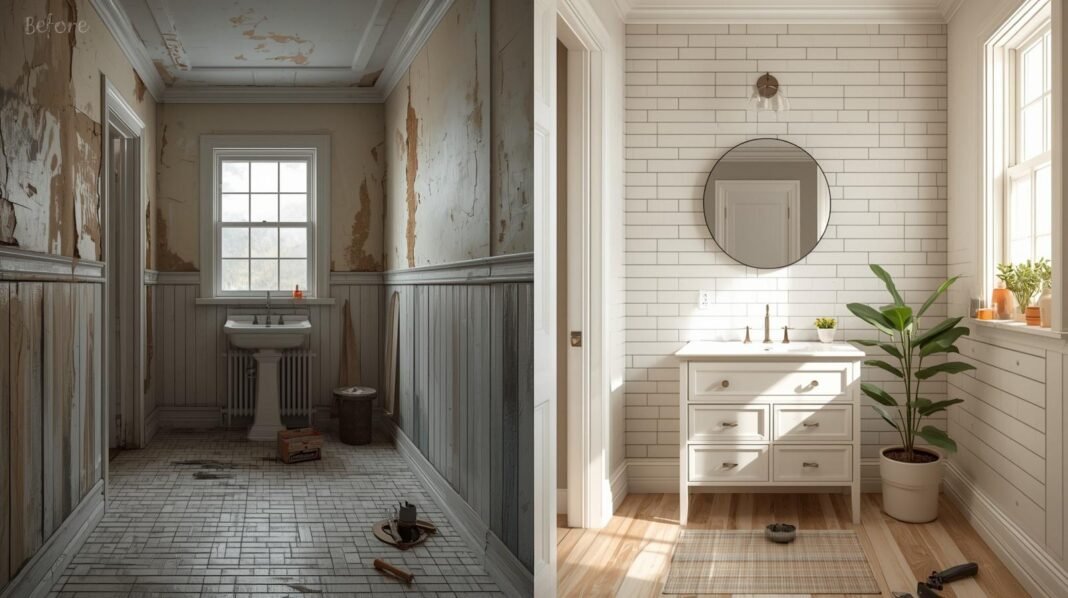
Your bathroom is one of the most-used rooms in your home — and one of the most powerful when it comes to first impressions, daily mood, and even property value.
Yet for many homeowners and renters, a full renovation sits firmly in the “someday” pile because it sounds expensive, disruptive, and complicated.
Here’s the truth most contractors won’t tell you: you don’t need a $10,000 gut job to make your bathroom look and feel like a completely different space.
With a sharp eye, a few weekends, and a budget of under $500, you can pull off a transformation that looks professional, feels intentional, and holds up for years.
This guide walks you through exactly how — from the upgrades that punch hardest per dollar, to a complete budget breakdown, to the order of operations that makes the whole process efficient and stress-free.
The bathroom is the room guests see alone — and the one you start and end every day in. Small investments here return outsized results in comfort, confidence, and home value.
Why Under $500 Is Completely Achievable
The bathroom renovation industry is built on a simple psychological trick: once you’re in a showroom touching marble countertops and rainfall showerheads, it’s easy to convince yourself that anything less is “cutting corners.” It isn’t.
Most of what makes a bathroom feel dated, grimy, or uninspiring comes down to surface-level issues — tired paint, corroded hardware, foggy mirrors, and stained grout. None of these require structural changes. All of them are solvable for tens of dollars, not thousands.
The $500 budget works because it forces you to prioritize impact over indulgence. You’re not replacing the tub — you’re reframing it. You’re not ripping up tile — you’re covering it. Every dollar goes toward visible change.
The Golden Rule: Fix What People See First
Before spending a single dollar, stand in your bathroom doorway and look at the room the way a guest would. What’s the first thing your eye lands on? What looks dirtiest, most dated, or most mismatched?
In most bathrooms, the hierarchy of visual impact looks like this:
- Walls and ceiling (paint is the single biggest ROI upgrade in any room)
- Lighting (bad lighting makes everything look worse, including you)
- Mirror (often the focal point — and usually the most neglected)
- Vanity faucet (a chrome faucet from 1987 announces the room’s age immediately)
- Floor (hard to change structurally, but peel-and-stick tiles can cover a multitude of sins)
- Hardware — towel bars, robe hooks, toilet paper holder (mismatch here reads as “unfinished”)
- Shower curtain and rod (one of the cheapest swaps with the most dramatic daily impact)
Work through this hierarchy in order and you’ll get the most transformation per dollar spent.
The Complete $500 Upgrade Playbook
1. Paint First — Always
If you do nothing else from this guide, paint your bathroom. Fresh paint is the single most cost-effective upgrade in home improvement, and nowhere is this more true than in a small, moisture-prone room like the bathroom.
Use a bathroom-specific paint with mold and mildew resistance — brands like Zinsser, Sherwin-Williams Emerald, or Rust-Oleum offer excellent options in the $15–$30/quart range.
For most bathrooms under 60 sq. ft., a single quart of wall color plus a quart of ceiling white will cover everything.
Color choices matter. Light neutrals (warm whites, pale greige, soft sage) make the space feel larger and cleaner.
Deep moody tones (charcoal, navy, forest green) work surprisingly well in small bathrooms — they create an intentional, spa-like atmosphere rather than making the room feel cramped.
Avoid builder-beige if you want the space to feel like it was actually designed.
Don’t forget the ceiling. A bright white ceiling visually raises the room. And if your trim is discolored or scuffed, a coat of semi-gloss white trim paint costs under $15 and makes the whole room feel sharper.
Budget: $35–$60 total
2. Swap the Mirror
Bathroom mirrors are undervalued upgrades. The standard builder mirror — a plain rectangle glued directly to the wall — is functional but completely forgettable.
Replacing it with a framed mirror, a sunburst design, an arch-top, or even a simple LED-backlit option creates an immediate focal point and makes the room feel designed rather than assembled.
You don’t have to spend much. IKEA’s NISSEDAL mirror runs around $30 and takes ten minutes to hang. HomeGoods, TJ Maxx, and Walmart regularly carry solid options in the $25–$50 range.
If you prefer a frameless look, a simple round mirror with a matte black hanging hardware set reads as modern and intentional.
Pro tip: If your existing mirror is glued to the wall and you don’t want the hassle of removal, you can purchase a mirror frame kit (like the MirrorMate system) that snaps over the existing glass. These run $30–$60 and take under an hour to install.
Budget: $20–$50
3. Upgrade Your Lighting
Lighting is the invisible hand that controls how every other upgrade looks. Bad lighting — especially the builder-standard single-bulb globe over the mirror — flattens faces, shows every flaw in the tile, and gives the room a clinical, dated energy.
The easiest and cheapest fix: swap bulbs. Replace cool blue-white bulbs (5000K+) with warm white LEDs in the 2700K–3000K range. The shift from harsh blue-white to warm gold is dramatic and costs under $15.
If you want to go further, replacing the vanity light bar is a DIY job that takes under an hour and requires only a screwdriver and wire nuts. Modern vanity bars from Home Depot and Lowes in brushed nickel, matte black, or gold finish start at $25–$40.
This is one of the highest-impact visual changes you can make for under $50.
Important: always turn off the circuit breaker before touching any wiring. If you’re not comfortable with basic electrical work, stick to the bulb swap — it’s genuinely more impactful than most people expect.
Budget: $25–$60
4. Replace the Faucet
A dated faucet — chrome from the ’90s, a single-handle unit with hard water stains baked in — undermines even a fresh paint job. A new faucet signals that the room has been thought about, not just maintained.
You don’t need a $200 designer faucet. Moen, Delta, and Glacier Bay all offer solid single-hole and widespread faucets in brushed nickel and matte black finishes for $30–$80. These are designed for standard drain configurations and come with everything you need for installation.
Faucet replacement is one of the more intimidating DIY tasks for first-timers, but it’s genuinely manageable with a basin wrench and a YouTube video.
The most common challenge is the old supply lines — if they’re corroded, replace them while you’re in there (less than $10 for the pair).
If your faucet is less than 10 years old and still functional, skip the replacement and instead deep-clean around the base, replace the aerator screen ($2), and address any hard water buildup with white vinegar. It won’t look new, but it’ll look maintained.
Budget: $30–$80
5. Coordinate Your Hardware
Nothing makes a bathroom look cheaper faster than mismatched hardware — a chrome towel bar, a bronze toilet paper holder, a brushed nickel robe hook.
It signals that the room was assembled from whatever was on sale rather than designed.
Matching hardware sets — towel bar, hand towel ring, toilet paper holder, and robe hook — are available at every price point.
At the under-$15 range you’ll find functional but plain sets; at $30–$40 you can get genuinely attractive matte black or brushed nickel sets that look intentional and feel solid.
Pick one finish and use it everywhere — faucet, hardware, light fixture, mirror frame, shower rod. Consistency is the hallmark of a professionally designed space.
Budget: $15–$40
6. Transform the Floor Without Touching the Subfloor
Replacing bathroom tile is expensive ($500+), messy, and requires at least a few days of downtime.
But peel-and-stick vinyl floor tiles have improved dramatically and now represent a genuinely viable option for budget renovations.
Modern peel-and-stick options from brands like Achim, Art3d, and FloorPops offer realistic stone, wood, and geometric patterns at $1–$3 per square foot. For a standard 50 sq. ft. bathroom floor, you’re looking at $50–$150 in material.
The key to success with peel-and-stick: prep the floor meticulously. The existing surface must be clean, dry, and as flat as possible. Loose tiles, deep grout lines, or significant warping will telegraph through the new surface. Use a floor leveling compound ($10) to fill deep grout channels before applying.
This upgrade works best when the existing floor is in decent structural shape but visually outdated. Cracked, heaved, or water-damaged subfloor needs professional attention before any cosmetic fix.
Budget: $30–$70 for a standard bathroom
7. The Shower Curtain Effect
The shower curtain is the largest single piece of fabric in most bathrooms and effectively functions as wall art. Yet most people leave up the mildew-edged builder curtain indefinitely.
A new shower curtain — particularly a linen-look curtain in white, warm gray, or a simple stripe pattern — instantly reads as spa-like. Pair it with a new curtain rod (curved tension rods add shower space for $20) and chrome or brushed nickel rings, and the entire shower zone transforms.
Stay away from novelty prints unless you’re committed to a specific aesthetic. Solid neutrals and subtle patterns are timeless and photograph well if you ever list the home.
Budget: $20–$50 for curtain + rod + rings
8. Regrout and Recaulk
This might be the least exciting item on this list and also the most impactful for perceived cleanliness.
Black or discolored grout lines make an otherwise fine tile job look filthy. Yellow or separating caulk around the tub suggests water damage and neglect.
Grout refresh: For minor staining, a grout pen (Rust-Oleum and Spectrum Noir both make them, around $8–$12) can restore white grout lines in under an hour.
For heavily discolored grout, a grout saw ($5) and fresh grout ($10) gives you a full reset.
Caulk replacement: Remove old caulk with a caulk remover tool or a utility knife, clean the joint thoroughly with rubbing alcohol, let it dry completely, and apply fresh DAP or GE silicone caulk ($6–$10). The difference is immediate and striking.
Budget: $10–$20
9. Accessories: The Finishing Layer
Coordinated accessories are the styling details that separate a renovated bathroom from a merely cleaned one.
A matching soap dispenser, toothbrush holder, and soap dish in ceramic or brushed metal; a simple rolled-towel basket; a small plant (pothos, air plants, and snake plants all thrive in bathroom humidity) — these details communicate that someone made intentional choices.
You don’t need a full set from a boutique store. Target, HomeGoods, and Amazon all carry coordinated bathroom accessory sets for $15–$30. Choose one finish color (matte black, brushed gold, and white ceramic are all currently very on-trend) and stick to it.
Budget: $15–$30
Complete Budget Breakdown
Here’s how a full under-$500 bathroom upgrade looks on paper:
Buy everything before you start. Seeing all your materials laid out gives you a visual sense of the finished room — and lets you return anything that doesn’t work before you’ve installed it.
The Right Order of Operations
Sequence matters in a bathroom project. Do these in order to avoid redoing work:
- Step 1: Deep clean everything — you need to see what you’re working with
- Step 2: Replace caulk and refresh grout — messy work first
- Step 3: Paint walls and ceiling (protect floor with drop cloth)
- Step 4: Paint trim if needed
- Step 5: Install new floor tiles (after paint is fully dry)
- Step 6: Replace faucet and hardware
- Step 7: Hang new mirror and light fixture
- Step 8: Install towel bars, hooks, toilet paper holder
- Step 9: Hang shower curtain and rod
- Step 10: Style with accessories and finishing touches
Following this order means you’re never painting over new hardware or tracking grout dust across your new floor tiles.
10 Pro Tips for a Better Budget Remodel
- Shop the clearance aisle first. Hardware stores regularly discount last-season finishes, floor tiles, and fixtures by 40–70%.
- Matte black is a budget hero. It’s in style, hides water spots better than chrome, and is available at every price point.
- Don’t skip primer before painting. In a moisture-heavy room, a mold-inhibiting primer under your topcoat will double the life of your paint job.
- Use a squeegee after every shower. This single habit prevents 80% of water stain and mildew problems — and costs nothing.
- Replace the toilet seat. It sounds minor, but a warped or yellowed toilet seat from 2004 undermines everything. A decent new seat runs $20–$40 and takes five minutes.
- Add a small shelf or floating ledge. Bathroom storage is always at a premium. A simple floating shelf in white or wood tone ($15–$25 at IKEA) solves function and adds warmth.
- Don’t overlook the ceiling. A painted ceiling and a new light fixture completely changes the vertical experience of the room — most budget renovators ignore this plane entirely.
- Warm up the textiles. Switch to thick, matching towels in a neutral tone. Rolled and displayed in a basket, they’re both functional and decorative.
- Use removable wallpaper on one wall. Peel-and-stick wallpaper has advanced massively. A single accent wall in a geometric or botanical print adds character without commitment. Budget: $20–$50 for a small wall.
- Take before-and-after photos. You’ll be surprised how dramatically different the room looks — and it’s motivating documentation for your next project.
What Not to Do on a Budget Remodel
A few common mistakes that waste money and time:
- Don’t buy the cheapest faucet you can find. At under $20, faucets often drip within a year. Spend $35+ for a brand-name unit with a warranty.
- Don’t skip cleaning before painting. Paint over bathroom soap scum or grease residue and it will peel within months. TSP substitute cleaner ($8) takes ten minutes and prevents this entirely.
- Don’t use indoor paint in a bathroom without mold-inhibiting additives. Moisture will cause regular paint to peel and blister quickly.
- Don’t replace functional fixtures just to upgrade the finish. If the tub is structurally fine, don’t rip it out — refinish it ($30 DIY kit) or work around it visually.
- Don’t overlook ventilation. A bathroom exhaust fan that’s clogged with dust is the root cause of most mold and moisture problems. Clean or replace it ($15–$30 for basic unit) before repainting.
Special Section: Renter-Friendly Upgrades Under $500
Many of these upgrades apply equally to renters — but some require landlord approval. Here are the best options for tenants working within lease restrictions:
- Peel-and-stick floor tiles (removable on departure)
- Removable wallpaper on one accent wall
- Tension rod shower curtain — no drilling required
- Over-toilet shelving units (freestanding, no holes)
- Renter-safe command strip mirror hooks and accessory holders
- New towels, bath mat, and accessories — 100% portable
- Adhesive backsplash tiles around vanity (some brands are genuinely removable)
Avoid anything requiring permanent alteration — paint, fixture swaps, tile adhesive — without explicit written landlord approval. Focus on textiles, lighting (bulb swaps), and removable surfaces instead.
The Bottom Line
A $500 bathroom remodel is not a compromise — it’s a constraint that makes you smarter about what actually matters.
The upgrades that change how a bathroom looks and feels are almost entirely surface-level: color, light, hardware finish, and cleanliness.
None of these require a general contractor, a building permit, or a two-week renovation.
The best bathroom renovation is the one that gets done. And with under $500, the right weekend, and this guide in hand, yours can be done by next Sunday.
Start with paint. Buy matching hardware. Replace the mirror. The rest follows naturally — and the result will be a space that looks like it cost ten times what it did.
Also Read
15 Easy Ways to Make Your Bathroom Feel More Luxurious
Top 6 must-have bathroom accessories

