
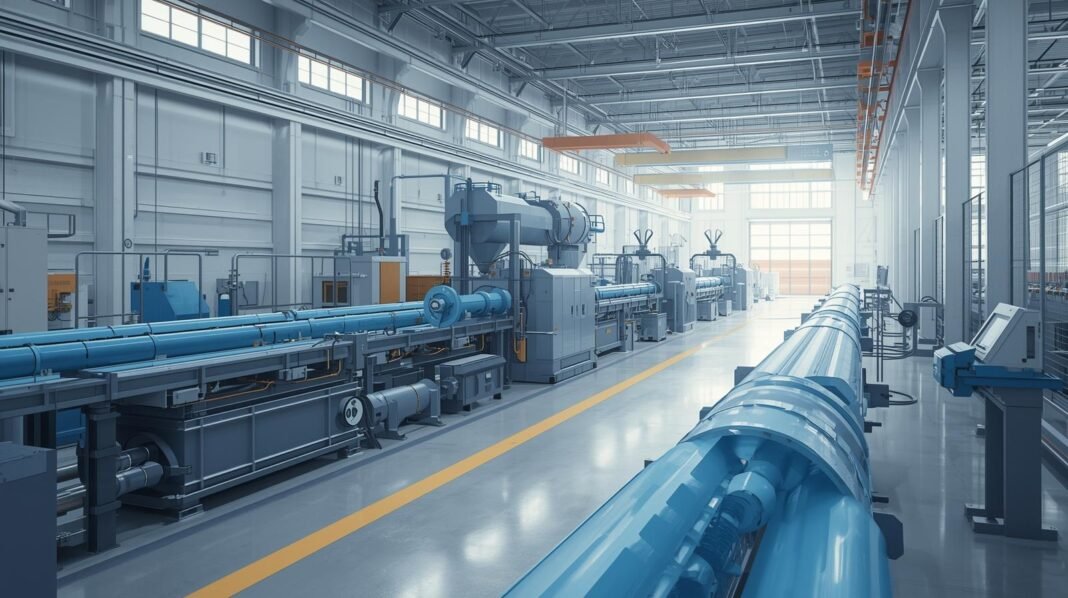
Polyvinyl chloride pipes have become the backbone of modern plumbing, drainage, and irrigation systems worldwide.
Understanding the intricate manufacturing process behind these ubiquitous construction materials reveals why they’ve earned their reputation for durability and reliability.
This comprehensive guide explores the sophisticated engineering that transforms raw PVC resin into the pipes that keep our infrastructure functioning.
The Foundation: Raw Material Preparation
The manufacturing journey begins long before the extrusion process. PVC resin arrives at manufacturing facilities as a fine white powder, which must be carefully formulated into a workable compound.
During this critical preparation phase, manufacturers blend the base resin with stabilizers that prevent degradation during processing, lubricants that facilitate smooth material flow, and impact modifiers that enhance the final product’s toughness.
This compounding stage requires precision chemistry. Heat stabilizers protect the polymer chains from breaking down under the intense temperatures they’ll encounter during extrusion.
Calcium-zinc or lead-based stabilizers have traditionally served this purpose, though modern facilities increasingly favor environmentally friendly alternatives.
The mixture also incorporates processing aids that improve melt characteristics and pigments that give pipes their characteristic coloration.
The homogenization process ensures every particle of the compound contains the proper ratio of additives.
High-intensity mixers blend the components at controlled temperatures, creating a uniform compound that will behave predictably throughout manufacturing. This consistency proves essential for maintaining quality standards across production runs.
Extrusion: Shaping Molten Polymer into Pipe
The heart of PVC pipe manufacturing lies in the extrusion process, a continuous operation that transforms prepared compound into hollow cylindrical forms.
Feed hoppers deliver the blended material into the extruder barrel, where it encounters a rotating screw that serves multiple functions simultaneously.
As the screw advances the material forward, friction and external heating elements gradually raise the temperature.
The PVC compound transitions from powder to a viscous melt, typically reaching temperatures between 170 and 200 degrees Celsius.
The screw design features varying depths along its length, creating compression zones that remove air pockets and ensure uniform density throughout the molten stream.
At the barrel’s terminus, the pressurized melt encounters the die assembly, the precision-engineered component that determines the pipe’s final dimensions.
The die comprises an outer ring and a central mandrel, creating an annular gap through which the PVC flows.
As material exits this gap, it forms a hollow tube with wall thickness controlled to tolerances measured in fractions of a millimeter.
Modern extrusion lines incorporate sophisticated die systems with adjustable components. Operators can fine-tune the gap width at multiple points around the circumference, compensating for slight variations in material flow and ensuring uniform wall thickness.
This adjustability becomes particularly crucial when manufacturing larger diameter pipes, where even minor inconsistencies could compromise structural integrity.
The freshly extruded tube emerges from the die in a semi-molten state, still pliable and dimensionally unstable. At this critical juncture, the cooling process must begin immediately to lock in the desired shape and dimensions.
Cooling Systems: Controlling Dimensional Stability
Proper cooling represents perhaps the most technically challenging aspect of pipe manufacturing.
The process must extract heat uniformly and rapidly enough to maintain production speeds, yet controlled enough to prevent internal stresses that could lead to warping or future failure.
Vacuum sizing tanks provide the first stage of dimensional control. As the hot pipe enters these water-filled chambers, external vacuum pressure draws the outer surface against a precisely machined cylindrical sleeve.
This contact serves dual purposes: it establishes the exact outer diameter while initiating heat transfer from the pipe wall to the surrounding water.
Multiple cooling tanks follow in succession, each maintaining carefully regulated water temperatures.
The initial tanks operate at moderate temperatures to avoid thermal shock that could create microscopic cracks in the polymer matrix. Subsequent tanks employ progressively cooler water, gradually solidifying the pipe wall from outside to inside.
Spray cooling systems supplement tank cooling for certain pipe sizes and specifications. Fine water jets directed at the pipe surface provide additional heat extraction capacity, particularly beneficial for thick-walled products that retain heat in their cores.
The spray pattern and water flow rate require careful calibration to ensure even cooling around the entire circumference.
Advanced manufacturing facilities employ closed-loop cooling systems with precise temperature control and filtration.
Maintaining water quality prevents mineral deposits from forming on cooling surfaces, which could create imperfections in the pipe exterior.
Temperature stability ensures consistent cooling rates between production runs, reducing variability in final product properties.
The cooling process typically extends across 20 to 40 meters of production line length, depending on pipe diameter and wall thickness.
By the time material exits the final cooling stage, it has achieved sufficient rigidity to withstand subsequent handling while remaining warm enough to accept printing and marking without damage.
Quality Control: Ensuring Performance Standards
Manufacturing excellence means nothing without rigorous quality verification. PVC pipe producers implement multi-tiered inspection protocols that begin with incoming material testing and continue through every production stage.
Dimensional verification occurs continuously during production. Laser micrometers scan the pipe surface, measuring outer diameter at multiple points along the circumference.
Wall thickness gauges employ ultrasonic or X-ray technology to verify that material distribution meets specifications without cutting into the product. Modern systems record thousands of measurements per hour, automatically alerting operators to any drift from target values.
Visual inspection remains crucial despite advanced instrumentation. Trained quality personnel examine pipe surfaces for defects like scoring, pitting, or contamination that automated systems might miss. Surface imperfections can indicate problems with die condition, material quality, or processing parameters that require immediate attention.
Mechanical property testing provides the ultimate performance verification. Samples undergo hydrostatic pressure testing, where internal water pressure increases gradually until failure occurs.
Results must exceed minimum requirements by substantial safety margins. Impact resistance testing drops weighted strikers onto pipe samples at specified temperatures, ensuring products can withstand installation stresses and service conditions.
Chemical composition analysis verifies that finished pipes contain appropriate levels of stabilizers and other additives. Improper formulation could leave products vulnerable to degradation from ultraviolet exposure or chemical attack in aggressive soil conditions.
Laboratory instruments analyze cross-sections to confirm additive distribution throughout the wall thickness.
Long-term performance testing subjects samples to accelerated aging protocols. Elevated temperature exposure simulates years of service in compressed timeframes, revealing potential weaknesses before products reach customers.
These tests validate that manufacturing processes consistently produce pipes capable of meeting or exceeding their rated service lives.
Process Optimization and Innovation
Leading manufacturers continuously refine their operations through technological advancement and process optimization. Computer-controlled extrusion systems adjust processing parameters in real-time, compensating for minor variations in material properties or environmental conditions.
Machine learning algorithms analyze production data to identify subtle patterns that human operators might overlook.
Energy efficiency improvements benefit both manufacturers and the environment. Heat recovery systems capture thermal energy from cooling water and extruder barrel cooling jackets, redirecting it to material preheating or facility heating applications.
Variable frequency drives on motor systems reduce electricity consumption by matching power delivery to instantaneous demand.
Material science advances enable enhanced pipe formulations. New stabilizer packages provide improved thermal stability and weathering resistance. Impact modifier technologies deliver better cold-temperature performance.
These innovations emerge from collaborative research between resin producers, additive manufacturers, and pipe fabricators.
Industry Standards and Compliance
PVC pipe manufacturing operates within frameworks established by standards organizations and regulatory agencies. ASTM International publishes specifications covering dimensions, material properties, and performance requirements for various pipe applications.
ISO standards provide internationally recognized benchmarks. National and local codes mandate compliance for products used in specific applications.
Manufacturers maintain certification programs demonstrating adherence to relevant standards.
Third-party testing laboratories conduct periodic audits, verifying that production processes and finished products meet requirements. This independent verification provides specifiers and end-users confidence in product quality.
Traceability systems link every pipe segment to its production history. Permanent markings identify the manufacturer, production date, material specification, and pressure rating.
Should field performance issues arise, this information enables rapid identification of affected production lots and investigation of root causes.
Environmental Considerations
Modern PVC pipe manufacturing increasingly emphasizes environmental stewardship. Closed-loop material handling systems minimize dust emissions during compound preparation.
Efficient extrusion processes reduce energy consumption per unit of production. Water recycling systems in cooling operations decrease freshwater consumption.
Post-industrial scrap management has evolved significantly. Clean production trim and rejected pipes undergo grinding and reprocessing, returning to production as regrind material blended with virgin resin.
Careful quality control ensures recycled content doesn’t compromise finished product performance.
End-of-life considerations influence manufacturing decisions. Pipes designed for recyclability simplify separation from other materials during demolition. Some manufacturers participate in take-back programs, accepting used pipe for recycling into new products or alternative applications.
Conclusion
The transformation of PVC powder into finished pipe represents a sophisticated interplay of chemistry, physics, and engineering precision. Each manufacturing stage contributes essential elements to final product quality and performance.
Extrusion creates the basic form, cooling establishes dimensional stability, and quality control verifies that every pipe meets exacting standards.
As construction demands evolve and infrastructure requirements become more stringent, PVC pipe manufacturing continues advancing.
Enhanced process controls, improved materials, and innovative technologies ensure these essential products will serve the industry reliably for generations to come.
Understanding this manufacturing complexity helps construction professionals appreciate the engineering excellence behind products they specify and install daily.
Also Read
Innovations in UPVC Pipe manufacturing: Trends to watch
Best HDPE Pipe Manufacturers in Kenya and Their Prices (2025 Update)

