
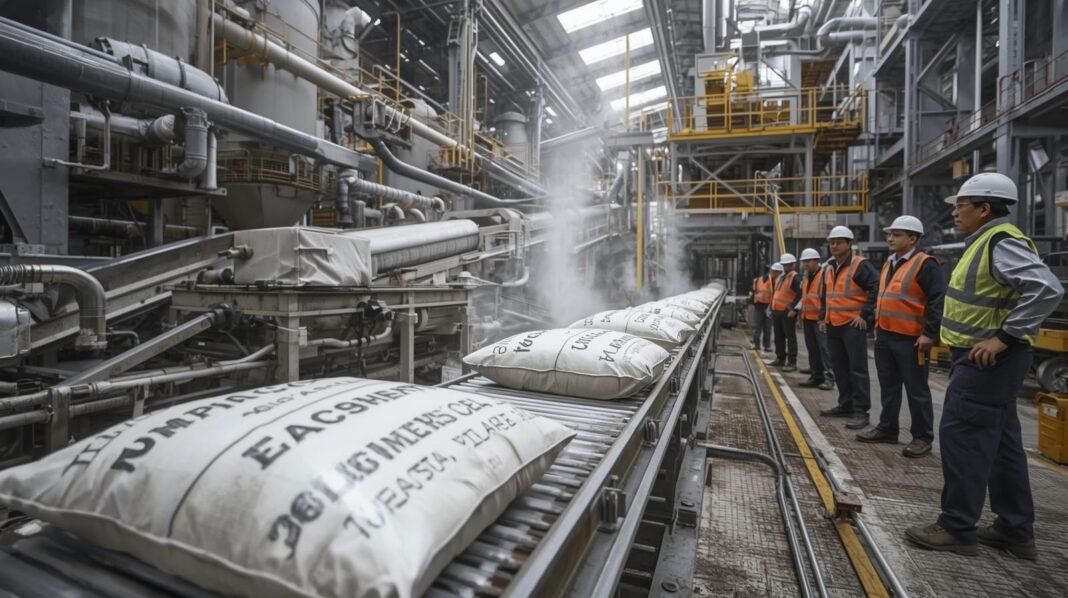
Cement is the invisible backbone of modern civilization. From the highways we drive on to the skyscrapers that define city skylines, this humble gray powder makes it all possible.
Yet despite its ubiquity, few people understand the fascinating industrial process that transforms raw limestone into the binding agent that literally holds our world together. Let’s take a journey through a modern cement plant to discover how this essential material is made.
The Raw Materials: Where Cement Begins
The cement manufacturing process starts in the earth itself. The primary ingredient is limestone, a sedimentary rock composed mainly of calcium carbonate.
Cement plants are typically located near limestone quarries to minimize transportation costs, as the production process requires massive quantities of this raw material.
But limestone alone isn’t enough. Modern cement plants also need clay or shale (which provide silica, alumina, and iron oxide), along with smaller amounts of sand and iron ore. These ingredients must be carefully balanced to create the precise chemical composition required for quality cement.
Think of it as a recipe that has been refined over more than two centuries, where even small variations can significantly impact the final product’s strength and durability.
Step One: Quarrying and Crushing
The cement-making process begins with controlled blasting in limestone quarries. Massive blocks of limestone, some weighing several tons, are broken loose and transported by enormous haul trucks to the plant’s primary crusher.
This crusher reduces the limestone boulders to pieces roughly the size of a basketball.
The crushed limestone then moves to a secondary crusher, which further reduces the material to gravel-sized particles.
Modern plants use sophisticated automated systems to monitor rock size and adjust crushing equipment in real-time, ensuring consistent material quality before the manufacturing process even truly begins.
Step Two: Raw Material Preparation and Blending
After crushing, the limestone is combined with the other raw materials in precisely controlled proportions.
This blending is critical because the chemical composition of natural materials varies, even within the same quarry. Advanced X-ray analyzers continuously sample the raw materials, and computerized systems adjust the mix to maintain the ideal chemical balance.
The blended materials are then ground into a fine powder in massive rotating mills. Some plants use vertical roller mills, while others employ traditional ball mills—large horizontal cylinders filled with steel balls that pulverize the material as the cylinder rotates.
The goal is to create a powder so fine that 90% of the particles are smaller than the diameter of a human hair. This fineness is essential because it dramatically increases the surface area available for the chemical reactions that occur in the next stage.
Step Three: The Kiln—Where the Magic Happens
The heart of any cement plant is the rotary kiln, and it’s here that raw materials undergo their dramatic transformation.
These massive cylindrical furnaces can measure up to 200 meters in length and seven meters in diameter.
Tilted at a slight angle, they rotate slowly while materials move through them, spending about 30 minutes inside at temperatures reaching 1,450 degrees Celsius (2,642 degrees Fahrenheit)—hot enough to melt some metals.
As the raw material powder enters the kiln, it first goes through a preheater tower where hot exhaust gases bring it up to about 900 degrees Celsius. This stage drives off carbon dioxide from the limestone in a process called calcination, converting calcium carbonate into calcium oxide (quicklime).
The material then enters the kiln itself, where extreme heat causes the calcium, silicon, aluminum, and iron to combine into entirely new compounds.
The end product of the kiln is called clinker: dark gray nodules about the size of marbles that look more like gravel than cement. These unassuming pellets contain the key compounds—primarily calcium silicates—that give cement its binding properties.
Step Four: Grinding the Clinker
Hot clinker emerges from the kiln and is rapidly cooled using massive fans that blast air across it. This cooling process is crucial because it affects the clinker’s crystalline structure and, ultimately, the cement’s performance characteristics.
The cooled clinker is then transported to finish grinding mills, where it’s pulverized into the fine powder we recognize as cement.
During this final grinding stage, a small amount of gypsum (typically 3-5%) is added. The gypsum acts as a set retarder, controlling how quickly the cement will harden when mixed with water.
Without gypsum, concrete would begin setting within minutes, making it impossible to work with on construction sites.
Modern finish mills can produce cement so fine that it has a surface area of up to 400 square meters per kilogram of material. This extreme fineness is what allows cement to react effectively with water and develop its binding strength.
Quality Control: Testing Every Batch
Throughout the entire manufacturing process, quality control is paramount. Modern cement plants operate sophisticated laboratories where technicians continuously test raw materials, intermediate products, and finished cement.
These tests measure everything from chemical composition to particle size distribution, setting time, and compressive strength.
Sample batches of cement are mixed with water and tested at various intervals—typically after 3 days, 7 days, and 28 days—to verify they meet industry standards. Only cement that passes these rigorous tests is approved for packaging and shipment.
Environmental Considerations in Modern Plants
Today’s cement plants incorporate numerous environmental controls that earlier generations lacked.
Electrostatic precipitators and fabric filters capture particulate matter before it can exit smokestacks.
Plants increasingly use alternative fuels like waste-derived fuels and biomass to reduce dependence on fossil fuels, and many capture waste heat for power generation or district heating systems.
The industry has also made significant strides in reducing carbon emissions per ton of cement produced, though cement manufacturing remains an energy-intensive process that contributes significantly to global CO2 emissions.
Innovations like carbon capture technology and new cement formulations that require less clinker are active areas of research aimed at making the process more sustainable.
From Plant to Construction Site
Once the cement passes quality control tests, it’s stored in massive silos until ready for shipment. Most cement is shipped in bulk by truck, rail car, or barge to concrete plants, where it will be mixed with sand, gravel, and water to create concrete.
Some cement is packaged in the familiar bags found at hardware stores for smaller construction and DIY projects.
The Remarkable Journey Continues
The next time you walk on a sidewalk or admire a concrete structure, consider the remarkable industrial journey that made it possible.
From explosive quarry blasts to infernal kiln temperatures to microscopic particle fineness, the cement manufacturing process represents one of humanity’s most successful transformations of raw earth into indispensable building material.
Modern cement plants are marvels of engineering efficiency, combining ancient chemical principles with cutting-edge automation and environmental controls.
As global construction continues to grow, these facilities will remain essential to building our future—literally forming the foundation upon which modern society stands.
Also Read

- U.S. Senators Push for Tariff Probe into Construction Equipment Imports from Mexico - March 30, 2026
- Top Smart Safety Shoes to Watch in 2026 - March 29, 2026
- SASSA Payment Dates for April 2026: What Every Beneficiary Needs to Know - March 29, 2026
