
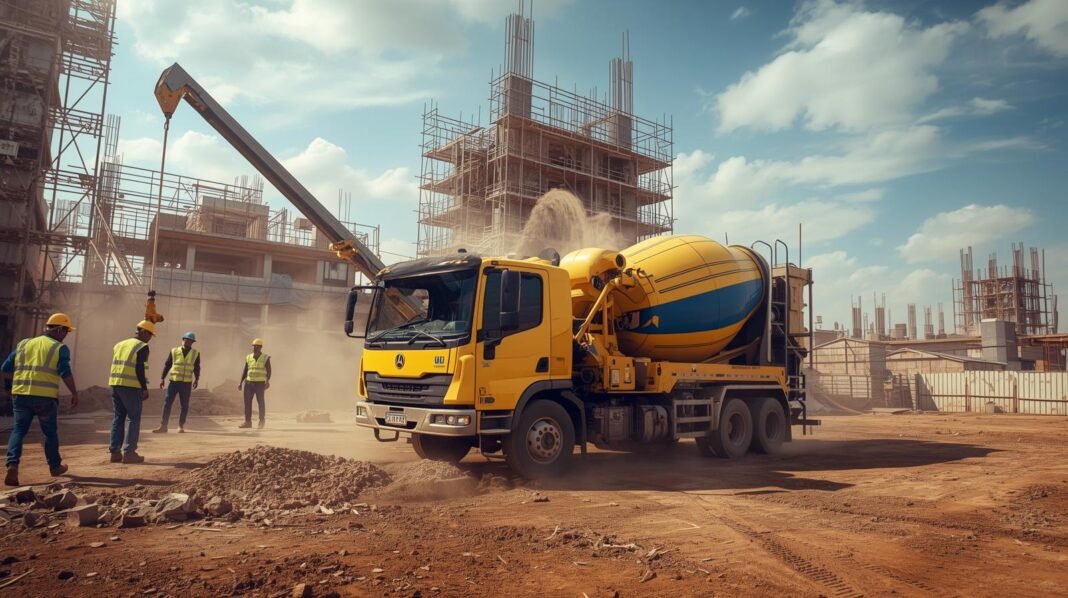
The African construction sector is experiencing unprecedented growth, driven by massive infrastructure projects, urbanization, and housing demands across the continent.
As construction companies seek efficient solutions for concrete placement, concrete mixer pumps have emerged as essential equipment that combines mixing and pumping capabilities in a single machine.
Understanding the costs associated with these versatile machines is crucial for contractors, project managers, and construction businesses operating in Africa.
Understanding Concrete Mixer Pumps
A concrete mixer pump is an integrated construction machine that performs two critical functions: mixing raw materials to create concrete and pumping the finished mixture to the desired location.
This dual functionality eliminates the need for separate mixing and pumping equipment, making it a cost-effective solution for small to medium-sized construction projects across Africa.
These machines are particularly valuable in African markets where construction sites may be located in remote areas with limited access to ready-mix concrete plants. The ability to produce and place concrete on-site significantly reduces dependency on external suppliers and transportation logistics.
Price Range for Concrete Mixer Pumps in Africa
The cost of concrete mixer pumps in Africa varies considerably based on several factors, including capacity, power source, features, and the country of operation.
Based on current market data from major African markets, here’s a comprehensive breakdown:
Entry-Level Models (30 m³/h capacity)
- Price Range: $20,000 – $25,000
- Typical Models: ABJZ30, JBS30 series
- Best For: Small residential projects, rural construction, foundations
Mid-Range Models (40 m³/h capacity)
- Price Range: $25,000 – $33,000
- Typical Models: ABJZ40, JBS40 series
- Best For: Medium-sized buildings, township projects, road construction
Advanced Models (with boom attachments)
- Price Range: $62,000 – $92,000
- Typical Models: ABY-15, ABY-18, ABY-20, ABY-26
- Best For: Multi-story buildings, complex projects requiring extended reach
Country-Specific Pricing Insights
Kenya: Concrete mixer pumps range from $20,000 to $33,000, with used equipment available starting from KES 2,500,000 (approximately $19,000).
South Africa: Similar pricing structure with new equipment priced between $20,000 and $35,000, depending on specifications and local market conditions.
Nigeria: Prices can be higher due to import costs and local demand, typically ranging from $22,000 to $45,000 for comparable models.
Tanzania: Equipment costs align closely with Kenyan prices, ranging from $20,000 to $32,000 for standard models.
Key Factors Affecting Concrete Mixer Pump Costs in Africa
1. Capacity and Output
The pumping capacity, measured in cubic meters per hour, significantly influences the price. Higher capacity pumps command premium prices due to their ability to handle larger volumes of concrete more quickly.
Capacities typically range from 20 m³/h for small projects to 100 m³/h for industrial applications.
2. Power Source
Diesel-Powered Pumps: Generally 10-15% more expensive than electric models but essential for remote African locations without reliable electricity access. Diesel pumps offer independence from power grids and are preferred for rural and infrastructure projects.
Electric-Powered Pumps: More economical to operate and maintain, suitable for urban areas with stable electricity supply. Initial costs are lower, typically $2,000-$5,000 less than diesel equivalents.
3. Mixing System Type
Drum Mixer Systems: Standard configuration with moderate mixing efficiency, representing the most affordable option.
Planetary Mixer Systems: Advanced mixing technology with faster, more uniform mixing, adding approximately $3,000-$5,000 to the base price.
Dual-Shaft Mixers: Premium mixing system that increases mixing speed by 2.3 times, suitable for high-quality concrete requirements.
4. Regional Considerations
Shipping and Logistics: Transportation costs to African markets can add 10-20% to the base equipment price, depending on the destination port and inland transportation requirements.
Import Duties and Taxes: African countries impose varying import duties, ranging from 10% to 25% on construction equipment, significantly affecting final costs.
Currency Fluctuations: Exchange rate variations between local currencies and the US dollar or Chinese yuan can impact pricing over time.
5. Brand and Manufacturing Quality
Established manufacturers like AIMIX, Luton, Schwing Stetter, and Zoomlion typically command higher prices but offer better build quality, longer warranties, and more reliable after-sales support.
Chinese manufacturers generally offer competitive pricing, making quality equipment accessible to African markets.
Additional Costs to Consider
Installation and Commissioning
Professional setup and operator training typically cost $1,500-$3,000, depending on equipment complexity and location accessibility.
Spare Parts and Maintenance
Annual maintenance costs range from 5-10% of the equipment’s purchase price. Access to genuine spare parts is crucial for minimizing downtime.
Operator Training
Comprehensive training programs range from $500-$1,500 per operator, essential for safe and efficient equipment operation.
Insurance
Equipment insurance adds approximately 2-4% of the equipment value annually, protecting against theft, damage, and operational risks.
Popular Concrete Mixer Pump Models in Africa
AIMIX ABJZ40C
- Capacity: 40 m³/h
- Power Options: Diesel/Electric
- Estimated Price: $26,000-$30,000
- Applications: Residential buildings, small commercial projects, rural construction
Luton JBS40-10-84R
- Capacity: 40 m³/h
- Power: Diesel engine
- Estimated Price: $24,000-$28,000
- Applications: Bridge construction, township projects, rural development
AIMIX ABJW40C (Vertical Shaft)
- Capacity: 40 m³/h
- Mixing Speed: 2.3x faster than standard
- Estimated Price: $28,000-$32,000
- Applications: Highway repairs, port expansions, industrial projects
Concrete Mixer Pump vs. Separate Equipment
One of the primary advantages of concrete mixer pumps is cost efficiency compared to purchasing separate mixing and pumping equipment:
Separate Equipment Investment:
- Concrete Mixer: $8,000-$15,000
- Concrete Pump: $18,000-$45,000
- Total: $26,000-$60,000
Combined Mixer Pump Investment: $20,000-$33,000
The integrated solution saves 20-30% on initial capital investment while reducing operational complexity, labor requirements, and maintenance costs.
Self-Loading Concrete Mixers: An Alternative Solution
For contractors seeking even greater mobility, self-loading concrete mixers represent another option, though at higher price points:
- Entry Models (1.8-2.6 m³): $12,000-$25,000
- Mid-Range (3.5-4.0 m³): $25,000-$40,000
- Large Capacity (5.5-6.5 m³): $40,000-$70,000
Self-loading mixers handle loading, batching, mixing, and transporting but require a separate pump for vertical or long-distance concrete placement.
Financing Options in Africa
Direct Purchase
Outright purchase offers full ownership without interest costs but requires significant upfront capital.
Installment Plans
Many suppliers offer payment plans with 20-40% down payment and 12-36 month terms, making equipment more accessible to smaller contractors.
Equipment Leasing
Lease-to-own arrangements allow contractors to generate revenue while building equity in equipment, with monthly payments typically 3-5% of equipment value.
Bank Financing
Commercial banks across Africa offer construction equipment loans with terms ranging from 3-5 years at interest rates varying by country and creditworthiness.
Cost-Saving Strategies
1. Match Equipment to Project Needs
Avoid over-specifying equipment capacity. A 30 m³/h pump is adequate for most residential and small commercial projects, saving $5,000-$8,000 compared to 40 m³/h models.
2. Consider Used Equipment
Well-maintained used concrete mixer pumps can offer 30-50% savings, though buyers should thoroughly inspect equipment condition and service history.
3. Group Purchasing
Construction cooperatives or multiple contractors pooling resources can negotiate better pricing and shipping rates from manufacturers.
4. Negotiate Bundled Services
Request package deals including spare parts, operator training, and extended warranties during initial purchase negotiations.
5. Optimize Power Source Selection
Choose diesel for remote sites and electric for urban projects with reliable power to minimize operational costs over the equipment’s lifespan.
Return on Investment Analysis
Understanding the financial return on a concrete mixer pump investment is crucial for African contractors:
Project Efficiency Gains
- Labor Cost Reduction: 40-60% savings by eliminating manual mixing and reducing crew size
- Time Savings: Projects complete 30-50% faster compared to traditional methods
- Concrete Quality: Consistent mixing reduces waste by 15-20%
Break-Even Timeline
For a $25,000 concrete mixer pump operating on medium-sized projects:
- Monthly Revenue Generation: $3,000-$5,000
- Operating Costs: $800-$1,200/month
- Net Monthly Profit: $2,000-$3,800
- Break-Even Period: 7-13 months
Regional Market Insights
East Africa (Kenya, Tanzania, Uganda)
Strong infrastructure development and urban growth drive steady demand. Local dealers provide good support, and spare parts availability is improving.
Southern Africa (South Africa, Zimbabwe, Zambia)
More mature markets with established distribution networks. Higher quality standards and better financing options available.
West Africa (Nigeria, Ghana)
Rapidly growing markets with significant infrastructure gaps. Higher equipment costs due to logistics but strong project demand justifies investment.
North Africa (Egypt, Morocco)
Developed construction sectors with stringent quality requirements. Equipment costs are moderate, and technical support is readily available.
Maintenance Cost Considerations
Annual maintenance costs for concrete mixer pumps in Africa typically include:
- Routine Servicing: $1,200-$2,000
- Hydraulic System Maintenance: $500-$800
- Engine Service (Diesel): $600-$1,000
- Spare Parts Replacement: $1,000-$2,500
- Total Annual Maintenance: $3,300-$6,300 (approximately 12-20% of purchase price)
Proper maintenance extends equipment lifespan from 5-7 years to 10-15 years, significantly improving ROI.
Key Considerations for African Buyers
Climate Adaptations
African climate conditions require specific equipment features:
- Enhanced cooling systems for hot climates
- Dust-proofing for arid environments
- Corrosion-resistant components for coastal areas
- Reinforced structures for rough terrain
These adaptations may add 5-10% to base costs but significantly improve equipment longevity.
After-Sales Support
Evaluate supplier after-sales capabilities:
- Local service centers and technicians
- Spare parts inventory and delivery times
- Technical support responsiveness
- Warranty coverage and terms
Operator Skill Level
Consider local labor skills when selecting equipment:
- Simpler machines reduce training requirements
- Automated features justify higher costs if skilled operators are scarce
- User-friendly controls minimize operational errors
Future Trends Affecting Prices
Technology Integration
Modern concrete mixer pumps increasingly feature GPS tracking, remote diagnostics, and automated controls, adding $2,000-$5,000 to equipment costs but improving efficiency and reducing downtime.
Environmental Regulations
Stricter emissions standards may increase diesel equipment costs by 10-15% as manufacturers adopt cleaner engine technologies.
Local Manufacturing
Emerging local assembly operations in countries like Nigeria and South Africa may reduce costs by 10-20% while improving parts availability and support.
Conclusion
Concrete mixer pump costs in Africa typically range from $20,000 to $33,000 for standard models, with advanced boom-equipped versions reaching $62,000-$92,000.
These prices reflect equipment capacity, power source, mixing technology, and regional factors including shipping, duties, and local market conditions.
For African contractors, concrete mixer pumps represent a sound investment, combining two essential construction functions while delivering significant cost savings compared to separate equipment.
The key to maximizing value lies in carefully matching equipment specifications to project requirements, selecting appropriate power sources for operating environments, and partnering with suppliers offering reliable after-sales support.
With proper selection, operation, and maintenance, concrete mixer pumps typically achieve payback within 7-13 months, making them one of the most cost-effective equipment investments available to African construction businesses.
As infrastructure development continues across the continent, these versatile machines will remain essential tools for efficient, profitable construction operations.
Whether you’re building residential homes in rural Kenya, constructing commercial facilities in South Africa, or developing infrastructure in Nigeria, understanding concrete mixer pump costs and capabilities empowers you to make informed investment decisions that enhance operational efficiency and project profitability.
Also Read
Used vs. New Concrete Pump Trucks: A Cost-Benefit Analysis for Construction Companies
Inside a Modern Asphalt Plant: Where Science Meets Infrastructure

- South Africa’s April 1 Triple Shock: When the Joke Is on the Consumer - March 26, 2026
- KeNHA’s World Bank Funding Boost: Inside Kenya’s KSh Multi-Billion Expressway Masterplan - March 25, 2026
- SASSA locks in full-year social grant payment schedule — and announces biggest increases in years - March 24, 2026
