
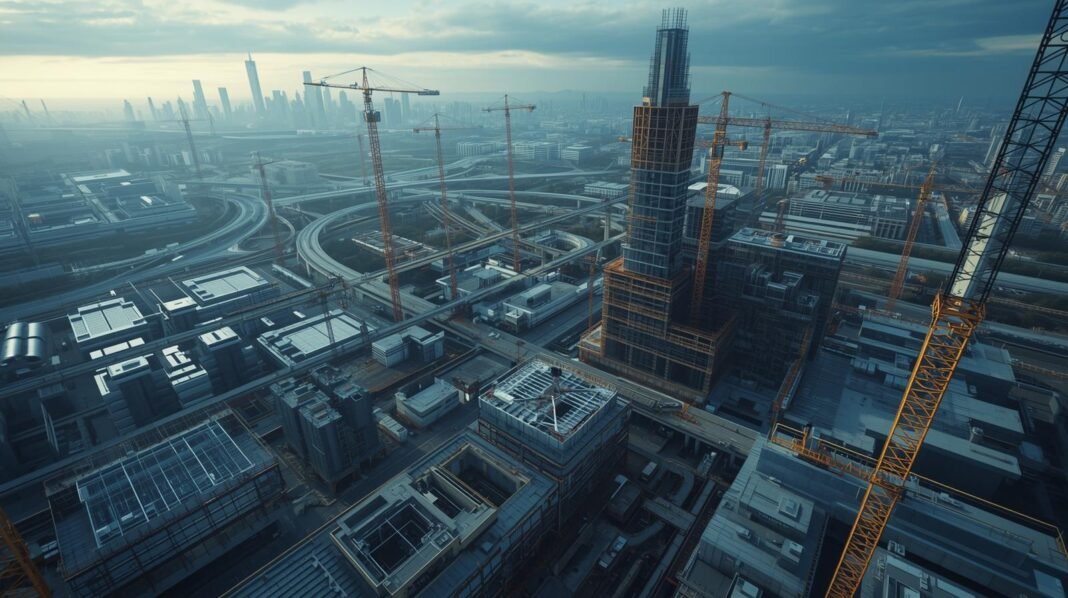
The United States construction industry stands at a critical inflection point in 2026.
As a $2.2 trillion economic powerhouse representing 4.5% of national GDP and employing 8.3 million workers, the sector faces a confluence of transformative forces: the maturation of artificial intelligence infrastructure buildouts, expiring federal infrastructure funding, unprecedented workforce shortages, and escalating trade tensions.
The industry’s trajectory over the next 12-24 months will shape not only domestic economic resilience but also America’s competitive positioning in advanced manufacturing, energy transition, and digital infrastructure.
This transition year arrives as construction spending shows signs of strain after years of exceptional growth.
Total construction spending reached a seasonally adjusted annual rate of $2.175 trillion in October 2025, declining 1.0% year-over-year in nominal terms and approximately 5% when adjusted for inflation.
The modest spending forecasts for 2026—projected gains of only 2.2% to 4.2% according to consensus estimates—mask profound sectoral divergences.
Data center construction surges while office development stalls. Infrastructure projects progress steadily but face funding cliffs. Residential construction grapples with affordability crises even as housing shortages persist.
Against this complex backdrop, five dominant themes define the 2026 construction landscape: the AI-driven data center boom creating unprecedented infrastructure demands; chronic labor shortages constraining capacity despite cooling demand; tariff-driven cost pressures reshaping supply chains and project economics; the approaching expiration of Infrastructure Investment and Jobs Act funding in October 2026; and accelerating technology adoption as firms deploy automation, AI, and modular construction to overcome labor constraints and improve productivity.
For contractors, investors, suppliers, and policymakers worldwide, understanding these American market dynamics offers crucial strategic intelligence. The US construction sector serves as both bellwether and proving ground for trends that will ripple across global markets.
1. US Construction Market Overview in 2026
The American construction industry enters 2026 navigating a challenging macroeconomic environment marked by policy uncertainty, elevated interest rates, and sectoral imbalances.
Total construction spending for 2025 finished at approximately $2.17 trillion, representing modest nominal growth but real contraction when adjusted for persistent inflation in construction inputs.
Sector-specific performance reveals striking disparities. Private construction spending reached $1.651 trillion annualized in October 2025, with residential construction at $913.9 billion and nonresidential at $737.4 billion.
Public construction totaled $524 billion, split between federal, state, and local projects. However, these top-line figures conceal profound shifts in composition and momentum.
According to the American Institute of Architects’ January 2026 Consensus Construction Forecast, overall spending on nonresidential buildings is projected to increase only 1.7% in 2025 and 2.0% in 2026—growth so modest it fails to cover rising material and labor costs.
The AIA Architecture Billings Index recorded its 13th consecutive month below 50 in November 2025, signaling continued contraction in design activity and foreshadowing further softness in construction starts.
The macroeconomic headwinds buffeting construction are multifaceted. The Federal Reserve’s extended period of elevated interest rates—necessary to combat inflation but painful for capital-intensive construction—has compressed developer appetite for new projects.
High-cost financing has particularly impacted speculative commercial development and market-rate multifamily housing. Consumer confidence declined throughout 2025, further dampening investment sentiment.
Trade policy volatility introduced additional complexity. The Trump administration’s expansion of Section 232 tariffs to 50% on steel and aluminum imports, combined with reciprocal tariffs ranging from 10% to 50% on various trading partners, created immediate cost pressures and procurement uncertainty.
These measures added approximately 3.2% to nonresidential construction input costs in 2025, with construction executives reporting project delays and cancellations as clients absorbed the implications.
Yet beneath this challenging surface, pockets of extraordinary strength persist—most notably in data center construction, utility infrastructure, and select industrial segments tied to national policy priorities.
This bifurcation between struggling traditional commercial sectors and booming AI-infrastructure categories will define market dynamics through 2026 and beyond.
2. Key Growth Sectors Driving US Construction
Data Centers and AI Infrastructure
The artificial intelligence revolution has catalyzed the most explosive construction boom in a generation.
US data center construction starts reached $77.7 billion in 2025, a staggering 190% increase year-over-year, with average monthly starts leaping from $500 million in mid-2021 to $6.5 billion by December 2025.
Looking ahead, ConstructConnect is tracking 76 projects valued at over $88 billion slated to begin within the next six months—already 13% higher than total 2025 starts.
The scale of committed capital is breathtaking. The January 2025 launch of the Stargate Project—a $500 billion, four-year commitment from OpenAI, SoftBank, Oracle, and MGX—signals that hyperscalers view AI infrastructure as strategic imperative rather than discretionary investment.
Meta completed its 30th data center and continues expanding across Wisconsin, Texas, and Kansas City. Amazon Web Services committed $100 billion to its Generative AI Innovation Center expansion. Microsoft is building what it calls the world’s most powerful data center in Wisconsin.
Credit ratings agency Moody’s projects $3 trillion in global spending over the next five years for data center expansion and AI capacity, with over 40% concentrated in the United States.
The Associated General Contractors’ 2026 outlook survey found data centers to be the most bullish sector, with a net 57% of respondents forecasting higher spending—far ahead of the next category.
The construction workforce implications are profound. A December 2025 study from the American Edge Project counted 4,149 active US data centers with 2,788 more announced or under construction, expected to generate 4.7 million temporary construction jobs. Data center employment is projected to reach 650,000 jobs by 2026, a 30% increase from 501,000 in 2023.
However, the boom carries structural risks. Power constraints represent the binding constraint on data center expansion, with electrical grid capacity unable to keep pace with demand.
The International Energy Agency estimates US data center electricity demand will more than triple by 2035, growing from 200 to 640 terawatt-hours annually.
Additionally, if AI investment fails to deliver anticipated returns, the potential collapse could devastate contractors heavily concentrated in this vertical.
Infrastructure and Transportation
Federal infrastructure investment continues to support construction activity in 2026, though the sector faces an uncertain transition as the Infrastructure Investment and Jobs Act reaches its October 2026 statutory expiration.
The IIJA authorized $1.2 trillion for transportation and infrastructure spending, with $550 billion in new investments over fiscal years 2022-2026. By December 2025, approximately $568 billion (47% of IIJA funds) had been allocated to 68,000 projects.
Highway construction maintained a seasonally adjusted annual rate of $141.6 billion through October 2025.
The transportation sector received particular support from formula-based federal highway programs and competitive grant initiatives like the Bridge Investment Program and RAISE grants. Water and sewer infrastructure projects similarly benefited from dedicated IIJA funding streams.
However, industry observers warn that the impending funding cliff poses significant risks. With reauthorization debates occurring amid broader federal spending reduction efforts and political uncertainty, contractors face the prospect of declining public infrastructure work if Congress fails to maintain IIJA-level baseline funding.
Additionally, the Trump administration’s reversal of Biden-era Justice40 equity commitments and broader funding freezes have already disrupted project implementation for some award recipients.
State and local governments, many of which have matched federal infrastructure dollars, will find themselves exposed if federal support contracts.
The heavy and civil engineering construction segment, which grew strongly from 2022-2025 on infrastructure tailwinds, must now prepare for a potential downturn in 2027-2028 if reauthorization disappoints.
Semiconductor and Advanced Manufacturing
The CHIPS and Science Act drove extraordinary manufacturing construction in 2023-2024, with spending peaking at over $230 billion in 2024—a 20% increase over 2023 levels.
However, the sector faces near-term headwinds. The AIA Consensus Forecast projects manufacturing facility spending will decline 2.0% in 2025 and an additional 2.6% in 2026 as the initial wave of semiconductor fabrication plants approaches completion.
This cooling should not be interpreted as abandonment of industrial policy goals. Rather, it reflects the lumpy, project-specific nature of megaproject construction.
Fabrication facilities require 2-3 years of intensive construction followed by extended commissioning periods. The pipeline of announced projects remains substantial, with major commitments from Intel, TSMC, Samsung, and other chipmakers still in various planning and execution stages.
Additionally, the broader advanced manufacturing category—including battery plants, electric vehicle facilities, and clean energy manufacturing—continues to attract investment driven by Inflation Reduction Act incentives and national security concerns around supply chain resilience.
While growth rates moderate from the explosive 2022-2024 period, this industrial construction segment remains structurally supported by policy and competitive dynamics.
Energy and Utilities
Power infrastructure construction represents a critical and rapidly growing segment driven by AI data center demands, electric vehicle charging networks, and renewable energy deployment. The AGC 2026 outlook survey found power construction to be the second-strongest sector after data centers, with net 34% of respondents expecting increased spending.
Grid modernization and transmission expansion have become urgent national priorities as electricity demand accelerates beyond infrastructure capacity.
Utilities, independent power producers, and infrastructure investors are deploying capital into baseload generation, transmission upgrades, battery storage, and distributed generation at unprecedented scale.
Natural gas-fired generation with long-term offtake agreements from data center operators represents a near-term winner, while small modular nuclear reactors gain credibility as solutions for 24/7 AI workload power requirements.
Renewable energy construction faces a complex 2026 environment. A surge of wind and solar projects racing to meet the Inflation Reduction Act’s July 4, 2026, federal deadline under Section 48E rules will drive workforce demand in early 2026, followed by continued activity through the December 31, 2027, placed-in-service deadline.
However, projects face headwinds from supply chain constraints, interconnection queue backlogs, and local permitting battles.
The energy construction outlook depends heavily on policy stability. Potential modifications to IRA tax credits or permitting reform could dramatically alter project economics and deployment timelines.
Nonetheless, the fundamental drivers—grid capacity constraints, electrification trends, and corporate sustainability commitments—ensure sustained demand for energy infrastructure construction.
3. Housing and Real Estate Construction Trends
The residential construction sector confronts deep structural challenges in 2026. Despite an estimated housing shortage of 3.7 to 4.9 million units—with some estimates reaching 7 million affordable units for extremely low-income households—new construction activity remains suppressed by high financing costs, regulatory barriers, and affordability constraints.
Residential construction spending reached a seasonally adjusted annual rate of $913.9 billion in October 2025, showing modest 1.3% month-over-month growth but facing headwinds from mortgage rates that, despite modest Federal Reserve rate cuts, remain elevated relative to the sub-3% rates of 2020-2021.
Home affordability has deteriorated to multi-decade lows, with median home prices and interest rates combining to price millions of households out of homeownership.
Single-family construction forecasts for 2026 show minimal improvement. Dodge Construction Network projects single-family housing starts finishing 2025 down 5% to 909,000 units, with only marginal recovery of 0.9% to 917,000 units in 2026.
The challenge extends beyond aggregate numbers to geographic and typological mismatches.
As industry analysts emphasize, housing needs to be affordable and built in high-demand states, yet those locations frequently maintain the most restrictive zoning and permitting frameworks.
Multifamily construction faces distinct pressures. After strong pandemic-era growth, the segment has cooled significantly.
Elevated construction and financing costs, combined with overbuilding in some markets, have reduced development feasibility.
The Harvard Joint Center for Housing Studies notes that new multifamily development is slowing despite record rents, as costs have outpaced revenue projections. Nearly half of renters are cost-burdened, spending over 30% of income on housing.
Commercial real estate construction presents a mixed picture. Office construction remains deeply challenged by structural vacancy increases and remote work trends.
Firms report widespread delays, cancellations, and scaled-back projects. However, this weakness drives growing interest in adaptive reuse—converting obsolete office buildings to residential, particularly in urban cores where housing demand remains strong.
Meanwhile, retail, hospitality, and mixed-use developments show signs of recovery in smaller metro areas with shorter entitlement timelines and easier financing.
Tariff impacts compound these challenges. Brookings Institution analysis calculates that current tariffs add roughly $30 billion to residential construction costs, with approximately 90% falling on new home construction.
Tariffs on steel, aluminum, lumber, gypsum, copper, and now kitchen cabinets and bathroom vanities create broad-based cost pressure precisely when affordability represents the binding constraint.
A 25% tariff on cement from Canada and Mexico took effect in 2025, creating significant challenges given domestic cement plants operate at full capacity and environmental constraints make new domestic production nearly impossible.
The Home Builders Institute quantifies the skilled labor shortage’s impact at $10.8 billion annually, including $2.7 billion in higher carrying costs and $8.1 billion in lost production (approximately 19,000 homes).
Longer construction cycles driven by labor scarcity amplify financing costs and reduce builder capacity to address the housing shortage.
Without meaningful policy interventions on zoning reform, labor development, or cost mitigation, the residential sector faces years of underproduction relative to demographic needs.
4. Technology Transforming the Construction Industry
Construction technology adoption accelerated dramatically in 2025-2026, driven less by enthusiasm for innovation than by workforce scarcity, margin pressure, and competitive necessity.
What once represented experimental pilot programs has become standard practice as firms deploy artificial intelligence, digital twins, robotics, and modular construction to overcome labor constraints and improve productivity.
Artificial intelligence applications have moved beyond conceptual discussions to operational deployment.
AI-powered project management platforms now optimize scheduling, resource allocation, and workforce deployment.
Smart scheduling systems reportedly cut downtime by up to 60%, while predictive maintenance algorithms prevent equipment failures and reduce costly delays.
The AI construction technology market is projected to surpass $4.5 billion by 2026, with 83% of construction professionals expressing trust in AI’s ability to improve productivity.
Building Information Modeling has achieved critical mass, with adoption now exceeding 60% nationwide.
BIM enables enhanced collaboration, clash detection, and project visualization, reducing rework and improving coordination among trades.
When combined with digital twin technology—creating virtual replicas of physical assets that enable simulation and optimization—BIM delivers measurable improvements in cost estimation, timeline accuracy, and commissioning efficiency.
Robotics and automation deployment addresses acute labor shortages in specific trades. Autonomous equipment for earth moving, concrete finishing, and material transport reduces reliance on increasingly scarce operators.
Exoskeletons enhance worker productivity and safety while reducing physical strain. Semi-autonomous bricklaying, welding, and rebar-tying robots augment rather than replace skilled tradespeople, enabling smaller crews to maintain output.
Modular and prefabricated construction represents perhaps the most transformative technology shift.
The global modular construction market reached approximately $173.5 billion in 2025 and is projected to exceed $300 billion by 2035.
Prefabrication moves work from constrained jobsites to controlled factory environments, improving quality, reducing waste, accelerating schedules, and mitigating weather delays. Critically for 2026’s labor-constrained market, prefab reduces on-site labor requirements by 30-50% depending on building type and system selection.
Drones and IoT sensors enable continuous site monitoring, progress tracking, and safety surveillance. Real-time data capture improves project visibility, facilitates remote oversight, and enables data-driven decision making.
Cloud-based construction management platforms integrate these technologies, providing stakeholders with unified dashboards for cost, schedule, and quality metrics.
Despite these advances, technology adoption faces barriers. Initial capital requirements deter smaller contractors.
Integration challenges create friction when legacy systems must interface with new platforms. Cybersecurity vulnerabilities proliferate as construction becomes increasingly digital. And cultural resistance persists in an industry where relationships and experience traditionally trumped data and automation.
Yet the productivity imperative—do more with fewer workers—leaves firms little choice but to embrace technological transformation.
5. Workforce Shortages and Skills Crisis
The construction workforce shortage represents the industry’s most persistent and consequential challenge.
While the immediate crisis has moderated from peak levels—Associated Builders and Contractors projects the industry needs 349,000 net new workers in 2026, down from 439,000 in 2025 and over 500,000 in prior years—this reduction reflects cooling demand rather than structural resolution.
More critically, ABC forecasts demand rebounding sharply to 456,000 workers in 2027 as construction spending accelerates.
The mathematics are sobering. More than half of the 349,000 workers needed in 2026 will simply replace retirees rather than support industry growth.
Approximately 20% of the construction workforce exceeds age 55, with exits tied to age, physical demands, and career transitions continuing to outpace the inflow of younger workers.
The National Center for Construction Education and Research estimates that 41% of the workforce will retire by 2031, creating an existential talent pipeline crisis.
Recent survey data from the Associated General Contractors and NCCER reveals the human impact of shortages. Ninety-two percent of contractors report difficulty filling open positions.
Forty-five percent experienced project delays due to workforce shortages in the past year, making labor scarcity the leading cause of schedule slippage. Overall, 78% of firms experienced at least one delayed project in the past twelve months.
The shortage manifests unevenly across trades and geographies. Electricians and mechanical workers face particularly acute deficits, creating bottlenecks for data center construction where precision electrical work and advanced cooling system installation represent critical path activities.
Hyperscalers racing to deploy AI infrastructure find that electrical capacity constraints bind tighter than capital availability.
Immigration policy volatility has compounded workforce challenges. Twenty-eight percent of construction firms report being affected directly or indirectly by immigration enforcement activities in recent months.
Approximately one-quarter of the construction workforce is foreign-born—a larger share than the overall labor force—making the sector particularly sensitive to policy shifts.
Enhanced workplace enforcement and restrictions on international arrivals contracted the immigrant workforce pipeline precisely when demand peaked.
Industry responses to the crisis have been multifaceted. Seven out of eight firms raised base pay as much or more than in the prior year, with wages for home building non-supervisory workers rising 9.2% in mid-2025—substantially outpacing inflation and broader sector wage growth.
Forty-two percent of firms initiated or increased spending on training and professional development. Fifty-five percent added online recruiting strategies including social media and targeted digital advertising to connect with younger applicants.
Yet structural impediments persist. Fifty-seven percent of firms report that available candidates lack essential skills or appropriate licenses.
Federal investment in construction workforce training and education remains inadequate relative to need.
Only 10% of firms successfully utilize the limited H-2B visa program or other temporary work visa programs to secure craft employees, highlighting the practical difficulties of navigating immigration pathways even where legal mechanisms exist.
Major employers have launched targeted training initiatives. Amazon’s $700 million skills training program targets 15,000 workers by 2026.
Microsoft partners with community colleges to produce 8,500 certified technicians annually. Google committed $50 million to apprenticeships across 12 metros, combining classroom instruction with on-the-job training.
The Data Center Workforce Initiative provides fast-track certifications in 25 states with transferable credentials.
Despite these efforts, the current slowdown provides contractors only a narrow window to prepare before the next upcycle.
Firms that invest now in recruitment, training, and retention strategies—particularly in high-demand specialty trades—will gain decisive competitive advantage when construction spending rebounds.
Those that view the temporary demand cooling as permission for complacency risk catastrophic labor shortages when market conditions tighten.
6. Tariffs, Materials, and Supply Chain Disruptions
Trade policy has emerged as a dominant source of cost volatility and strategic uncertainty for US construction.
The Trump administration’s aggressive expansion of tariffs throughout 2025—culminating in 50% duties on steel and aluminum, 50% on copper derivatives, 10-25% on lumber and timber products, and reciprocal tariffs ranging from 10-50% on various trading partners—created immediate and sustained inflationary pressure on construction inputs.
The numbers tell a stark story. Nonresidential construction input costs finished 2025 up 3.2% year-over-year, with tariff-exposed materials driving the increase. Copper wire and cable prices jumped 22% annually.
Aluminum mill shapes surged 30.5% from December 2024 to December 2025—the largest year-over-year increase in recent memory.
Steel-intensive construction scopes now carry embedded tariff costs of approximately $15-25 per square foot on mid-rise multifamily projects, depending on structural system selection.
The May and August 2025 expansions to cover over 400 derivative product categories amplified impacts beyond primary metals.
Wind turbines, mobile cranes, bulldozers, railcars, furniture, compressors, pumps, and hundreds of other products now face 50% duties on their steel and aluminum content.
This derivative coverage creates procurement complexity as importers must separate and document the value of metal content versus other components—or face 50% tariffs on entire assemblies.
Project impacts have been tangible and disruptive. An AGC-NCCER survey found that 43% of general contractors reported at least one project canceled, postponed, or scaled back in the past six months due to higher material costs driven by tariffs.
Skanska case studies indicate that new tariffs could add approximately $22 million to a $375 million healthcare development, with nearly half tied to derivative components embedding steel or aluminum in assemblies.
Supply chain responses have varied by material and market segment. Some manufacturers shifted sourcing to minimize tariff exposure, rerouting cross-border contracts and adjusting North American production footprints.
Suppliers stockpiled materials in late 2024 and early 2025 ahead of announced tariff implementation, temporarily cushioning price impacts but creating subsequent inventory depletion challenges.
Domestic production capacity, while theoretically capable of expansion, faces practical constraints—US steel mills currently operate at approximately 75% capacity, while idled aluminum smelting capacity will take years to restart economically.
The residential sector faces particular pressure from lumber and building material tariffs. A 10% tariff on softwood lumber and timber combines with 25% duties on various derivative products.
With over half of US gypsum imports originating from Canada and Mexico—now subject to broad IEEPA tariffs—drywall costs face sustained pressure.
The $30 billion aggregate residential construction cost increase calculated by Brookings reflects these cascading tariff impacts across the material spectrum.
Construction executives must now navigate unprecedented procurement complexity. The same part can carry dramatically different tariff burdens depending on country of origin, product classification, and documentation of metal content versus other components.
Canada and Mexico maintain USMCA exemptions for compliant goods, but non-compliant imports face 25-35% tariffs.
China faces combined tariffs reaching 30% before sector-specific duties. The rapid evolution of tariff policy—including the January 2026 volatility where UK tariffs briefly spiked to 10% before reverting to zero—creates planning paralysis.
Looking ahead, contractors face difficult strategic choices. Accepting tariff exposure means reduced competitiveness on fixed-price contracts.
Attempting to pass costs through to clients risks project cancellations in price-sensitive segments. Stockpiling materials against future price increases ties up working capital and exposes firms to inventory obsolescence if tariff policies shift again.
Developing domestic supply relationships may offer long-term resilience but requires time and relationship investment.
The consensus among industry economists is clear: tariffs will continue driving cost escalation in 2026 absent dramatic policy reversals.
The Associated Builders and Contractors chief economist warns that construction costs are certain to rise further as long as current tariffs remain in place.
For an industry already grappling with labor shortages, demand uncertainty, and financing constraints, sustained tariff-driven inflation represents an additional strategic burden with no clear resolution timeline.
7. Sustainability and Green Construction Trends
Sustainability has transitioned from aspirational goal to operational imperative in US construction.
Regulatory requirements, investor pressures, tenant demands, and corporate ESG commitments now mandate attention to embodied carbon, operational efficiency, and lifecycle environmental performance.
The challenge for 2026 lies in maintaining sustainability momentum amid cost pressures and economic uncertainty.
Net-zero building targets proliferate across corporate real estate portfolios and institutional projects. Major developers and building owners have committed to carbon neutrality goals, typically targeting 2030-2040 achievement dates.
These commitments drive demand for low-carbon materials, energy-efficient systems, and renewable energy integration.
However, the premium costs associated with green building—estimated at 5-15% for advanced sustainability features—create tension with affordability objectives in an already expensive construction environment.
ESG reporting requirements have intensified. Public companies face growing pressure from investors and regulators to disclose Scope 3 emissions, including those embedded in buildings they own or develop.
The SEC’s climate disclosure rules, while politically contested, signal directional momentum toward mandatory carbon accounting.
Construction firms responding to these client demands must develop capabilities in carbon measurement, Environmental Product Declaration verification, and lifecycle assessment.
Low-carbon materials represent a rapidly evolving category. Cement alternatives, mass timber, recycled steel, and low-carbon concrete formulations offer pathways to reduce embodied carbon in building structures.
However, availability, cost, and performance verification remain challenges. Supply chains for novel materials are immature, creating procurement risk.
Performance data for long-term durability and structural integrity remains limited for some innovative materials.
Energy-efficient building codes continue tightening at state and local levels. California, Washington, and New York lead in mandating electric-ready construction, enhanced insulation standards, and renewable energy integration.
These requirements add upfront costs but deliver operational savings and improved asset value over building lifecycles.
The construction industry increasingly views code compliance not as burden but as competitive differentiator in attracting quality tenants and securing financing.
Federal and state incentive programs provide financial support for green construction. Inflation Reduction Act tax credits for energy efficiency, renewable energy, and clean transportation infrastructure offset incremental costs.
State-level programs offer rebates, expedited permitting, and density bonuses for sustainable development. However, the potential for federal policy reversals—given political transitions and fiscal pressures—creates uncertainty about long-term incentive availability.
Data center construction presents a particular sustainability paradox. While these facilities enable digital transformation and AI advancement, they consume extraordinary energy and water resources.
Power Usage Effectiveness metrics and renewable energy procurement help mitigate impacts, but the fundamental tension between AI infrastructure growth and climate goals remains unresolved.
The industry’s response—developing more efficient cooling systems, co-locating with renewable generation, and investing in grid modernization—will prove critical to maintaining the sector’s social license to operate.
8. Policy, Regulation, and Funding Landscape
The policy environment governing US construction in 2026 is characterized by programmatic maturity intersecting with political transition and fiscal constraint.
The Infrastructure Investment and Jobs Act enters its final year of authorization, having distributed $568 billion (47% of total funding) to 68,000 projects by its third anniversary in November 2024. The challenge now shifts from implementation to preservation and extension.
IIJA’s October 2026 expiration creates a pivotal decision point. Congress must choose whether to revert to historical underfunding of transportation and infrastructure needs or build on IIJA investments by adopting similar funding levels in reauthorization.
Transportation advocacy organizations argue that IIJA represented a necessary down payment rather than complete solution, emphasizing the need for sustained multi-year commitments to address deferred maintenance backlogs and modernization requirements.
However, reauthorization occurs against a challenging fiscal backdrop. Federal spending reduction initiatives, debt ceiling politics, and competing priorities create headwinds for infrastructure funding.
The Highway Trust Fund—traditionally supported by motor fuel taxes—faces long-term solvency challenges as vehicle electrification reduces gas tax revenues.
Without structural funding reforms or new revenue mechanisms, maintaining current infrastructure investment levels will prove difficult.
State and local funding dynamics add complexity.
Many jurisdictions matched federal IIJA dollars with state appropriations or bond proceeds, creating exposure if federal support contracts.
Public-private partnerships have grown as mechanisms to leverage private capital for infrastructure delivery, but P3 structures require sophisticated procurement capabilities and political will that many jurisdictions lack.
Additionally, the Trump administration’s reversal of Biden-era Justice40 commitments—requiring 40% of infrastructure benefits flow to disadvantaged communities—eliminates a major equity framework without replacing it with alternative approaches.
Beyond infrastructure, regulatory developments shape construction markets. Environmental permitting timelines, energy codes, labor regulations, and procurement requirements all influence project feasibility and cost.
The tension between regulatory streamlining advocates who emphasize speed and efficiency versus those prioritizing environmental protection and community input remains unresolved. Administrative actions can shift this balance dramatically, as evidenced by rapid policy reversals following presidential transitions.
For contractors and developers, the policy uncertainty necessitates scenario planning and risk management. Projects dependent on federal funding face timing and allocation risks.
Those requiring multi-year regulatory approvals must account for potential policy shifts. And firms making capital investments in equipment, facilities, or capabilities must evaluate resilience across different policy futures.
In this environment, strategic agility becomes as important as operational excellence.
9. Risks and Challenges Facing US Construction in 2026
The US construction industry navigates multiple interrelated risk categories in 2026, any one of which could trigger significant market disruption.
Understanding these vulnerabilities and developing mitigation strategies represents essential risk management for industry participants.
Elevated interest rates and financing costs continue constraining development activity despite modest Federal Reserve rate cuts. Commercial real estate faces a refinancing wave as loans originated at 3-4% rates mature into a 6-7% environment.
Many projects that penciled at lower rates no longer achieve required returns, leading to cancellations or significant redesign.
Construction lenders have tightened underwriting standards, requiring higher equity contributions and pre-leasing thresholds. This credit tightening disproportionately impacts smaller developers and speculative projects.
Trade tensions and geopolitical risks extend beyond tariffs to fundamental questions about global supply chain resilience.
Potential escalation of US-China economic conflict could disrupt electronics, equipment, and specialty material availability.
Energy market volatility linked to Middle East tensions or Russia-Ukraine conflict could spike fuel and petrochemical costs. These geopolitical factors remain largely outside industry control but create tail risks that prudent planners must acknowledge.
Labor shortage structural persistence represents perhaps the most intractable challenge. While the 2026 need for 349,000 net new workers is lower than recent peaks, the 2027 rebound to 456,000—a 31% single-year increase—will test industry capacity.
The retirement wave continues unabated, with projections suggesting 41% workforce turnover by 2031.
Young people increasingly pursue college degrees over skilled trades despite substantial earning potential and job security in construction. Reversing these cultural trends requires sustained, coordinated effort across industry, education, and policy domains.
Productivity stagnation undermines the industry’s ability to address cost and timeline pressures. Despite technology investments and process improvements, construction productivity growth lags other major industries.
The complex, project-specific, weather-dependent nature of construction work resists standardization. Fragmented supply chains and adversarial contracting practices inhibit innovation.
Until the industry achieves step-change productivity improvements—whether through technology, industrialization, or business model transformation—cost inflation will continue outpacing general economic growth.
Power and water constraints for megaprojects have emerged as unexpected bottlenecks. Data center development increasingly encounters grid capacity limitations that no amount of capital can immediately overcome.
Utility infrastructure requires years of planning, permitting, and construction to expand. Water availability for cooling systems faces similar constraints in arid regions. These resource limitations may prove binding even where land, capital, and labor align.
Technology adoption barriers persist despite growing recognition of digital tools’ value. Smaller contractors lack capital and expertise to implement advanced systems.
Interoperability challenges create friction when different software platforms must exchange data. Workforce digital literacy varies widely, with older workers sometimes resistant to new approaches.
And cybersecurity vulnerabilities proliferate as construction becomes increasingly connected—exposing projects to ransomware, data breaches, and operational disruption.
Climate-related physical risks—extreme weather, flooding, wildfires—increasingly impact construction timelines and costs. Projects face weather delays, material damage, and workforce safety challenges.
Insurance costs rise in catastrophe-prone regions. Resilience requirements add to project complexity and expense. While climate adaptation creates construction opportunities, it also represents a fundamental risk factor that historical planning models inadequately captured.
10. Outlook Beyond 2026: Forecast to 2030
Projecting US construction trajectories beyond 2026 requires acknowledging inherent uncertainties while identifying probable directional trends. T
he industry’s 2027-2030 evolution will be shaped by policy choices, technology maturation, workforce dynamics, and macroeconomic conditions that remain highly variable.
Residential construction faces a multi-year journey toward equilibrium. The 3.7 to 4.9 million unit housing shortage cannot be addressed quickly given current production rates and affordability constraints.
Gradual improvement requires sustained attention to zoning reform, construction cost reduction, workforce development, and financing innovation. Optimistic scenarios envision annual housing starts climbing toward 1.5-1.7 million units by 2030, supported by demographic demand from Millennials and Gen Z household formation.
Pessimistic scenarios see continued underproduction, worsening affordability, and social consequences from housing scarcity.
Infrastructure spending trajectories hinge critically on IIJA reauthorization outcomes. If Congress maintains funding at or above IIJA levels, transportation, water, and utility infrastructure will continue supporting construction activity through 2030.
However, reversion to pre-IIJA baselines would create a significant demand reduction, potentially triggering heavy and civil engineering sector contraction.
The political dynamics remain fluid, with infrastructure traditionally enjoying bipartisan support but facing fiscal pressures that could overcome historical consensus.
Industrial and manufacturing construction megaprojects will continue in waves tied to specific policy initiatives.
While CHIPS Act fabrication plants moderate after the 2024-2025 peak, battery manufacturing, hydrogen production, carbon capture, and advanced materials facilities represent multi-year pipelines.
The sustainability transition—electrification, clean energy, circular economy—creates decades of industrial infrastructure demand.
However, these projects remain sensitive to policy stability, with abrupt subsidy elimination or regulatory shifts capable of stranding announced investments.
Data center construction faces the most uncertainty of any major segment. The $3 trillion global investment projected by Moody’s through 2030 assumes sustained AI demand growth and return on invested capital justifying continued buildout.
However, if AI applications fail to generate anticipated value—or if technological breakthroughs enable dramatic efficiency improvements—the data center boom could reverse sharply.
Additionally, power constraints may impose physical limits on expansion regardless of capital availability. The sector embodies both extraordinary opportunity and concentrated risk.
Technology adoption will continue accelerating driven by competitive necessity. Modular construction, AI-powered project management, robotics, and digital twins will transition from early adoption to mainstream deployment.
The construction technology sector will consolidate as platforms mature and interoperability improves.
Successful firms will be those achieving step-change productivity improvements through technology integration, while laggards face margin compression and competitive disadvantage. However, technology alone cannot solve fundamental challenges like regulatory complexity, fragmented supply chains, or adversarial contracting practices.
Workforce dynamics present the industry’s longest-term challenge and opportunity. The 2031 projection of 41% workforce retirement creates both crisis and renewal.
If industry, education, and policy leaders successfully attract and train next-generation workers—emphasizing technology skills, career pathways, and competitive compensation—construction could emerge with a more productive, diverse, and digitally fluent workforce.
Failure to develop talent pipelines would constrain industry growth regardless of demand. This human capital challenge transcends any single economic cycle or policy initiative.
For global markets, American construction trends offer critical insights. The data center phenomenon spreading from the US to Europe, Asia, and emerging markets will face similar workforce, power, and cost challenges.
The industrial reshoring and supply chain resilience themes playing out in US manufacturing construction reflect broader geopolitical realignments affecting infrastructure planning worldwide.
And the technology adoption accelerating in American construction—driven by labor scarcity and productivity imperatives—foreshadows trajectories other markets will likely follow as their own demographic transitions unfold.
Also Read
Top 10 Mega Construction Projects in the United States 2026

- U.S. Senators Push for Tariff Probe into Construction Equipment Imports from Mexico - March 30, 2026
- Top Smart Safety Shoes to Watch in 2026 - March 29, 2026
- SASSA Payment Dates for April 2026: What Every Beneficiary Needs to Know - March 29, 2026
