
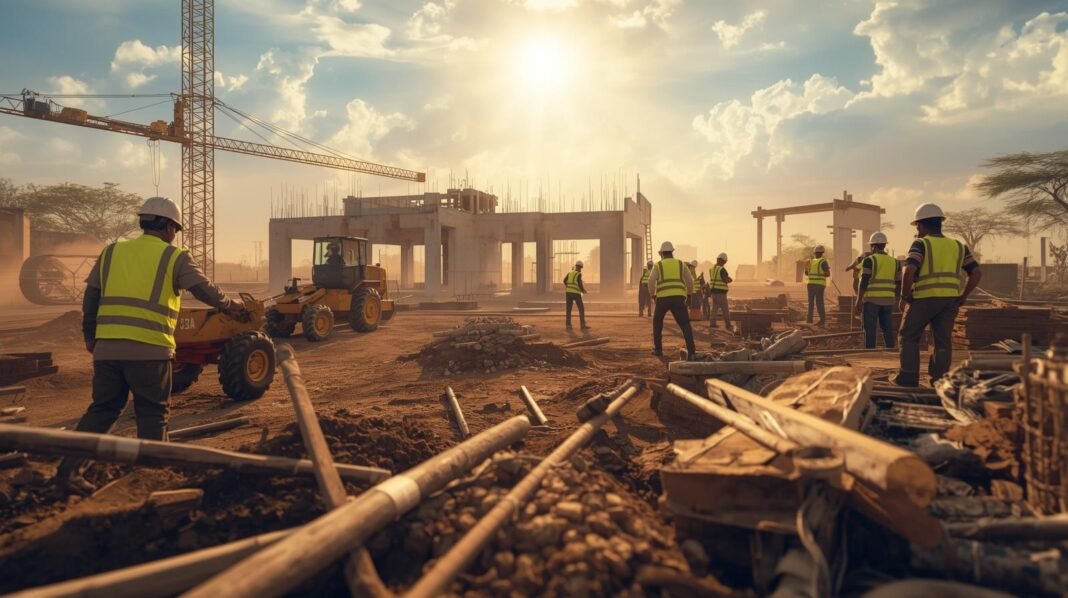
Africa’s infrastructure deficit presents one of the most compelling opportunities for global construction firms, and Indian companies are positioning themselves as key partners in the continent’s transformation.
With over $155 billion required annually until 2040 to meet Africa’s infrastructure needs, Indian construction giants are leveraging decades of experience, competitive pricing, and strategic government support to carve out a significant presence across the continent.
The India-Africa Infrastructure Partnership: A Growing Strategic Alliance
The relationship between India and Africa in infrastructure development has evolved from modest beginnings into a sophisticated partnership backed by billions in financing and decades of project execution experience.
Unlike other international players, Indian firms bring a unique value proposition: they understand emerging market challenges firsthand, offer cost-effective solutions, and operate with a development-oriented rather than purely commercial approach.
Since the early 2000s, India’s Export-Import Bank has emerged as the financial backbone of this expansion, channeling concessional Lines of Credit to African governments and regional institutions.
As of 2024, the India Exim Bank has extended over $1.14 billion specifically to the ECOWAS Bank for Investment and Development alone, supporting projects across West Africa.
Recent agreements include a $40 million credit line signed in August 2025, targeted at energy, health, transportation, agriculture and infrastructure sectors throughout the 15-member ECOWAS region.
Tanzania leads as the largest recipient of Indian LOCs with $860.53 million, followed by the Democratic Republic of Congo at $406.44 million, and Mozambique with $383 million between 2014 and 2024.
This strategic financing has opened doors for Indian construction firms to execute large-scale infrastructure projects while building long-term relationships with African governments.
Major Indian Construction Players in Africa
Larsen & Toubro: The Infrastructure Giant
Larsen & Toubro stands as India’s most prominent construction presence in Africa, with operations spanning energy, water, transportation, and industrial sectors. The Mumbai-based conglomerate, with revenues exceeding $27 billion, has made Africa a cornerstone of its international strategy.
In October 2024, L&T’s Power Transmission & Distribution division secured major contracts valued between $5,000 crore and $10,000 crore across Africa and West Asia.
The centerpiece is the National System Control Centre for Kenya, designed to manage the country’s entire power flow by integrating renewable energy sources and high-voltage regional interconnections.
The facility will incorporate diverse generation sources, dispatch power based on merit order, and include a backup energy management system for operational resilience.
If completed on schedule, this project could significantly improve Kenya’s grid efficiency and stability by 2026.
L&T’s African portfolio showcases remarkable diversity.
In Tanzania, the company secured contracts for water supply schemes across multiple towns, with scope including design and construction of raw water intake systems, storage tanks, water treatment plants totaling 71 MLD capacity, five clear water reservoirs, pumping stations, and 263 kilometers of pipeline.
The project, funded by India’s Exim Bank, addresses critical water infrastructure needs in East Africa.
The company’s historic projects set the foundation for its current expansion. The Songo-Songo Gas Development and Power Generation Project in Tanzania involved collecting gas from offshore and onshore wells, processing it, and piping it 215 kilometers to Dar Es Salaam.
In Kenya, L&T constructed a pure soda ash plant for Magadi Soda Company, while in Mauritius, the firm built a 10.8 million liter-per-day water treatment plant at Mont Blanc, the 70-meter-high Cyber Tower, and the Swami Vivekananda International Convention Centre.
For fiscal year 2024-25, L&T recorded an order inflow of ₹356,631 crore, with a remarkable 58% coming from international projects—a 17.8% increase over the previous year.
The company’s international order book represents 46% of its total portfolio, underscoring Africa’s growing importance to its business strategy.
L&T has also established a separate Renewable EPC business vertical as of September 2024, positioning itself to capitalize on Africa’s renewable energy boom with a portfolio spanning 22 GWp of renewable EPC experience globally.
Shapoorji Pallonji Group: Engineering Excellence Across the Continent
The Shapoorji Pallonji Group, operating through multiple divisions including SP EPC, SP International, and its subsidiary Afcons Infrastructure, has established a formidable presence in Africa since entering the market in 2009.
With operations in over 40 countries and a workforce exceeding 60,000, the group brings 150 years of engineering expertise to African infrastructure challenges.
In Rwanda, Shapoorji Pallonji’s EPC division constructed a landmark 2×35 MW Peat-fired Thermal Power Plant at Gisagara District, utilizing Bubbling Bed boiler technology from Finland.
Completed in 2021, the 70 MW facility represents sophisticated power generation in East Africa, addressing Rwanda’s chronic energy deficits.
The group’s West African achievements are equally impressive. In Ghana, the Seat of Government & Presidency project marked Shapoorji Pallonji’s first design-build project in Africa.
The company later completed the Tema-Mpakadan Railway Project, which includes Ghana’s longest railway bridge spanning Lake Volta. This infrastructure connects critical economic zones and demonstrates the firm’s capacity for complex engineering challenges.
In Gabon, Afcons Infrastructure—Shapoorji Pallonji’s infrastructure development arm—completed the New Owendo International Port in just 18 months, maintaining the company’s reputation for on-time delivery.
The project has enhanced Gabon’s maritime trade capacity and regional connectivity.
Zambia’s Lusaka City Roads Decongestion Project showcased the firm’s efficiency, with completion six months ahead of schedule.
In Guinea, the Bauxite Handling Facility built for Guinea Alumina Corporation represents one of the country’s largest industrial projects, completed in full compliance with GAC standards, Equator Principles, and International Finance Corporation Performance Standards.
North African projects include Algeria’s Douera Maternity Hospital and multi-story residential buildings with 2,000 homes for Assure Immo, a CNEP Bank subsidiary.
In Nigeria, the Admiralty Evercare Hospital complex includes a 165-bed hospital building, car park building, and ancillary facilities, while the Alausa Power Plant features gas and diesel engines providing reliable power generation.
Afcons Infrastructure: Specialized Marine and Transportation Excellence
As the EPC construction arm of the Shapoorji Pallonji Group, Afcons Infrastructure has carved out expertise in challenging engineering projects, particularly in marine construction and tunneling.
The company’s operations span over 25 countries across Asia, Africa, and the Middle East.
In Mauritius, Afcons executed the Cruise Mauritius Berth marine project in just 10 months, demonstrating rapid execution capabilities for complex port infrastructure. The project has enhanced Mauritius’s tourism infrastructure by accommodating larger cruise vessels.
East Africa represents 78.13% of Afcons’ listed projects, with significant concentrations in Kenya and Mauritius.
The company’s railway expertise is particularly notable, having constructed the Tema-Akosombo Railway Line in Ghana, which created over 1,000 jobs and significantly improved regional connectivity.
Overseas Infrastructure Alliance: The Emerging EPC Specialist
Overseas Infrastructure Alliance represents a newer generation of Indian EPC firms focused exclusively on Africa.
With offices in Ethiopia, Mozambique, Tanzania, Republic of Congo, Burkina Faso, Rwanda, Sudan, Comoros, and Maldives, OIA operates a pan-African network from its Mumbai headquarters.
By 2016, OIA had already executed projects worth $1 billion across eight African countries. The company’s portfolio spans electrification, water infrastructure, power transmission, and transportation sectors.
OIA first entered Africa through an electrification project in Mozambique’s Gaza Province and has since expanded rapidly across the continent.
The firm’s business model emphasizes alliance partnerships, syndicating skills and sourcing products from partners with strong manufacturing credentials while maintaining compliance with global environmental and quality standards.
Other Indian Players Making Their Mark
Indian Railways has supplied locomotives to Mozambique, Tanzania, Mali, and Senegal, and coaches to Angola, while also rehabilitating railway sections in Mozambique and Liberia. This represents strategic government-to-government cooperation in critical transport infrastructure.
Hindustan Construction Company (HCC), operating primarily through public-private partnerships, signed an MOU with Egypt’s Orascom Construction Industries in 2010 to jointly develop large national highway projects, with plans to expand across Africa leveraging Orascom’s regional strength.
Subhash Projects and Marketing, with over three decades of water and power infrastructure experience, has undertaken important water-related projects in South Africa, Swaziland, and Tanzania, specializing in treatment plants and distribution systems.
Regional Focus and Strategic Opportunities
East Africa: The Primary Hub
East Africa remains the epicenter of Indian construction activity in Africa. Kenya, Tanzania, Uganda, Ethiopia, and Rwanda account for the majority of projects, benefiting from proximity to the Indian Ocean, sizeable Indian diaspora communities, and close economic ties dating back centuries.
Kenya’s infrastructure boom creates particularly strong opportunities. Beyond L&T’s National System Control Centre, the country is developing the $470 billion Mombasa-Nairobi Expressway, commuter rail extensions, and renewable power corridors.
Foreign exchange stability and judicial reforms strengthen project bankability, elevating Nairobi’s status as the gateway for East African EPC firms.
The Ethiopia-Kenya electricity highway, opened in 2023 after more than 10 years of construction, exemplifies regional connectivity ambitions.
The 1,045-kilometer high-voltage DC infrastructure connects Wolayta-Sodo in Ethiopia to Suswa in Kenya, enabling both countries to pool hydroelectric, geothermal, and wind resources.
The $1.26 billion project, partly funded by $338 million from the African Development Bank, serves as the foundation for East Africa’s power exchange ambitions.
Tanzania requires annual infrastructure investments of $42 billion until 2040, the second-highest need after Ethiopia.
Government spending on infrastructure reached 5% of GDP, well above the African average, creating sustained demand for construction services.
Major projects include the Julius Nyerere Hydropower Station on the Rufiji River and the Zambia-Tanzania Interconnector.
West Africa: The Emerging Frontier
Indian companies have expanded significantly into West Africa, driven by the International Solar Alliance established in March 2018 and strategic Exim Bank LOCs.
Countries like Niger, Sierra Leone, Senegal, Ghana, and Nigeria now represent attractive destinations for Indian firms.
Nigeria, Africa’s most populous nation with 401.31 million people projected by 2050, faces a housing deficit requiring innovative solutions.
The construction industry is projected to grow from $179 billion in 2024 to $337 billion by 2034, positioning Nigeria among Africa’s top five construction markets. Major opportunities span housing, transport, oil and gas facilities, and mining-related infrastructure.
Ghana’s infrastructure needs include the Abidjan-Lagos development corridor, which requires coordinated investments across transport, power, and water sectors to catalyze urban development.
The ECOWAS Bank for Investment and Development’s partnerships with India Exim Bank, totaling $1.14 billion since 2006, have facilitated numerous Indian-executed projects across the 15-member region in power plants, road networks, and essential infrastructure.
North Africa: High-Value Markets
Egypt, Morocco, Algeria, and Sudan represent sophisticated markets with mature regulatory frameworks.
Egypt captured 37.8% of Africa’s construction market in 2024, leveraging a mature contractor base and steady mega-project flow including the New Administrative Capital and Suez Canal upgrades.
Indian companies have engaged through partnerships rather than independent operations. Hindustan Construction Company’s MOU with Egypt’s Orascom Construction Industries positioned it to access North Africa’s lucrative highway and infrastructure markets.
Southern Africa: Mining and Industry Focus
South Africa, Zambia, and Mozambique offer opportunities in mining infrastructure, industrial facilities, and energy projects.
From 2010 to 2022, 14.2% of India’s investments in the SADC region targeted agriculture and mining sectors, with construction firms following to build supporting infrastructure.
Mozambique has received substantial Indian engagement, including L&T’s transmission line tower supply for the Boane Salamanga Project and Indian Railways’ locomotive supplies.
India’s Ministry of Mines has signed MOUs on mineral resources cooperation with Zimbabwe, Zambia, Mozambique, Namibia, and Malawi, potentially spurring mining-related construction projects.
Financing Mechanisms Driving Expansion
Lines of Credit: The Government Partnership Model
India’s Export-Import Bank provides the financial architecture enabling Indian firms to compete for African projects.
These concessional LOCs to African governments or regional institutions specifically fund procurement of Indian goods and services, creating a tied-aid model that benefits both infrastructure development and Indian exports.
As of September 2010, almost two-thirds of India Exim Bank’s total operative LOCs were directed to Africa, amounting to $2.8 billion. Half targeted infrastructure directly.
Recent 2025 agreements continue this trajectory, with the $40 million ECOWAS facility and $100 million to the Africa Finance Corporation specifically earmarked for infrastructure gaps exacerbated by COVID-19.
The LOC model provides multiple advantages: African countries access concessional financing with favorable terms, Indian companies secure projects backed by sovereign guarantees, and India strengthens bilateral relationships while promoting exports.
Most LOCs fall within the $10-50 million range, though sizeable commitments to strategic countries can exceed $100 million.
Multilateral Partnerships
The Africa Finance Corporation received its first $100 million credit line from India Exim Bank in 2021, specifically to develop critical infrastructure for Africa’s economic revival post-pandemic.
This 10-year floating rate loan marked India’s entry into partnership with AFC, a private sector-focused multilateral development bank.
The World Bank announced partnerships with Indian Railways in December 2009 to implement projects throughout the developing world with a focus on Africa, recognizing Indian Railways’ logistical synergies with low-income African countries.
With revenues exceeding $20 billion and 1.4 million employees, Indian Railways brings operational scale matching African needs.
Private Sector Investment
Beyond government-backed LOCs, Indian construction firms increasingly pursue commercial opportunities. L&T’s 58% international order share and growing Middle East and North Africa focus demonstrates commercial viability.
Shapoorji Pallonji’s diversified portfolio across six business segments provides financial resilience for African operations.
Key Projects to Watch: 2025-2026
Energy and Power
Kenya’s National System Control Centre (L&T): This transmission hub will transform Kenya’s grid management by integrating diverse renewable generation sources and enabling merit order dispatch.
The backup energy management system in a separate location ensures operational resilience. Completion targeted for 2026 will position Kenya as East Africa’s power exchange leader.
Tanzania Water Supply Schemes (L&T): Multiple towns will receive modern water treatment plants, storage facilities, and distribution networks totaling 71 MLD capacity with 263 kilometers of new pipeline, addressing critical water security.
West African Solar Projects: India Exim Bank LOCs are funding multiple solar photovoltaic installations in DRC’s Karawa, Mbandaka, and Lusambo provinces, alongside hydroelectric and transmission projects, with Indian firms positioned as primary contractors.
Transportation Infrastructure
LAPSSET Corridor Development: The Lamu Port-South Sudan-Ethiopia Transport Corridor connecting Kenya, Ethiopia, and South Sudan represents a transformational regional project where Indian firms are pursuing railway, road, and port construction opportunities.
Nigerian Transport Expansion: With construction spending projected to reach $337 billion by 2034, Nigeria’s road, bridge, and railway needs create sustained opportunities for experienced Indian EPC firms.
Ghana Railway Projects: Building on the Tema-Mpakadan Railway success, additional railway corridors in Ghana present opportunities for firms with proven track records in complex rail engineering.
Industrial and Mining Infrastructure
SADC Mining Support: India’s mineral resources MOUs with five SADC countries will necessitate supporting infrastructure including processing facilities, transport links, and port expansions where Indian construction expertise can add value.
Industrial Parks: The African Continental Free Trade Area (AfCFTA) is spurring development of industrial estates and manufacturing zones, requiring construction of warehousing, utilities, and transport connections.
Urban Development
Affordable Housing Programs: Kenya’s 250,000 annual unit mandate, Nigeria’s demographic surge, and Zimbabwe’s 220,000-unit program create massive opportunities for residential construction specialists.
Smart Cities and Digital Infrastructure: Africa’s urban population doubling to 1.4 billion by 2050 requires smart city planning, with Indian firms bringing experience from domestic smart cities missions.
Competitive Advantages of Indian Firms
Cost Competitiveness
Indian construction companies operate with cost structures 20-30% lower than European or American competitors, making them attractive for price-sensitive African markets. This advantage stems from efficient project management, lower overhead, and competitive labor costs.
Technical Expertise in Emerging Markets
Having built India’s infrastructure from similar baseline conditions, Indian firms understand emerging market challenges: unpredictable supply chains, skilled labor development, working within budget constraints, and navigating complex regulatory environments. This experiential knowledge proves invaluable in African contexts.
Adaptability and Innovation
Indian companies demonstrate remarkable adaptability, successfully executing projects in diverse African environments from tropical coastal zones to arid inland regions. They customize solutions to local conditions rather than imposing standardized approaches.
Long-Term Relationship Building
Unlike firms pursuing transactional project approaches, Indian companies emphasize long-term relationships with African governments and institutions.
Repeat business across multiple projects in the same country demonstrates this partnership mindset. L&T’s decades-long presence in Tanzania and Kenya exemplifies sustained engagement.
Comprehensive Service Offerings
Major Indian firms provide end-to-end capabilities from design through commissioning and operations. This turnkey approach simplifies procurement for African governments and ensures accountability throughout project lifecycles.
Challenges and Strategic Responses
Financing Constraints
African governments face growing sovereign debt burdens, with countries like Madagascar, Kenya, and Somalia spending multiples more on debt servicing than infrastructure investment.
Indian firms have responded by partnering with multilateral development banks, leveraging Exim Bank LOCs, and structuring innovative public-private partnerships to mobilize capital.
Regulatory Complexity
Construction regulations vary dramatically across Africa, from South Africa’s mature framework to inconsistent enforcement in other countries.
Indian firms invest in local legal expertise, maintain compliance teams, and work closely with government ministries to navigate regulatory challenges.
Competition from Chinese Firms
Chinese construction giants dominate mega infrastructure projects through government-backed contracts and aggressive financing. Indian firms compete by emphasizing quality, timely delivery, environmental compliance, and sustainable practices.
The reputation for finishing projects on schedule—as demonstrated by Shapoorji Pallonji’s six-month early completion in Zambia—differentiates Indian contractors.
Infrastructure and Logistics
Poor road networks, unreliable electricity, and limited water access complicate African construction projects. Indian firms address these through careful logistics planning, establishing local supply chains, and investing in site infrastructure before project commencement.
Skills Development
Managerial and technical skill gaps at local government levels slow project approvals and implementation. Indian firms contribute through training programs, technology transfer, and capacity building initiatives that develop local workforce capabilities while ensuring project success.
Corporate Social Responsibility and Sustainability
Leading Indian construction firms in Africa emphasize environmental, social, and governance (ESG) standards beyond basic compliance requirements.
L&T publishes comprehensive sustainability reports following International Integrated Reporting Council frameworks and Global Reporting Initiative standards, covering occupational health and safety, employee training, carbon emissions, energy conservation, and water recycling.
Projects increasingly incorporate green building practices, renewable energy integration, and climate resilience measures. The Rwanda peat-fired power plant by Shapoorji Pallonji, while thermal, utilized advanced Bubbling Bed boiler technology to minimize emissions. L&T’s 22 GWp renewable EPC experience positions it for Africa’s transition to clean energy.
CSR initiatives focus on healthcare, safe drinking water and sanitation, education, and social inclusion in project communities. These programs build goodwill, strengthen social license to operate, and contribute to development outcomes beyond infrastructure itself.
The Road Ahead: Strategic Imperatives
Scaling Up to Meet Demand
Africa requires $155 billion in annual infrastructure investment until 2040—far exceeding current spending levels. Indian firms must scale operations significantly to capture their share of this opportunity.
This necessitates establishing permanent regional offices, building local partnerships, and investing in Africa-dedicated human resources.
Technology Integration
Digital transformation through Building Information Modeling, AI-driven analytics, IoT-enabled smart construction, and drone surveying can leapfrog traditional limitations. Indian firms bringing these technologies to African markets will gain competitive advantages in execution speed and quality.
Climate Resilience Focus
Infrastructure projects must increasingly account for climate change impacts. Indian firms should emphasize climate-resilient design, renewable energy integration, water conservation, and sustainable materials to align with African countries’ climate adaptation priorities.
Strategic Geographic Diversification
While East Africa remains dominant, West African opportunities are expanding rapidly through Exim Bank LOCs and the International Solar Alliance. North African markets offer higher-value projects though with different competitive dynamics.
Southern African mining-linked infrastructure presents industrial specialization opportunities. Diversification across all regions reduces concentration risk.
Public-Private Partnership Expertise
As African government fiscal space narrows, PPP models will become more prevalent. Indian firms should develop financial structuring expertise, partner with institutional investors, and demonstrate capacity to deliver revenue-generating infrastructure that attracts private capital.
Conclusion: A Partnership for Transformation
Indian construction companies have evolved from occasional contractors to strategic partners in Africa’s infrastructure transformation.
With demonstrated execution capabilities, cost competitiveness, and sustained commitment backed by government support, Indian firms are well-positioned to help bridge Africa’s infrastructure gap.
The projects completed and underway—from Kenya’s grid control systems to Ghana’s railway bridges, from Rwanda’s power plants to Tanzania’s water schemes—showcase the breadth and depth of this engagement.
As Africa’s infrastructure investment needs accelerate toward $155 billion annually, Indian construction companies represent essential partners in building the continent’s economic future.
The coming decade will determine whether this partnership reaches its potential. Success requires Indian firms to scale operations, embrace technology, prioritize sustainability, and maintain their reputation for quality and timely delivery.
African governments must create enabling regulatory environments, ensure transparent procurement, and support long-term partnerships over transactional relationships.
For stakeholders watching this space—investors, African governments, development institutions, and contractors themselves—the trajectory is clear: Indian construction companies in Africa represent one of the most significant South-South cooperation stories of the 21st century, building not just infrastructure but enduring partnerships that will shape the continent’s transformation for generations to come.
Also Read
SA Construction Roars Back: 10% Jump Signals Sector Revival
U.S. Construction Spending Rises Slightly in August 2025, but Underlying Weakness Persists

