
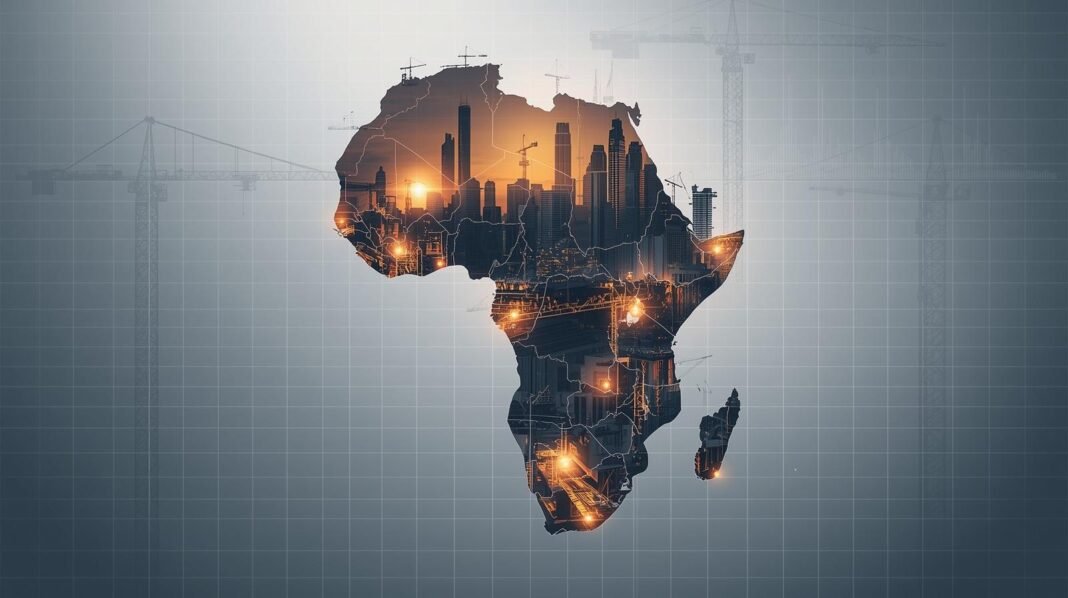
Africa stands on the precipice of an unprecedented infrastructure transformation.
With cranes dotting skylines from Nairobi to Cairo, and mega-projects reshaping the continent’s economic geography, Africa’s construction sector is experiencing growth rates that dwarf those of most developed economies.
The numbers tell a compelling story: the continent’s construction market is expanding at 7.57% annually, racing toward a valuation of $432 billion by 2033.
But behind these figures lies a more nuanced narrative—one of ambition, strategic positioning, and the race to build the foundation for Africa’s future.
Not all countries are moving at the same pace, and understanding which nations are leading this charge offers crucial insights into where Africa’s economic power will concentrate in the coming decades.
Kenya: The Runaway Leader
When it comes to construction growth velocity, Kenya has emerged as Africa’s undisputed champion. The East African nation is expanding its construction sector at a blistering 9.1% compound annual growth rate through 2030, outpacing every other country on the continent.
This isn’t merely about building more structures. Kenya’s construction boom represents a fundamental reimagining of its economic infrastructure.
The $470 billion Mombasa-Nairobi Expressway stands as Africa’s largest transport investment, a project so ambitious it rivals infrastructure undertakings anywhere in the world.
Beyond this flagship initiative, Kenya is extending commuter rail networks, developing renewable energy corridors, and pushing forward with the massive LAPSSET Corridor megaproject that will eventually connect Kenya, Ethiopia, and South Sudan.
What makes Kenya’s story particularly compelling is the foundation supporting this growth. Foreign exchange stability and judicial reforms have created an environment where long-term infrastructure investments make economic sense.
International investors and development banks are responding accordingly, channeling billions into projects that will define East Africa’s connectivity for generations.
Egypt: Size Meets Momentum
While Kenya claims the fastest growth rate, Egypt dominates by sheer scale. Commanding 37.8% of Africa’s construction market in 2024, Egypt represents more than a third of all construction activity on the continent.
This isn’t a mature market coasting on past achievements—Egypt is simultaneously the largest and one of the fastest-growing construction markets in Africa, expanding at 6.67% annually.
The New Administrative Capital, rising from the desert east of Cairo, exemplifies Egypt’s ambitions.
This isn’t urban sprawl; it’s a planned city designed to accommodate six million residents, complete with government buildings, residential districts, and a business hub that aims to position Egypt as a regional powerhouse.
Egypt’s construction vision extends far beyond new cities. The country is developing a 10-gigawatt wind farm project valued at over $10 billion, upgrading the Suez Canal infrastructure, and investing $6.9 billion in 5G infrastructure.
These projects signal Egypt’s determination to build not just for today’s needs but for the technological and energy demands of 2040 and beyond.
Rwanda: The Small Giant
Rwanda’s inclusion among Africa’s construction leaders might surprise those who equate size with significance. The country’s construction industry reached $1.3 billion in 2024 and is projected to hit $1.4 billion in 2025.
While modest in absolute terms, Rwanda’s growth trajectory reveals a nation punching well above its weight class.
The $2 billion Bugesera International Airport represents Rwanda’s ambitions perfectly. When completed, this aviation hub will transform Kigali into a regional transit point, challenging Nairobi’s and Addis Ababa’s dominance in East African air travel.
Rwanda’s industrial strategy focuses on high-value sectors like pharmaceuticals and ICT infrastructure, avoiding the low-margin industries that have limited other African nations’ development.
Rwanda’s participation in the $15 billion Northern Corridor infrastructure initiative demonstrates how smaller nations can leverage regional cooperation to access projects that would be impossible alone.
This approach—strategic positioning within larger regional frameworks—may prove to be a template for other African nations with limited domestic capital.
Ethiopia: The Infrastructure State
Contributing 21% to national GDP, Ethiopia’s construction sector has become the engine driving the country’s economic transformation. With annual growth rates exceeding 8%, Ethiopia has positioned infrastructure development as the cornerstone of its economic policy.
The $7.8 billion Bishoftu Airport and the controversial Grand Ethiopian Renaissance Dam represent Ethiopia’s willingness to pursue projects that reshape regional dynamics.
The dam alone has sparked diplomatic tensions with downstream Egypt and Sudan, yet Ethiopia has pressed forward, viewing infrastructure development as non-negotiable for achieving its development goals.
Ethiopia’s industrial park development strategy deserves particular attention. Rather than allowing construction to proceed haphazardly, the government has created designated zones where infrastructure, power, and transportation are provided upfront.
This approach has attracted international manufacturers seeking African production bases, creating a virtuous cycle where infrastructure investment attracts industry, which justifies further infrastructure investment.
Tanzania: The Steady Climber
Tanzania’s construction story lacks the headline-grabbing mega-projects of its neighbors, but this masks a steadily accelerating sector that’s becoming fundamental to East African connectivity.
With the economy projected to grow 6% in 2025, Tanzania is channeling significant resources into transport and energy infrastructure that will determine whether East Africa functions as an integrated economic region or remains a collection of isolated markets.
The standard gauge railway development connecting Tanzania’s ports with its interior and eventually with neighboring countries represents patient, strategic thinking. These projects may not generate immediate returns, but they’re establishing Tanzania as an essential node in East African trade networks.
The Regional Dynamics
East Africa’s construction industry, valued at $48.1 billion in 2024, comprises roughly one-quarter of Africa’s total construction activity and is projected to reach $73 billion by 2028.
This regional concentration reveals how infrastructure development is clustering in specific areas, potentially widening the economic gap between Africa’s infrastructure-rich and infrastructure-poor regions.
West Africa presents a different picture. Nigeria dominates, capturing 31.3% of the region’s construction value in 2024, yet this dominance reflects need as much as progress.
With a housing deficit of 22 million units and a population projected to reach 401 million by 2050, Nigeria faces infrastructure challenges of almost inconceivable scale.
Ghana’s construction sector grew at 13.8% annually from 2013 to 2021, contributing an average of 7.2% to GDP.
The country’s Agenda 111 program, building 111 hospitals nationwide, demonstrates how targeted construction programs can simultaneously address infrastructure deficits and create employment.
Cameroon’s construction sector, expanding 3.5% in 2025 with expectations of 6.3% annual growth from 2026 to 2029, benefits from substantial government commitment.
The allocation of approximately $3 billion to infrastructure in 2025, with targets to increase paved roads from 9,885 kilometers to 11,300 kilometers by 2027, shows how sustained investment can gradually transform a nation’s infrastructure base.
North Africa’s Quiet Revolution
Morocco’s approval of a $10.3 billion rail expansion in April 2025 represents one of the largest single infrastructure commitments on the continent.
The high-speed rail link to Marrakesh will connect 43 cities and 12 ports by 2030, fundamentally altering Morocco’s internal economic geography and potentially establishing it as a logistics hub between Europe and sub-Saharan Africa.
South Africa, despite being a mature market, has committed approximately $52.4 billion to infrastructure over three years, focusing on roads, bridges, dams, and ports.
This investment represents an attempt to reverse decades of infrastructure underinvestment and address bottlenecks that have constrained economic growth.
The Forces Driving Growth
Several converging trends explain why Africa’s construction sector is experiencing this moment of explosive growth.
Urbanization heads the list—Africa’s urban population is expected to double to 1.4 billion by 2050. This isn’t gradual city growth; this represents the largest urban migration in human history, requiring massive investments in housing, transportation, water systems, and energy infrastructure.
The housing deficit of 51 million affordable units across the continent creates both a humanitarian imperative and an economic opportunity. Addressing this deficit requires annual construction investments far exceeding current levels, suggesting that high growth rates could persist for decades.
Infrastructure investment needs of $130 billion to $170 billion annually dwarf current spending levels, indicating substantial room for continued expansion.
The gap between what Africa needs and what it’s building remains enormous, meaning that even rapid growth rates barely scratch the surface of required development.
The African Continental Free Trade Area implementation is spurring cross-border infrastructure projects that would have been unthinkable a decade ago.
As trade barriers fall, the economic logic for highways, railways, and ports connecting previously isolated markets becomes overwhelming.
Public-private partnerships have expanded dramatically, bringing private capital and expertise to projects traditionally funded entirely by governments.
This shift is accelerating project timelines and introducing efficiency pressures that are improving outcomes.
Digital transformation and Building Information Modeling adoption are making construction projects more efficient and reducing the waste that has historically plagued African construction.
While these technologies are still in early adoption stages, their impact is already measurable in project completion rates and cost overruns.
The Risks and Challenges
This optimistic narrative shouldn’t obscure substantial challenges. Debt sustainability concerns loom over many countries pursuing aggressive infrastructure development.
Several nations have borrowed heavily to finance construction, raising questions about whether future revenue streams will justify current expenditures.
Corruption and project mismanagement remain persistent issues. Grand infrastructure visions have historically been undermined by inflated contracts, substandard construction, and projects that serve political rather than economic purposes.
Climate change introduces uncertainty into infrastructure planning. Building roads and bridges designed for historical weather patterns may prove inadequate as rainfall patterns shift and extreme weather events become more common.
Few African construction projects adequately account for climate adaptation, potentially creating infrastructure that’s obsolete before its useful life ends.
The skills gap in construction management and engineering means many African countries lack sufficient domestic expertise to oversee complex projects effectively.
This dependency on foreign contractors, while pragmatic, can result in technology transfer failures and missed opportunities for local capacity building.
Looking Forward
Africa’s construction boom represents more than buildings and roads. These projects are literally constructing the platform upon which Africa’s economic future will be built.
The countries leading this construction race—Kenya, Egypt, Rwanda, Ethiopia, Tanzania, and others—are positioning themselves to capture disproportionate shares of the continent’s future economic growth.
As Africa’s population approaches 2.5 billion by 2050, the infrastructure decisions made today will determine which cities become regional powerhouses, which countries become manufacturing hubs, and which regions remain economically marginalized.
The construction boom isn’t merely responding to current needs; it’s creating the possibilities for what Africa can become.
For investors, policymakers, and businesses seeking to understand Africa’s trajectory, watching construction trends offers more predictive value than almost any other indicator. Infrastructure precedes economic growth, and the nations building today are the ones most likely to prosper tomorrow.
The question isn’t whether Africa’s construction boom will continue—demographic and economic forces ensure it will.
The question is whether this construction will be smart, sustainable, and equitable, building an infrastructure foundation that serves all Africans rather than a privileged few. The next decade will reveal the answer, one concrete pour and steel beam at a time.
Also Read
10 Mega Construction Projects Set to Transform Africa by 2026
Next-Gen Stadiums: Innovative Designs Shaping Africa’s Sporting Venues

