

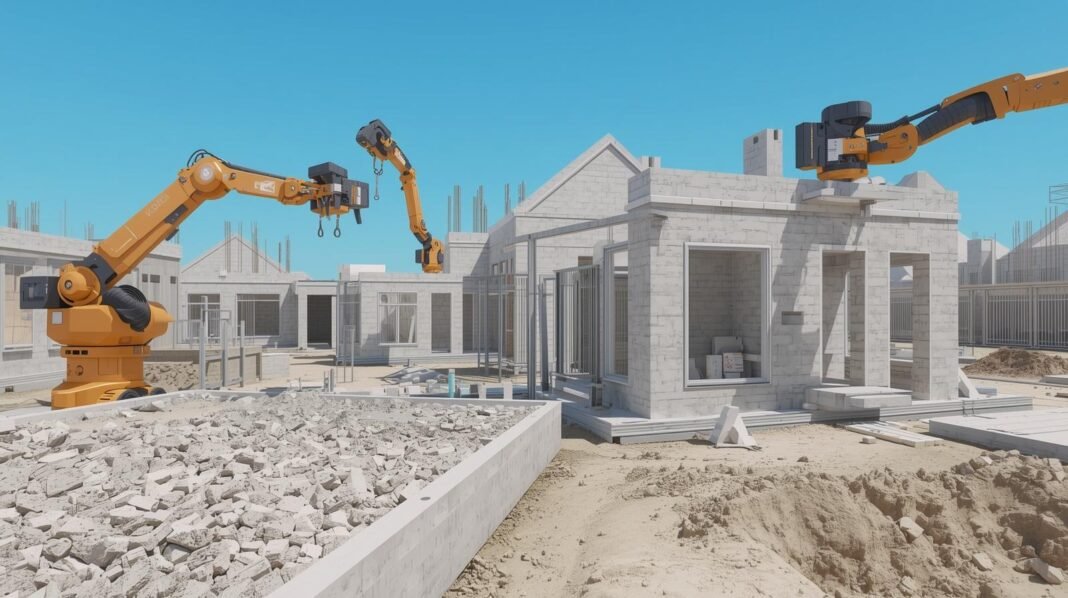
Georgetown, Texas — In a quiet development 30 miles north of Austin, a construction revolution is unfolding.
Seven massive robotic printers are methodically layering concrete to build what will become the world’s largest community of 3D-printed homes.
The Genesis Collection at Wolf Ranch represents more than just another suburban development—it’s a proving ground for technology that could fundamentally change how we build shelter.
The Vulcan: A Mobile Factory on Wheels
At the heart of this transformation is ICON’s Vulcan construction system, a purpose-built machine that reimagines the entire homebuilding process.
Measuring 46.5 feet wide and 15.5 feet tall, the Vulcan weighs nearly 5 tons yet can be rapidly transported between build sites and deployed in as little as 10 feet of lateral clearance.
Unlike desktop 3D printers that build small objects layer by layer, the Vulcan operates on an architectural scale.
The system uses a gantry-based design with a robotic arm and nozzle that traverses the build site, extruding material with precision measured in milliseconds.
The current generation can print structures up to 3,000 square feet—1.5 times larger and twice as fast as previous models.
What makes the Vulcan particularly innovative is its integration of hardware, materials, and software into a single cohesive system.
Every component has been designed from the ground up specifically for volume home construction, creating what ICON calls a “digitally-native approach to homebuilding.”
Lavacrete: Engineering a Printable Building Material
The Vulcan’s effectiveness depends entirely on ICON’s proprietary building material, Lavacrete—a specialized cement-based mixture engineered to meet the unique demands of robotic construction.
Developing a material that could be extruded through a nozzle while maintaining structural integrity presented significant technical challenges.
The mixture needed to be fluid enough to pump through hoses and extrude cleanly, yet firm enough to support subsequent layers within minutes. It also had to meet or exceed traditional building codes for strength and durability.
ICON’s material science team formulated Lavacrete as a combination of Portland cement, fillers, supplementary cementitious materials, and advanced additives.
The result is a high-strength concrete with compressive strength ranging from 2,000 to 3,500 psi. In structural testing conducted for the Wolf Ranch project, the wall system exceeded building code design requirements by more than 350 percent.
Quality control testing at Wolf Ranch has been rigorous. Material samples are extracted from the printer nozzle approximately every 2,500 to 10,000 linear feet of printing, with each home yielding 15-20 quality control samples.
The average 28-day compressive strength has exceeded 4,000 psi—double the specified design strength of 2,000 psi.
The material also demonstrates impressive interlayer bond strength, a critical property for 3D-printed structures where layers must fuse together to create a monolithic wall. Testing shows flexural bond strengths exceeding 110 psi for certain Lavacrete formulations, ensuring structural continuity throughout the printed walls.
The Magma System: Smart Material Mixing On-Site
Supporting each Vulcan printer is the Magma portable mixing unit—essentially a mobile batch plant optimized for 3D printing.
The Magma system represents a significant advance in construction logistics, eliminating the need for ready-mix concrete trucks and enabling continuous printing operations.
The Magma ingests dry Lavacrete material, hydrates it, and automatically adjusts the formula in real-time based on current site conditions including temperature, humidity, and weather.
This environmental awareness ensures consistent material properties regardless of printing conditions—a crucial capability for maintaining quality across hundreds of homes built over months or years.
Once mixed, the Magma pumps material directly to the Vulcan printer through dedicated hoses. The system is designed to maintain a continuous supply, preventing printing interruptions that could compromise structural integrity at layer boundaries.
BuildOS: The Digital Brain
Orchestrating the entire operation is BuildOS, ICON’s proprietary software platform that functions as the digital operating system for robotic construction.
BuildOS handles three critical functions: translating architectural designs into printable instructions, controlling the hardware during printing, and monitoring quality in real-time.
The software generates parametric toolpaths that define exactly how the printer will construct each wall, accounting for reinforcement placement, door and window openings, and even electrical conduit routing.
These toolpaths are optimized for speed while ensuring structural requirements are met.
During printing, BuildOS controls both the Vulcan and Magma systems with millisecond-level precision, adjusting print speed, material flow, and other parameters dynamically.
The system provides intuitive tablet-based controls that allow a small team—typically four to six people per printer—to monitor and manage the entire printing process.
Remote monitoring capabilities enable support staff to oversee multiple active print sites simultaneously, providing assistance and troubleshooting without being physically present. This scalability is essential for projects like Wolf Ranch, where seven printers operate concurrently.
The Three-Week Construction Window
At Wolf Ranch, each home’s walls are completed in approximately three weeks of printing—roughly 30 percent faster than conventional framing methods. But the speed advantage isn’t just about the printing itself.
The construction sequence has been carefully engineered to minimize delays. Each home sits on a post-tensioned concrete slab-on-ground foundation—standard for central Texas construction. Once the slab cures, the Vulcan printer is positioned and begins printing the wall system.
ICON uses a “three-bead” wall design where the printer creates parallel shells of printed material with spaces between them for reinforcement and insulation.
Each bead measures approximately three-quarters of an inch tall and two and a half inches wide. The printer stacks these beads layer by layer following predetermined paths, leaving voids called “cores” at structural locations.
After printing completes, workers install vertical reinforcing bars in the cores—typically #5 rebar spaced at six feet on center or closer at high-load locations.
These cores are then filled with additional Lavacrete to create integrated columns throughout the wall system. Horizontal reinforcement within the printed shells ties the entire structure together.
Precision and Waste Reduction
The robotic construction process delivers a level of precision difficult to achieve with traditional methods.
The Vulcan places material with extreme accuracy, creating airtight building envelopes that significantly reduce air infiltration.
Early residents at Wolf Ranch report noticeably stable interior temperatures and reduced HVAC cycling—tangible benefits of precision construction.
Material waste is dramatically reduced compared to conventional framing. Traditional wood-frame construction generates significant cut-off waste as dimensional lumber is trimmed to fit.
The Vulcan, by contrast, extrudes exactly the amount of material needed with minimal excess.
The on-site mixing capability of the Magma system means no unused concrete returning to a batch plant.
Structural Performance Beyond Code
The Genesis Collection homes underwent extensive structural testing to verify performance. Full-scale wall specimens were tested for axial capacity, out-of-plane flexural capacity, and in-plane shear capacity following ASTM E72 standards for building construction panels.
The results exceeded expectations. The wall system demonstrated structural capacity well above minimum code requirements, with the ability to resist hurricane-force winds, seismic loads, and other extreme conditions.
The printed walls are resistant to water intrusion, mold growth, termites, and fire damage—durability advantages inherent in the concrete construction method.
Beyond Wolf Ranch: Scaling the Technology
The Wolf Ranch project serves as proof that 3D-printed construction can scale from demonstration projects to production homebuilding.
Seven Vulcan printers working simultaneously have produced more than 100 homes—far more than any previous 3D printing construction project.
This scale has enabled ICON to refine its processes and establish production workflows that can be replicated at other developments.
The company has developed standard operating procedures for site preparation, printer deployment, quality control, and finishing work. These procedures are being codified into documentation that will enable future projects to launch more quickly.
The success at Wolf Ranch has caught the attention of developers, builders, and policymakers worldwide.
Housing affordability challenges, labor shortages, and sustainability concerns are driving interest in construction technologies that can deliver better homes faster and with less environmental impact.
Integration with Traditional Methods
While the walls are 3D-printed, the Genesis Collection homes integrate robotic construction with conventional methods where appropriate.
After wall printing completes, traditional construction crews install wood top plates and rim beams, attach roof trusses, and complete interior and exterior finishes.
This hybrid approach leverages the strengths of each method: robotic precision and efficiency for the structural envelope, and proven techniques for elements where automation hasn’t yet shown clear advantages.
All homes feature standing seam metal roofs, energy-efficient windows, and modern interior finishes indistinguishable from conventionally-built homes.
The Labor Question
One concern frequently raised about construction automation is workforce displacement. At Wolf Ranch, ICON has found that while fewer workers are needed per home, the workers present require different skill sets.
Each printer is attended by a small crew trained to operate the Vulcan system, monitor print quality, place reinforcement, and troubleshoot issues.
These roles combine elements of traditional construction with robotic operation and quality assurance. As printing wraps up, conventional trades take over for finishing work.
Rather than eliminating construction jobs, the technology appears to be shifting them toward higher-skilled positions while addressing chronic labor shortages in the residential construction industry.
The quiet, methodical nature of robotic printing also creates a safer, less physically demanding work environment compared to traditional framing crews.
Energy Performance and Sustainability
Every Genesis Collection home includes rooftop solar panels as standard equipment, but the sustainability benefits extend deeper. The printed walls’ superior air sealing reduces heating and cooling loads significantly.
Early monitoring data suggests HVAC energy consumption running 20-30 percent below comparable conventionally-built homes in the area.
The thermal mass of the concrete walls provides passive temperature stabilization, moderating interior temperatures and reducing peak heating and cooling demands.
During Texas summers, residents report that even when air conditioning systems aren’t running at full capacity, interior spaces remain comfortable.
Construction waste reduction represents another sustainability benefit. The precision of robotic printing and on-site material mixing eliminates the job-site waste typical of conventional construction. There are no lumber scraps, no drywall cut-offs, no unused concrete to dispose of.
Regulatory Path: Proving the System
Gaining building department approval for such a novel construction system required extensive documentation. ICON worked closely with the Authority Having Jurisdiction (AHJ) in Georgetown to demonstrate compliance with the 2021 International Residential Code.
The company provided comprehensive material testing data, structural analysis, and quality control procedures.
Independent third-party laboratories verified material properties and structural capacity. Special inspection protocols were established to ensure quality throughout construction.
This regulatory pathway has been documented in evaluation reports that future projects can reference, streamlining the approval process for subsequent 3D-printed developments.
What’s Next: Phoenix and Multi-Story Printing
Even as Wolf Ranch nears completion, ICON is developing next-generation technology. The company has announced its Phoenix printer—a new system capable of constructing entire buildings including roofs and foundations, expanding design possibilities beyond single-story homes.
The recently introduced Titan system represents another leap forward: the world’s first multi-story construction 3D printer.
Titan can print structures within a 70-foot radius and requires minimal lateral clearance for deployment, making it viable for dense urban construction sites.
The Bigger Picture
The Genesis Collection at Wolf Ranch may be remembered as a watershed moment in construction history—the point when robotic homebuilding moved from novelty to production reality.
The project demonstrates that 3D printing technology can deliver homes faster, with less waste, and with performance characteristics superior to conventional construction.
For an industry that has seen relatively little fundamental innovation in decades, the implications are profound.
As ICON co-founder Jason Ballard noted during the project launch, “For the first time in the history of the world, what we’re witnessing here is a fleet of robots building an entire community of homes.”
Whether this technology becomes widespread or remains a niche solution depends on numerous factors: continued cost reduction, workforce development, regulatory streamlining, and market acceptance.
But for the families moving into 3D-printed homes at Wolf Ranch, the future of construction has already arrived.
The Genesis Collection at Wolf Ranch is a collaboration between ICON, Lennar Corporation, and architectural firm BIG-Bjarke Ingels Group. Homes range from 1,574 to 2,112 square feet with pricing starting at $469,990. The development is located in Georgetown, Texas, approximately 30 miles north of Austin.
Also Read
US Construction Begins Race to Find 456,000 Workers by 2027
US Building Codes and Regulations Every Contractor Should Know

- From Operator to Algorithm: Bedrock Puts Autonomous Excavators to Work on Live Construction Sites - September 7, 2026
- Built For The Rough Stuff: Inside Titan’s new ForestEDGE™ Tyre Line - September 4, 2026
- South Africa Has R395 Billion in Infrastructure Projects — But Can the Industry Deliver Them? - August 26, 2026
