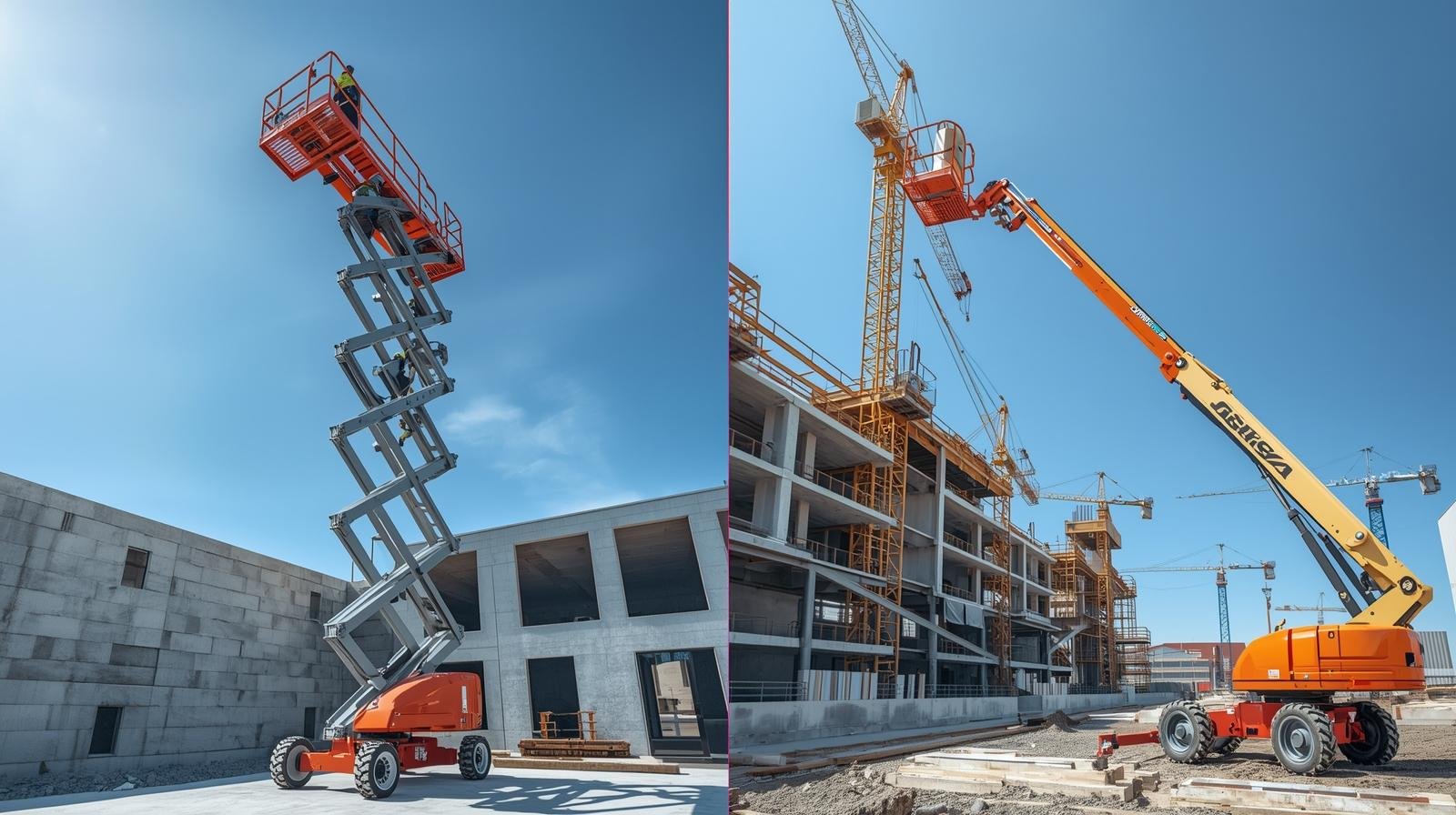
Aerial work platforms have revolutionized how construction professionals approach elevated tasks, replacing traditional scaffolding with faster, safer, and more efficient solutions.
Among these essential machines, scissor lifts and boom lifts stand as the two dominant categories, each engineered for specific operational requirements.
Understanding the scissor lift vs boom lift comparison is critical for contractors, equipment buyers, and project managers making procurement or rental decisions.
While both platforms elevate workers and materials to height, their mechanical designs, reach capabilities, and ideal applications differ significantly. Choosing the wrong equipment can result in project delays, budget overruns, and compromised safety standards.
This comprehensive guide examines the technical specifications, operational advantages, and real-world applications of both lift types to help construction professionals make informed equipment decisions.
What Is a Scissor Lift?
A scissor lift is a mobile elevated work platform that achieves vertical lift through a crisscrossing, accordion-style mechanism of linked supports.
Hydraulic, pneumatic, or mechanical systems power the scissor arms, extending and retracting to raise and lower the platform in a strictly vertical motion.
Working Mechanism and Specifications
The scissor mechanism consists of interlocking supports arranged in an X-pattern. As hydraulic cylinders compress or extend, these supports fold or unfold, creating vertical movement.
This design inherently limits the platform to moving straight up and down, with minimal horizontal deviation from the base position.
Typical Working Heights:
- Compact models: 10-19 feet
- Mid-range units: 20-32 feet
- Large industrial scissor lifts: 33-50+ feet
Load Capacity:
- Standard platforms: 500-1,000 lbs
- Heavy-duty models: 1,500-2,500 lbs
- Specialized units can exceed 3,000 lbs
Common Applications
Scissor lifts excel in environments requiring stable, vertical elevation with substantial platform space.
Construction teams deploy these machines for interior finishing work, electrical installations, HVAC system maintenance, and warehouse operations. The generous platform dimensions accommodate multiple workers, tools, and materials simultaneously.
Industries frequently utilizing scissor lifts include commercial construction, facility maintenance, retail store installations, manufacturing plants, and entertainment venues for lighting and rigging work.
What Is a Boom Lift
A boom lift, also called an aerial boom or cherry picker, features a hydraulic arm (boom) mounted on a grounded base, with a bucket or platform at the elevated end. Unlike scissor lifts, boom lifts provide both vertical and horizontal reach, accessing areas far beyond the machine’s footprint.
Types of Boom Lifts
Articulating Boom Lifts: These feature multiple boom sections connected by joints, allowing the arm to bend around obstacles. The articulated design navigates over buildings, under structures, and around barriers, making them ideal for complex jobsites with restricted access points.
Telescopic Boom Lifts: Also called stick booms, these extend in a straight line for maximum outward and upward reach. Telescopic models achieve greater heights and horizontal distances than articulating versions but sacrifice maneuverability around obstacles.
Reach Capabilities
Vertical Reach:
- Compact models: 30-40 feet
- Standard units: 40-80 feet
- Large telescopic booms: 80-185+ feet
Horizontal Reach:
- Articulating booms: 20-60 feet outward
- Telescopic booms: 40-80+ feet outward
Platform Capacity: Most boom lift buckets accommodate 500 lbs, with some heavy-duty models rated for 750-1,000 lbs.
Common Applications
Boom lifts dominate outdoor construction projects, utility maintenance, high-rise building work, and industrial facilities requiring horizontal reach.
Construction teams use them for exterior cladding installation, window washing on tall structures, bridge inspection and repair, telecommunications tower maintenance, and tree trimming in arboriculture.
The superior reach makes boom lifts indispensable for projects where workers must access elevated positions away from the base location.
Key Differences: Scissor Lift vs Boom Lift
| Feature | Scissor Lift | Boom Lift |
|---|---|---|
| Movement | Vertical only | Vertical and horizontal |
| Maximum Height | 10-50 feet (most models) | 30-185+ feet |
| Horizontal Reach | Minimal (directly above base) | 20-80+ feet from base |
| Platform Size | Large (up to 15′ x 6′) | Small bucket (3-4 feet diameter) |
| Load Capacity | 500-3,000+ lbs | 500-1,000 lbs |
| Maneuverability | Excellent in tight spaces | Requires more clearance |
| Terrain Capability | Smooth, level surfaces | Rough terrain models available |
| Indoor/Outdoor | Primarily indoor (electric models) | Primarily outdoor (diesel/gas) |
| Typical Rental Cost | $100-200/day | $200-400/day |
| Operator Training | Basic certification | Advanced certification required |
| Stability | Highly stable platform | Requires outriggers on some models |
Vertical vs Horizontal Reach
Scissor lifts move exclusively upward, keeping workers directly above the base. This vertical-only movement limits access to areas requiring lateral positioning.
Boom lifts extend both up and out, with articulating models reaching over obstacles and telescopic versions stretching to distant elevated points.
Working Height
While scissor lifts typically max out at 50 feet for standard construction models, boom lifts routinely reach 80-100 feet, with specialty telescopic units exceeding 180 feet. Projects involving mid-rise or high-rise structures necessitate boom lift capabilities.
Maneuverability
Scissor lifts offer superior maneuverability in confined spaces due to compact base dimensions and tight turning radiuses.
Electric models navigate narrow warehouse aisles and congested job sites efficiently. Boom lifts require larger operating envelopes, particularly when extending the boom, making them less suitable for crowded indoor environments.
Terrain Capability
Standard scissor lifts operate on smooth, level concrete or asphalt. Rough terrain scissor lifts exist but remain less common.
Conversely, rough terrain boom lifts feature larger tires, four-wheel drive, and enhanced suspension systems, handling gravel, dirt, slopes, and uneven outdoor surfaces effectively.
Indoor vs Outdoor Use
Electric scissor lifts dominate indoor applications, producing zero emissions, quieter operation, and non-marking tires suitable for finished floors. Diesel or gas-powered boom lifts excel outdoors where emissions are dissipated and greater power supports extended reach and rough terrain navigation.
Cost Considerations
Scissor lift rentals typically cost 30-50% less than boom lifts, reflecting simpler mechanical systems and more limited capabilities. Purchase prices follow similar patterns, with new scissor lifts ranging $10,000-$50,000 and boom lifts starting at $50,000 and exceeding $200,000 for large telescopic models.
Pros and Cons of Each Lift Type
Scissor Lift Advantages
Stability and Platform Size: The wide, stable platform accommodates multiple workers and substantial material loads. This design minimizes worker fatigue during extended elevated tasks.
Cost Efficiency: Lower rental and purchase prices make scissor lifts accessible for budget-conscious projects and small contractors.
Ease of Operation: Simplified controls reduce training time. Many jurisdictions require only basic aerial lift certification rather than specialized credentials.
Indoor Performance: Electric models operate quietly without emissions, preserving indoor air quality and meeting OSHA indoor equipment standards.
Higher Load Capacity: Platforms supporting 1,500-2,500 lbs enable teams to transport more tools and materials in single trips.
Scissor Lift Limitations
No Horizontal Reach: Workers can only access areas directly above the machine’s footprint, requiring frequent repositioning.
Height Restrictions: Maximum elevations of 50 feet exclude scissor lifts from high-rise construction and tall structure maintenance.
Terrain Sensitivity: Most models require level, solid ground. Uneven surfaces compromise stability and create tip-over hazards.
Limited Outdoor Versatility: Electric scissor lifts struggle on jobsites lacking power sources or featuring rough ground conditions.
Boom Lift Advantages
Superior Reach: Both vertical and horizontal extension accesses remote elevated locations without repositioning the base unit.
Obstacle Navigation: Articulating booms maneuver around buildings, under structures, and through complex architectural features.
Extreme Heights: Telescopic booms reach elevations inaccessible to scissor lifts, serving high-rise and industrial applications.
Rough Terrain Capability: Four-wheel-drive models traverse jobsites with poor ground conditions, mud, gravel, and slopes.
Outdoor Versatility: Diesel and gas engines provide power independent of electrical infrastructure.
Boom Lift Limitations
Higher Costs: Rental rates and purchase prices significantly exceed scissor lift equivalents, impacting project budgets.
Complex Operation: Advanced controls and reach capabilities require comprehensive operator training and often specialized certification.
Smaller Platform: Buckets accommodate fewer workers and minimal material loads compared to scissor lift platforms.
Indoor Restrictions: Engine emissions prevent diesel/gas boom lifts from operating in enclosed spaces without extensive ventilation.
Stability Concerns: Extended booms create tip-over risks, requiring outrigger deployment and careful load management.
How to Choose the Right Lift for Your Project
Assess Height and Reach Requirements
Calculate maximum working heights for your specific tasks. Projects under 40 feet with vertical-only access favor scissor lifts.
Work exceeding 40 feet or requiring horizontal reach beyond 5-10 feet from the base necessitates boom lift capabilities.
Evaluate Terrain and Space Constraints
Examine ground conditions at your worksite. Smooth concrete floors in warehouses or commercial buildings suit electric scissor lifts.
Outdoor construction sites with dirt, gravel, or slopes require rough terrain boom lifts. Confined indoor spaces with narrow aisles demand compact scissor lift dimensions.
Consider Indoor vs Outdoor Environment
Indoor projects mandate zero-emission electric equipment. Outdoor jobsites accommodate diesel or gas-powered machines with greater power and rough terrain capabilities.
Some hybrid models offer flexibility for mixed indoor/outdoor applications.
Analyze Budget Parameters
Compare rental costs for project duration. Short-term indoor finishing work benefits from affordable scissor lift rentals.
Extended outdoor projects may justify boom lift expenses when horizontal reach eliminates scaffolding costs and repositioning delays.
Safety and Regulatory Compliance
Review OSHA standards, local regulations, and project-specific safety requirements. Some jurisdictions mandate specific operator certifications for boom lifts.
Union worksites may have contractual equipment and training stipulations. Insurance coverage often varies between lift types, affecting liability costs.
Load and Personnel Requirements
Determine how many workers and how much material must be elevated simultaneously. Teams of 2-3 workers with substantial tools favor scissor lift platform capacity.
Single-operator tasks requiring minimal materials suit boom lift buckets.
Safety Considerations
Operator Certification
OSHA requires aerial lift operators to receive employer-provided training specific to equipment types.
Many states mandate third-party certification programs. Boom lift operation typically demands more comprehensive training than scissor lift certification due to complex controls and tip-over risks.
Load Limits
Never exceed manufacturer-specified platform capacity, including combined weight of workers, tools, and materials.
Overloading causes structural failure and tip-over incidents. Account for uneven weight distribution on platforms when positioning personnel and equipment.
Ground Stability
Inspect work surfaces before deploying lifts. Soft soil, slopes exceeding manufacturer specifications, and underground voids create instability. Use outriggers on boom lifts when required. Deploy stabilization pads to distribute weight on marginal surfaces.
Fall Protection Requirements
OSHA mandates fall protection for all aerial lift operators. This typically requires full-body harnesses attached to designated platform anchor points rather than boom structures.
Guardrails must remain in place and functional. Never sit, stand, or climb on platform guardrails to gain additional height.
Pre-Operation Inspections
Conduct daily visual inspections covering hydraulic systems, tire condition, controls functionality, safety devices, and structural integrity.
Document inspections per OSHA recordkeeping requirements. Remove damaged equipment from service immediately.
Environmental Hazards
Maintain clearance from overhead power lines—OSHA mandates minimum distances based on voltage. Check weather conditions; high winds prohibit aerial lift operation. Ensure adequate lighting for nighttime work.
Barricade ground-level perimeters to prevent pedestrian injuries from moving equipment.
Market Trends and Innovations
Electric and Hybrid Lift Growth
Environmental regulations and indoor air quality concerns drive electric scissor lift and boom lift adoption.
Manufacturers now offer electric rough terrain scissors and electric articulating booms, expanding zero-emission equipment into applications traditionally dominated by diesel machines.
Hybrid boom lifts combine electric operation for indoor work with diesel backup for outdoor environments.
Rental Market Expansion
The aerial work platform rental market continues robust growth, projected to exceed $12 billion globally by 2028.
Construction companies increasingly favor rental over ownership to minimize capital expenditures, access latest technologies, and eliminate maintenance overhead.
Rental companies respond with expanded fleets, online reservation systems, and delivery logistics optimization.
Telematics and Smart Monitoring
Advanced fleet management systems track equipment location, utilization rates, maintenance schedules, and operator behavior.
Telematics reduce theft, optimize rental fleet allocation, and provide predictive maintenance alerts preventing breakdowns.
Some systems monitor load weights, boom angles, and operating parameters, triggering warnings when operators approach safety limits.
Lightweight Materials and Design
Manufacturers incorporate high-strength aluminum and composite materials, reducing equipment weight while maintaining load capacities.
Lighter lifts decrease ground pressure, expand suitable operating surfaces, and reduce transportation costs. Some compact models now fit through standard doorways and elevators for multi-floor building access.
Sustainability and Emission Regulations
California and European emission standards push diesel equipment toward cleaner Tier 4 Final and Stage V engines.
Some jurisdictions prohibit diesel equipment in urban centers, accelerating electric adoption.
Manufacturers invest in battery technology extending electric lift runtime and reducing charging frequency.
Leading Scissor and Boom Lift Manufacturers
Understanding major industry manufacturers helps contractors source quality equipment and attracts potential advertisers and sponsors to industry publications.
Genie (Terex Corporation): Market leader offering comprehensive scissor and boom lift lines, known for Z-boom articulating models and GS scissor series. Strong rental market presence.
JLG Industries: Major competitor with extensive product range including ultra-boom telescopic lifts, articulating booms, and electric scissors. Pioneer in hybrid technology.
Skyjack: Canadian manufacturer focusing on simplified, reliable designs. Strong reputation for electric scissors and compact articulating booms.
Haulotte Group: European leader expanding globally, known for compact scissors and innovative articulating booms with advanced safety features.
Snorkel (Ahern Rentals): Specializes in electric scissors and articulating booms with competitive pricing. Growing market share in North America.
Manitou Group: French manufacturer offering rough terrain scissors and rotating telescopic booms for specialized applications.
Emerging Players: Chinese manufacturers including Dingli, Sinoboom, and Runshare gain market share with cost-competitive models meeting international safety standards, disrupting traditional pricing structures.
Conclusion
The scissor lift vs boom lift decision fundamentally depends on project-specific reach requirements, site conditions, and budget parameters.
Scissor lifts deliver cost-effective, stable vertical access for indoor projects, warehouse operations, and tasks requiring substantial platform capacity.
Boom lifts provide essential horizontal reach and extreme heights for outdoor construction, utility work, and high-rise applications.
Construction professionals should prioritize detailed site assessments, accurate height calculations, and terrain evaluations when selecting aerial work platforms. The equipment choice directly impacts project timelines, labor productivity, and safety outcomes.
For contractors working primarily on interior finishing, facility maintenance, or projects under 40 feet, electric scissor lifts offer optimal value.
Teams tackling exterior envelope work, infrastructure projects, or applications exceeding 50 feet should invest in appropriate boom lift capabilities despite higher costs.
As industry trends favor electric equipment and smart monitoring technologies, forward-thinking contractors can achieve competitive advantages through strategic equipment selection aligned with evolving regulatory landscapes and customer expectations.
Frequently Asked Questions
Q: Can scissor lifts be used outdoors?
A: Yes, rough terrain scissor lifts with diesel or gas engines operate outdoors on uneven surfaces. However, standard electric scissors work best indoors on smooth, level floors.
Outdoor applications requiring significant horizontal reach still favor boom lifts over rough terrain scissors.
Q: What is the typical rental cost difference between scissor lifts and boom lifts?
A: Scissor lifts typically rent for $100-200 per day depending on size, while boom lifts cost $200-400+ daily. Weekly and monthly rates offer better value, with scissors averaging $400-800/week and booms $800-1,500/week. Prices vary by location, model specifications, and rental company.
Q: Do I need special certification to operate a boom lift?
A: OSHA requires employer-provided training for all aerial lift operators. While no federal certification mandate exists, many states and insurance providers require third-party certification. Boom lifts demand more comprehensive training than scissors due to complex controls and greater tip-over risks.
Q: Which lift type is safer for construction work?
A: Both equipment types are safe when operated properly within manufacturer specifications. Scissor lifts offer inherent stability advantages with wider bases and vertical-only movement. Boom lifts introduce additional risks from extended reach and tip-over potential but enable safer access to difficult locations versus ladders or scaffolding.
Q: Can boom lifts work in confined spaces?
A: Compact articulating boom lifts navigate some confined areas, but scissor lifts generally excel in tight spaces. Boom lifts require clearance for boom extension and rotation. Always verify overhead clearances, aisle widths, and turning radiuses before selecting equipment for restricted environments.
Also Read
Mobile & Modular Batching Plants: The Future of On-Site Concrete Production
New vs Used Heavy-Duty Trucks: What Works Best in Africa?

- SODECA Highlights Industrial Ventilation Technology at Mega Clima Expo Kenya 2026 - October 14, 2026
- How They Were Built: Inside the Engineering of the Lesotho Highlands Water Project - October 11, 2026
- Africa’s Water Reuse Opportunity: Building the Infrastructure for a Water-Secure Future - September 28, 2026