

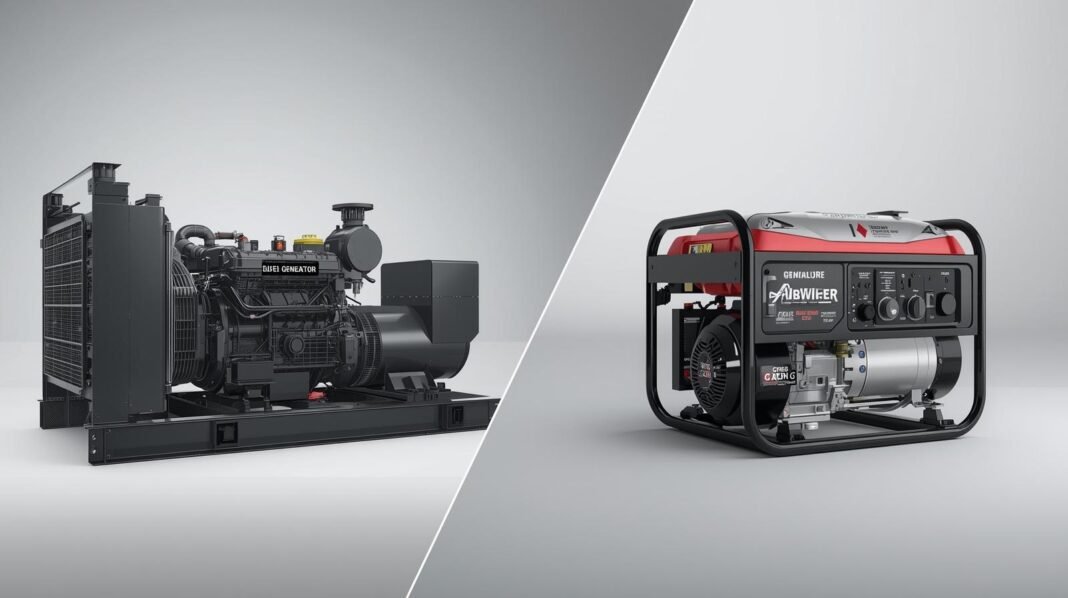
For decades, diesel generators dominated industrial power generation. Their rugged reliability, high power density, and fuel availability made them the default choice for construction sites, mines, factories, and remote operations worldwide.
But that dominance is being challenged.
Rising fuel costs, tightening emissions regulations, and mounting ESG pressure are forcing industries to reconsider their power strategies.
In Europe, Stage V emission standards have effectively banned older diesel gensets from urban areas. In the United States, Tier 4 Final regulations have pushed diesel technology to its technical limits.
Meanwhile, natural gas prices have stabilized in many markets, LNG infrastructure has expanded globally, and manufacturers are rolling out hydrogen-ready gas engines.
The result? A fundamental shift in how industries approach backup and prime power. Gas generators, once relegated to niche applications, are gaining ground in manufacturing plants, data centers, and even construction sites.
Hybrid systems combining gas engines with battery storage are emerging as serious contenders in mining camps and microgrids. The question is no longer whether to consider alternatives to diesel—it’s which alternative makes the most sense for your operation.
Emissions Comparison: CO₂, NOx, and Particulate Matter
The environmental case against diesel is straightforward: combustion produces significant levels of carbon dioxide, nitrogen oxides, and particulate matter. Gas generators offer measurable improvements across all three categories.
Carbon Dioxide Emissions
Natural gas generates approximately 117 pounds of CO₂ per million BTU of energy, compared to 161 pounds for diesel fuel—roughly 27% less carbon intensity.
When translated to electrical generation, gas generators typically produce 40-50% less CO₂ per kWh than their diesel counterparts, depending on engine efficiency and load factors.
Nitrogen Oxides (NOx)
NOx emissions represent one of diesel’s most significant environmental challenges.
Modern Tier 4 Final diesel generators use selective catalytic reduction (SCR) and diesel exhaust fluid (DEF) to reduce NOx, but baseline emissions remain high. Gas generators produce 80-90% less NOx than diesel units, even before aftertreatment.
For urban and near-urban installations, this difference can determine whether a permit is granted or denied.
Particulate Matter
Diesel combustion inherently produces soot and particulate matter—microscopic particles linked to respiratory disease and environmental damage.
Gas combustion produces virtually no particulate emissions.
This eliminates the need for diesel particulate filters (DPF), reducing maintenance complexity and avoiding the regeneration cycles that plague diesel systems in low-load applications.
| Emission Type | Diesel Generator | Gas Generator | Reduction |
|---|---|---|---|
| CO₂ (g/kWh) | 650-750 | 400-500 | 40-50% |
| NOx (g/kWh) | 4.0-8.0 (pre-SCR) | 0.5-1.0 | 80-90% |
| Particulate Matter (g/kWh) | 0.1-0.3 | <0.01 | >95% |
| SOx (g/kWh) | 0.3-0.6 | <0.01 | >95% |
Regulatory Landscape
The EPA’s Tier 4 Final standards and Europe’s Stage V regulations have forced diesel manufacturers to add complex emissions control systems—SCR, DPF, exhaust gas recirculation (EGR)—that increase capital costs and maintenance requirements.
Gas engines meet these standards with simpler three-way catalytic converters or lean-burn technology. As carbon pricing mechanisms expand globally, the emissions advantage of gas will translate directly into operating cost savings.
Fuel Cost Trends and Operating Economics
Fuel represents the largest operational expense for generator fleets. Over a typical 20-year asset life, fuel costs can exceed capital costs by a factor of five to ten, depending on runtime.
Understanding fuel price dynamics is critical to making informed generator investments.
Price Volatility and Stability
Diesel prices have experienced significant volatility over the past decade, driven by crude oil markets, refining capacity constraints, and geopolitical events.
Between 2020 and 2024, industrial diesel prices in major markets fluctuated between $2.50 and $5.50 per gallon—a 120% range that makes budgeting and long-term planning challenging.
Natural gas prices show greater regional variation but generally exhibit lower volatility in established markets.
In the United States, Henry Hub natural gas averaged $2-4 per MMBtu over the same period.
In markets with LNG import infrastructure, prices have remained competitive with diesel on an energy-equivalent basis.
Cost Per kWh Analysis
Fuel costs per kWh depend on three factors: fuel price, fuel consumption rate, and engine efficiency. Modern diesel generators typically consume 0.25-0.30 gallons per kWh at rated load. Gas generators consume 7-9 cubic feet of natural gas per kWh (approximately 7,000-9,000 BTU/kWh).
At typical industrial fuel prices—$3.50/gallon for diesel and $6.00/MCF for natural gas—diesel gensets produce power at $0.875-1.05 per kWh in fuel costs alone.
Gas generators produce power at $0.42-0.54 per kWh.
Even accounting for higher capital costs, gas generators deliver lower total cost of ownership in most prime power applications exceeding 3,000 operating hours annually.
Case Study: Mining Operation in Nevada
A gold mining operation replaced four 500 kW diesel generators with two 1 MW gas generators supplied by pipeline gas.
The operation runs 7,000 hours annually in prime power mode. Annual fuel savings exceeded $1.2 million, with payback on the additional capital investment achieved in 18 months.
Maintenance costs dropped by 35% due to longer service intervals and elimination of DPF regeneration downtime.
LNG and Remote Applications
For remote sites without pipeline access, LNG offers a viable alternative. Modern cryogenic storage and regasification systems make LNG practical for operations from 100 kW to 10 MW.
LNG delivered to remote Australian mine sites costs approximately $12-15/MMBtu—higher than pipeline gas but still competitive with diesel when total cost of ownership is considered.
Total Cost of Ownership Framework
| Cost Component | Diesel | Pipeline Gas | LNG |
|---|---|---|---|
| Capital Cost ($/kW) | $800-1,200 | $1,000-1,500 | $1,200-1,800 |
| Fuel Cost ($/kWh) | $0.90-1.10 | $0.40-0.55 | $0.65-0.85 |
| Maintenance ($/kWh) | $0.020-0.030 | $0.012-0.018 | $0.015-0.022 |
| Emissions Compliance | Rising | Stable | Stable |
For operations exceeding 4,000 hours annually, gas generators typically deliver 20-30% lower TCO than diesel over a 15-year lifecycle.
Maintenance and Reliability Differences
Reliability defines generator value in critical applications. A genset that fails during a grid outage or production shift can cost millions in lost revenue.
Understanding the maintenance and reliability tradeoffs between diesel and gas engines is essential.
Engine Wear and Service Intervals
Diesel engines operate through compression ignition at high cylinder pressures (2,000+ psi), which creates mechanical stress on components.
Oil becomes contaminated with soot, requiring changes every 250-500 hours in prime power applications.
Diesel particulate filters require regeneration cycles that consume fuel and create thermal stress.
Turbochargers, injectors, and high-pressure fuel pumps represent additional maintenance-intensive components.
Gas engines use spark ignition at lower compression ratios, reducing mechanical stress. Oil change intervals typically extend to 500-1,000 hours, and some lean-burn gas engines achieve 1,500-2,000 hour intervals with synthetic lubricants.
Gas combustion produces minimal carbon deposits, extending valve and piston life. The absence of DPF systems eliminates regeneration-related failures.
Maintenance Cost Comparison
Industry data suggests gas generators incur 30-40% lower maintenance costs per operating hour than diesel generators in prime power service.
Standby applications show less dramatic differences, but gas still maintains an advantage due to longer service intervals and fewer emissions-related components.
A 1 MW diesel genset operating 5,000 hours annually typically incurs $15,000-20,000 in maintenance costs (oil, filters, DEF, scheduled component replacement). An equivalent gas genset incurs $10,000-13,000 for the same runtime.
Reliability in Harsh Environments
Diesel’s reputation for rugged reliability is well-earned. Diesel fuel is less flammable than gasoline, and compression ignition eliminates spark plug fouling—common issues in dusty, humid, or extreme temperature environments.
Diesel generators routinely operate in deserts, arctic conditions, and offshore platforms.
Gas generators have historically been perceived as less robust, but modern industrial gas engines have closed this gap.
Three-way catalytic converters are simpler and more durable than SCR/DPF systems. Spark plugs remain a vulnerability in contaminated environments but represent a minor maintenance item compared to diesel injector or DPF failures.
In offshore and marine applications, diesel retains advantages due to fuel handling safety.
Downtime and Parts Availability
Diesel generators benefit from decades of global infrastructure development. Parts are available in virtually every market.
Gas generator parts availability has improved dramatically but remains less universal, particularly for specialized components like turbochargers and catalytic converters in emerging markets.
Hybrid Integration Benefits
Hybrid systems pairing generators with battery storage reduce generator run hours by 30-50%, extending maintenance intervals and component life for both diesel and gas units. This shift is particularly valuable for applications with variable loads or daily cycling.
Performance and Power Output Comparison
Generator performance encompasses multiple factors beyond nameplate capacity. Load response, power density, efficiency curves, and operating envelope all influence real-world suitability.
Power Density
Diesel engines deliver higher power density than gas engines—approximately 20-30% more output per liter of displacement.
This translates to smaller, lighter packages for mobile and space-constrained applications. A 500 kW diesel genset occupies roughly 70-80% of the footprint of an equivalent gas unit.
For permanent installations where space is not constrained, this advantage matters less. For rental fleets, emergency response equipment, and construction sites, diesel’s compactness remains valuable.
Load Response and Transient Performance
Diesel generators excel at handling sudden load steps. The high torque characteristics of diesel combustion allow rapid acceleration to full load without voltage sag or frequency deviation.
Gas generators, particularly lean-burn designs optimized for emissions, may require 3-5 seconds to stabilize when hit with a 100% load step.
For applications with motor starting or other high-inrush loads, diesel maintains performance advantages.
Modern gas gensets with improved controls and governors have narrowed this gap but cannot match diesel’s instantaneous response.
Efficiency Across Load Range
Both diesel and gas generators achieve peak efficiency at 70-85% rated load. Diesel maintains relatively flat efficiency from 50-100% load.
Gas engines, particularly stoichiometric designs with three-way catalysts, show steeper efficiency degradation at light loads.
For standby applications that run infrequently at variable loads, diesel’s broader efficiency curve offers advantages. For prime power applications operating near rated capacity, gas efficiency equals or exceeds diesel.
Prime Power vs Standby Service
Gas generators thrive in prime power applications with continuous or near-continuous operation: combined heat and power (CHP) installations, industrial cogeneration, data centers, and manufacturing facilities.
The fuel cost advantage, lower maintenance intervals, and emissions benefits compound with runtime.
Diesel excels in standby and emergency applications: hospitals, telecommunications sites, water treatment plants. The fuel stability, long storage life, and rapid start capability make diesel ideal for infrequent but critical operation.
Hybrid Generator Performance
Hybrid systems combine the strengths of both technologies with battery storage. The generator operates in its optimal efficiency range while batteries handle transient loads and peak shaving.
Runtime decreases by 30-50%, maintenance intervals extend proportionally, and emissions drop. Hybrid systems represent the future for variable-load applications.
Use Cases: Where Each Generator Type Wins
Selecting the right generator technology requires matching capabilities to operational requirements. Different industries and applications favor different solutions.
Diesel Dominates: Remote and High-Load Industrial
Remote mine sites, offshore platforms, and construction projects in areas without gas infrastructure rely on diesel.
Fuel logistics favor diesel’s energy density—10,000 BTU per pound versus 1,000 BTU per pound for compressed gas. A single fuel truck delivers meaningful runtime.
Pipeline gas isn’t an option, and LNG infrastructure requires capital investment that only makes sense for multi-year operations.
Heavy industrial applications with high load factors also favor diesel. Cement plants, large-scale mining operations, and oil field services run generators at 80-100% capacity continuously.
Diesel’s power density allows smaller generator packages, and the efficiency advantage of gas narrows at sustained high loads.
Gas Wins: Urban Manufacturing and ESG-Driven Operations
Manufacturing plants in urban and suburban locations increasingly choose gas for environmental compliance. NOx and particulate limits effectively ban diesel from many jurisdictions. Pipeline gas availability and stable pricing make operating economics favorable.
Data centers represent a growing market for gas generators. Reliability requirements demand on-site generation, runtime hours justify gas economics, and corporate ESG commitments favor lower emissions. Major cloud providers have standardized on gas for new facilities.
Food and beverage processing, pharmaceutical manufacturing, and other industries with cogeneration opportunities favor gas.
Waste heat recovery for process heating or cooling can achieve overall system efficiencies exceeding 80%, impossible with diesel.
Hybrid Systems: Construction, Mining Camps, and Microgrids
Hybrid systems combining generators (diesel or gas) with battery storage and often solar PV are transforming temporary and remote power. Construction sites reduce generator runtime by 50-70%, cutting fuel costs and noise.
Mining camps achieve similar savings while improving power quality.
Microgrids serving island communities, remote facilities, or resilience-critical infrastructure increasingly adopt hybrid architectures.
The generator provides firm capacity, batteries handle transient loads and frequency regulation, and renewables reduce overall fuel consumption. This approach works with both diesel and gas prime movers but increasingly favors gas where fuel infrastructure permits.
Regional Considerations
North America and Europe show accelerating gas adoption driven by emissions regulations and pipeline infrastructure.
Africa, parts of Asia, and remote Australia maintain diesel dominance due to fuel logistics.
The Middle East is transitioning to gas as associated petroleum gas utilization expands. Latin America shows mixed patterns depending on natural gas development.
Future Outlook: Will Gas Replace Diesel?
The generator market is in transition, driven by policy, technology, and economics. Predicting the future requires examining these forces and their trajectory.
Policy Trends and Carbon Pricing
Emission regulations continue tightening globally. The European Union’s Carbon Border Adjustment Mechanism (CBAM) and expansion of emissions trading systems create direct financial penalties for high-carbon power generation.
By 2030, carbon prices in major markets may reach $75-150 per tonne CO₂, adding $0.10-0.20 per kWh to diesel generation costs.
Several jurisdictions are implementing outright bans on diesel generators in certain applications. California’s Air Resources Board has proposed phasing out diesel gensets in urban areas by 2030.
Similar proposals exist in London, Amsterdam, and Singapore.
Hydrogen-Ready Gas Engines
Major manufacturers including Caterpillar, Wärtsilä, and Rolls-Royce are launching hydrogen-capable gas engines.
These units operate on natural gas today but can transition to hydrogen blends (20-100%) as green hydrogen production scales. This technology roadmap provides a path to zero-carbon power generation using existing generator infrastructure.
Hydrogen remains expensive—$4-8/kg for green hydrogen versus $0.50-1.00/kg energy-equivalent for natural gas—but costs are declining.
Hydrogen-ready engines position gas generators for long-term relevance in a decarbonizing economy.
Hybrid Microgrids and Smart Power Systems
The future of distributed generation is not a single technology but integrated systems. Hybrid microgrids combine solar PV, battery storage, generators (gas or diesel), and intelligent controls to optimize cost, emissions, and reliability.
Generators transition from baseload to peaking and backup roles as renewable penetration increases.
These systems favor gas generators due to faster start times, lower cycling costs, and better part-load emissions. Diesel’s advantage in emergency standby persists, but market share will contract.
Regional Divergence
Developed markets will continue rapid gas adoption. North America and Europe may see diesel relegated to emergency standby and remote applications by 2035. Emerging markets will transition more slowly, constrained by gas infrastructure investment requirements.
Africa presents a particular challenge and opportunity. Limited gas infrastructure and abundant diesel distribution favor status quo.
However, stranded gas reserves and modular LNG solutions could accelerate gas adoption if economics align. The continent’s generator market could grow 6-8% annually through 2040, representing 15-20 GW of new capacity.
Market Projections
Industry analysts project global gas generator market growth at 7-9% CAGR through 2035, while diesel generator growth slows to 2-3%. Hybrid systems may achieve 12-15% growth as battery costs continue declining.
By 2040, gas could represent 45-50% of distributed generation capacity versus 35% today, with diesel falling to 30-35% from 55%.
Conclusion: Cleaner vs Cheaper vs Reliable
No single generator technology wins across all metrics and applications. The optimal choice depends on operational requirements, fuel infrastructure, environmental regulations, and financial priorities.
Gas generators deliver:
- 40-50% lower CO₂ emissions
- 80-90% lower NOx and near-zero particulates
- 20-30% lower operating costs in prime power applications
- Longer maintenance intervals and reduced service complexity
- Alignment with ESG commitments and regulatory trends
Diesel generators maintain advantages in:
- Remote locations without gas infrastructure
- Emergency standby and infrequent-run applications
- Mobile and space-constrained installations
- Harsh environments and extreme conditions
- Applications requiring rapid load response
Hybrid systems emerge as the versatile solution:
- Reducing generator runtime by 30-70%
- Optimizing fuel consumption and emissions
- Improving power quality and reliability
- Enabling renewable integration
- Providing technology flexibility as markets evolve
For operations with access to pipeline gas, annual runtime exceeding 3,000 hours, and regulatory pressure on emissions, gas generators represent the superior choice.
For remote sites, backup power, and applications requiring maximum power density, diesel remains viable.
For variable loads, integration with renewables, and long-term flexibility, hybrid systems offer the best of both worlds.
The question is not whether gas will replace diesel universally—it won’t. The question is which technology aligns with your operational reality and strategic direction.
As carbon costs rise, regulations tighten, and hybrid technologies mature, that calculus increasingly favors gas and hybrid solutions for the majority of applications.
The generator industry is not experiencing a revolution but an evolution. Diesel will persist in niches where its strengths matter most.
Gas will dominate where infrastructure and economics align. And hybrid systems will expand as the intelligent bridge between reliability and sustainability.
Also Read
The Ultimate Guide to Equipment Maintenance Schedules in Construction
Africa’s Solar Boom: Chinese Panel Imports Hit Record High

- From Operator to Algorithm: Bedrock Puts Autonomous Excavators to Work on Live Construction Sites - September 7, 2026
- Built For The Rough Stuff: Inside Titan’s new ForestEDGE™ Tyre Line - September 4, 2026
- South Africa Has R395 Billion in Infrastructure Projects — But Can the Industry Deliver Them? - August 26, 2026
