

The United States is experiencing an unprecedented construction boom in 2026, with billions of dollars invested in transforming infrastructure, transportation, and urban landscapes across the nation.
From coast to coast, mega construction projects are reshaping American cities and communities, creating thousands of jobs while addressing critical needs in transportation, energy, and urban development.
This comprehensive guide explores the most significant construction projects currently underway in the United States, featuring detailed information about contractors, budgets, timelines, and the transformative impact these developments will have on the American economy and infrastructure.
1. Gateway Hudson Tunnel Project – New York/New Jersey
Location: New York City and New Jersey
Estimated Cost: $16.1 billion
Primary Contractors: Kiewit-Traylor Brothers Joint Venture
Completion Target: 2035
The Gateway Hudson Tunnel Project stands as the most critical infrastructure project in the United States today.
This massive undertaking will construct a new two-track rail tunnel beneath the Hudson River, connecting New York Penn Station with Newark Penn Station.
The project also includes rehabilitating the existing 113-year-old North River Tunnel, which suffered extensive damage during Hurricane Sandy.
The Gateway Program represents more than just tunnel construction—it’s a complete transformation of the Northeast Corridor rail system.
With over 200,000 daily passenger trips depending on this connection, the project addresses a crucial bottleneck that has plagued Amtrak and NJ Transit for decades.
The new tunnel will feature state-of-the-art safety systems, improved ventilation, and modern rail infrastructure capable of handling increased capacity for generations to come.
Construction involves complex underground engineering beneath one of the world’s busiest waterways, requiring innovative tunneling techniques and careful coordination with existing infrastructure.
The project has secured significant federal funding through the Infrastructure Investment and Jobs Act, marking a historic commitment to America’s rail infrastructure.
2. High Speed Rail – California
Location: San Francisco to Los Angeles
Estimated Cost: $128 billion (total program)
Primary Contractors: Tutor Perini/Zachry/Parsons (Design-Build Consortium)
Current Focus: Central Valley segments
California’s high-speed rail project remains one of the most ambitious transportation initiatives in American history.
In 2026, construction continues on the Central Valley segment, with over 119 miles of guideway under active development between Merced and Bakersfield.
This segment represents the foundation for eventual high-speed rail service connecting California’s major metropolitan areas.
The project showcases American engineering at its finest, with massive viaducts spanning agricultural lands, sophisticated grade separations, and advanced rail systems designed for speeds up to 220 mph.
Current construction focuses on completing 30 major structures, including bridges and viaducts, while simultaneously advancing station development in Fresno and Kings/Tulare counties.
Despite facing numerous challenges and budget revisions, the California High Speed Rail Authority continues pushing forward with construction activities that employ thousands of workers across the Central Valley.
The project has generated over $10 billion in economic activity and created more than 11,000 construction jobs since groundbreaking.
3. JFK Airport New Terminal One – New York
Location: Queens, New York
Estimated Cost: $9.5 billion
Primary Contractors: Turner Construction/AECOM Hunt Joint Venture
Completion Target: 2030 (phased opening beginning 2026)
The transformation of John F. Kennedy International Airport represents New York’s commitment to world-class aviation infrastructure.
The New Terminal One project will demolish outdated terminals and construct a state-of-the-art, 2.4 million square foot facility featuring 23 gates in its first phase, expanding to 32 gates upon completion.
This flagship terminal will anchor JFK’s comprehensive redevelopment, creating a unified, modern airport experience befitting New York’s status as a global gateway city.
The design emphasizes passenger comfort, operational efficiency, and sustainability, targeting LEED certification with numerous green building features including advanced energy systems and sustainable materials.
Construction in 2026 focuses on completing the first phase while simultaneously advancing work on subsequent phases.
The terminal will feature cutting-edge technology, premium retail and dining options, and enhanced security screening capabilities.
Upon completion, New Terminal One will handle over 14 million passengers annually, establishing new standards for airport design and passenger experience in the United States.
4. I-10 Corridor Express Lanes – Los Angeles
Location: Los Angeles County, California
Estimated Cost: $6.3 billion
Primary Contractors: Kiewit Infrastructure West
Completion Target: 2030
Los Angeles is tackling its legendary traffic congestion with one of the largest freeway expansion projects in California history.
The I-10 Corridor Express Lanes project will add express lanes along critical segments of Interstate 10, one of America’s most congested highways, stretching from downtown Los Angeles to the San Gabriel Valley.
This mega project involves complex construction activities including widening existing freeway sections, constructing new bridges and overpasses, upgrading interchanges, and installing sophisticated tolling infrastructure for the express lanes system.
The project will integrate with LA Metro’s existing ExpressLanes network, creating a comprehensive managed lanes system across the region.
Engineering challenges include maintaining traffic flow on a highway that serves 300,000 vehicles daily while simultaneously executing major construction activities.
The project employs advanced construction techniques including accelerated bridge construction and nighttime closures to minimize impacts on commuters.
Beyond congestion relief, the project includes significant improvements to pedestrian and bicycle infrastructure, connecting communities currently divided by the freeway.
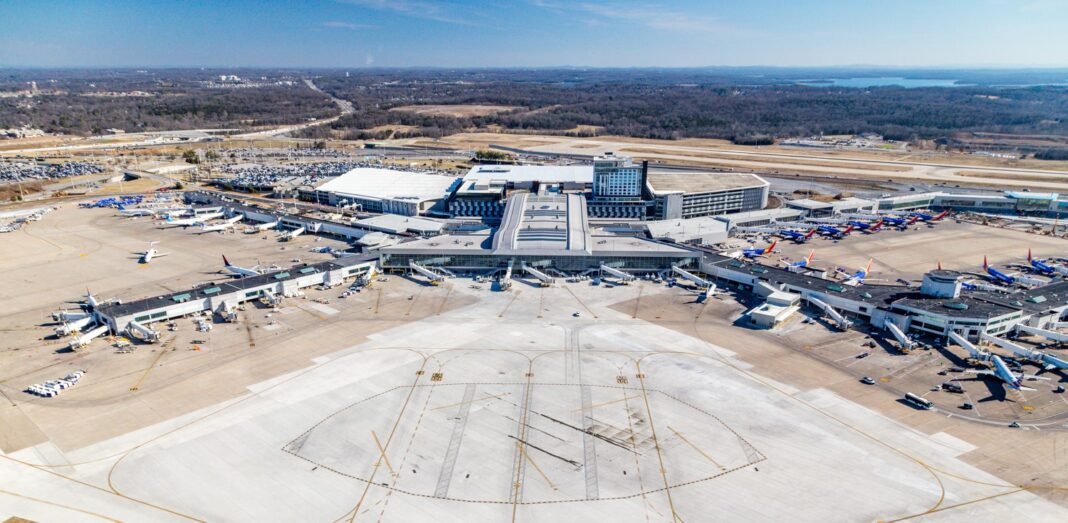
5. Nashville International Airport Expansion – Tennessee
Location: Nashville, Tennessee
Estimated Cost: $1.8 billion
Primary Contractors: Hensel Phelps Construction
Completion Target: 2028
Nashville’s explosive growth as a destination city has necessitated a dramatic expansion of its airport facilities.
The BNA Vision project represents the largest construction project in Tennessee’s history, completely transforming Nashville International Airport to meet surging passenger demand that has increased by over 50% in recent years.
The centerpiece of this expansion is a new International Arrivals Facility featuring expanded customs and immigration processing, a new Concourse D with 8 additional gates, and comprehensive terminal renovations.
The project also includes a new Grand Lobby entrance, expanded security checkpoints, and modernized baggage handling systems.
Construction activities in 2026 focus on the new concourse structure and terminal renovations, all while maintaining full airport operations.
The design emphasizes Nashville’s unique character, incorporating live music stages, local food and beverage offerings, and design elements reflecting Tennessee’s cultural heritage.
The expansion will increase the airport’s capacity to handle over 23 million passengers annually, supporting Nashville’s continued economic growth and tourism industry.
According to Metropolitan Nashville Airport Authority CEO Douglas Kreulen, it is a project that combines “Ease of transportation, beautiful art and the ability to flow in and out in a seamless travel experience.”
6. Texas Central Railway High-Speed Rail – Texas
Location: Dallas to Houston
Estimated Cost: $30 billion
Primary Contractors: Webuild (formerly Salini Impregilo)
Projected Completion: 2032
Texas is pursuing its own high-speed rail vision with the Texas Central Railway, a privately-funded project that would connect Dallas and Houston with 200+ mph bullet train service.
Utilizing Japan’s proven Shinkansen technology, the railway would cover 240 miles in approximately 90 minutes, transforming transportation between Texas’s two largest metropolitan areas.
While the project has faced regulatory and land acquisition challenges, advancement continues on environmental studies, engineering designs, and securing necessary approvals.
The railway would create an estimated 17,000 direct jobs during construction and thousands of permanent positions once operational.
The project represents a unique public-private partnership model for American infrastructure, potentially serving as a blueprint for future high-speed rail development.
The proposed route includes a central station in the Brazos Valley, creating economic development opportunities in rural Texas communities along the corridor.
7. Purple Line Light Rail – Maryland
Location: Prince George’s and Montgomery Counties, Maryland
Estimated Cost: $9.3 billion
Primary Contractors: Purple Line Transit Partners (Fluor/Lane Joint Venture)
Completion Target: 2027
The Purple Line represents the largest transit investment in Maryland history, creating a 16.2-mile light rail line connecting Bethesda, Silver Spring, College Park, and New Carrollton in the Washington DC suburbs.
This east-west transit connection will fill a critical gap in the regional transportation network, linking multiple Metro stations and communities currently underserved by rapid transit.
Construction in 2026 focuses on completing trackwork, station construction, and systems installation across 21 stations.
The project involves complex construction in densely populated urban areas, requiring careful coordination with existing roads, utilities, and neighborhoods.
Major elements include bridge construction over significant roadways, creation of dedicated transit lanes, and integration with existing Metro and bus systems.
The Purple Line will serve approximately 74,000 daily riders, reducing automobile dependence and spurring economic development along the corridor.
The project emphasizes transit-oriented development principles, with numerous mixed-use projects planned near station locations.
8. Port of Long Beach Pier B On-Dock Rail Expansion – California
Location: Long Beach, California
Estimated Cost: $1.5 billion
Primary Contractors: Shimmick Construction/OHL USA Joint Venture
Completion Target: 2032
As America’s second-busiest container port, Long Beach is investing heavily in infrastructure to handle growing cargo volumes while reducing environmental impacts.
The Pier B On-Dock Rail Support Facility represents a critical upgrade, creating direct rail connections that will enable cargo containers to move from ships to trains without truck transportation through local communities.
This mega project includes constructing ten working tracks spanning 10,000 feet, extensive rail infrastructure, a new intermodal container transfer facility, and supporting buildings and systems.
The facility will handle up to 1.5 million containers annually, significantly reducing truck traffic and air pollution in surrounding communities.
Construction involves complex coordination with active port operations, requiring phased development that maintains cargo handling capabilities throughout the project timeline.
The on-dock rail facility represents the future of port logistics, improving efficiency while addressing environmental justice concerns that have long affected port-adjacent communities.
9. Las Vegas Convention Center Loop Expansion – Nevada
Location: Las Vegas, Nevada
Estimated Cost: $750 million (system-wide expansion)
Primary Contractor: The Boring Company
Ongoing Expansion: 2026
Las Vegas continues pioneering underground transportation with the expansion of the Vegas Loop, a tunnel-based transportation system utilizing Tesla vehicles in underground tunnels.
Following the successful Convention Center Loop, the system is expanding to connect major resort properties, the airport, and downtown Las Vegas through a network of underground stations.
The 2026 construction phase focuses on extending tunnels to additional resorts along the Strip and connecting to Harry Reid International Airport.
The Boring Company’s innovative tunneling approach has dramatically reduced construction costs and timelines compared to traditional subway systems, potentially offering a new model for urban transportation.
The expanded system will feature dozens of stations and move thousands of passengers hourly through the underground network, alleviating surface traffic congestion in one of America’s most visited cities.
The project showcases American innovation in transportation technology and construction methods.
10. Gordie Howe International Bridge – Michigan/Ontario
Location: Detroit, Michigan to Windsor, Ontario
Estimated Cost: $5.7 billion (Canadian)
Primary Contractors: Bridging North America (Fluor, Aecon, ACS Infrastructure)
Completion Target: 2026
The Gordie Howe International Bridge represents a transformational infrastructure project connecting the United States and Canada.
Spanning the Detroit River, this six-lane bridge will become the longest cable-stayed bridge in North America, featuring a 2,799-foot main span suspended 148 feet above the water.
Construction in 2026 focuses on completing the bridge deck, finishing the iconic twin towers rising 722 feet above the Detroit River, and advancing work on the U.S. Port of Entry complex in Detroit.
The project includes not just the bridge itself but also comprehensive port-of-entry facilities, Michigan interchange improvements, and connections to existing highway systems.
This crossing will handle commercial and passenger vehicles between two nations with the world’s largest trading relationship.
The bridge will process an estimated 8,000 trucks daily, supporting supply chains for automotive manufacturing and countless other industries. Advanced tolling systems and customs facilities will streamline border crossings while maintaining security.
The Economic Impact of Mega Construction Projects
These ten projects collectively represent over $200 billion in infrastructure investment, directly employing tens of thousands of construction workers, engineers, and project managers.
The economic multiplier effects extend far beyond construction sites, supporting manufacturing, materials suppliers, professional services, and local businesses in communities nationwide.
The Infrastructure Investment and Jobs Act, passed in 2021, has catalyzed many of these projects through unprecedented federal funding for transportation, water systems, and broadband infrastructure.
This historic legislation has created a pipeline of major construction projects that will continue transforming American infrastructure for decades.
Looking Ahead
These mega construction projects showcase American ambition, engineering excellence, and commitment to building infrastructure for future generations.
From high-speed rail to modern airports, expanded highways to innovative transit systems, these projects address critical needs while creating economic opportunities across the country.
As construction continues through 2026 and beyond, these transformational projects will enhance quality of life, improve economic competitiveness, and demonstrate that America remains capable of executing world-class infrastructure development on a massive scale.
Also Reads
10 Mega Construction Projects Set to Transform Africa by 2026
Mega Projects Transforming the Middle East Construction Landscape in 2025

- From Operator to Algorithm: Bedrock Puts Autonomous Excavators to Work on Live Construction Sites - September 7, 2026
- Built For The Rough Stuff: Inside Titan’s new ForestEDGE™ Tyre Line - September 4, 2026
- South Africa Has R395 Billion in Infrastructure Projects — But Can the Industry Deliver Them? - August 26, 2026
