

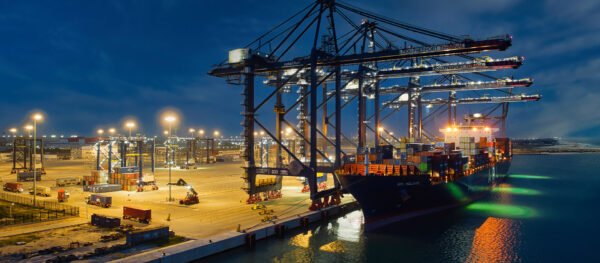
The container ship docks at Mombasa’s modern deep-sea berth, its cargo destined for the East African interior.
A few thousand kilometers west, construction crews put finishing touches on Nigeria’s Lekki Deep Sea Port.
What connects these distant coastal projects is more than just the Indian and Atlantic oceans—it’s the unmistakable imprint of Chinese investment, engineering, and strategic vision that is fundamentally transforming Africa’s port infrastructure.
China’s expansion into African port development represents one of the most significant shifts in the continent’s economic geography since independence.
From the shores of Kenya to the Gulf of Guinea, Chinese state-owned enterprises and financial institutions have become the primary architects of Africa’s maritime future, constructing, operating, or financing port facilities that handle billions of dollars in trade annually.
The Scale of China’s Port Ambitions
China’s involvement in African ports extends far beyond simple construction contracts. Through its Belt and Road Initiative (BRI), Beijing has positioned itself as the indispensable partner for nations seeking to modernize their maritime infrastructure.
The numbers tell a compelling story: Chinese companies have invested in or operate ports in at least 13 African countries, from Djibouti in the Horn of Africa to Walvis Bay in Namibia.
The Mombasa Port in Kenya exemplifies this deep engagement. China Road and Bridge Corporation has been instrumental in expanding the port’s capacity, including the construction of new berths and container terminals.
The project, part of a broader transportation corridor linking Mombasa to Uganda, Rwanda, and beyond, demonstrates how port development fits into China’s comprehensive approach to African infrastructure.
Nigeria’s Lekki Deep Sea Port, which began operations in 2023, represents perhaps the most ambitious Chinese port project in West Africa.
Built by the China Harbour Engineering Company in partnership with Nigerian and Singaporean firms, the $1.5 billion facility is designed to become West Africa’s largest deep-sea port, capable of handling the world’s biggest container ships.
The port is expected to generate substantial revenue and transform Nigeria into a major transshipment hub.
Strategic Locations, Strategic Interests
Geography explains much of China’s port selection strategy. Djibouti, home to China’s first overseas military base, sits at one of the world’s most strategic chokepoints where the Red Sea meets the Indian Ocean.
The Doraleh Container Terminal, operated by China Merchants Port Holdings, handles traffic from landlocked Ethiopia and serves as a critical node in global shipping routes.
In Tanzania, the Bagamoyo Port project—though currently stalled—was envisioned as a $10 billion mega-port that would dwarf Dar es Salaam’s existing facilities.
Even in its incomplete state, the project illustrates China’s willingness to pursue transformative infrastructure that could reshape regional trade patterns.
The strategic calculus extends beyond commerce. These ports provide China with influence over critical maritime infrastructure along both the Indian Ocean rim and Atlantic coast.
For a nation that depends on seaborne trade for its economic vitality and imports the majority of its oil from Africa and the Middle East, securing friendly ports along these routes offers tangible strategic benefits.
The Debt-for-Equity Question
Perhaps no aspect of China’s port expansion has generated more controversy than concerns about debt sustainability and the possibility of asset seizures.
The cautionary tale frequently cited is Sri Lanka’s Hambantota Port, which was leased to China Merchants Port for 99 years after Colombo struggled to service its debts.
While Hambantota lies outside Africa, the precedent has intensified scrutiny of Chinese port deals across the continent.
In Kenya, questions about the financial terms of Chinese loans for Mombasa Port expansion have fueled domestic political debates.
Critics worry that unsustainable debt could potentially give China leverage over the port’s operations.
The Kenyan government has repeatedly denied that Mombasa Port was used as collateral, but the perception persists, reflecting broader anxieties about the terms of Chinese infrastructure financing.
However, the debt-trap narrative requires nuance. Many African nations have few alternatives for infrastructure financing on the scale China offers.
Western lenders and multilateral development banks often impose conditions that governments find restrictive or offer funding insufficient for transformative projects.
China’s willingness to finance large-scale infrastructure without governance conditions has made it an attractive partner, even if the financial terms carry risks.
Research from institutions like the Johns Hopkins China-Africa Research Initiative suggests that while some Chinese loans carry commercial interest rates, many are concessional, and debt renegotiations have often resulted in extensions and forgiveness rather than asset seizures.
The reality appears more complex than simple debt colonialism, though legitimate concerns about transparency and debt sustainability remain.
Economic Transformation and Local Impact
Beyond geopolitics, Chinese port investments are driving tangible economic changes. Modern port facilities reduce shipping costs, decrease transit times, and can catalyze broader economic development.
The Lekki Port is projected to generate 170,000 jobs and add $361 billion to Nigeria’s economy over the next 45 years, according to project sponsors.
In Djibouti, port development has become the cornerstone of the nation’s economic strategy to transform itself into a regional logistics hub.
Chinese investment has been central to this vision, complementing port facilities with free trade zones, railways, and other infrastructure.
However, questions persist about technology transfer and local capacity building. Critics argue that Chinese projects often rely heavily on Chinese contractors, equipment, and even labor, limiting knowledge transfer to local populations.
While this criticism applies broadly to Chinese infrastructure projects, some port developments have included training programs and commitments to local employment.
The economic benefits also depend on complementary investments. Ports achieve maximum impact when connected to efficient road and rail networks, reliable electricity, and streamlined customs procedures.
China’s integrated approach—often bundling port development with railways and industrial parks—addresses this reality, though implementation remains uneven across different countries.
Geopolitical Implications and Great Power Competition
China’s port expansion occurs against the backdrop of intensifying great power competition.
The United States and European nations have watched China’s growing influence with concern, viewing it as part of Beijing’s broader strategy to expand its global footprint and potentially challenge Western-dominated international order.
The establishment of China’s military base in Djibouti in 2017, adjacent to Chinese-operated port facilities, crystallized these concerns.
While Beijing frames its military presence as necessary for anti-piracy operations and protecting Chinese nationals, critics see it as evidence of more expansive strategic ambitions.
This competition has spurred responses. The United States has increased engagement through initiatives like Prosper Africa and the Development Finance Corporation, though American investment in African infrastructure remains modest compared to China’s.
The European Union’s Global Gateway initiative explicitly positions itself as an alternative to the BRI, emphasizing quality standards and sustainability.
African nations increasingly find themselves navigating between these competing interests. Some governments have become more sophisticated in negotiating with China, pushing for better terms and greater transparency.
Others have diversified their partnerships, balancing Chinese investment with engagement from other powers.
The Future of China-Africa Port Relations
Looking ahead, several factors will shape the evolution of China’s role in African ports. Global supply chain disruptions revealed during the COVID-19 pandemic have emphasized the importance of resilient port infrastructure.
Climate change poses challenges for coastal facilities, requiring investments in resilience and adaptation.
Financial sustainability will remain critical. As some African nations struggle with debt burdens, the terms and transparency of port financing will face continued scrutiny.
China has shown willingness to renegotiate problematic loans, but the pressure for more favorable terms and clearer agreements will likely intensify.
Technology will also play an increasing role. Modern ports are becoming increasingly automated and data-driven.
China’s leadership in digital infrastructure and smart port technology could deepen its influence, though concerns about data security and surveillance may prompt greater caution from African governments.
China’s growing presence in African ports represents a fundamental realignment of economic and strategic relationships.
From Mombasa’s expanded container terminals to Lekki’s deep-sea berths, Chinese investment is creating modern facilities that many African nations desperately need but could not finance independently.
This transformation brings both opportunities and risks. Modern ports can drive economic growth, create employment, and integrate African economies more fully into global trade networks.
Yet concerns about debt sustainability, strategic dependence, and equitable benefit-sharing are legitimate and require careful attention.
The ultimate impact of China’s port expansion will depend not just on Beijing’s intentions but on the capacity of African governments to negotiate effectively, ensure transparency, and leverage infrastructure investments for broad-based development.
As great power competition intensifies, African nations have opportunities to shape terms that serve their own interests rather than simply choosing between competing external powers.
What’s clear is that China’s footprint on Africa’s coastline will define maritime trade patterns and geopolitical relationships for decades to come.
How this influence is managed—by China, African governments, and the international community—will significantly shape Africa’s economic trajectory and position in an increasingly multipolar world.
Also Read
Africa Construction in Rail and Ports: Boosting Regional Trade
Africa Construction Finance: How PPPs Are Funding Major Projects

- How They Were Built: Inside the Engineering of the Lesotho Highlands Water Project - October 11, 2026
- Africa’s Water Reuse Opportunity: Building the Infrastructure for a Water-Secure Future - September 28, 2026
- Why Water Reuse Is Becoming a Business Imperative for African Industry - September 28, 2026