

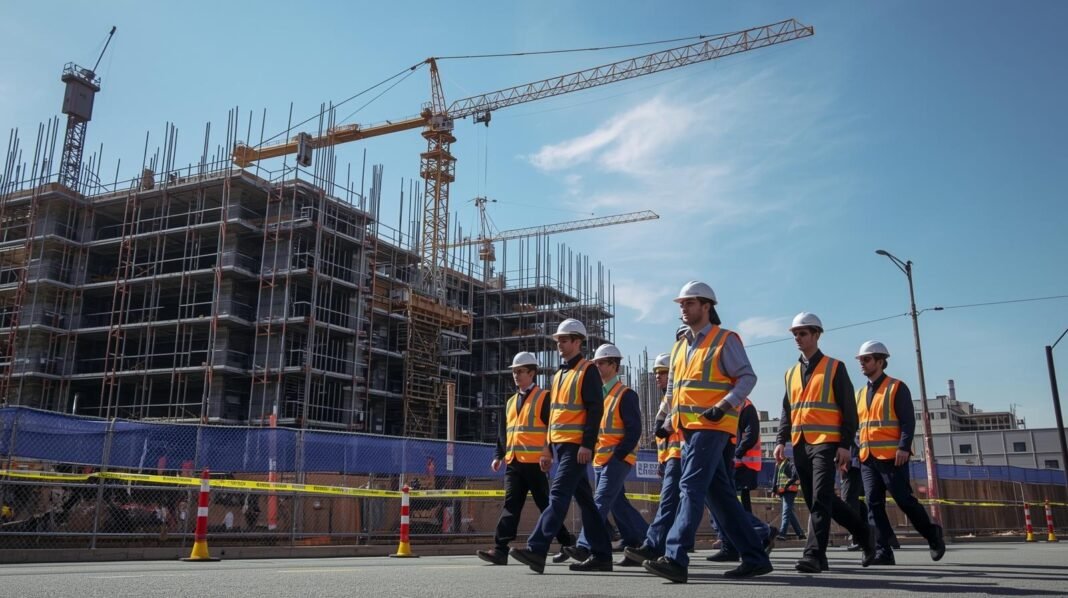
The U.S. construction industry stands at a critical crossroads.
According to a January 2026 report from Associated Builders and Contractors (ABC), the sector will need to attract 456,000 new workers by 2027—a dramatic 30.7% increase from the 349,000 workers needed in 2026.
This sharp uptick signals that the construction workforce shortage, already a persistent challenge, is poised to intensify significantly as the industry enters a new growth cycle.
Understanding the Numbers Behind the Crisis
ABC’s proprietary workforce model reveals a concerning trajectory for construction employment.
The analysis, which examines the historical relationship between inflation-adjusted construction spending and employment data from the U.S. Census Bureau and Bureau of Labor Statistics, estimates that every $1 billion increase in construction spending generates demand for approximately 3,450 additional workers.
For 2026, the industry requires 349,000 net new workers—the lowest annual workforce gap ABC has projected since 2021.
However, this temporary reprieve shouldn’t be mistaken for progress. ABC Chief Economist Anirban Basu emphasizes that the lower figure reflects reduced construction activity rather than an improved labor situation.
The real challenge arrives in 2027, when construction spending growth is expected to resume after years of modest performance. That’s when the industry must find 107,000 additional workers beyond 2026 levels—a 31% jump in a single year.
Why 2026’s “Relief” Is Misleading
The construction industry’s current workforce needs are lower than recent years, but not because the fundamental labor shortage has been solved. Several factors explain this temporary dip:
Cyclical Slowdown: Nominal construction spending declined approximately 1.5% over the past year, translating to roughly a 5% decline in real terms after accounting for inflation. This slowdown has temporarily reduced the demand for new hires.
Retirements Dominating Demand: More than half of the 349,000 workers needed in 2026 will replace retirees rather than support industry growth. With approximately one-fifth of all electricians over age 55, the retirement wave continues unabated.
K-Shaped Construction Economy: Large general contractors tied to megaprojects like data centers and industrial facilities continue reporting strong backlogs. Meanwhile, smaller and mid-sized firms, particularly those focused on office, retail, and local commercial work, are experiencing backlog declines.
Basu cautions that this cyclical pause provides only a “narrow but valuable window” for contractors to prepare. Firms that use this time to recruit strategically, invest in training, and upskill their workforce will be better positioned when demand inevitably rebounds.
The Immigration Policy Wild Card
Immigration enforcement represents a significant uncertainty in workforce projections. Foreign-born workers account for approximately 25% to 31% of the construction workforce nationally, according to U.S. Census Bureau data.
In states like California and Texas, this figure reaches 35% to 40%.
Data on border encounters indicate that the flow of undocumented workers into the country fell precipitously in 2025, while voluntary deportations accelerated.
The extent to which undocumented workers have exited the workforce remains unclear, but early estimates suggest the number of people immigrating to the U.S. has declined and potentially even reversed.
This labor supply constriction has already impacted construction markets.
As documented workers become scarcer, labor costs have risen even as demand for new projects in many segments has softened—creating what Basu describes as “a marketplace in which demand for construction services has been declining in many segments, while the cost of delivering such services has been rising.”
High-profile Immigration and Customs Enforcement (ICE) actions, including raids in Portland, Los Angeles, Chicago, and a September 2025 raid at a Hyundai plant in Georgia that resulted in 475 arrests, have heightened risk perception among undocumented workers.
Some may not show up for work, effectively shrinking the available labor pool further.
Critical Shortage Areas: Specialty Trades Under Pressure
While the overall workforce need is substantial, certain occupations face particularly acute shortages:
Electricians: Demand has surged due to rapid data center construction growth, which requires precision wiring capabilities. These “major league” electricians command premium wages that only hyperscale technology companies can afford at scale. With one-fifth of all electricians over 55, the retirement cliff looms large.
Mechanical Workers: Advanced cooling systems for AI infrastructure require specialized mechanical skills that are in extremely short supply.
Industrial Megaproject Trades: Workers with experience in semiconductor fabrication facilities, manufacturing plants, and other large-scale industrial projects remain scarce, particularly in regions where these megaprojects are concentrated.
Nonresidential specialty trade contractors have added 95,000 jobs since August 2024, demonstrating strong hiring in certain sectors. However, this growth has been concentrated in high-demand areas, leaving many other market segments struggling to find qualified workers.
Where Will These 456,000 Workers Come From?
Meeting the 2027 workforce demand requires a comprehensive, multi-pronged approach:
1. Expanding Apprenticeship and Training Programs
Registered Apprenticeship programs represent one of the most effective pathways to construction careers. In 2024, over 451,000 apprentices were served in the construction industry—a 22% increase over the previous five years.
These programs offer “earn while you learn” opportunities, providing paid on-the-job training combined with classroom instruction. Apprentices avoid large student debt while entering high-wage occupations with strong long-term earning potential.
Pre-apprenticeship certification training programs are also expanding. Colorado’s Construction Education Foundation, for example, offers free sustainable building certification training to high school students and incumbent workers, preparing them for careers without student loan debt.
2. Recruiting from Underrepresented Populations
The construction industry must cast a wider recruitment net:
Young Workers and Gen Z: Currently comprising only 16.8% of construction workers, younger generations represent an untapped talent pool. Promoting construction careers to high school students, working with guidance counselors, and highlighting vocational schools can help attract this demographic.
Women: Construction remains heavily male-dominated. Targeted recruitment efforts and creating more inclusive workplace cultures could significantly expand the workforce.
Career Changers: Adults seeking new career paths, particularly those seeking hands-on work with tangible results and competitive pay, represent another potential source of workers.
3. Immigration Reform
Industry leaders, including ABC President and CEO Michael Bellaman, advocate for federal lawmakers to introduce a market-based worker visa system. The National Association of Home Builders similarly calls for:
- Replacing the statutory cap for H-2B worker visas with limits driven by market demand rather than arbitrary federal limits
- Creating new temporary worker visa programs
- Establishing pathways to residency or citizenship for workers already contributing to the economy
America will need approximately 2.2 million new skilled construction workers over the next three years to reduce the nation’s housing deficit, estimated at 1.5 million homes. Immigration policy that complements vocational training efforts is essential to filling these labor gaps.
4. Technology and Automation
While technology won’t replace workers entirely, it can multiply their productivity and make the industry more attractive to younger, tech-savvy workers:
AI-Driven Tools: Artificial intelligence can optimize project scheduling, predict equipment failures, enhance safety protocols through real-time hazard detection, and automate repetitive administrative tasks. McKinsey research suggests AI could increase construction productivity by up to 20%, reduce costs by up to 15%, and improve project delivery times by up to 30%.
Robotics: The construction robotics market is projected to grow from $442 million in 2025 to $909 million by 2030. Robots can handle dangerous tasks, reduce physical strain on workers, and maintain consistent productivity without fatigue.
Digital Twins and BIM: Building Information Modeling and digital twin technology enable better planning, reduce rework, and improve coordination—allowing smaller crews to accomplish more.
Wearables and Exoskeletons: These technologies reduce physical strain and improve safety, making construction work less physically demanding and helping retain older workers longer.
5. Improving Retention and Job Satisfaction
Attracting workers is only half the battle; keeping them is equally critical. Strategies include:
- Competitive Compensation: Construction wages have been rising above 4% annually, reflecting fierce competition for workers
- Steady Hours and Predictable Schedules: Reliability matters to workers balancing family and personal commitments
- Career Development: Clear pathways for advancement and skills development keep workers engaged
- Safety Culture: A genuine commitment to worker safety reduces injuries, improves morale, and demonstrates that employees are valued
- Work-Life Balance: Modern workers increasingly prioritize quality of life alongside compensation
The 2027 Rebound: What’s Driving Increased Demand?
Several factors are expected to drive the sharp increase in workforce needs in 2027:
Interest Rate Expectations: Assumptions that interest rates will eventually fall below key behavioral thresholds could unlock stalled projects and stimulate new development.
Data Center and AI Infrastructure: The artificial intelligence boom is driving unprecedented data center construction. These projects require specialized skilled trades and generate sustained demand.
Industrial Megaprojects: Announced semiconductor fabrication facilities, manufacturing plants, and other industrial projects moving from planning into active construction will require substantial workforces.
Infrastructure Investment: The Infrastructure Investment and Jobs Act’s $550 billion federal investment in roads, bridges, mass transit, water infrastructure, and broadband continues creating demand through 2026 and beyond.
Renewable Energy: A surge of wind and solar projects racing to meet the July 4, 2026, federal deadline under the Inflation Reduction Act’s Section 48E rules will drive workforce demand in early 2026, followed by projects continuing through the December 31, 2027, placed-in-service deadline.
Basu stresses that these projections assume relatively conservative spending forecasts. If project financing costs decline unexpectedly or policy uncertainty resolves favorably, actual workforce needs could exceed the 456,000 estimate.
Regional Variations and Market Dynamics
Workforce shortages aren’t uniform across the country. Labor availability varies significantly by region:
Major Metropolitan Areas: Large cities with multiple megaprojects, particularly those building data centers, face severe skilled labor shortages and corresponding wage inflation.
Industrial Project Regions: Areas with semiconductor fabrication facilities and other industrial megaprojects experience acute shortages of specialized trades.
Secondary Markets and Rural Areas: These regions typically have fewer active projects and relatively lower labor costs, though they may still struggle to attract young workers entering the trades.
Competition for workers has intensified dramatically. Projects that historically attracted five to ten bidding firms now see ten to fifteen competitors, including larger upstream firms and out-of-market companies expanding their footprints.
The Stakes: Why This Matters
The construction workforce shortage has consequences extending far beyond the industry:
Housing Affordability Crisis: Labor shortages slow construction, drive up costs, and ultimately lead to higher home prices—exacerbating America’s housing deficit.
Infrastructure Delays: Critical infrastructure projects face extended timelines when qualified workers can’t be found.
Economic Growth: Construction contributed approximately 4.4% of national GDP in 2023. Workforce constraints limit the industry’s ability to support broader economic expansion.
Project Safety: First-year employees account for nearly half of all construction injuries. Labor shortages force contractors to rely on less experienced crews, elevating safety risks.
National Competitiveness: America’s ability to build advanced manufacturing facilities, data centers, and other critical infrastructure depends on having sufficient skilled construction workers.
Moving Forward: Action Not Complacency
ABC President Michael Bellaman emphasizes that “the construction industry does not have to fall off the workforce shortage cliff.” However, avoiding that outcome requires decisive action now rather than waiting for the crisis to fully materialize.
The industry faces a stark choice between two futures. One path leads to intensifying labor shortages, escalating costs, delayed projects, and constrained economic growth.
The other requires coordinated effort from industry, education, and government to expand training programs, reform immigration policy, embrace technology, and make construction a career of choice for the next generation.
The 456,000-worker challenge isn’t just a number—it’s a test of the construction industry’s ability to adapt, innovate, and compete for talent in today’s complex job market.
With construction spending projected to approach $2.05 trillion in 2026, driven by AI-powered data centers, renewable energy projects, and infrastructure modernization, the economic opportunity is substantial.
The question is whether the U.S. construction industry can build the workforce pipeline needed to seize it. The window to prepare is now, and 2027 is just around the corner.
Also Read
Top UK Construction Regulatory Changes to Watch in 2026
The Materials and Technologies Shaping the Next Generation of Buildings

- From Operator to Algorithm: Bedrock Puts Autonomous Excavators to Work on Live Construction Sites - September 7, 2026
- Built For The Rough Stuff: Inside Titan’s new ForestEDGE™ Tyre Line - September 4, 2026
- South Africa Has R395 Billion in Infrastructure Projects — But Can the Industry Deliver Them? - August 26, 2026
