
In the shimmering heat of Saudi Arabia’s Red Sea coast, an architectural marvel is rising at a pace that defies conventional expectations.
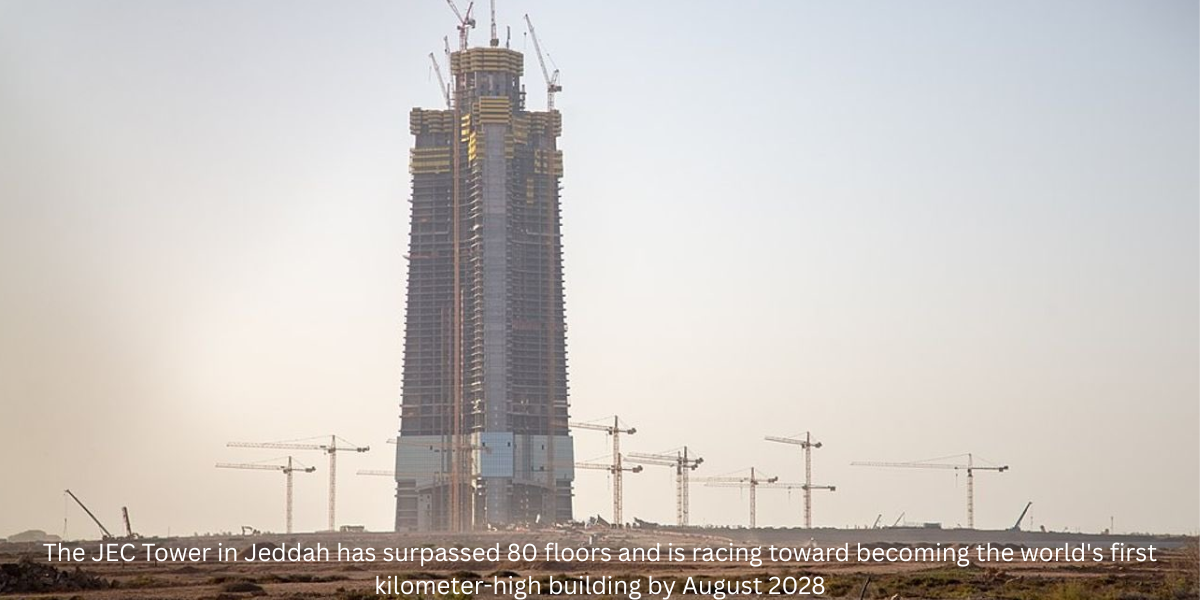
The JEC Tower in Jeddah has surpassed 80 floors and is racing toward becoming the world’s first kilometer-high building by August 2028.
For Africa’s construction industry, currently valued at $219.66 billion and grappling with its own set of challenges, this megaproject offers crucial lessons in ambition, innovation, and execution.
Breaking Records, Redefining Possibility
The tower, designed by Adrian Smith + Gordon Gill Architecture, will reach beyond 1,000 meters (3,281 feet) when completed, standing approximately 173 meters taller than Dubai’s Burj Khalifa.
With at least 157 floors, the structure will house luxury residences, office space, a five-star hotel, and the world’s highest observation deck at 652 meters.
The building’s unique three-petal footprint is not merely aesthetic; it’s a critical aerodynamic feature designed to shed wind vortices and reduce structural sway at extreme altitudes.
What makes this achievement particularly remarkable is the pace of construction. Following a seven-year hiatus that began in 2018 due to political and economic challenges, work resumed in January 2025.
Since then, construction crews have been completing one floor every three to four days, a blistering pace enabled by advanced concrete pumping technology and meticulous coordination.
Engineering firm Thornton Tomasetti confirmed in early January 2026 that the tower had surpassed the 80-floor mark, with projections to reach 100 floors by February 2026.
The Technology Behind the Tower
The JEC Tower represents a masterclass in cutting-edge construction technology. The project employs concrete pumping systems capable of reaching heights exceeding 2,624 feet, with ongoing work to extend this capability to the tower’s ultimate height.
The building’s 59 elevators, including five double-deckers, utilize KONE’s UltraRope technology with carbon-fiber cores to eliminate weight issues associated with traditional steel cables in supertall buildings.
These elevators will travel at speeds exceeding 10 meters per second.
The structural core is performing exactly as modeled in wind-tunnel tests, demonstrating how advanced computational modeling can ensure structures withstand unique environmental forces.
Turner Construction, which took over project management in March 2025, describes the site as “one of the most complex construction environments on Earth,” requiring precise coordination between the tower’s construction and the surrounding infrastructure of the 57-million-square-foot Jeddah Economic City development.
Lessons for Africa’s Construction Landscape
Africa’s construction industry stands at a pivotal moment. The sector is projected to reach $239.99 billion by 2030, with infrastructure construction expected to grow at 9.4% annually.
Countries like Egypt, Nigeria, Kenya, and South Africa are driving ambitious megaprojects, from Egypt’s New Administrative Capital to South Africa’s $54 billion infrastructure plan and Kenya’s $470 billion Mombasa-Nairobi Expressway. Yet the continent faces distinct challenges that the JEC Tower experience illuminates.
Project Continuity and Long-Term Vision
The JEC Tower’s journey teaches a crucial lesson about maintaining project momentum. Despite facing a seven-year construction halt due to political purges and the COVID-19 pandemic, the project secured a SR7.2 billion contract with Saudi Binladin Group and resumed with unwavering commitment to its 2028 deadline.
This aligns with Saudi Arabia’s Vision 2030, demonstrating how megaprojects can anchor broader economic diversification strategies.
African projects often suffer from political instability and policy shifts that disrupt continuity.
The solution lies in institutional frameworks that transcend electoral cycles. Kenya’s Vision 2030 and similar long-term development blueprints provide this foundation, but implementation requires protected funding mechanisms and cross-party political consensus to ensure projects survive government transitions.
Technology Adoption as Non-Negotiable
The JEC Tower’s success hinges on advanced technologies: Building Information Modeling (BIM), sophisticated concrete pumping systems, aerodynamic design software, and state-of-the-art materials engineering.
Africa’s construction industry has been historically slow to adopt such innovations, constrained by lower internet penetration, limited digital skills, and a large informal sector.
However, the gap is closing. Countries like Botswana are integrating drones, 3D printing, and green technologies in infrastructure projects.
The African construction market is witnessing growing adoption of BIM, with ALLPLAN’s 2024 launch enhancing cloud-based workflows across the continent.
The key is systematic assessment of which technologies best suit specific national contexts, rather than wholesale adoption of foreign solutions.
Localizing Innovation While Maintaining Standards
While the JEC Tower imports cutting-edge international expertise, African countries must balance technology transfer with local capacity building.
When local capability is low, countries purchase construction services from foreign firms, limiting employment generation and local content. Sub-Saharan Africa fares poorly in regional firms winning contracts, particularly as contract sizes increase.
The solution involves strategic investment in local manufacturing of construction materials.
For instance, the global green cement market, expected to reach $38.1 billion by 2024, presents opportunities for African countries to develop geomaterials and bio-based materials for advanced construction techniques like 3D printing.
This reduces import dependence while creating jobs and reducing carbon footprints.
Overcoming Regulatory and Logistical Bottlenecks
The JEC Tower benefits from streamlined regulatory processes within Saudi Arabia’s ambitious development framework.
In contrast, African construction projects face lengthy permit approvals, bureaucratic red tape, and inconsistent regulation enforcement that significantly delay execution and increase costs.
Countries making progress include Ghana, which signed a $350 million public-private partnership for the Accra-Tema Motorway reconstruction, signaling growing appetite for private capital in infrastructure.
Nigeria’s 2020 Finance Act introduced tax incentives for infrastructure investment, while modernized arbitration frameworks in Ghana, South Africa, and Tanzania are improving dispute resolution.
These reforms demonstrate that regulatory modernization directly impacts project delivery.
Financing Innovation
The JEC Tower’s $20 billion Jeddah Economic City development relies on substantial private investment, including $75 million from Standard Chartered. Africa faces a $100 billion annual infrastructure financing gap, according to the African Development Bank.
Closing this gap requires creative financing models beyond traditional government funding.
Public-private partnerships are gaining traction, but success demands investment protection laws, effective regulatory systems, and good governance to attract domestic and international capital.
Morocco’s $40 billion water-security master plan and Kenya’s transport investments demonstrate how flagship projects can catalyze private investment when properly structured.
Sustainability Must Be Integral, Not Optional
The JEC Tower incorporates modern technologies aimed at reducing its carbon footprint relative to projected occupancy levels.
For Africa, where buildings account for 37% of energy-related CO2 emissions and construction material emissions could reach 3.5 to 4.6 Gt CO2eq/year by 2060, sustainability is existential.
With 70% of Africa’s building stock expected for 2040 yet to be built, the continent has a unique opportunity to leapfrog to sustainable construction practices.
This means capitalizing on local construction materials and techniques, which brings co-benefits like job creation, reduced ecosystem impacts, cultural heritage preservation, and improved resilience.
Morocco’s target of 52% renewable power by 2030 and South Africa’s $36 billion investment in solar and wind infrastructure show regional leaders embracing this imperative.
The Path Forward
The JEC Tower’s rapid progress toward completion demonstrates what becomes possible when ambition meets advanced technology, sustained political will, and sophisticated project management.
For Africa’s construction industry, the lessons are clear: embrace technology systematically, create regulatory environments that support rather than hinder development, develop local capacity while maintaining international standards, and anchor projects within long-term national visions that survive political transitions.
As the JEC Tower reshapes Jeddah’s skyline and prepares to claim the title of world’s tallest building, African nations are writing their own construction stories.
Egypt’s New Administrative Capital, Kenya’s expressways, and South Africa’s renewable energy infrastructure represent the continent’s ambition.
The question is not whether Africa can build at scale—the $399 billion in projects currently under construction proves the capacity exists—but whether it can build with the efficiency, innovation, and sustainability that will define 21st-century infrastructure.
The kilometer-high tower rising on Saudi Arabia’s Red Sea coast is more than an engineering feat.
It’s a blueprint for possibility—one that Africa’s construction industry would be wise to study, adapt, and ultimately surpass with solutions tailored to the continent’s unique challenges and vast potential.
Also Read
M&S’s £340m DIRFT Warehouse: The Rail Freight Gambit That Could Reshape British Grocery Logistics
December 2025 US Employment Report: What the Jobs Data Means for Construction

- SODECA Highlights Industrial Ventilation Technology at Mega Clima Expo Kenya 2026 - October 14, 2026
- How They Were Built: Inside the Engineering of the Lesotho Highlands Water Project - October 11, 2026
- Africa’s Water Reuse Opportunity: Building the Infrastructure for a Water-Secure Future - September 28, 2026