

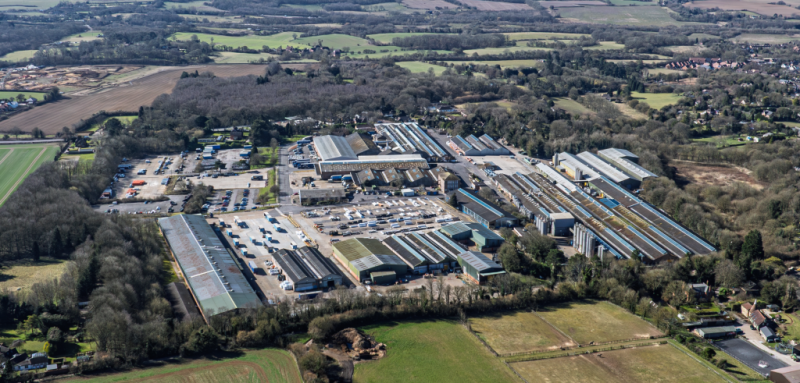
When Marks & Spencer breaks ground on its £340 million distribution center at Daventry International Rail Freight Terminal this year, the retailer won’t just be building Britain’s largest food warehouse.
It will be making a calculated wager that the future of grocery logistics runs on rails as much as roads—and arriving fashionably late to a party where its rivals have been dancing for more than a decade.
The 1.3 million square foot facility, awarded to Winvic Construction on January 12, represents M&S’s largest-ever supply chain investment.
But the real story isn’t the automation technology or the 2,000 jobs it will create. It’s about location, infrastructure, and a fundamental shift in how Britain’s major grocers are positioning themselves for a decarbonizing economy.
The Last Major Grocer to Arrive
DIRFT has been the logistics industry’s worst-kept secret since the late 1990s. Positioned at the junction of the M1, A5, and A428, with direct rail access to the West Coast Main Line, it represents the kind of intermodal connectivity that supply chain strategists dream about.
Tesco completed its 840,000 square foot grocery distribution center at DIRFT II in September 2011, giving the UK’s largest grocer a commanding position at the heart of Britain’s logistics golden triangle.
Sainsbury’s established its presence at DIRFT II as well, while Asda has leveraged rail freight for over two decades to move ambient goods, general merchandise, and clothing from ports to distribution centers.
M&S, by contrast, is just now committing to the location with a facility that won’t open until 2029. The question is: why the delay, and why now?
More Than Just a Warehouse: The Rail Infrastructure Play
The answer lies in understanding what DIRFT actually offers beyond cheap land and motorway access.
Moving goods by rail instead of road reduces carbon dioxide emissions by 76 percent—a figure that becomes increasingly critical as retailers face mounting pressure to decarbonize their supply chains.
Tesco currently operates seven daily rail services linking DIRFT with terminals in Mossend, Tilbury, Wentloog, Teesport, and Inverness, demonstrating how rail connectivity enables efficient distribution across Scotland, England, and Wales while dramatically reducing road miles. One of these services alone saves 6,000 tonnes of CO2 equivalent per year.
M&S’s facility will feature tri-temperature capability (frozen, chilled, and ambient storage) in a single rail-connected location—a configuration that’s rare in UK grocery logistics.
This setup will allow the retailer to consolidate food flows that currently require multiple facilities, streamlining a supply chain that has historically been more fragmented than its larger competitors.
The Strategic Context: Doubling Down on Food
To understand why M&S is making this investment now, you need to look at the company’s broader strategic pivot.
M&S has introduced a ‘Reshaping M&S for Growth’ plan aimed at modernizing the business and has delivered three consecutive years of growth in sales and market share. The food division has been a standout performer, with M&S aiming to increase its market share by 1% in both food and clothing over the next five years.
This isn’t just about incremental growth. The food division’s profit soared to nearly £400 million from £248 million the previous year, making food the engine of M&S’s resurgence.
The retailer has released a list of 500 target locations for new and renewed food stores as it looks to double the size of its food business.
Here’s where DIRFT becomes essential: you can’t double the size of a food business without fundamentally rethinking your distribution infrastructure. The new facility isn’t just supporting current operations—it’s being designed to handle the scale M&S envisions for 2030 and beyond.
The Decarbonization Imperative
While competitors have been at DIRFT for years, M&S’s 2029 opening means it will have one of the UK’s newest, most advanced food logistics facilities precisely when regulatory pressure on supply chain emissions intensifies.
The UK government has set regulated targets to grow rail freight by 7.5% in England and Wales and 8.7% in Scotland by 2029.
Rail freight contributed just 0.3% to overall transport emissions in 2018 and 2019, while HGVs and vans contributed 17% and 16% respectively.
These figures explain why Tesco has committed to achieving net zero across its operations by 2035, with rail freight playing an important role in the network.
M&S faces the same timeline and the same carbon accounting pressures. The DIRFT facility, with its inherent rail connectivity, positions the retailer to shift significant volumes from road to rail—exactly the kind of modal shift that will be necessary to meet mid-2030s carbon targets.
The Automation Factor
While the rail angle has been largely overlooked, the facility’s automation capabilities shouldn’t be dismissed.
The development will combine temperature-controlled storage, advanced automated fulfillment, returns and recycling operations, and dedicated office space.
This represents M&S catching up to—and potentially leapfrogging—competitors in warehouse automation.
The three-year build timeline allows for integration of the latest automated fulfillment systems, robotics, and inventory management technologies. By 2029, when the facility opens, it will represent the state-of-the-art in UK grocery distribution.
The automation arms race among UK grocers has been intensifying, with each major player building progressively more advanced facilities. M&S’s late arrival means it can learn from its competitors’ deployments and avoid their mistakes.
What This Reveals About UK Grocery Logistics
M&S’s investment illuminates a broader trend: the consolidation of UK grocery logistics into a handful of strategically positioned, rail-connected mega-facilities. DIRFT’s success in attracting multiple major grocers isn’t accidental.
DIRFT III has grown its handling capacity to 32 trains per day, creating the kind of scale that makes rail operations economically viable.
This consolidation pattern has implications for the competitive landscape. Retailers without access to rail-connected infrastructure will face increasing cost pressures as road freight becomes relatively more expensive due to fuel costs, driver wages, and potential carbon pricing mechanisms.
The location question also reveals something about M&S’s geographic strategy. DIRFT is situated in the logistics golden triangle, close to the M1 motorway with a direct connection to the Northampton loop of the West Coast Main Line, providing rail access to South East ports and up the spine of the country to Scotland.
HGV delivery drivers leaving DIRFT can reach 95% of the country in under four-and-a-half hours.
This combination of rail connectivity for long-haul movements and road accessibility for final-mile delivery represents the optimal configuration for a national food distribution network.
The 2029 Question
Three years for construction and a 2029 opening raises an important question: what happens to M&S food distribution in the meantime?
The retailer will need to continue operating its current network while preparing for the transition to DIRFT—a complex operational challenge that will require careful planning to avoid service disruptions.
The timing also suggests M&S is building for a post-2030 regulatory environment. Zero emission vehicle mandates, stricter carbon reporting requirements, and potential supply chain emission taxes are all likely to accelerate in the 2030s. By opening in 2029, M&S positions itself with infrastructure designed from the ground up for this new regulatory reality.
The Competitive Implications
M&S’s DIRFT investment represents more than catching up to Tesco and Sainsbury’s. It signals that the retailer is serious about competing head-to-head with the big grocers on distribution efficiency and scale—areas where it has historically been at a disadvantage.
The facility is expected to support more than 1,000 permanent jobs once operational, with an additional 1,000 roles created during construction, making it a significant economic development for the region.
But the real competitive advantage will come from the operational efficiencies and carbon savings the facility enables.
Looking Ahead
M&S’s £340 million bet on DIRFT isn’t just about moving food more efficiently. It’s about positioning the company for a future where supply chain sustainability is as important as price and quality in consumers’ purchasing decisions, where carbon reporting becomes mandatory and granular, and where rail freight reclaims a significant share of the logistics market from road transport.
The facility also represents a vote of confidence in the UK’s rail freight infrastructure at a time when the sector faces challenges, with the cost of moving goods by rail having risen three times faster than by road over the last decade.
Major retail commitments like M&S’s DIRFT facility could help justify the infrastructure investments and policy changes needed to make rail freight more competitive.
When the facility opens in 2029, it will mark not just M&S’s arrival at Britain’s premier logistics hub, but potentially a tipping point in how the UK grocery sector approaches the twin challenges of growth and decarbonization. The question for other retailers will be: can they afford not to follow?
The M&S DIRFT facility is scheduled to open in 2029, representing a 52-week build programme beginning in 2026. The project is targeting BREEAM Outstanding certification and utilizes stage 2 Building Information Modeling to support its low carbon construction credentials.
Also Read
Ethiopia Breaks Ground on Africa’s Largest Airport — A Strategic Leap for Continental Aviation
Henry Boot Completes Sale of Construction Division as Strategic Refocus Accelerates

- From Operator to Algorithm: Bedrock Puts Autonomous Excavators to Work on Live Construction Sites - September 7, 2026
- Built For The Rough Stuff: Inside Titan’s new ForestEDGE™ Tyre Line - September 4, 2026
- South Africa Has R395 Billion in Infrastructure Projects — But Can the Industry Deliver Them? - August 26, 2026
