Every bridge, high-rise building, and highway begins with a fundamental material: concrete.
Behind the scenes of these massive infrastructure projects stands a facility that most people never see but every construction professional depends on—the concrete batching plant.
These industrial complexes transform raw materials into the precisely mixed concrete that forms the backbone of modern construction.
A modern concrete batching plant represents far more than just mixing equipment. It embodies the construction industry’s evolution toward automation, quality control, and operational efficiency.
Where manual processes once dominated, today’s facilities employ sophisticated weighing systems, digital controls, and automated workflows that ensure every cubic meter of concrete meets exacting specifications.
For construction professionals, understanding how these plants operate reveals why consistent, high-quality concrete production has become achievable at unprecedented scales.
What Is a Modern Concrete Batching Plant?
A concrete batching plant is an industrial facility designed to combine aggregate materials, cement, water, and chemical admixtures in precise proportions to produce ready-mix concrete.
The term “batching” refers to the controlled measurement and combination of these ingredients according to specific mix designs.
Modern concrete batching plants differ fundamentally from their predecessors through integration of computerized control systems, automated material handling, and real-time quality monitoring.
Where older systems relied on manual measurement and operator judgment, contemporary facilities employ load cells, programmable logic controllers, and batching software that manage the entire production process with minimal human intervention.
These plants serve as centralized production facilities that supply construction sites with concrete mixed to exact engineering specifications. The shift from on-site mixing to centralized batching plants has transformed construction logistics, enabling larger projects, faster completion times, and more consistent material quality across entire developments.
Core Components of a Concrete Batching Plant
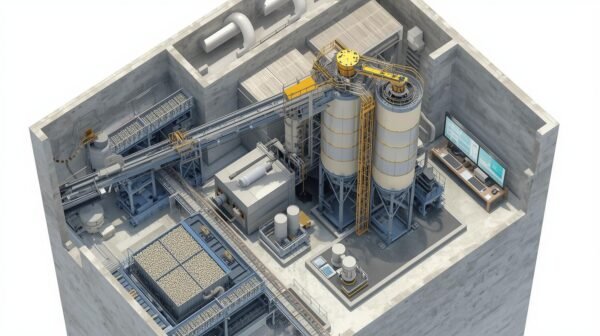
Understanding batching plant components reveals how precision is maintained throughout the concrete production process. Each element plays a specific role in ensuring accurate material proportioning and thorough mixing.
Aggregate Bins and Conveyor Systems
Aggregate storage bins hold various sizes of sand, gravel, and crushed stone in separate compartments. These materials typically constitute 60 to 75 percent of concrete’s total volume. Belt conveyors or skip hoists transport aggregates from storage bins to weighing hoppers, maintaining material flow without contamination between different aggregate sizes.
Cement Silos and Screw Conveyors
Vertical cement silos store bulk cement powder in moisture-controlled environments. Capacities range from 50 to several hundred tons depending on plant size and production demands. Screw conveyors move cement from silos to weighing systems through enclosed pathways that prevent moisture contact and minimize dust generation.
Water Dosing Systems
Water dosing systems deliver precise quantities of water through calibrated flow meters and control valves. Modern systems account for aggregate moisture content, automatically adjusting water addition to maintain correct water-cement ratios regardless of weather conditions or material variations.
Admixture Systems
Chemical admixture tanks store plasticizers, retarders, accelerators, and other additives that modify concrete properties. Automated pumps dispense these materials in small, precisely measured quantities—often mere liters per cubic meter—that significantly impact workability, setting time, and final strength.
Weighing and Batching Units
Load cells beneath aggregate hoppers, cement hoppers, and water tanks provide continuous weight measurements accurate to within 0.3 percent of target values. This precision ensures that every batch meets specified proportions, which directly affects concrete strength, durability, and performance.
Control Room and Software
The control room houses computers running specialized batching software that manages production sequences. Operators input mix designs, monitor batch production in real-time, and access historical data for quality documentation. The software coordinates all plant components, from material feeding through mixing and discharge.
The Concrete Production Process: Step by Step
The ready-mix concrete plant operates through a carefully orchestrated sequence that transforms individual materials into homogeneous concrete.
Material Storage and Preparation
Raw materials arrive at the plant by truck or rail and transfer into designated storage areas. Aggregates undergo screening to remove oversized particles or contaminants. Cement remains in sealed silos to maintain optimal moisture levels. Water and admixtures stay in temperature-controlled tanks.
Precise Weighing and Batching
Production begins when an operator selects a mix design from the batching software. The system automatically calculates required quantities for the specified batch size. Aggregates move first, dropping into weighing hoppers until load cells confirm target weights. Cement follows through screw conveyors into its own weigh hopper. Water and admixtures measure simultaneously in separate systems.
Mixing Process
Once all materials reach correct weights, discharge gates open and components drop into the mixer. Modern plants typically use twin-shaft mixers or planetary mixers that blend materials for 60 to 90 seconds. High-speed paddles and arms ensure thorough mixing, eliminating pockets of unmixed cement or aggregate and creating uniform concrete consistency.
Quality Checks and Consistency Control
During mixing, the batching software monitors motor current, mixing time, and material quantities. Deviations trigger alarms that alert operators to potential issues. Periodic sampling and laboratory testing verify that produced concrete matches specified compressive strength, slump, and air content parameters.
Discharge and Transportation
Completed batches discharge directly into transit mixer trucks through chutes or conveyor systems. The entire cycle from empty mixer to loaded truck typically completes within three to four minutes, enabling high-volume production that keeps pace with demanding construction schedules.
Automation and Digital Control Systems
Automated concrete batching systems have revolutionized how plants operate, replacing manual processes with integrated digital control.
Programmable logic controllers coordinate all plant functions through a central interface. These industrial computers execute batching sequences, monitor equipment status, and adjust operations based on real-time sensor feedback. The shift from manual to automated control has reduced human error while increasing production speed and consistency.
Batching software maintains digital libraries of mix designs, each containing exact proportions for specific applications.
When an operator selects a design, the system automatically sequences material delivery, adjusts for moisture content, and documents every parameter. This digital recipe management ensures that concrete produced today matches concrete produced months earlier for the same project.
Data logging capabilities create comprehensive production records. Every batch generates a digital ticket recording materials used, mixing time, discharge time, and destination. This traceability supports quality assurance programs, enables rapid investigation of any performance issues, and provides documentation for regulatory compliance.
The benefits extend beyond consistency. Automated plants require fewer operators, reduce material waste through precise dosing, and enable remote monitoring that lets managers oversee multiple facilities from centralized locations.
Environmental and Safety Considerations
Modern concrete batching plants incorporate systems that address environmental impacts and protect worker safety.
Dust control remains a primary concern. Cement and aggregate handling generate airborne particles that pose respiratory hazards and environmental pollution.
Contemporary plants employ fabric filter collectors on cement silos, water spray systems at aggregate transfer points, and enclosed conveyor paths that capture dust before it escapes into surrounding areas.
Noise reduction measures include sound-dampening enclosures around compressors and vibrating equipment, rubber mountings that absorb vibration, and strategic positioning of noisy components away from property boundaries. These interventions make plants more compatible with nearby commercial or residential areas.
Water recycling systems capture washout water from mixer cleaning and truck washing operations. After settlement and filtration, this water returns to production use, reducing freshwater consumption and eliminating wastewater discharge.
Progressive plants achieve near-zero liquid waste through closed-loop water management.
Safety features protect operators through emergency stop systems, interlocked access gates that prevent entry during operation, guardrails on elevated platforms, and clearly marked hazard zones. Regular maintenance protocols and operator training complement these physical safeguards.
Stationary vs Mobile Concrete Batching Plants
The concrete production process adapts to different project requirements through two primary plant configurations.
Stationary plants establish permanent installations on secured sites with utility connections and substantial foundations. These facilities feature larger capacity, more extensive automation, and higher production volumes.
Stationary plants serve urban areas, supply ready-mix concrete companies, and support long-term infrastructure development where consistent production over months or years justifies capital investment.
Mobile batching plants mount on trailers or skid frames for relocation between projects. These compact units trade some production capacity for flexibility, making them ideal for remote construction sites, temporary projects, or areas where establishing permanent facilities proves impractical.
Mobile plants assemble quickly, require minimal site preparation, and relocate when projects complete.
The choice between configurations depends on project duration, production volume requirements, site accessibility, and capital availability. Large infrastructure projects increasingly employ stationary plants for their superior automation and output, while mobile units serve specialized applications where adaptability matters more than maximum capacity.
Why Modern Batching Plants Matter for Infrastructure Development
The evolution of concrete batching technology directly influences construction industry capabilities and project outcomes.
Quality consistency achieved through automated batching systems ensures that concrete performs as engineers specify.
When every batch meets design parameters, structural elements achieve intended strength, durability improves, and long-term maintenance costs decline. This reliability proves especially critical for infrastructure projects where concrete failures create public safety risks and expensive repairs.
Production efficiency impacts project timelines significantly. Modern plants produce 60 to 120 cubic meters per hour, maintaining steady material supply that prevents construction delays. When concrete arrives on schedule in correct quantities, contractors optimize labor deployment, avoid equipment idle time, and complete projects within budget constraints.
Cost efficiency emerges from reduced material waste, lower labor requirements, and minimized quality failures. Precise batching eliminates the overordering that manual systems encouraged as safety margins.
Automated operations require fewer skilled operators than manual plants. Consistent quality reduces the rejected batches and reconstruction work that drain project budgets.
Scalability enables plants to support projects ranging from residential developments to major transportation infrastructure. The same facility that supplies a small commercial building can increase production for a large dam or highway project simply by extending operating hours and optimizing logistics.
For emerging markets where infrastructure development accelerates economic growth, modern batching plants provide the reliable concrete supply that ambitious construction programs demand.
Frequently Asked Questions About Concrete Batching Plants
How do concrete batch plants work?
Concrete batch plants work by precisely measuring and combining four essential ingredients: aggregates, cement, water, and admixtures.
The process begins when an operator selects a mix design in the control system. Automated gates release aggregates from storage bins onto conveyor belts that transport them to weighing hoppers.
Load cells beneath these hoppers measure exact quantities down to fractions of a percent.
Simultaneously, screw conveyors move cement from silos to separate weighing containers, while pumps measure water and chemical admixtures. Once all components reach their target weights, discharge gates open and materials drop into a high-speed mixer. Rotating paddles blend everything for 60 to 90 seconds until the mixture achieves uniform consistency.
The finished concrete then discharges into transit mixer trucks for delivery to construction sites. Throughout this sequence, computerized controls monitor weights, mixing times, and equipment performance to ensure every batch matches specifications exactly.
What is the 20/30/40 rule in concrete?
The 20/30/40 rule in concrete refers to a general guideline for proportioning concrete aggregates by weight or volume. This rule suggests using approximately 20 percent fine aggregate (sand), 30 percent medium-sized aggregate, and 40 percent coarse aggregate, with the remaining 10 percent consisting of cement, water, and admixtures.
However, this rule represents a simplified starting point rather than a precise specification. Actual concrete mix designs depend on numerous factors including intended application, required strength, environmental conditions, and available materials.
Modern batching plants use engineered mix designs developed through laboratory testing and calculations that account for aggregate characteristics, cement type, water-cement ratio, and performance requirements.
Professional mix designs often deviate significantly from the 20/30/40 ratio to optimize workability, strength, durability, and cost for specific projects. Engineers and concrete technologists develop these formulations based on industry standards and project specifications rather than general rules.
How to operate a concrete batching plant?
Operating a concrete batching plant requires trained personnel following systematic procedures. Operators begin by conducting pre-start inspections, checking aggregate levels, cement silo contents, water supply, and admixture tank quantities.
They verify that all conveyors, mixers, and control systems function properly and that safety interlocks engage correctly. Once preparations complete, operators access the batching software and select the appropriate mix design for the day’s production schedule.
The system displays required material quantities, and the operator initiates the batching cycle. Automated sequences handle material measurement and mixing, but operators monitor the control panel continuously, watching for alarm conditions, equipment malfunctions, or quality deviations.
Between batches, operators coordinate with dispatch personnel to schedule truck loading, communicate with quality control staff conducting concrete tests, and adjust production rates to match delivery requirements.
Throughout shifts, operators document production quantities, record any equipment issues, and maintain cleanliness around discharge areas.
Proper operation also includes understanding moisture content adjustments, recognizing when maintenance becomes necessary, and responding appropriately to emergency stop situations.
What is the working process of RMC plant?
RMC (ready-mix concrete) plant working process mirrors that of standard batching plants, as RMC plants are concrete batching facilities specifically configured for producing concrete that delivers to construction sites in unhardened state.
The process starts with material storage, where aggregates occupy separate bins by size, cement fills silos, and water and admixtures remain in designated tanks.
When production begins, the control system executes the selected mix design by sequencing material delivery to weighing systems.
Aggregates transfer via conveyors or skip hoists to weigh hoppers positioned above the mixer. Cement moves through enclosed screw conveyors to its weighing container. Water and liquid admixtures measure through calibrated flow meters or weigh scales.
After achieving target weights with precision typically within 0.3 percent accuracy, all materials discharge into a twin-shaft or planetary mixer.
The mixing cycle lasts 60 to 90 seconds, producing homogeneous concrete. Completed batches discharge directly into rotating drum trucks that maintain concrete workability during transport.
The entire cycle from empty mixer to loaded truck completes in three to four minutes. Advanced RMC plants incorporate moisture sensors that automatically adjust water addition based on aggregate dampness, ensuring consistent water-cement ratios regardless of weather conditions or material variations.
Conclusion
Modern concrete batching plants represent the construction industry’s commitment to precision, efficiency, and quality control.
Through sophisticated component integration, automated processes, and digital management systems, these facilities transform raw materials into the concrete that literally builds modern civilization.
The technological evolution from manual mixing to computerized batching has fundamentally changed what construction projects can achieve.
Consistent material quality, high-volume production, comprehensive documentation, and reduced environmental impact make contemporary plants indispensable infrastructure for serious construction operations.
For construction professionals, understanding how concrete batching plants work provides insight into material quality, project planning requirements, and the technological capabilities that enable today’s ambitious infrastructure projects.
As construction demands grow more complex and quality standards rise, the role of advanced batching plants in delivering reliable concrete supplies will only increase in importance.
Also Read
How Ready-Mix Concrete Plants Work
How a concrete batching plant works

- SODECA Highlights Industrial Ventilation Technology at Mega Clima Expo Kenya 2026 - October 14, 2026
- How They Were Built: Inside the Engineering of the Lesotho Highlands Water Project - October 11, 2026
- Africa’s Water Reuse Opportunity: Building the Infrastructure for a Water-Secure Future - September 28, 2026