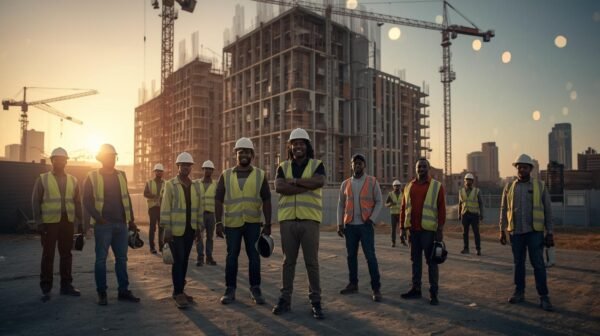
The construction site never really sleeps. Even as the rest of us gather around holiday tables, someone somewhere is tightening bolts on a critical infrastructure project, pouring concrete before the frost sets in, or putting the finishing touches on a shelter that will become someone’s first real home.
This year, as we close out 2025, it’s worth pausing to recognize the hands that built our year—the crews who showed up when the weather didn’t cooperate, who met impossible deadlines, and who poured not just concrete, but heart, into projects that will shape communities for generations.
Project of the Year: The Riverside Commons
Our 2025 Project of the Year isn’t the tallest building or the most expensive contract. It’s the Riverside Commons in Akron, Ohio—48 units of affordable housing built on a lot that sat vacant for nearly a decade after flooding destroyed the neighborhood’s original apartment complex.
The project didn’t make headlines. The budget was modest. But when the last family moved in this October, something shifted in that community.
Kids who’d been doubling up in relatives’ living rooms got their own bedrooms. A single mother working two jobs cut her commute in half.
An elderly veteran on a fixed income found a place where the rent didn’t consume his entire check.
The crew from Buckeye Construction worked through one of the wettest springs on record to remediate that flood-damaged soil.
They navigated supply chain delays that would have derailed a less committed team. And when the original timeline stretched from eight months to fourteen, they didn’t cut corners—they just kept showing up.
That’s the kind of work that matters. Not because it’s glamorous, but because it’s foundational to everything else we claim to value as a society.
To Those Who Worked Through It All
This year tested everyone. We saw record heat waves across the Southwest that made afternoon shifts genuinely dangerous.
Crews in the Midwest faced polar vortex conditions that froze equipment and made every task three times harder.
Hurricane season brought devastation that demanded emergency bridge repairs, road reconstructions, and infrastructure stabilization—all on accelerated timelines because communities were cut off from essential services.
To the workers who endured those conditions: thank you.
Thank you for starting before dawn to beat the heat. For layering up in subzero wind chills. For understanding that when a bridge goes out, it’s not just an engineering problem—it’s a grandmother who can’t get to her dialysis appointment, a small business owner cut off from suppliers, a community severed from itself.
Thank you for the holidays you missed. The Thanksgivings spent in motels three states over. The Christmas Eves working double shifts to meet a deadline that would let a hospital expansion open on schedule.
The New Year’s Eves ensuring a water treatment facility came back online before a town ran dry.
The Invisible Architecture of Community
There’s a particular kind of pride in building something that lasts. Anyone who’s ever framed a wall or poured a foundation knows that feeling—the satisfaction of creating something solid, something real, something that will outlive the moment.
But there’s something even deeper in building something that serves. The electrician who wired the community center where kids go after school. The plumber who ensured clean water reaches the new clinic in a healthcare desert.
The heavy equipment operator who cleared the debris after the tornado so rebuilding could even begin.
This is the invisible architecture of community—not just the physical structures, but the commitment and craftsmanship that turns blueprints into places where life actually happens.
Looking Ahead
As we head into 2026, the challenges aren’t getting smaller. Climate change means more extreme weather to work through. Aging infrastructure means more critical repairs that can’t wait.
The affordable housing crisis means more projects like Riverside Commons are desperately needed.
But if 2025 taught us anything, it’s that the workforce is up for it. Not because construction workers are superhuman, but because they’re deeply human—motivated by the knowledge that their work matters, that someone will live better because they showed up, that communities are held together by the structures they build.
A Final Thank You
To every worker who wore a hard hat in 2025: you built more than buildings. You built possibility. You built safety. You built home.
You worked through conditions that would send most of us running for climate-controlled comfort. You met deadlines that seemed impossible. You showed up when showing up was the hardest thing to do.
The skylines and subdivisions will credit the developers and architects. The ribbon cuttings will feature the politicians and financiers.
But everyone in the industry knows the truth: nothing gets built without the workers. Nothing lasts without the craftsmanship. Nothing matters without the commitment to do it right.
So from all of us who benefit from what you build—from the families in Riverside Commons to the commuters crossing that repaired bridge to the patients in that expanded hospital—thank you.
Your work this year built the foundation for someone else’s better tomorrow.
And that’s worth celebrating.
Have a project or crew you think deserves recognition? Share your story in the comments. Let’s use this space to celebrate the work that often goes unnoticed but never unappreciated.
Also Read
Top 3 Construction Trends to Watch in 2026
US Construction Firms Face Scrutiny Over DJI Drone Deployment on Federal Sites

- PV Guangzhou 2027 to Highlight Solar and Energy Storage Technologies - October 22, 2026
- Accurate and Reliable Measurement and Monitoring of Industrial Plant Water Treatment - October 21, 2026
- SODECA Highlights Industrial Ventilation Technology at Mega Clima Expo Kenya 2026 - October 14, 2026