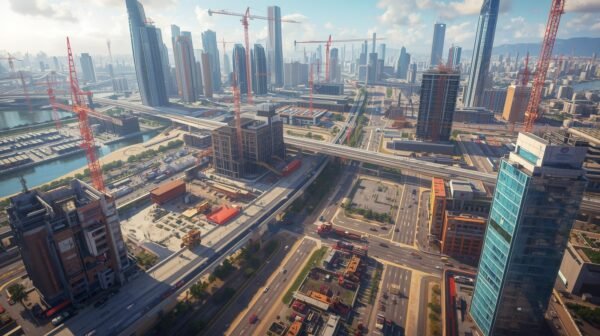
Africa is experiencing an unprecedented construction renaissance. As 2026 unfolds, the continent is witnessing the simultaneous development of some of the most ambitious infrastructure projects in its history—collectively worth hundreds of billions of dollars.
From railways that will revolutionize trade routes to smart cities rising from desert sands, these mega-projects are not just changing skylines; they’re rewriting Africa’s economic future.
The Railway That Will Transform Continental Trade
The Lobito Corridor railway extension stands as a testament to Africa’s connectivity ambitions.
This $1 billion greenfield railway will slice through 830 kilometers of challenging terrain, connecting Angola’s Luacano to Zambia’s copper-rich Chingola region.
Breaking ground in early 2026, this engineering marvel promises to compress what currently takes 45 days into a mere seven-day journey from the Copperbelt to international markets.
The environmental credentials are equally impressive. Project engineers estimate the corridor will eliminate 300,000 tons of CO2 emissions annually by shifting cargo from congested road networks to efficient rail transport.
For landlocked Zambia and the Democratic Republic of Congo, this railway represents economic liberation—a direct artery to global commerce through Angola’s Atlantic ports.
Ethiopia’s Hydroelectric Giant Reaches Completion
The Grand Ethiopian Renaissance Dam continues its march toward becoming Africa’s largest power station. With a capacity of 6,000 megawatts, this $4.8 billion colossus on the Blue Nile will rank as the seventh-largest hydroelectric facility globally.
As 2026 progresses, the reservoir filling process enters critical phases, bringing Ethiopia closer to energy independence and potential electricity exports to neighboring nations.
The dam’s completion represents more than infrastructure—it symbolizes Africa’s ability to execute continent-scale engineering projects despite political headwinds and technical challenges.
Nigeria’s Refinery Revolution
Aliko Dangote’s vision of Africa’s largest oil refinery has materialized outside Lagos. The $12-19 billion complex, capable of processing 650,000 barrels daily, enters its final commissioning phases in 2026.
This facility alone could transform Nigeria from a crude oil exporter that imports refined products into a regional petroleum powerhouse.
The refinery’s petrochemical complex will produce fertilizers, polypropylene, and other derivatives, creating an industrial ecosystem that could employ thousands and spawn ancillary industries across West Africa.
Egypt’s Administrative Capital Takes Shape
Forty-five kilometers east of Cairo, a completely new city is emerging from the desert. Egypt’s New Administrative Capital features 21 residential districts, 25 commercial zones, artificial lakes, solar farms, and a gleaming international airport.
This smart city incorporates cutting-edge urban planning, with infrastructure work accelerating through 2026.
The project represents Egypt’s boldest bet on urban decentralization, designed to alleviate pressure on overcrowded Cairo while showcasing the nation’s technological aspirations to global investors.
Kenya’s Silicon Savannah Dreams
South of Nairobi, Konza Technology City is materializing as Africa’s answer to Silicon Valley. The $14.5 billion project, located in Machakos County, targets business process outsourcing, software development, and data center operations.
Construction phases continuing through 2026 will establish the digital infrastructure needed to position Kenya as Africa’s technology hub.
Meanwhile, Kenya’s Nairobi-Mombasa Expressway—Africa’s largest road public-private partnership—advances through critical construction phases, promising to revolutionize the country’s most vital economic corridor.
Uganda’s Transportation Renaissance
In January 2026, construction resumed on the Busega-Mpigi and Kagitumba-Kayonza-Rusumo roads project, backed by €425 million in financing.
This comprehensive infrastructure package includes seven bridges, 54 kilometers of drainage systems, and multiple interchanges designed to unclog the Northern Corridor connecting Kampala to Kigali.
The project exemplifies regional integration efforts, where infrastructure transcends national boundaries to serve broader East African economic objectives.
Angola’s Infrastructure Surge
Beyond the Lobito Corridor, Angola is pursuing an aggressive domestic infrastructure agenda.
The government has committed to completing multiple landmark projects in 2026, including the Luanda Convention Center, the Boa Vista-Kimakienda road network, and integrated infrastructure developments in Caxito.
These projects signal Angola’s determination to modernize beyond its oil-dependent economy.
Nigeria’s Long-Awaited Hydroelectric Project
The Mambila Hydroelectric Power Project in Taraba State, decades in planning, is finally advancing toward reality.
The $5.8 billion development will span three dams across the Donga River, generating 3,050 megawatts of electricity. For power-starved Nigeria, Mambila represents hope for industrial transformation and improved quality of life for millions.
LAPSSET: Kenya’s Corridor to the Future
The Lamu Port-South Sudan-Ethiopia-Transport Corridor continues reshaping East Africa’s economic geography.
This multi-faceted infrastructure program encompasses port construction, highway development, and railway networks designed to open Kenya’s northern frontier while providing landlocked Ethiopia and South Sudan with alternative trade routes.
The Broader Picture
These projects emerge against a backdrop of staggering continental ambition. West Africa alone hosts projects worth over $1 trillion, while North Africa commands $930 billion in active developments. Egypt dominates with 450+ active projects valued at $640 billion.
The Infrastructure Africa 2026 summit in Cape Town serves as the nexus where Africa’s G20 commitments translate into concrete action.
International partners, including substantial U.S. investment in the Lobito Corridor and various development finance institutions, demonstrate growing global confidence in Africa’s infrastructure future.
As these mega-projects progress through 2026, they’re not merely constructing roads, railways, and power plants.
They’re building the physical foundation for Africa’s economic transformation—creating jobs, enabling trade, connecting communities, and positioning the continent as a serious player in the global economy.
The Africa rising narrative is being literally constructed, one project at a time.
Also Read
Next-Gen Stadiums: Innovative Designs Shaping Africa’s Sporting Venues
Mega Projects Transforming the Middle East Construction Landscape in 2025

- SODECA Highlights Industrial Ventilation Technology at Mega Clima Expo Kenya 2026 - October 14, 2026
- How They Were Built: Inside the Engineering of the Lesotho Highlands Water Project - October 11, 2026
- Africa’s Water Reuse Opportunity: Building the Infrastructure for a Water-Secure Future - September 28, 2026