

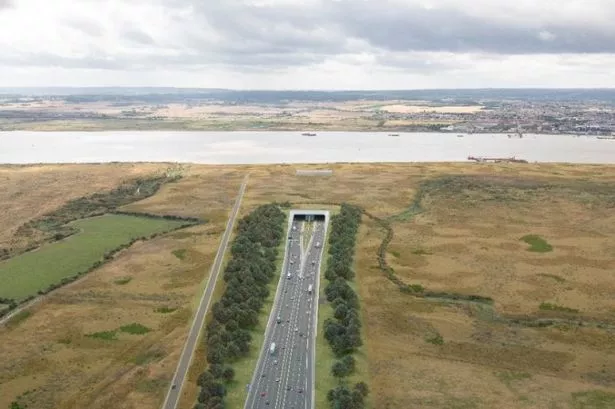
The race is on to build one of the world’s widest tunnel boring machines as the Lower Thames Crossing project moves into its next critical phase.
Bouygues Travaux Publics Murphy joint venture has officially opened tenders for suppliers to construct the colossal machine that will carve through chalk beneath the Thames, marking a pivotal moment in Britain’s largest road infrastructure project.
A Machine of Superlatives
The specifications alone are staggering. At 16.4 meters wide, this will be no ordinary tunnel boring machine.
It will excavate more than 4 kilometers of tunnel capable of carrying three lanes of traffic in each direction, creating the longest road tunnel in the UK and one of the widest bored tunnels anywhere on the planet.
To put that in perspective, the machine’s diameter is roughly equivalent to stacking three double-decker buses on top of each other.
Yet despite its mammoth proportions, the TBM will need to operate with surgical precision as it burrows through the Thames riverbed, navigating geological challenges while maintaining millimeter-level accuracy.
Innovation Meets Sustainability
What sets this project apart is its innovative approach to construction. Rather than deploying two separate machines for the northbound and southbound tunnels—the traditional method—the consortium has opted for a single TBM strategy.
This isn’t just about saving money; it’s a calculated move to reduce the project’s carbon footprint without extending the construction timeline.
The decision reflects a broader shift in major infrastructure projects toward sustainable practices.
By minimizing the manufacturing impact and reducing the overall material requirements, the Lower Thames Crossing is positioning itself as a blueprint for low-carbon mega-projects.
From Tender to Tunnel
The procurement timeline reveals an ambitious schedule. With tenders now open, the machine is expected to be purchased next year, giving suppliers a narrow window to demonstrate their technical capabilities and competitive pricing.
Work on the northern tunnel entrance is set to begin next summer, with the actual boring operation commencing in 2028.
This phased approach allows for careful preparation of launch sites and supporting infrastructure while the TBM is being manufactured and assembled.
The machine itself will likely take years to build, with components fabricated in specialized facilities before being transported to the site for final assembly.
Why It Matters
The £10 billion Lower Thames Crossing isn’t simply about adding road capacity. The Dartford Crossing, currently the only road link across the Thames east of London, has become a notorious bottleneck, with congestion costing the economy an estimated £1 billion annually.
The new crossing between Kent and Essex promises to fundamentally reshape connectivity in the region.
The UK government’s recent allocation of £891 million in funding through the Budget has provided the financial certainty needed to move forward with major procurement decisions like the TBM tender.
This injection of capital signals government confidence in the project’s viability and importance to national infrastructure goals.
Engineering Challenges Ahead
Boring beneath one of the world’s busiest waterways presents unique challenges. The Thames bed geology includes layers of chalk, which while relatively homogeneous, requires careful management to prevent water ingress and maintain stability.
The TBM will need to balance cutting speed with ground support, installing segmental concrete lining as it advances to create a permanent tunnel structure.
The machine’s cutting head will be studded with replaceable disc cutters capable of grinding through solid chalk, while sophisticated navigation systems ensure the tunnel follows its precise alignment.
Behind the cutting face, a factory-like operation will install pre-cast concrete tunnel segments, seal joints, and manage the excavated material—thousands of tons that will need to be transported away.
A Glimpse Into the 2030s
When the tunnels finally open to traffic in the early 2030s, drivers will experience one of the most advanced road tunnels in the world.
LED lighting, sophisticated ventilation systems, and state-of-the-art safety features will ensure the crossing operates efficiently around the clock.
For suppliers eyeing the current tender, winning this contract means cementing their reputation on one of Europe’s most high-profile infrastructure projects.
For the UK, it represents a statement of ambition and capability in an era when major infrastructure projects face increasing scrutiny over costs, timelines, and environmental impact.
As tender documents circulate among the world’s leading TBM manufacturers, the Lower Thames Crossing moves from planning to reality.
The machine that emerges from this process will write its own chapter in British engineering history, one meter of chalk at a time.
Also Read
Bauer Technologies Secures Piling Contract for London’s Dovetail Building
UK Construction Faces Worst Crisis Since Pandemic Peak

- From Operator to Algorithm: Bedrock Puts Autonomous Excavators to Work on Live Construction Sites - September 7, 2026
- Built For The Rough Stuff: Inside Titan’s new ForestEDGE™ Tyre Line - September 4, 2026
- South Africa Has R395 Billion in Infrastructure Projects — But Can the Industry Deliver Them? - August 26, 2026
