

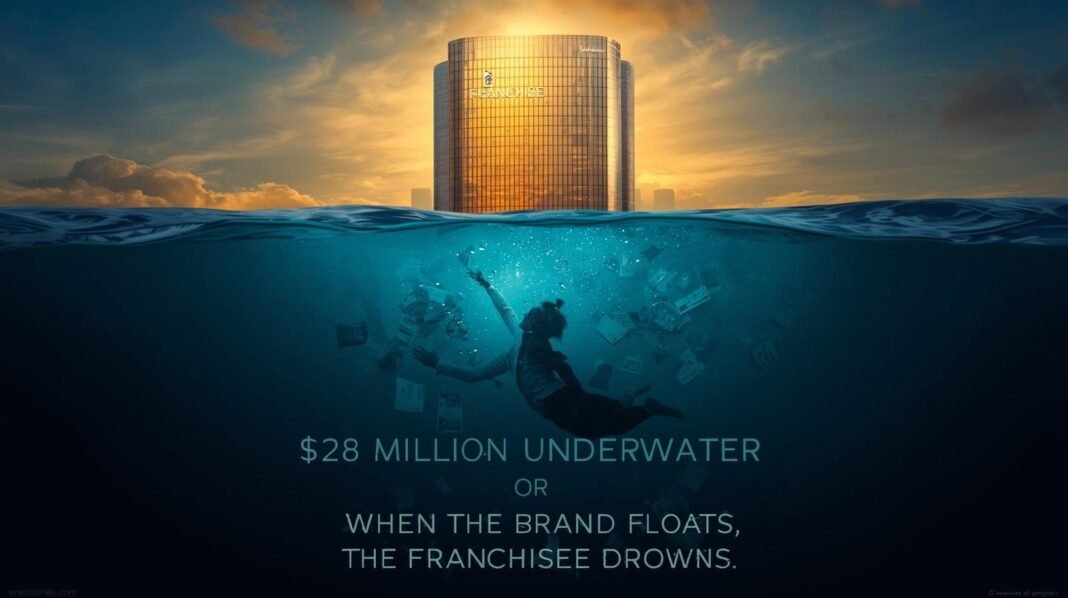
When M&M Custard LLC filed for Chapter 11 bankruptcy last Thursday with $27.7 million in debt against just $5.2 million in assets, it became the latest casualty in an accelerating crisis that corporate America doesn’t want to talk about: the franchising model is systematically destroying the people it promised to enrich.
The story isn’t about frozen custard. It’s about a business structure where risk flows downward and profit flows up—and how the economic pressures of 2025 have turned that imbalance into an existential threat for thousands of small business owners across America.
The Franchisee Death Spiral
M&M Custard operated 32 Freddy’s Frozen Custard & Steakburgers locations across six states—Missouri, Kansas, Illinois, Indiana, Kentucky, and Tennessee.
On paper, they were one of the brand’s largest franchisees, a success story in the making. In reality, they were carrying debt that exceeded their assets by more than five times.
This isn’t an anomaly. It’s becoming the norm.
The first half of 2025 has witnessed a franchisee bloodbath that tells a remarkably consistent story.
A Subway franchisee in California filed for bankruptcy in June. Consolidated Burger Holdings, operating 57 Burger King locations in Florida and Georgia, filed in April. The Little Mint Inc., parent of Hwy 55 Burger Shakes & Fries, filed on the last day of 2024 after closing 13 corporate locations.
In February, Hy-Vee quietly shuttered all 79 Wahlburgers franchises in its stores without even filing bankruptcy—just walked away.
The pattern is unmistakable: franchisees are collapsing while their corporate parent companies remain financially stable, if not thriving. Freddy’s parent company didn’t file for bankruptcy. Neither did Burger King, Subway, or the Wahlburgers brand.
The Corporate Shield
Here’s what makes the franchise model so insidious in moments of economic stress: the brand gets paid regardless. Franchisees owe royalties based on gross sales, not net profit. Whether M&M Custard was making money or hemorrhaging cash, Freddy’s still collected its cut.
Look at M&M Custard’s creditor list. The largest unsecured creditor is Equity Bank, owed $8.5 million. But also on that list: insiders Eric H. Cole and Steven Nordstrom, each holding 17% equity and personally owed $700,000 and $550,000 respectively.
These aren’t absentee investors—these are owner-operators who loaned their own money to keep the dream alive, only to watch it die anyway.
Meanwhile, U.S. Food is owed over $524,000 for supplies. Budderfly LLC is owed $869,000 for energy management services. Flowers Food, the bread supplier, is out over $91,000. The entire supply chain bet on M&M Custard’s survival because franchisees are supposed to be the safe bet in fast food—backed by a proven brand, established systems, corporate support.
Except when the economics shift, none of that matters.
The 2025 Breaking Point
What changed? Everything, and all at once.
Interest rates that began climbing in March 2022 have made debt servicing crushingly expensive. Franchisees who borrowed to expand during cheap-money years now face loan payments that consume any operating margin.
Inflation has driven up costs for labor, food, and supplies at rates that far outpace what consumers will tolerate in menu prices.
And consumer behavior fundamentally shifted during the pandemic and never shifted back—people got used to eating at home, to saving money, to being more selective about discretionary spending.
McDonald’s CEO Chris Kempczinski recently told analysts that lower-income consumers have seen traffic decline by nearly double digits, a trend that has persisted for almost two years. Higher-income consumers, meanwhile, are increasing their quick-service restaurant visits.
The market has bifurcated, and franchisees operating in secondary markets—the Paducahs and Sedalias and Hopkinsvilles of America where M&M Custard had locations—are on the wrong side of that divide.
Bankruptcy attorney Daniel Gielchinsky put it bluntly to Fox Business earlier this year: “Restaurants that exist today may not exist in five years. They’ll be off the map.”
The Remodel Trap
Perhaps nothing illustrates the franchisee squeeze better than the remodel mandate story. Earlier this year, American Dairy Queen revoked franchise rights from Project Lonestar, resulting in about 30 Texas locations closing. The reason? The franchisee failed to complete mandatory remodels.
Think about that dynamic. A franchisee struggling with debt, facing declining traffic, watching margins evaporate, is told by corporate: spend hundreds of thousands of dollars to remodel your locations or lose your franchise.
The remodel doesn’t change the underlying economics. It doesn’t bring back customers who can’t afford to eat out. It doesn’t make the debt payments smaller. But it’s required.
And when the franchisee can’t afford it, corporate takes the franchise rights back. The franchisee loses everything. Corporate moves on to the next operator willing to take the risk.
M&M Custard isn’t just closing—they’re planning targeted closures as part of their bankruptcy restructuring. Translation: some of those 32 locations will never reopen, and the communities they served will lose local employers, gathering places, and economic anchors. The brand will survive. The franchisees won’t.
What Bankruptcy Really Means
M&M Custard’s filing states there will be funds available for unsecured creditors. That sounds reassuring until you understand what it means: after secured creditors (like Equity Bank with its $8.5 million claim) get paid first, whatever’s left gets divided among everyone else. Suppliers, landlords, vendors—they’ll get pennies on the dollar if they’re lucky.
The 32 locations are continuing to operate “as normal” during the restructuring. Normal, except employees don’t know if they’ll have jobs in six months. Suppliers don’t know if they’ll get paid. The owner-operators who put their personal fortunes into this venture are watching it dissolve.
This is what Chapter 11 reorganization looks like from the franchisee side: a controlled demolition of someone’s American Dream.
The Uncomfortable Truth
The franchise model was supposed to democratize business ownership. Buy into a proven system, follow the playbook, work hard, and build wealth.
For decades, it worked. Now the model is revealing its fundamental flaw: when economic conditions change, franchisees absorb all the downside risk while brands maintain their revenue streams.
Freddy’s didn’t file for bankruptcy. In September, the chain was acquired by Rhône, a global private equity firm, from Thompson Street Capital Partners.
The brand is being positioned for growth. The parent company’s CEO talked about “unlocking even greater opportunities” and taking success “to the next level.”
Meanwhile, one of their largest franchisees just declared they have 18 cents in assets for every dollar of debt.
M&M Custard’s bankruptcy isn’t a story about bad management or poor business decisions. It’s a story about a business model that works beautifully for corporate brands and catastrophically for franchisees when the economic tide goes out.
And in 2025, that tide is receding fast, leaving franchisees across America exposed and drowning.
The only question is how many more will go under before we acknowledge that the model itself is broken—or before the few franchisees still solvent decide the risk simply isn’t worth it anymore.
Because when they all figure that out at once, the brands won’t have anyone left to take the risk for them. And then we’ll discover what fast food really costs when corporate can’t externalize the losses anymore.
Social Security Payment Updates: What 70 Million Americans Need to Know
The $1,325 Question: Why Millennials Are Staying Renters (And They’re Not Wrong)

- From Operator to Algorithm: Bedrock Puts Autonomous Excavators to Work on Live Construction Sites - September 7, 2026
- Built For The Rough Stuff: Inside Titan’s new ForestEDGE™ Tyre Line - September 4, 2026
- South Africa Has R395 Billion in Infrastructure Projects — But Can the Industry Deliver Them? - August 26, 2026
