

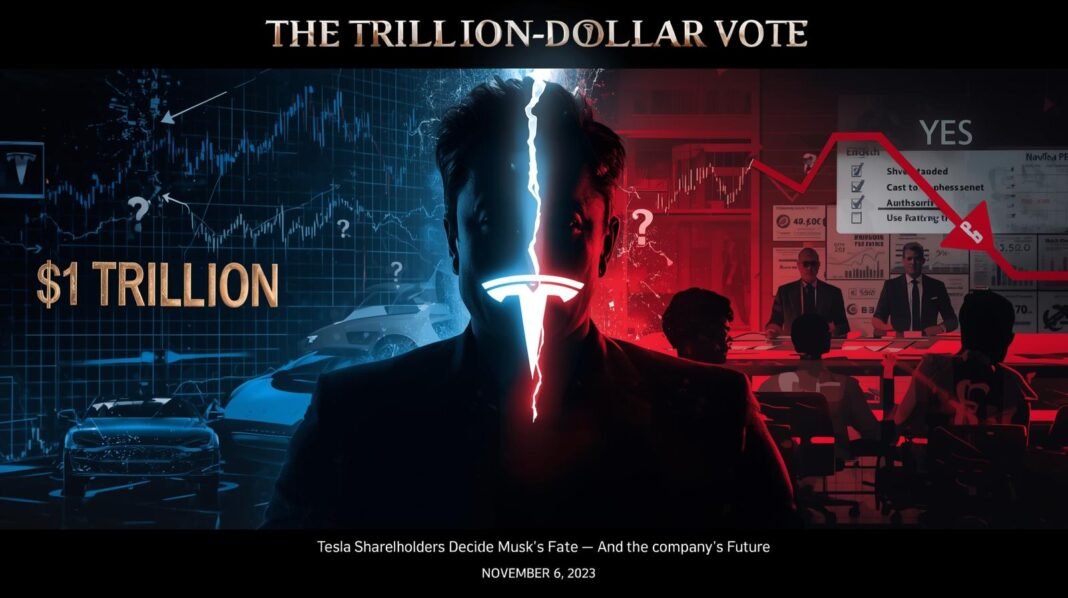
In what may become the most consequential corporate governance decision in modern business history, Tesla shareholders are casting votes today on a compensation package that could transform Elon Musk into the world’s first trillionaire — or trigger his departure from the electric vehicle giant he built into a market sensation.
A Pay Package Beyond Precedent
The stakes couldn’t be higher. The proposed compensation would grant Musk as many as 423.7 million additional shares of Tesla stock over the next decade, a figure that staggers even by Silicon Valley’s extravagant standards.
If Tesla reaches the ambitious $8.5 trillion market cap target, those shares would be worth approximately $1 trillion — making this the largest compensation package in corporate history by an astronomical margin.
But this isn’t simply about money. The full award would increase Musk’s stake from roughly 13% to about 25% of the company, fundamentally reshaping Tesla’s power structure.
Board Chair Robyn Denholm made the company’s position crystal clear: the vote represents an existential moment for Tesla’s future direction.
“Robot Army” Dreams and Reality Check
Musk insists the package is less about compensation and more about securing voting control, particularly given Tesla’s planned “robot army” of Optimus humanoid workers that he claims he cannot trust anyone else to control.
The billionaire’s vision extends far beyond traditional automaking — he’s betting the company’s future on autonomous robotaxis, humanoid robots, and artificial intelligence breakthroughs.
Yet the road to this futuristic vision has been rocky. Tesla has faced mounting challenges this year, with global sales declining and a 13.5 percent drop in U.S. sales reported in July.
More troubling for the brand’s image, Musk’s political activities have damaged Tesla’s market position — a recent study estimated that if Musk had avoided politics, Tesla’s sales could have been 67 to 83 percent higher, equivalent to roughly 1 to 1.26 million additional vehicles.
The Battle Lines Are Drawn
The compensation vote has split the investment community into warring camps. Major proxy advisory firms Glass Lewis and Institutional Shareholder Services have urged shareholders to reject the deal, wielding significant influence over institutional investors.
Norway’s $2 trillion sovereign wealth fund, holding 1.14% of Tesla valued at about $11.6 billion, has voted against the package, citing concerns over its total size, dilution, and lack of mitigation of key person risk.
Musk’s response to the proxy firms was characteristically combative, calling them “corporate terrorists” during Tesla’s recent earnings call. He argued that their influence over institutional investors is precisely why he needs greater voting control.
On the opposite side, influential supporters like Wedbush Securities analyst Dan Ives remain bullish.
The State Board of Administration of Florida has thrown its weight behind the package, while retail investors — comprising about 30% of Tesla’s shareholder base — showed strong support in last year’s compensation vote.
The Price of Genius (or Distraction?)
Critics point to Musk’s deteriorating public image, with a Gallup poll finding him viewed favorably by only 33 percent of Americans by August, trailing only President Trump and Israeli Prime Minister Netanyahu in unpopularity.
New York State Comptroller Thomas DiNapoli, who controls 3.3 million shares through the state’s pension fund, didn’t mince words about the proposal’s logic.
To unlock the full package, Musk must achieve both market capitalization and operational goals over a 7.5 to 10-year period, hitting 12 increasingly ambitious tranches starting at a $2 trillion market cap and culminating at $8.5 trillion.
The targets include doubling vehicle sales, tripling operating profits, and delivering one million robots from a current base of zero.
A Vote With Global Reverberations
Despite its central role in Tesla’s campaign for the compensation package, the company’s “Master Plan 4” — promoted as a roadmap to “sustainable abundance” — remains frustratingly vague, drawing criticism even from Tesla’s biggest fans.
Musk himself acknowledged the criticism as “fair” and promised to add specifics, yet the document remains unchanged.
What makes this vote particularly intriguing is its democratic theater. Tesla has mounted an aggressive campaign targeting retail investors, complete with slick websites, social media blitzes on X, and even promotional videos featuring Optimus robots demonstrating how to cast votes.
Last year’s ratification vote, which passed with 72% support, provides a strong indication of how this year’s vote might unfold.
The Bottom Line
As voting closes tonight at 11:59 PM ET, the question looms: Is Musk indispensable to Tesla’s ambitious pivot toward autonomous vehicles and robotics, justifying a compensation package that dwarfs anything in corporate history?
Or does this represent a board captured by a charismatic but increasingly distracted CEO, handing over unprecedented rewards while the company’s core business struggles?
The answer will reverberate far beyond Tesla’s Austin headquarters, potentially reshaping norms around executive compensation, founder-CEO relationships, and corporate governance for generations to come.
One thing is certain — whether approved or rejected, this vote marks a watershed moment in the ongoing saga of Elon Musk and the electric vehicle revolution he catalyzed.
Shareholders have spoken through their proxies. Now the world waits to see if they’ve bet on genius — or simply doubled down on a very expensive distraction.
Also Read
The Man Behind ‘Please Call Me’ Just Won His 18-Year Battle With Vodacom
Check Your Account Now: SASSA Children’s Grants Hitting Bank Accounts Today

