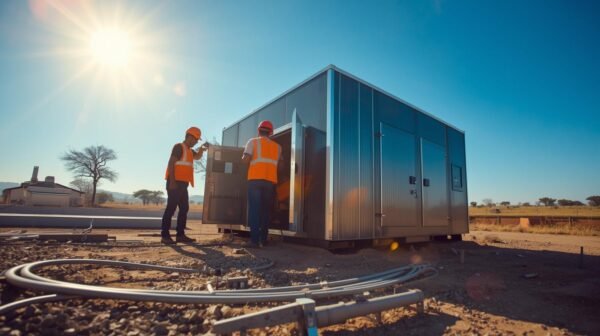
Temporary power is an essential safeguard for manufacturing plants facing an increasingly complex mix of planned and unplanned disruptions.
Whether the challenge is a sudden grid outage, disaster recovery or planned maintenance shutdown, reliable rental power solutions are essential.
Here’s a deep dive into the fundamentals of renting, plus an evaluation of the best temporary power rental options for manufacturing plants.
1. Sunbelt Solomon
Sunbelt Solomon is a market-leading provider of electrical transformer solutions, with a history spanning over 100 years.
The company specializes in transformer rental, sales, repair and recycling, servicing utilities, industrial, and commercial clients across North America. It provides everything for temporary power, from transformers and cables to switchgear or entire turnkey mobile substation solutions.
Experts collaborate with each client to find the right arrangement for their power demands. The field service team ensures your temporary power project works seamlessly, safely and efficiently.
With a vast inventory and rapid deployment, Sunbelt Solomon stands out for its deep industry experience. Its expertise in both emergency and planned outages ensures minimal downtime for manufacturing plants. It is a one-stop shop for emergency temporary power needs.
Key services:
| Temporary power transformer rentals — all voltages and sizes | 24/7 emergency response and rapid mobilization |
| On-site installation and technical support | Custom engineering and project management |
2. Aggreko
Aggreko has been providing mobile power solutions since 1962 and has a strong presence in over 80 countries. It works with all kinds of manufacturers and offers temporary power, temperature control equipment, and supplemental cooling.
The business offers Tier 4F generators and natural gas generators to help plants meet environmental goals. Hybrid power options also provide a greener solution.
Aggreko can offer turnkey solutions when required, and 24/7 remote monitoring supports the equipment. Its global scale and advanced technology ensure reliable, scalable solutions for manufacturing emergencies.
Key services:
| Temporary power generation | Load bank testing |
| Transformer and switchgear rental | 24/7 emergency response |
3. United Rentals
United Rentals provides comprehensive temporary power solutions, including generators, power distribution and climate control equipment. It also offers manufacturing plant solutions for planned upgrades, unplanned outages and remote site needs.
Services include expert planning, equipment rental from a wide fleet, on-site monitoring and customized engineering to maintain production continuity.
United Rentals is North America’s largest equipment rental brand — its extensive branch network and integrated logistics allow for rapid deployment anywhere in the U.S. or Canada.
Key services:
| Temporary power and transformer rentals | Climate control equipment |
| Nationwide logistics | Emergency response teams |
4. Trystar
Trystar specializes in power distribution equipment and temporary power solutions. The enterprise is known for rugged systems that are built to perform in demanding industrial or emergency conditions.
With custom engineering and consultative services, it offers flexible configurations to meet any manufacturing need.
Renewable energy options include the GridPak for clean, temporary power. Trystar’s durable and highly portable equipment includes load banks for testing and power management, as well as specialized cable assemblies.
Key services:
| Portable transformers and distribution panels | Custom cable assemblies |
| Emergency and planned outage support | Engineering and technical services |
5. Herc Rentals
Herc Rentals offers a wide range of industrial generator rental options for heavy-duty and large-scale manufacturing.
It also provides portable lighting, air compressors, material handling equipment, climate control tools, pumps and compressors.
The company focuses on safety, compliance and tailored solutions. It has a track record of over 50 years in equipment and power solutions for manufacturing and construction.
With round-the-clock support and custom project planning, Herc Rentals is a reliable partner for critical manufacturing operations.
Key services:
| Temporary power and transformer rentals | Generators and distribution equipment |
| 24/7 emergency support | Project planning and logistics |
6. Power Plus
Power Plus has industrial-grade temporary power solutions for manufacturing plants. It provides high-voltage and extended-distance solutions and a diverse range of equipment.
This includes trailer-mounted and high-capacity generators, distribution systems, and uninterruptible power supply for critical equipment.
The business offers custom system design and installation, auxiliary fuel tanks, and fuel management. Power Plus also has turnkey permitting and compliance services to streamline emergency deployments.
Key services:
| Temporary power pole and transformer rentals | Generator and distribution equipment |
| Emergency response | Permitting and compliance support |
7. National Power
National Power is a strategic partner for sectors including manufacturing, healthcare and the military. It provides generators, switchgear equipment, energy storage systems and HVAC systems.
Experienced local teams are available across the country for expert design, installation and maintenance services. With an emphasis on proactive support and 24/7 emergency response, National Power is a strong partner for manufacturers seeking operational stability.
Key services:
| Nationwide service from local teams | 24/7 emergency response |
| Critical power systems and custom HVAC | Emphasis on safety and quality |
Selection Criteria for Rental Companies
In compiling this list of top brands, options are evaluated and ranked on the following key factors:
| Industry reputation and experience | ● Years in business
● Market presence ● Customer trust ● Recognition as a leader in the temporary power and transformer rental sector |
| Service breadth and depth | ● Range of inventory — transformer sizes, voltages and related equipment
● Ability to provide turnkey solutions including engineering, installation and project management ● Emergency response capabilities such as 24/7 support and rapid deployment |
| Geographic reach | ● Nationwide or global coverage |
| Technical innovation and sustainability | ● Use of advanced technologies such as remote monitoring, hybrid/battery systems
● Committment to green power, recycling and sustainable practices |
| Customer support and customization | ● Availability of on-site tech support, custom engineering and compliance assistance
● Flexibility in rental terms and project-specfic solutions |
Understanding Temporary Power Rental
Instead of purchasing permanent infrastructure that may only be used occasionally, manufacturers can rent the exact capacity they need for the duration of the emergency.
This short-term leasing of power generation and distribution equipment can include generators, transformers, load banks, switchgear and in many cases full mobile substations.
The equipment is delivered, installed and maintained by the rental provider, ensuring continuity of production with minimal burden on existing internal teams.
Manufacturing environments require constant electricity to power machinery, maintain HVAC and process control systems and keep safety infrastructure operational. Situations that trigger the need for temporary power include:
- Emergency outages: Utility disruptions, accidents or equipment failure can halt production without warning. A rental solution can restore power within hours.
- Disaster recovery: After storms, floods or earthquakes, rental power can restore operations well before utilities are available again.
- Planned shutdowns: Plants often need to shut down transformers, switchgear or utility connections for inspection or upgrades. Temporary power ensures that critical systems remain online.
- Plant expansion: New lines or production areas sometimes require power before utility connections are finalized. Rentals bridge this gap, allowing new capacity to come online without delays.
Key Benefits of Temporary Power Solutions
Rental power provides flexibility and insurance against an unpredictable operating environment.
Minimizing Downtime and Protecting Productivity
Every hour of unplanned downtime in manufacturing translates into lost output, missed delivery schedules or potential penalties from customers.
Temporary power eliminates much of this risk by allowing production to continue while maintenance or recovery is underway.
For industries with perishable goods or high-temperature processes — such as food processing, chemical plants or metal works — power continuity can prevent catastrophic losses.
Cost Benefits
Purchasing additional generators, switchgear or distribution infrastructure is capital-intensive.
Most manufacturers only require supplemental power for a few weeks each year. Rental enables access to the same equipment at a fraction of the upfront cost while also avoiding expenses on storage, maintenance and testing. Rental entities often include engineering support and logistics to reduce internal labor costs.
Compliance and Safety
The best temporary power rental options for manufacturing plants have equipment that meets Tier-4 final emissions standards, noise regulations and electrical safety codes. They often assist with permitting, fuel handling and environmental compliance.
By leveraging rental expertise, manufacturers can avoid fines, shutdowns or accidents that might occur if equipment is installed without sufficient oversight.
Assessing Your Plant Power Needs
A successful rental project begins with a price understanding of load requirements. Manufacturers should calculate total demand in kilowatts or kilovolt-amperes, considering both steady-state loads and peaks.
Voltage and phase must also be clearly specified. Mismatches in this area can cause serious safety hazards and prevent equipment from operating properly.
To avoid costly changes later, plant managers should be ready with the following information when engaging a rental partner:
- Total load requirement, including base and peak demand
- Load profile — steady or variable
- Voltage, frequency and phase details
- Harmonic or sensitive load considerations
- On-site fuel availability
- Environmental conditions such as high temperatures, noise restrictions or limited space
This level of detail enables the provider to configure a solution that is both efficient and compliant.
Do You Need a Turnkey Substation Solution?
For larger facilities, a single generator may not suffice. Turnkey mobile substations provide a comprehensive package including high-voltage transformers, switchgear, metering and protection systems.
They are often delivered on trailers or skid-mounted units. Pre-engineered and tested, these allow rapid installation and commissioning.
Turnkey solutions typically include site surveys, engineering design, permitting assistance, delivery, installation, testing and ongoing maintenance.
Many providers also offer remote monitoring and on-site project managers who coordinate between utility companies, plant engineers, and safety authorities. This level of service ensures projects stay on schedule and within compliance boundaries.
Simple generator projects may be deployed in a matter of hours. More complex turnkey solutions typically require days to weeks for mobilization.
Demobilization takes less time but must still be carefully planned to avoid unintentional outages. Agreeing on a clear timeline in advance prevents surprises.
How to Choose the Best Temporary Power Rental Options for Manufacturing Plants
Not all rental enterprises deliver the same level of service. In an emergency, every hour counts. Providers with regional depots and 24/7 dispatch can mobilize equipment within hours, not days.
Asking about average response times and recent deployment history can reveal whether an option is truly prepared.
A provider should offer generators, transformers, load banks, automatic transfer switches and cabling.
A broad inventory allows it to design solutions tailored to your site rather than forcing you to adapt to what they have available.
Look for those offering engineering assistance, on-site technicians and remote monitoring, which can reduce the risk of failure, optimize fuel efficiency and provide a single point of accountability.
Equipment should also meet or exceed regulatory standards such as EPA Tier-4 for diesel engines, ISO quality certifications, and local electrical codes.
Providers that invest in green technologies such as battery energy storage or hydrogen-ready generators are better positioned to help you meet corporate sustainability goals.
Key Questions to Ask Before Signing a Contract
Before committing to a temporary power rental provider, plant managers should ask:
- What is your average deployment time for emergencies?
- Can you scale the solution up or down if requirements change?
- How do you handle permitting and regulatory compliance?
- What environmental safeguards are in place for fuel and emissions?
- Do you offer hybrid or renewable options?
- What level of technical support is included in the rental fee?
Thorough vetting in advance prevents misunderstanding and ensures a smooth execution.
Common Pitfalls in Renting Power Solutions and How to Avoid Them
Most problems with temporary power rentals can be avoided with some forethought and planning. One of the most common is renting equipment that cannot handle peak loads, which leads to tripped breakers, overheating or outright system failure.
The solution is to account for both base and surge loads when calculating requirements and to err slightly on the side of additional capacity.
The opposite problem results in wasted rental fees and inefficient operation. Generators that run well below their rated capacity burn fuel inefficiently and may develop maintenance issues. Proper load profiling will help strike the right balance.
Local authorities may require permits for fuel storage, emissions or electrical interconnections. Failing to secure these can delay deployment for weeks.
Even if equipment operates correctly, noncompliance with noise limits or emissions standards can lead to complaints, fines or enforced shutdowns.
Engage providers early so they can guide you through the permitting process, and always verify that the rental fleet meets Tier-4 Final of local equivalent standards and request noise-attenuated units if operating near sensitive areas.
Improper grounding, inadequate fuel containment, or poor site security can lead to accidents, environmental incidents or theft.
The best practice is to ensure the provider installs UL-rated panels, includes spill containment systems, and provides fencing or security for long-term rentals.
By anticipating these pitfalls, plant managers can safeguard both productivity and reputation.
Powering Through — Choosing Your Ideal Partner
When manufacturing operations face the threat of power emergencies, choosing the right rental partner is crucial.
Each of the companies showcased here brings unique strengths, from global reach and comprehensive services to specialized expertise and customer-focused solutions.
By carefully evaluating your specific needs and priorities, you can choose a provider who will keep your operations running smoothly and contribute to your overall resilience and sustainability.
Also Read
How Site Supervisors Can Pick Abrasives That Save Time and Money
The comprehensive guide to Solar Generators: Powering your home sustainably

- SODECA Highlights Industrial Ventilation Technology at Mega Clima Expo Kenya 2026 - October 14, 2026
- How They Were Built: Inside the Engineering of the Lesotho Highlands Water Project - October 11, 2026
- Africa’s Water Reuse Opportunity: Building the Infrastructure for a Water-Secure Future - September 28, 2026