
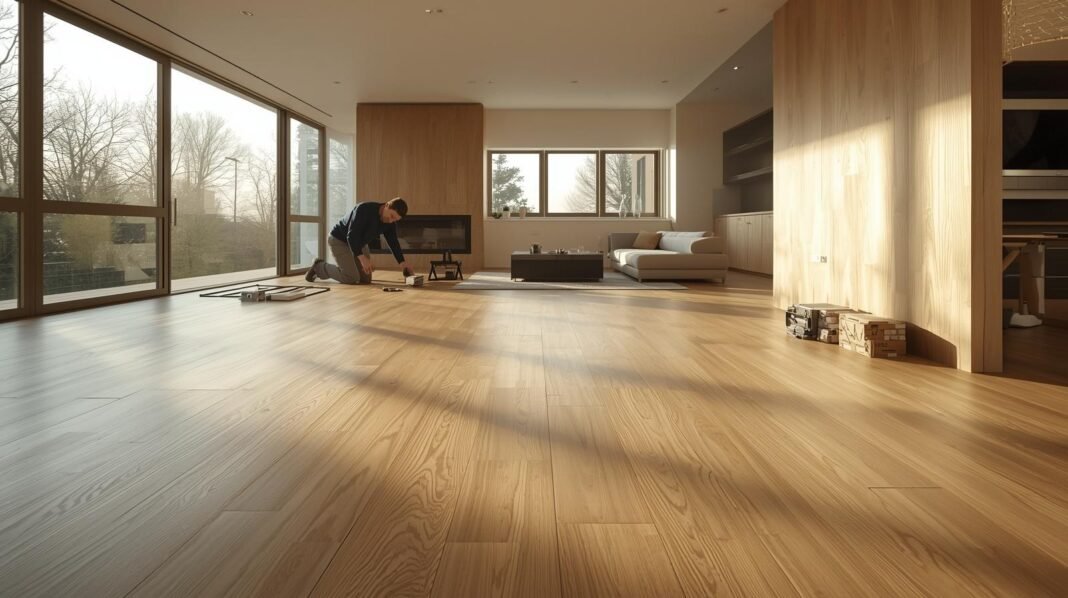
Planning a wood floor installation requires a clear understanding of current pricing trends and cost factors.
In 2026, homeowners can expect to invest between $6 and $25 per square foot for complete hardwood floor installation, including both materials and labor.
This comprehensive guide breaks down the specific costs you’ll encounter and helps you budget effectively for your flooring project.
Average Wood Flooring Costs in 2026
The national average for wood floor installation falls within a broad range depending on several key factors.
Current estimates show basic installation costs starting at approximately $13 to $17 per square foot, while the overall national average ranges from $6 to $12 per square foot for standard installations, with high-end projects reaching $13 to $25 per square foot.
For a typical 250-square-foot room, homeowners should budget between $1,800 and $6,300, while larger spaces of 1,200 square feet can cost anywhere from $8,500 to $31,500. Most homeowners spend around $4,724 on average for their wood flooring project.
Material Costs Breakdown
The type of wood flooring you select significantly impacts your overall budget. Here’s what you can expect to pay for materials alone in 2026:
Solid Hardwood Flooring Solid hardwood made from a single piece of wood costs $11 to $25 per square foot installed. Material prices for solid hardwood typically range from $5 to $15 per square foot, depending on the wood species and quality grade.
Engineered Hardwood Flooring Engineered hardwood made of multiple layers costs $9 to $20 per square foot installed. Material costs alone for engineered hardwood range from $4 to $13 per square foot, making it a more budget-friendly option for many homeowners.
Wood Species Pricing Different wood species carry different price points based on availability, durability, and aesthetic appeal:
- Domestic hardwoods (Oak, Maple, Hickory): $4 to $8 per square foot for materials
- Exotic hardwoods (Brazilian Cherry, Teak, Mahogany): $8 to $12 per square foot for materials
- White Oak: $5 to $12 per square foot
- Brazilian Walnut: $9 to $15 per square foot
Labor Costs for Installation
Labor for hardwood floor installation generally costs $3 to $6 per square foot, with simpler wide-plank installations sometimes as low as $3 to $4 per square foot.
Professional installation ensures proper placement, finishing, and longevity of your investment.
Labor expenses can account for 50% to 70% of your total project cost. The installation method you choose also affects labor pricing. Nail-down installation, the traditional method for solid hardwood, tends to be more labor-intensive and costly.
Engineered hardwood offers more flexibility with nail-down, glue-down, or floating installation options, which can reduce labor expenses.
Factors That Influence Wood Floor Installation Costs
Wood Grade and Quality
Hardwood flooring falls into grades based on physical characteristics, with low-grade floors costing about $6 to $18 per square foot installed and high-grade clear wood ranging from $8 to $23 per square foot. Lower grades feature natural character marks, knots, and color variations, while higher grades offer uniform appearance without imperfections.
Plank Width and Thickness
Plank dimensions affect both material and labor costs. Wide plank formats cost more at $4.50 to $18 per square foot for materials alone, though they can reduce labor costs since fewer boards are needed to cover the floor.
Standard hardwood planks measure 5 inches wide or narrower, while wide planks range from 6 to 12 inches.
Thickness also matters for durability and refinishing potential. Most hardwood comes in 3/4-inch, 5/8-inch, or 1/2-inch thickness, with thicker flooring costing more but offering better longevity.
Installation Pattern Complexity
Simple straight installations are the most affordable option. Complex patterns like herringbone or parquet significantly increase labor costs, with true parquet floors costing $13 to $40 per square foot and prefabricated parquet-style tiles ranging from $10 to $16 per square foot installed.
Geographic Location
Installation costs vary by region due to differences in labor rates and material availability. Northeastern states typically see higher labor costs ($5 to $8 per square foot) compared to Midwestern states ($4 to $6 per square foot).
Solid vs. Engineered Hardwood: Cost and Value Comparison
Understanding the differences between solid and engineered hardwood helps you make a cost-effective choice for your specific situation.
Solid Hardwood Solid hardwood consists of planks milled from a single piece of wood, typically 3/4 inch thick. It offers authentic, timeless appeal and can be refinished multiple times throughout its lifespan, potentially lasting over 100 years with proper maintenance. However, solid hardwood is susceptible to moisture and temperature fluctuations, making it unsuitable for basements, bathrooms, or rooms with concrete subfloors.
Engineered Hardwood Engineered hardwood features a top layer of real hardwood bonded to a high-quality plywood or fiberboard core.
This construction provides superior dimensional stability, making it resistant to warping and suitable for installation over concrete, in basements, and over radiant heating systems.
While engineered hardwood can only be refinished once or twice depending on veneer thickness, quality products can last 30 to 50 years.
The choice between solid and engineered often depends on installation location, moisture concerns, and long-term refinishing plans rather than price alone.
Additional Costs to Consider
Beyond materials and basic installation, several additional expenses may apply to your project:
Subfloor Preparation Damaged or uneven subfloors require repair or leveling before installation. Expect to pay $1,000 to $3,000 for subfloor repairs, with floor joist repairs costing $40 to $60 per square foot.
Removal of Existing Flooring Removing old carpet, tile, or flooring adds to labor costs. This service typically adds $1 to $2 per square foot to your total project cost.
Finishing and Staining If you purchase unfinished hardwood, on-site finishing adds $1 to $3 per square foot beyond standard installation costs. Pre-finished floors eliminate this expense but offer less customization.
Permits and Inspection Fees Some jurisdictions require building permits for flooring installation. Check with your local building department for applicable fees.
Refinishing vs. Replacing: Cost Comparison
If you already have hardwood floors in reasonable condition, refinishing may be a more economical option than replacement. Refinishing existing hardwood floors costs an average of $3 to $8 per square foot, while dustless refinishing typically ranges from $5 to $8 per square foot.
Solid hardwood can be refinished four to six times or more over its lifetime, while engineered hardwood with thick veneer layers (around 4mm) can typically be refinished once or twice.
Money-Saving Strategies for Wood Floor Installation
1. Time Your Project Strategically Schedule installations during off-peak seasons (January through February) to potentially save 10% to 15% on contractor rates.
2. Buy in Bulk Purchasing 500 square feet or more of material often results in 8% to 12% discounts from suppliers.
3. Choose Cost-Effective Materials Domestic hardwoods like oak and maple offer excellent durability at lower price points than exotic species.
4. Consider Engineered Hardwood For moisture-prone areas or budget-conscious projects, engineered hardwood provides the appearance of solid wood at a lower total cost.
5. Account for Waste Always order 10% to 15% extra material to account for waste, cuts, and future repairs. Factor this into your total budget calculation.
Calculating Your Total Project Cost
Use this formula to estimate your wood flooring project:
Total Cost = (Material Cost per sq ft + Installation Cost per sq ft) × Total Square Footage × 1.15 (waste factor)
For example, for 500 square feet of engineered wood at $10 per square foot installed: $10 × 500 × 1.15 = $5,750 total
Long-Term Value and Return on Investment
Wood flooring represents a significant investment that pays dividends over time. Hardwood floors increase home value and have an impressive return on investment. New wood flooring achieves a 118% ROI, while refinishing recovers 147% of project costs.
With proper maintenance, hardwood floors can serve your home for decades or even over a century for solid hardwood installations. Regular sweeping, avoiding water damage, and periodic refinishing keep your floors looking beautiful for generations.
Making Your Final Decision
When budgeting for wood floor installation in 2026, remember that the cheapest option isn’t always the most economical over the floor’s lifetime.
Consider durability, maintenance requirements, installation location, and your home’s specific conditions. Quality materials and professional installation ensure your investment stands the test of time.
Always obtain written quotes from multiple reputable contractors, verify their credentials and insurance, and check references before committing to any flooring project.
With proper planning and informed decision-making, your new wood floors will enhance your home’s beauty and value for years to come.
Also Read
Carpet Installation Cost: Price Per Sq Ft, Labor, Materials & Hidden Fees (2026 Guide)
