
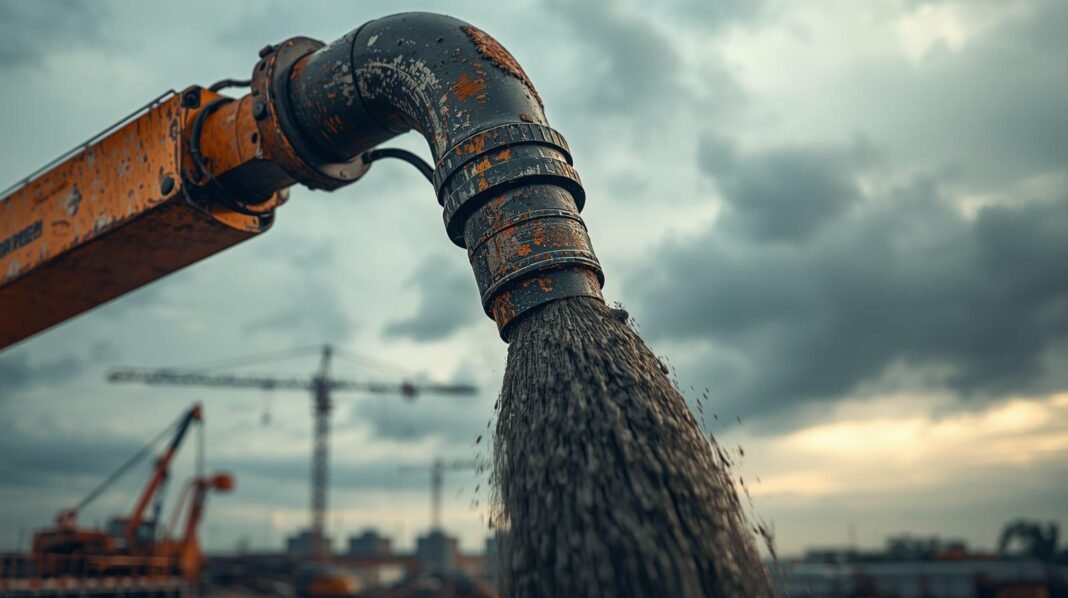
When concrete needs to move from the mixer to a structure, two tools dominate the job site: the boom pump and the line pump.
Both move concrete efficiently, and both have loyal advocates in the construction world. But they are fundamentally different machines built for fundamentally different tasks.
Understanding where each pump excels — and where it falls short — is the difference between a smooth pour and a costly delay.
This guide breaks down the key distinctions in cost, reach, mobility, and application so you can make the right call every time.
What Is a Concrete Boom Pump?
A boom pump is a truck-mounted concrete pumping system that uses a remote-controlled, multi-section articulating arm (the “boom”) to place concrete with precision.
The boom can extend, fold, and rotate to reach over, around, and above obstacles that would stop a line pump cold.
Boom pumps are purpose-built for large-scale, high-demand pours. Think high-rise construction, commercial foundations, bridges, and stadium decks.
The truck arrives on site, deploys its outriggers for stability, extends the boom, and can begin pumping within minutes.
Modern boom pumps typically feature booms ranging from 17 to over 60 meters, with some specialized units reaching beyond 100 meters in vertical height.
The concrete travels through a rigid pipeline attached to the boom and exits at a flexible hose at the tip, giving operators fine-grained placement control.
What Is a Concrete Line Pump?
A line pump — also called a trailer pump or ground line pump — operates differently. Instead of a self-contained boom, it uses a series of flexible rubber or rigid steel pipes and hoses laid out across the ground, up scaffolding, or through structures to carry concrete wherever it’s needed.
Line pumps are smaller, trailer-mounted machines that are towed to the job site. They’re designed for residential work, smaller commercial projects, swimming pools, footings, slabs, and anywhere that concrete volume and reach requirements are moderate.
The pump itself is straightforward: a diesel or electric motor drives pistons that push concrete through the pipeline. The operator sets up the line manually, adjusting as the pour progresses. It’s a simpler system — and that simplicity is precisely its advantage on the right job.
Cost: Day Rates, Mobilization, and Hidden Expenses
Cost is often the first factor contractors consider, and the gap between boom pumps and line pumps is significant.
Line pumps are substantially cheaper to rent and operate. Day rates for a trailer-mounted line pump typically range from $500 to $1,500 depending on region, pump capacity, and job duration. Mobilization costs are low — the unit can be towed by a standard truck and set up by a small crew.
For residential pours and small commercial jobs, this translates into real savings that go straight to the bottom line.
Boom pumps command a premium. Rental rates typically start around $1,500 to $3,000 per day for mid-range units and climb steeply for larger, high-reach machines.
Beyond the day rate, boom pumps carry higher mobilization fees due to the size and weight of the truck, potential permit requirements for traveling oversized vehicles, and the need for experienced operators. Setup time, while faster than manually laying pipe, also comes at a cost.
However, the cost comparison isn’t always straightforward. On large commercial jobs, a boom pump can actually lower overall project costs by dramatically reducing labor.
A boom pump eliminates the need for workers to manually move, lay, and reposition pipe — a task that on complex jobs can involve multiple laborers over many hours. On a large slab or multi-story pour, the speed advantage of a boom pump can offset its higher rental cost entirely.
The rule of thumb: for pours under 100 cubic meters in accessible locations, a line pump usually wins on cost. Above that threshold — or when site access is complex — a boom pump often pays for itself.
Reach and Placement: Where Each Pump Shines
Reach is where boom pumps truly separate themselves from the competition.
A boom pump’s articulating arm can reach horizontally over walls, fences, and other structures, and deliver concrete to floors, rooftops, or elevated slabs without any ground-level pipeline setup.
Its vertical reach — often exceeding 40 to 60 meters on standard units — makes it the only practical choice for multi-story construction.
When you’re pouring a deck on the eighth floor of a building under construction, a line pump simply cannot do the job without an elaborate (and expensive) pipe arrangement running up through the structure.
Line pumps, by contrast, are limited by the physical length of the pipe and hose system that workers can realistically lay out.
Practical horizontal reach is typically 300 to 500 meters with the right pipe configuration, but vertical reach is considerably limited.
Every meter of elevation adds pressure demand on the pump, and steep vertical climbs require higher-capacity units and careful pipe layout. Line pumps work best when the concrete destination is relatively close to ground level and accessible via a clear path for the pipeline.
Placement precision is another dimension to consider. Boom pumps offer remote-controlled, highly precise placement.
The operator can swing the boom to deposit concrete in tight, exact locations without repositioning the truck. Line pumps require workers to physically move the end hose during pouring, which is effective on open slabs but less practical in confined or elevated spaces.
Efficiency and Output Rates
For sheer volume, boom pumps are the clear winner. High-capacity boom pumps can deliver 150 to 200 cubic meters of concrete per hour. Even mid-range units comfortably push 80 to 120 cubic meters per hour.
This throughput makes them indispensable on large commercial pours where time is critical and delays cost thousands of dollars per hour.
Line pumps are more modest in output, typically delivering 15 to 60 cubic meters per hour depending on the machine, concrete mix, and pipeline configuration. For most residential and small commercial applications, this is entirely sufficient. A standard house slab, a swimming pool shell, or a small commercial footing rarely demands the output of a boom pump.
Setup time also factors into efficiency calculations. A boom pump truck can be operational in under 30 minutes.
A line pump requires workers to lay out and connect potentially hundreds of meters of pipe, which can take one to two hours on complex jobs. When the pour itself takes only a few hours, setup time matters.
On the other hand, line pump cleanup is simpler. Cleaning the short pipeline of a line pump takes less time and water than flushing a boom pump’s longer system.
Mobility and Site Access
Line pumps win decisively on mobility. A trailer-mounted line pump can be towed by a pickup truck or light commercial vehicle, parked in a standard parking space, and maneuvered into sites that would be inaccessible to a boom pump truck.
Tight suburban lots, narrow laneways, and sites with weight-restricted access are all natural line pump territory.
Boom pump trucks are large, heavy vehicles — often classified as heavy machinery requiring special transport permits for road travel.
They need substantial space to park, significant clearance overhead for boom deployment, and solid, level ground for outrigger placement.
On congested urban sites or residential lots surrounded by mature trees and structures, deploying a boom pump can be a logistical challenge.
This accessibility factor is one reason line pumps remain the dominant choice in residential construction even as boom pump availability has increased.
The neighborhood streets, confined driveways, and small yards of typical residential builds simply don’t accommodate a 40-tonne boom pump truck.
Concrete Mix Compatibility
Both pump types can handle a wide range of concrete mixes, but there are differences worth noting.
Boom pumps, due to their longer pipelines and higher operating pressures, generally require mixes with good workability — typically a slump of 100 to 180mm is recommended to ensure smooth flow and prevent blockages.
Mixes with large aggregate (40mm or above) can cause problems and typically require the boom pipeline diameter to be sized appropriately.
Line pumps are somewhat more flexible with mix design, particularly on shorter runs. They can handle stiffer mixes on short, straight runs and are commonly used for shotcrete and wet-mix applications in addition to standard ready-mix concrete.
For specialty applications — fiber-reinforced concrete, heavyweight concrete, or foamed concrete — consult with your pump operator in advance to confirm compatibility.
Which Pump Is Right for Your Project?
There’s no single answer, but the decision tree is fairly clear once you understand your project’s demands.
Choose a boom pump when:
- You’re working on multi-story structures or elevated slabs
- Pour volume exceeds 100 cubic meters
- Site access is difficult but overhead space is available
- Precision placement around obstacles is required
- Labor costs make manual pipe-laying impractical
Choose a line pump when:
- The project is residential or small-to-medium commercial
- Pour volume is modest and access is at or near ground level
- Budget is tight and the site is accessible by pipeline
- The site cannot accommodate a large truck
- You’re working on pools, footings, or slabs in confined areas
On large, complex projects, it’s also worth knowing that boom pumps and line pumps are sometimes used together — the boom pump handles the high or difficult placements while a line pump covers accessible ground-level areas simultaneously.
Final Thoughts
Both concrete boom pumps and line pumps are mature, reliable technologies with distinct roles in modern construction.
The boom pump is the powerhouse of large-scale pours — fast, precise, and capable of reaching places no other equipment can.
The line pump is the workhorse of everyday construction — affordable, flexible, and perfectly suited to the vast majority of concrete work that happens across residential and light commercial sites every day.
The best choice depends on your specific project: its scale, its access challenges, its budget, and its timeline.
When in doubt, talk to your concrete pumping contractor early in the planning phase. An experienced operator can assess your site conditions and recommend the right equipment before you’re committed to a pour schedule — and that conversation can save you significant time and money on the day.
Planning a concrete pour? Understanding your pumping options is the first step toward a project that runs on time and on budget. For more practical guides on construction equipment and best practices, explore the rest on CCE NEWS.
Also Read
Maintenance Costs of Concrete Mixer Pumps: What to Expect
Best Pumps for Concrete: Types, Prices, and Buying Guide in 2025

