
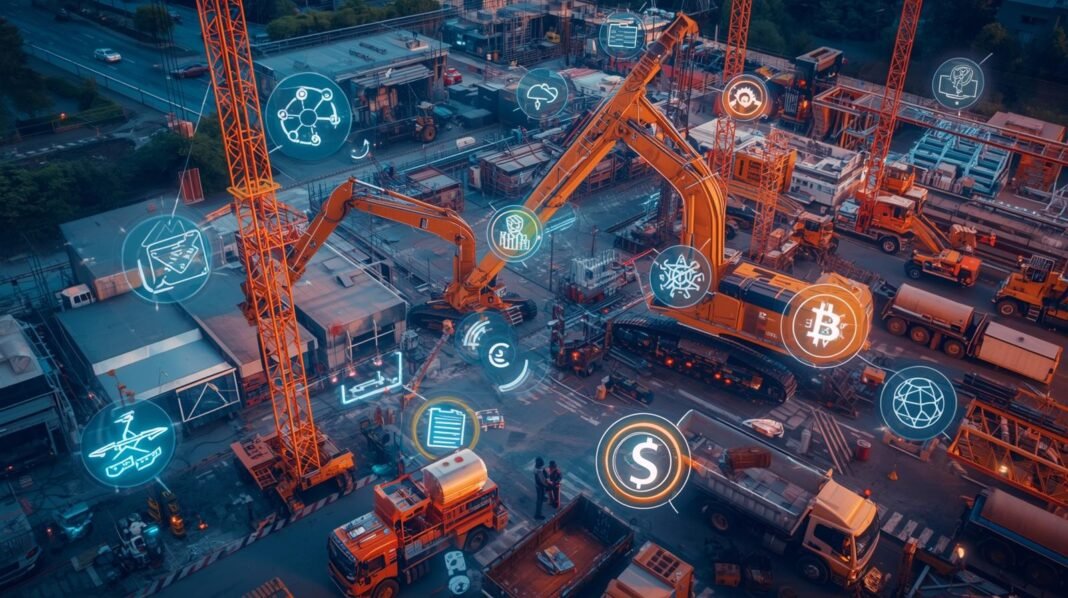
The construction equipment leasing industry, valued at over $100 billion globally, has long operated through traditional intermediaries, opaque pricing structures, and fragmented record-keeping systems.
Web3 technology—the decentralized iteration of the internet built on blockchain principles—promises to fundamentally transform how contractors access, manage, and monetize heavy machinery.
By eliminating intermediaries, creating transparent marketplaces, and enabling fractional ownership models, Web3 applications are poised to make equipment leasing more efficient, accessible, and equitable for stakeholders across the construction ecosystem.
The Current State of Equipment Leasing Challenges
Traditional construction equipment leasing involves numerous friction points that increase costs and reduce efficiency.
Contractors typically work through leasing companies or dealerships that charge significant markup fees, often 20-40% above direct ownership costs.
Verification of equipment condition, maintenance history, and usage data relies heavily on manual inspections and paper documentation that can be incomplete, inaccurate, or deliberately falsified.
Small and medium-sized contractors face particular disadvantages in this system. Accessing premium equipment requires substantial credit checks, deposits, and long-term commitments that many growing businesses cannot afford.
Equipment owners with idle machinery lack efficient channels to monetize underutilized assets, leading to significant capital inefficiency across the industry.
Cross-border equipment leasing compounds these challenges with complex customs procedures, currency exchange risks, and difficulty verifying international equipment certifications.
These barriers prevent optimal asset allocation and limit competition in regional markets.
Decentralized Equipment Marketplaces
Web3 enables peer-to-peer equipment leasing platforms where contractors can connect directly with equipment owners without intermediaries extracting substantial fees.
Smart contracts—self-executing agreements coded on blockchain networks—automatically manage lease terms, payment schedules, security deposits, and equipment returns.
When a contractor identifies needed equipment on a decentralized marketplace, they can review the machine’s complete blockchain-verified history including previous usage hours, maintenance records, operator feedback, and performance metrics.
Smart contracts ensure that payment transfers occur automatically upon delivery confirmation, while security deposits are held in escrow and released when equipment returns in acceptable condition.
This disintermediation dramatically reduces transaction costs. Equipment owners receive higher returns on their assets while contractors pay lower rates than through traditional leasing channels.
The transparency inherent in blockchain systems creates competitive pressure that prevents price gouging and encourages fair market valuations.
Tokenized Equipment Ownership and Fractional Leasing
Web3 introduces fractional ownership models where expensive construction equipment can be tokenized and divided into multiple ownership shares.
A $500,000 excavator might be represented by 1,000 tokens, each worth $500, allowing multiple investors to collectively own the machine and share rental income proportionally.
This approach democratizes access to equipment investment opportunities. Individual contractors, equipment operators, or investors can purchase tokens representing partial ownership in high-value machinery portfolios without requiring hundreds of thousands in capital.
Token holders receive automated rental income distributions through smart contracts whenever their equipment is leased.
For contractors, this model enables collaborative ownership arrangements. Three small construction firms might jointly purchase tokens representing a specialized crane they each need occasionally, sharing both costs and usage rights according to predetermined schedules encoded in smart contracts.
This cooperative approach maximizes asset utilization while minimizing individual financial burden.
Secondary markets for equipment tokens create liquidity previously impossible in traditional ownership models. Investors can trade equipment ownership shares instantly without the complications of selling physical machinery, while token prices reflect real-time market demand and equipment condition.
Transparent Maintenance and Usage Tracking
IoT sensors integrated with blockchain technology create immutable records of equipment performance, location, and maintenance activities.
Every operating hour, fuel consumption reading, and maintenance intervention gets automatically recorded on-chain, creating transparent histories that benefit all stakeholders.
For lessees, this transparency ensures they receive well-maintained equipment with verified performance capabilities. For lessors, blockchain-recorded usage data protects against disputes about equipment condition or contract violations.
Insurance companies can offer usage-based pricing models with premiums adjusted automatically based on verifiable operational data rather than estimates.
Predictive maintenance becomes more sophisticated when equipment data is aggregated across decentralized networks.
Machine learning algorithms analyzing blockchain-recorded performance data from thousands of similar machines can predict component failures before they occur, triggering automatic maintenance scheduling and reducing unexpected downtime.
Smart contracts can enforce maintenance requirements by automatically withholding rental income from equipment owners who fail to perform scheduled servicing, incentivizing proper asset care and protecting lessees from unreliable machinery.
Simplified Cross-Border Equipment Access
International construction projects often struggle with equipment availability in remote locations.
Web3 platforms can facilitate cross-border equipment leasing by managing complex logistics through smart contracts that automatically handle customs documentation, currency conversions, and compliance verification.
Stablecoins—cryptocurrencies pegged to traditional currencies—eliminate exchange rate volatility and enable instant international payments without expensive wire transfers or currency conversion fees.
Contractors in developing markets gain access to premium equipment from global providers, while equipment owners expand their potential customer base beyond local markets.
Blockchain-verified certifications and compliance documents simplify regulatory approval processes. Import authorities can instantly verify equipment safety certifications, emissions compliance, and operator qualification credentials by referencing blockchain records rather than processing paper documentation.
Reputation Systems and Trust Building
Decentralized reputation systems create transparent track records for both equipment owners and lessees.
Every completed lease generates mutual ratings and reviews stored permanently on-chain, creating comprehensive profiles that new transaction partners can verify independently.
Contractors with excellent payment histories and equipment care records earn reputation scores that qualify them for better lease terms, lower deposits, and priority access to high-demand machinery.
Equipment owners who consistently provide well-maintained machines with accurate descriptions build reputations that command premium rates and frequent bookings.
Unlike centralized platforms where companies control and can manipulate reputation data, blockchain-based systems ensure that reviews and ratings cannot be deleted, altered, or suppressed. This immutability creates authentic trust signals that improve market efficiency and reduce fraud.
Dynamic Pricing and Demand Optimization
Smart contracts enable sophisticated dynamic pricing models that optimize equipment utilization.
Rental rates can automatically adjust based on real-time demand, seasonal patterns, equipment availability, and geographic location. During peak construction seasons, prices increase to reflect scarcity, while off-season rates decrease to encourage utilization.
Equipment owners can set minimum acceptable rates and availability windows, with smart contracts automatically accepting bookings that meet their criteria.
This automation reduces administrative overhead while ensuring equipment generates maximum returns without remaining idle.
Contractors benefit from price transparency and competition. They can compare real-time rates across multiple providers instantly, with smart contracts automatically selecting the best available options within their budget and timeline requirements.
Challenges and Implementation Considerations
Despite transformative potential, Web3 equipment leasing faces meaningful adoption barriers.
Technical complexity remains high, with many construction professionals unfamiliar with cryptocurrency wallets, blockchain transactions, and smart contract interfaces. User experience improvements and educational initiatives are essential for mainstream adoption.
Regulatory uncertainty surrounding cryptocurrency transactions and smart contract enforceability varies significantly across jurisdictions.
Legal frameworks must evolve to provide clarity on digital asset ownership rights, dispute resolution mechanisms, and liability allocation in automated agreements.
Equipment tokenization raises questions about physical asset custody, insurance responsibilities, and maintenance obligations when ownership is distributed among hundreds of token holders.
Industry standards for governance structures and decision-making processes in fractional ownership arrangements require development.
Network scalability and transaction costs on some blockchain platforms may prove prohibitive for small-value equipment rentals.
However, layer-two scaling solutions and emerging blockchain networks designed for high transaction volumes and low fees are addressing these limitations.
The Path to Industry Transformation
Early adopters in equipment leasing are already experimenting with blockchain-based systems, creating proof-of-concept platforms that demonstrate Web3’s practical benefits.
Equipment manufacturers are exploring partnerships with blockchain developers to integrate IoT sensors and tokenization capabilities directly into new machinery.
Industry associations can accelerate adoption by developing standardized protocols for equipment data recording, maintenance verification, and smart contract templates.
These standards would enable interoperability between different Web3 platforms and reduce integration complexity for market participants.
Educational programs targeting contractors, equipment owners, and leasing professionals will prove essential.
As comfort with Web3 technologies increases and success stories accumulate, network effects will drive broader participation and create the critical mass necessary for ecosystem sustainability.
The construction industry’s traditional conservatism and relationship-based business practices may slow Web3 adoption compared to other sectors.
However, the substantial cost savings, efficiency gains, and improved asset utilization that decentralized systems offer create compelling economic incentives that ultimately drive technological transformation.
Conclusion
Web3 technology represents more than incremental improvement in construction equipment leasing—it enables fundamental restructuring of how the industry manages valuable assets.
By removing intermediaries, creating transparent marketplaces, enabling fractional ownership, and automating complex agreements, blockchain-based systems address longstanding inefficiencies that have constrained market development.
As technical barriers diminish and regulatory frameworks mature, construction equipment leasing may emerge as one of Web3’s most impactful real-world applications.
The industry’s enormous scale and clear pain points create ideal conditions for blockchain solutions to deliver measurable value.
Forward-thinking contractors, equipment owners, and leasing companies embracing these technologies today position themselves advantageously in an industry undergoing inevitable digital evolution.
Also Read
NFTs in Architecture and Construction: From Digital Twins to Design Ownership
Web3 in Construction: How Blockchain Is Transforming Project Transparency

