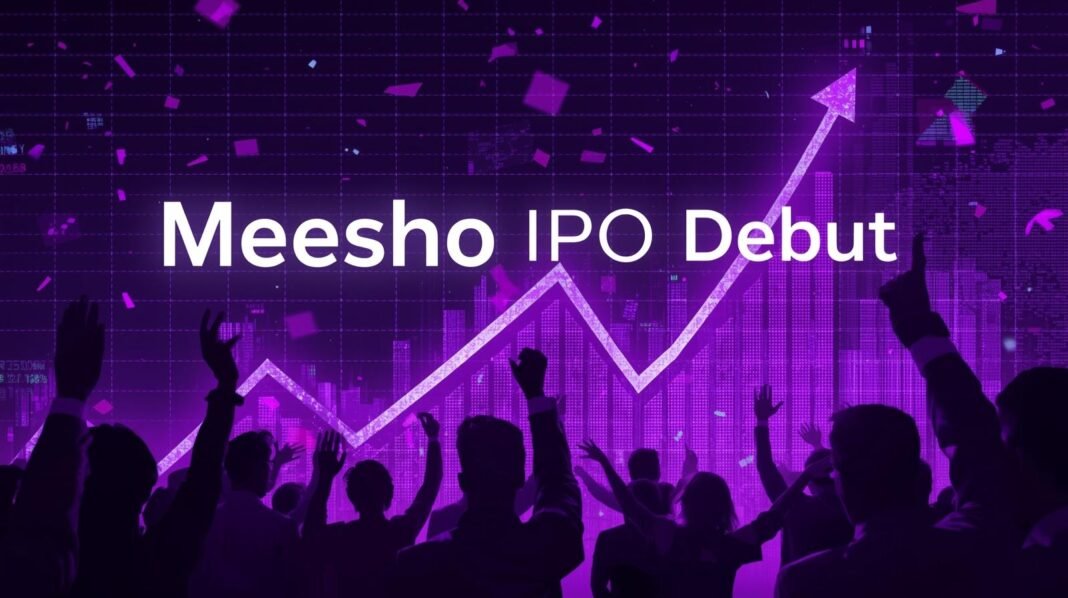
When Meesho shares began trading on December 10, 2025, they didn’t just list—they soared.
Opening at a 46% premium over the issue price and climbing to nearly 60% by midday, the SoftBank-backed e-commerce platform’s debut sent a clear message to investors: India’s next wave of digital commerce isn’t happening in Mumbai or Bangalore—it’s taking place in places like Mathura, Jhansi, and thousands of other Tier-2 and Tier-3 cities across the country.
The numbers behind Meesho’s initial public offering tell a compelling story. The company raised ₹5,421 crore through a combination of fresh shares and an offer for sale, with the IPO priced between ₹105-111 per share.
But it was the overwhelming investor enthusiasm that truly captured attention. The offering was oversubscribed nearly 79 times overall, with the Qualified Institutional Buyer category alone seeing subscriptions of 120 times.
By any measure, this was one of the most sought-after IPOs in recent Indian market history.
The Small-Town Strategy That Changed Everything
While giants like Amazon and Flipkart battled for dominance in India’s top 100 million urban consumers, Meesho took a radically different path. Founded in 2015 by IIT Delhi alumni Vidit Aatrey and Sanjeev Barnwal, the company identified an underserved market that its competitors had largely overlooked: price-conscious shoppers in smaller cities and rural areas who prioritized affordability over convenience.
The strategy has proven remarkably successful. Today, over 75% of Meesho’s user base comes from Tier-2 cities and beyond, with the platform serving approximately 198 million annual transacting users.
The company has emerged as India’s largest e-commerce platform by number of orders placed, processing 1.83 billion orders in the fiscal year ending March 2025—a testament to the massive untapped demand in non-metro markets.
What makes Meesho’s approach unique is its understanding of its customer base. With an average order value of just ₹274, the platform caters to shoppers making frequent, small purchases of everyday items.
These aren’t consumers looking for next-day delivery or premium brands—they’re families stretching household budgets, first-time online shoppers building trust in digital commerce, and entrepreneurs seeking affordable inventory for their small businesses.
Zero Commission, Maximum Impact
At the heart of Meesho’s business model lies a counterintuitive decision: charging sellers zero commission on sales. In an industry where platforms typically take 10-25% of each transaction, Meesho’s approach seemed radical, if not reckless.
The company monetizes instead through value-added services—logistics support, advertising solutions, and business analytics tools that sellers can choose to purchase.
This model has allowed Meesho to attract over 575,000 active sellers, many of whom are small businesses, homemakers, and micro-entrepreneurs who would be priced out of traditional e-commerce platforms.
The zero-commission strategy also enables Meesho to offer “everyday low prices” that resonate with its cost-conscious customer base.
By reducing the fees charged to sellers, the platform creates a virtuous cycle: lower prices attract more buyers, more buyers attract more sellers, and the resulting scale improves operational efficiency for everyone involved.
Technology Meets Localization
Behind Meesho’s folksy, small-town appeal lies sophisticated technology. The company has developed AI and machine learning algorithms designed to deliver personalized shopping experiences based on hyperlocal preferences.
Its proprietary GeoIndia Large Language Model interprets unstructured Indian addresses—a notoriously difficult problem—and converts them into accurate geographic coordinates for efficient delivery.
The platform supports 10 languages including Hindi, Tamil, Bengali, and Gujarati, making it accessible to users who aren’t comfortable with English.
Multi-modal search features allow customers to find products using text, images, or voice inputs—crucial capabilities for users who may be new to online shopping.
This technology infrastructure extends to Meesho’s logistics network, Valmo, which coordinates with third-party delivery partners across India to ensure last-mile connectivity even in remote areas.
The company has effectively built the digital and physical infrastructure needed to serve markets that were previously considered too fragmented or too expensive to reach profitably.
The Path to Profitability
Perhaps the most impressive aspect of Meesho’s story is its improving financial trajectory. While the company reported a loss of ₹3,941 crore in fiscal year 2025, the vast majority stemmed from one-time accounting items related to corporate restructuring and accelerated ESOP vesting.
The adjusted net loss was just ₹108 crore—a dramatic improvement that suggests the business is approaching sustainable profitability.
Revenue growth has been robust, climbing 26% from ₹7,859 crore in fiscal 2024 to ₹9,901 crore in fiscal 2025.
More importantly, the company’s contribution margin has improved from 2.94% to 4.95% of net merchandise value, demonstrating that scale and operational discipline are beginning to pay dividends.
Meesho has also generated positive operating cash flow for two consecutive years—a rare achievement for a zero-commission marketplace still in growth mode.
What the IPO Funds Will Build
The fresh capital raised through the IPO will be deployed strategically across three main areas.
First, ₹1,390 crore will go toward cloud infrastructure investments through Meesho Technologies, the company’s technology subsidiary, strengthening the digital backbone that powers its AI and machine learning capabilities.
Second, ₹480 crore will fund salaries for existing and newly hired employees in ML, AI, and technology teams—a clear signal that Meesho views technology development as critical to its competitive advantage.
Finally, ₹1,020 crore has been earmarked for marketing and brand development, particularly across Tier-2 cities and smaller markets.
After years of relatively frugal marketing spending, this represents a major push to cement Meesho’s position before competitors can replicate its small-town success.
The Bigger Picture
Meesho’s successful IPO represents more than just one company’s achievement. It validates a broader thesis about India’s digital economy: that the next wave of growth will come not from urban elites upgrading to faster delivery or premium products, but from hundreds of millions of new internet users in smaller cities and towns discovering e-commerce for the first time.
This market is massive. Over half of India’s new online shoppers come from Tier-3 cities and beyond, and rural consumption growth has consistently outpaced urban markets.
Companies that can serve these customers profitably stand to capture enormous value.
The strong investor response to Meesho’s IPO—with QIBs subscribing 120 times and the stock gaining 60% on debut—suggests that institutional investors recognize this opportunity.
It also signals growing confidence in business models that prioritize scale and accessibility over premium positioning.
For entrepreneurs and investors, Meesho’s journey offers valuable lessons: that seemingly saturated markets often have overlooked segments, that serving the underserved can be both socially impactful and commercially viable, and that patient capital combined with genuine customer understanding can build businesses that transform entire industries.
As Meesho’s shares continue trading on public markets, the company’s challenge will be maintaining its focus on the customers and sellers who powered its growth while meeting the expectations of public market investors.
If it succeeds, the platform that made e-commerce accessible to millions of Indians will have proven that inclusion and profitability aren’t mutually exclusive—they’re complementary.
Also Read
Intel Eyes Major Comeback with Reported Apple Manufacturing Deal
How Nvidia Turned ‘America First’ Against Export Hawks

