
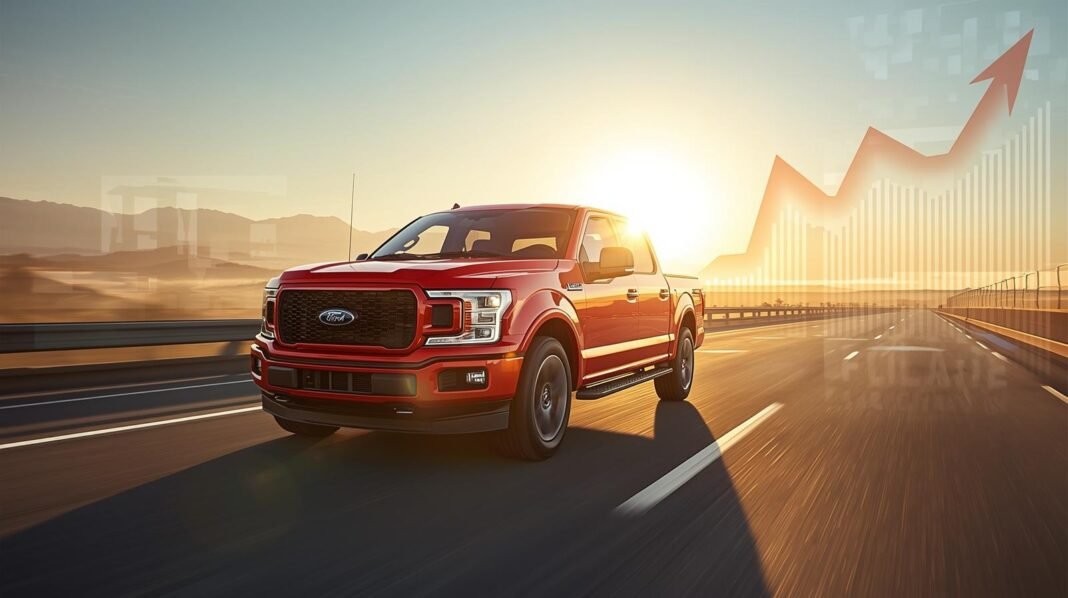
Ford Motor Company (NYSE: F) has shifted into high gear. The iconic automaker’s stock recently rallied to a 52-week high, fueled by strong third-quarter earnings, a confident restructuring plan, and growing optimism around its long-term strategy.
Despite temporary headwinds — including a supply chain setback caused by an aluminum plant fire — Wall Street appears convinced that Ford’s renewed focus on profitability and disciplined electric vehicle (EV) investment is setting the stage for a stronger, more balanced future.
Strong Earnings Drive Investor Confidence
Ford’s latest quarterly report surprised investors. The company posted adjusted earnings of $0.45 per share on revenue of $50.5 billion, outperforming analyst expectations and signaling robust demand in its core truck and commercial vehicle segments.
While the EV unit continues to face losses, Ford’s internal combustion and hybrid divisions remain profitable, providing a vital cushion as the company navigates the evolving automotive landscape.
Investors were quick to respond — pushing the stock up more than 10% in a single day, its best performance in months.
This surge underscores growing confidence in Ford’s turnaround strategy, led by CEO Jim Farley, who has prioritized cost control, product quality, and operational efficiency.
A New Era for the American Auto Industry
Ford’s 52-week high carries a larger message for U.S. automakers: the industry’s future lies in balance, not extremes.
While some EV startups are struggling to stay afloat and traditional manufacturers are rethinking aggressive electrification timelines, Ford is charting a middle course — investing in EV technology while leveraging the profitability of its truck and SUV lineup.
This pragmatic approach may prove essential for legacy automakers aiming to remain competitive in a high-interest-rate, capital-intensive environment.
Ford’s F-150, Maverick, and Transit lines continue to dominate, providing stable cash flow to fund next-generation innovations.
Supply Chain Setbacks and a Strong Recovery Plan
In October, Ford faced an unexpected disruption: a fire at supplier Novelis’ aluminum plant in New York temporarily constrained production of high-margin trucks like the F-150.
However, the company acted swiftly — diversifying suppliers and accelerating recovery measures. This quick response not only reassured investors but also demonstrated how far Ford has come in supply chain agility since the pandemic years.
The lesson here extends beyond Ford. U.S. automakers increasingly recognize that manufacturing resilience — not just technology — will define competitive advantage in the coming decade.
EV Reset: Strategy Over Speed
Unlike some rivals who overextended in the EV rush, Ford is now taking a measured approach. It has temporarily scaled back on certain EV projects while focusing on models with clear profitability potential, such as the Mustang Mach-E and F-150 Lightning.
At the same time, Ford is redeploying workers from underperforming EV lines to its highly profitable truck plants — a move applauded by analysts as a sign of financial discipline rather than retreat.
This “EV reset” signals a broader shift in the U.S. auto market: investors are rewarding companies that pursue sustainable growth over aggressive, loss-making expansion.
What Ford’s Rally Means for the Industry
Ford’s performance isn’t just about one company. It reflects renewed investor appetite for American manufacturing strength and the belief that traditional automakers can still lead the mobility revolution.
The stock’s 52-week high may mark the beginning of a broader re-rating for legacy auto stocks, particularly those balancing innovation with profitability.
Competitors such as General Motors (GM) and Stellantis (STLA) are likely to take cues from Ford’s hybrid model — combining core vehicle profitability with a cautious but steady EV rollout.
Conclusion
Ford’s latest rally is more than a stock market milestone — it’s a sign that the U.S. automotive industry is adapting with agility, discipline, and strategic focus.
By pairing innovation with practicality, Ford is proving that the road to the future isn’t a straight line to electrification, but a carefully engineered path that blends legacy strength, smart technology, and resilient operations.
Also Read
Alaska Airlines: How a Single IT Glitch Can Ground an Entire Airline
Social Security COLA 2026: What a 2.8% Increase Means for Retirees and Workers

