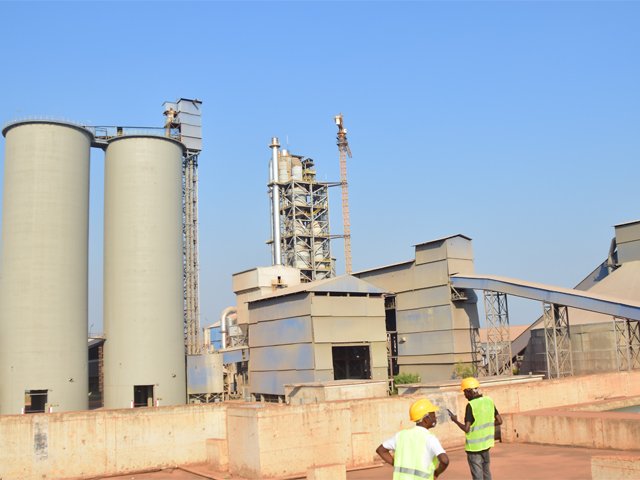
Kinshasa, Democratic Republic of Congo – Cimenterie Kongo (CIMKO), one of the Democratic Republic of Congo’s leading cement manufacturers, has unveiled ambitious plans to more than double its production capacity through a $300 million expansion project set for completion by 2027.
The joint venture between Pakistan’s Rawji Group and Lucky Cement aims to increase its annual output from 1.4 million tons to 3 million tons at its facility in Songololo, located in the Kongo-Central province.
The expansion represents a major vote of confidence in the DRC’s construction sector and broader economic prospects.
Meeting Growing Demand
The investment comes at a critical time for the Central African nation, where cement consumption has been steadily rising. Data from the Central Bank of the Congo shows that domestic cement consumption reached 2.55 million tons in 2023, while local production totalled only 2.3 million tons.
The resulting shortfall has been covered through imports, representing both a drain on foreign exchange reserves and an opportunity for domestic producers.
CIMKO’s expansion is designed to help bridge this supply gap while positioning the company to capture a larger share of what industry observers expect will be a growing market.
The DRC’s infrastructure needs remain substantial, with ongoing urbanization and government investment in roads, buildings, and public works driving cement demand higher.
Strategic Position in Competitive Market
Since commencing operations in 2018, CIMKO has established itself as a significant player in the Congolese cement industry. However, the company is not alone in recognizing the market’s potential.
China-based WIH Cement is pursuing its own capacity expansion, targeting an increase to 2.2 million tons per year by 2027.
Meanwhile, the Chinese consortium Avic-Conch has partnered with the Congolese government to restart the National Cement plant in Kimpese, adding further production capacity to the market.
This wave of investment suggests that industry players anticipate robust demand growth that will absorb the additional capacity without triggering destructive price competition.
The optimism appears grounded in the DRC’s economic fundamentals, including its vast mineral wealth, growing population, and need for extensive infrastructure development.
Government Support Bolsters Industry
The Congolese government has taken concrete steps to support domestic cement producers and encourage investment in the sector.
In July 2024, authorities implemented a ban on imports of grey cement and clinker in the southeastern and southwestern regions of the country. This protective measure aims to shield domestic manufacturers from foreign competition while they scale up operations and improve efficiency.
Such policy support creates a more favorable investment climate for companies like CIMKO, providing greater certainty that their expanded capacity will find ready markets.
The government’s approach reflects a broader strategy of import substitution and industrial development, using the country’s large domestic market as a foundation for building competitive local industries.
Economic Implications
The $300 million investment will generate significant economic benefits beyond cement production.
The construction phase alone will create numerous jobs, while the expanded facility will require additional permanent staff for operations and maintenance. Indirect employment effects will ripple through the supply chain, from limestone quarrying to logistics and distribution.
Moreover, increased domestic cement production will reduce the DRC’s reliance on imports, helping to preserve foreign exchange for other critical needs.
This becomes particularly important as the country seeks to balance its external accounts while funding development priorities.
For the construction sector, reliable domestic cement supply at competitive prices can lower building costs and enable more projects to move forward. This has implications for housing affordability, commercial development, and public infrastructure projects.
Looking Ahead
As CIMKO moves forward with its expansion plans, the company’s success will serve as a barometer for the broader business climate in the DRC.
The 2027 target date gives the company roughly three years to complete construction and ramp up to full capacity, a timeline that will test both the company’s execution capabilities and the country’s ability to support large-scale industrial projects.
With multiple cement producers expanding simultaneously, the DRC appears poised to transition from a cement-importing nation to one that is largely self-sufficient in this critical building material.
Whether the market can absorb this expanded capacity will depend on the pace of economic growth and infrastructure development in the years ahead.
Also Read
SA Construction Roars Back: 10% Jump Signals Sector Revival
Malawi Welcomes Game-Changing $100M Cement Plant as Huaxin Delivers Record-Breaking Project

