
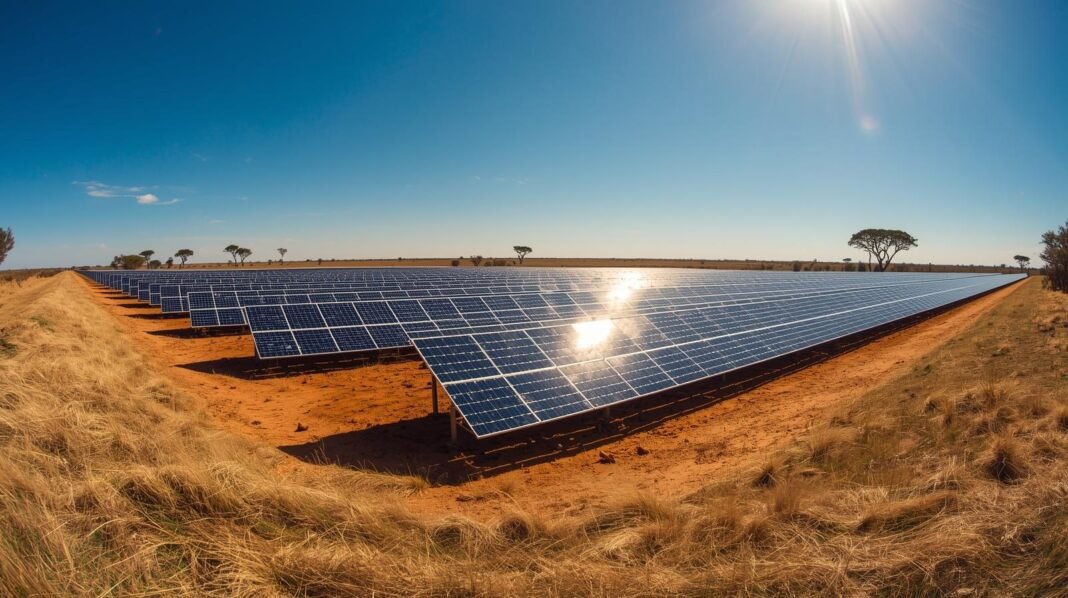
Africa’s solar power market recorded a historic leap in 2025, with new installations rising by 54% year-on-year, highlighting accelerating momentum toward clean energy across the continent.
However, industry experts warn that financing constraints continue to threaten Africa’s ability to fully harness its vast solar potential.
According to the Global Solar Council (GSC), Africa added approximately 4.5 gigawatts (GW) of new solar capacity in 2025, marking the strongest growth rate ever recorded for the region.
Despite the surge, solar energy still contributes only a small share of Africa’s electricity generation, underscoring the scale of untapped opportunity.
Rapid Growth Driven by Utility-Scale and Distributed Solar
The latest GSC Africa Solar Market Outlook report shows that solar development is being driven by a combination of large utility-scale projects and rapidly expanding distributed solar systems, including rooftop installations and mini-grids.
Distributed solar accounted for an estimated 44% of new capacity additions, reflecting growing demand from commercial users, industries, and households seeking reliable alternatives to unstable grid electricity.
Analysts say this trend signals a dual energy transition across Africa, combining centralized power generation with decentralized clean energy solutions.
South Africa remained the continent’s leading solar market, followed by Egypt, Nigeria, Morocco, Algeria, and emerging markets such as Zambia, Ghana, Botswana, Tunisia, and Chad.
The top 10 markets accounted for nearly 90% of new installations, highlighting uneven deployment across the continent.
Africa’s Massive Solar Potential Remains Untapped
Africa possesses some of the world’s highest solar irradiation levels and is estimated to hold more than 60% of global solar potential, yet it remains one of the least developed solar markets globally.
Solar power currently contributes only about 3% of Africa’s electricity mix, compared with much higher shares in Europe and parts of Asia.
The GSC projects that Africa could install over 23 GW of additional solar capacity by 2028 and more than 33 GW by 2029, provided policy frameworks and financing conditions improve.
Financing Bottlenecks Threaten Expansion
Despite the record growth, the Global Solar Council warns that access to affordable finance remains the single biggest barrier to scaling solar deployment in Africa.
High interest rates, currency risks, and limited local capital markets make solar projects more expensive than in developed economies.
Developers and investors also face regulatory uncertainties, slow permitting processes, and grid infrastructure limitations, which delay project implementation and increase costs.
“Unlocking low-cost capital is critical if Africa is to meet global renewable energy targets and achieve universal electricity access,” the GSC noted in its report.
Implications for Africa’s Energy Future
Experts say accelerating solar deployment is crucial for Africa’s industrialization, digital transformation, and climate commitments.
Solar energy offers a pathway to reduce reliance on diesel generators, lower electricity costs, and expand power access to millions of people currently without electricity.
As governments, development banks, and private investors push for innovative financing mechanisms—including blended finance, guarantees, and local currency funding—the continent could be on the verge of a major solar boom.
However, without urgent financial reforms and supportive policies, Africa risks falling short of global climate targets and missing a historic opportunity to leverage its abundant solar resources.
Also Read
Ethiopia Commissions First Phase of Aysha II Wind Power Project, Adding 80MW to National Grid
Major Backing Secured for Egypt’s Obelisk Solar Mega Project

- KeNHA’s World Bank Funding Boost: Inside Kenya’s KSh Multi-Billion Expressway Masterplan - March 25, 2026
- SASSA locks in full-year social grant payment schedule — and announces biggest increases in years - March 24, 2026
- Next-Gen Excavators Heading to Steinexpo: Efficiency, Automation & Power - March 24, 2026
