
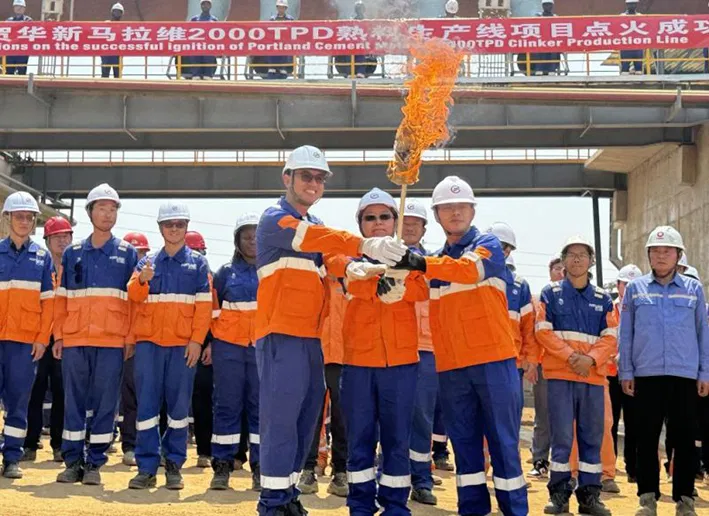
Balaka, Malawi – In a development set to transform Malawi’s construction sector, Chinese cement giant Huaxin Building Materials Group has officially opened a state-of-the-art integrated cement production facility that promises to reshape the nation’s infrastructure landscape.
The $100 million plant, commissioned this week in Balaka district, represents the largest manufacturing investment by a Chinese company in Malawian history.
Rapid Construction Sets New Benchmark
What makes this project particularly remarkable is its execution timeline. From groundbreaking to commissioning, the entire facility was completed in just 11 months – a feat that sets a new record for Huaxin’s overseas clinker production lines across Africa.
The plant began taking shape on October 28, 2024, and was fully operational by early December 2025, demonstrating impressive project management and construction efficiency.
The integrated facility, operated through Huaxin’s subsidiary Portland Cement Malawi, boasts an annual production capacity of 800,000 tonnes.
This more than doubles the company’s previous output of 300,000 tonnes and positions Malawi to meet domestic demand while exploring regional export opportunities.
Economic Impact Beyond Construction
The plant’s significance extends far beyond its immediate contribution to cement supply. Economic analysts project the facility will save Malawi approximately $50 million annually in foreign exchange by dramatically reducing the country’s reliance on imported clinker and finished cement products.
Additionally, the plant is expected to generate $15 million in annual export earnings as surplus production reaches neighboring markets.
These figures align perfectly with Malawi’s ambitious Malawi 2063 development agenda, which prioritizes industrialization and economic self-sufficiency.
Finance Minister Joseph Mwanamvekha emphasized the project’s strategic importance, noting that cement production forms the backbone of any nation’s infrastructure development capacity.
Job Creation and Skills Transfer
Employment generation represents another critical dimension of the project’s impact. The facility is projected to create 500 direct jobs, with an impressive 90 percent reserved for local Malawian workers.
Beyond direct employment, economic multiplier effects are expected to generate approximately 3,000 indirect jobs across the supply chain, from raw material suppliers to logistics and distribution networks.
This employment structure reflects a commitment to skills transfer and local capacity building – essential elements for sustainable industrial development in emerging economies.
The plant incorporates modern production technology, offering Malawian workers exposure to international best practices in cement manufacturing.
Strategic Location and Infrastructure
The choice of Balaka, situated 215 kilometers south of the capital Lilongwe, reflects careful strategic planning.
The location provides access to necessary raw materials while serving as a distribution hub for both domestic markets and potential exports to Mozambique, Zimbabwe, and Zambia.
Chinese Ambassador to Malawi Lu Xu highlighted the project as a milestone in bilateral cooperation, representing the tangible benefits of China’s infrastructure investment initiatives across Africa.
The ambassador noted that the plant demonstrates how strategic foreign investment can catalyze local industrial capacity and economic growth.
Implications for Regional Construction
For Malawi’s construction industry, the plant’s commissioning couldn’t come at a better time.
The country faces significant infrastructure deficits, with ongoing and planned projects in transportation, housing, and public facilities requiring substantial cement supplies. Previously, supply constraints and import dependencies often led to price volatility and project delays.
The new production capacity promises greater price stability and supply security, potentially accelerating infrastructure development timelines across the country.
Construction firms and developers now have assurance of consistent local supply, reducing the risks associated with import-dependent procurement strategies.
Looking Ahead
As the plant ramps up to full production capacity, industry observers will watch closely to see how effectively it meets both domestic demand and export targets.
The project serves as a test case for integrated cement manufacturing in smaller African economies, potentially influencing investment decisions across the region.
For Malawi, the Huaxin plant represents more than industrial capacity – it symbolizes a step toward the self-reliance and economic transformation outlined in the nation’s long-term development vision.
As construction activity accelerates in coming years, this facility will likely stand as a cornerstone of that progress.
Also Read
SA Construction Roars Back: 10% Jump Signals Sector Revival
U.S. Construction Spending Rises Slightly in August 2025, but Underlying Weakness Persists

