
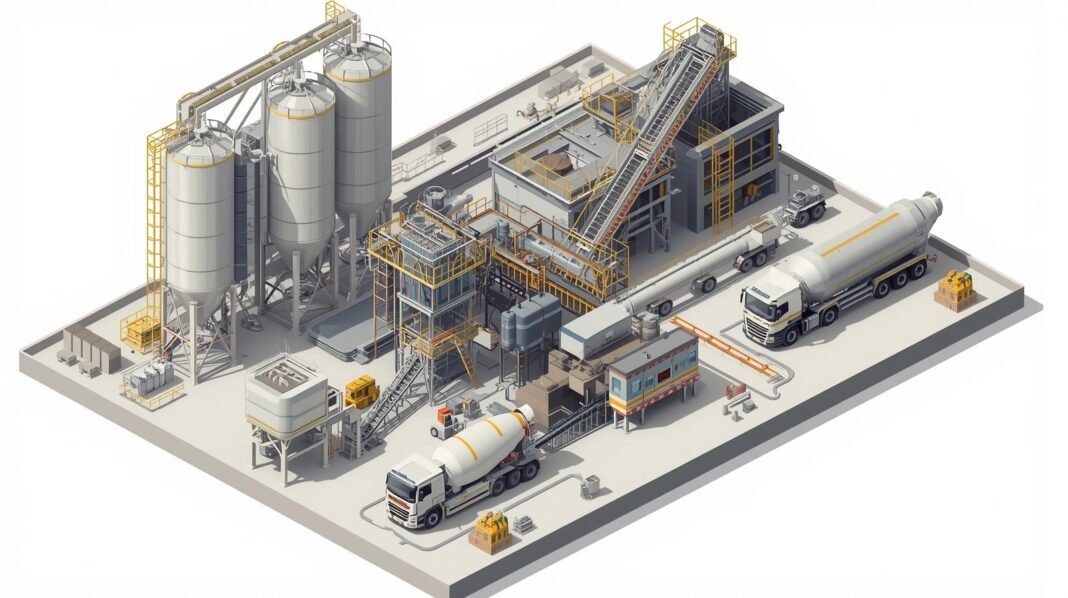
If you’ve ever driven past a construction site and seen those rotating drum trucks delivering concrete, you’ve witnessed the end result of a fascinating industrial process.
Ready-mix concrete plants are the unsung heroes of modern construction, producing millions of cubic yards of concrete annually for everything from residential driveways to massive infrastructure projects.
Let’s dive into how these essential facilities operate and why they’ve become the backbone of the construction industry.
What Is a Ready-Mix Concrete Plant?
A ready-mix concrete plant, also called a batch plant, is a facility that manufactures concrete by combining cement, aggregates like sand and gravel, water, and chemical admixtures in precise proportions.
The “ready-mix” designation means the concrete is mixed at the plant or in transit, arriving at job sites ready to pour—no additional mixing required.
This centralized production model revolutionized construction by ensuring consistent quality, reducing on-site labor, and eliminating the need for contractors to mix concrete themselves.
The Basic Components of a Ready-Mix Plant
Every ready-mix concrete plant contains several key systems working in harmony:
Aggregate Storage and Handling: Large bins or bays store different sizes of crushed stone, gravel, and sand. These materials are kept separated by size to ensure accurate batching. Conveyor belts or front-end loaders transport aggregates to the batching area.
Cement Storage Silos: Towering cement silos dominate the plant skyline, storing bulk cement delivered by tanker trucks. These silos protect cement from moisture and contamination while allowing gravity-fed discharge into the batching system.
Water System: Accurate water measurement is critical for concrete strength. Plants use calibrated water meters and tanks, often with heating capabilities for cold-weather production.
Admixture Dispensers: Modern concrete uses various chemical additives to modify properties like setting time, workability, and strength. Automated dispensers inject precise amounts of these admixtures into each batch.
Batching Controls: The plant’s computer system acts as the brain of the operation, controlling ingredient proportions based on the specific mix design ordered by the customer.
Mixer or Loading Area: Depending on plant type, concrete is either mixed on-site or ingredients are loaded into truck mixers for transit mixing.
Types of Ready-Mix Concrete Plants
Ready-mix plants fall into three main categories, each with distinct operational characteristics:
Central Mix Plants produce fully mixed concrete at the facility using stationary mixers. The concrete is then discharged into agitator trucks that keep it moving during transport. This method provides superior mixing consistency and is ideal for high-volume projects requiring uniform quality.
Dry Batch Plants load precise quantities of dry ingredients and measured water separately into truck mixers. The actual mixing occurs in the rotating drum during transit to the job site. This approach offers flexibility and extends the time concrete remains workable.
Wet Batch Plants represent a hybrid approach, partially mixing concrete at the plant before loading it into trucks for final mixing during delivery. This balances quality control with operational flexibility.
The Step-by-Step Production Process
Understanding how a ready-mix plant operates requires following concrete from raw materials to delivery truck.
The process begins when a customer places an order specifying the concrete mix design, quantity, and delivery schedule. The plant operator enters this information into the batching computer, which calculates exact ingredient quantities based on the engineered mix formula.
Aggregates move first. Conveyor belts carry sand and various gravel sizes from storage bins to an overhead weigh hopper. Load cells precisely measure each aggregate type, ensuring accuracy typically within one percent. Once the correct weight is achieved, gates open and aggregates discharge into the mixer or truck.
Cement flows next from storage silos through screw conveyors into its own weigh hopper. Because cement affects concrete strength so dramatically, measurement must be extremely precise.
The batching system monitors cement weight continuously during discharge.
Water comes from calibrated tanks through flow meters that measure volume to the gallon. For quality control, many plants also monitor water temperature, as it affects concrete setting time and early strength development.
Admixtures inject last, dispensed through automated systems that add exact amounts of plasticizers, accelerators, retarders, or air-entraining agents based on the mix requirements and ambient conditions.
In central mix plants, all ingredients combine in a stationary mixer for 60 to 90 seconds of intensive mixing. The homogeneous concrete then discharges into waiting agitator trucks. In dry batch operations, ingredients load separately into the truck mixer, which rotates during the journey to thoroughly blend everything before arrival.
Quality Control Measures
Professional ready-mix plants implement rigorous quality control protocols to ensure every batch meets specifications.
Aggregate moisture content testing happens multiple times daily because wet aggregates affect water-cement ratios. Plants adjust water additions based on aggregate moisture to maintain consistent mix designs.
Slump tests measure concrete workability by determining how much a concrete sample subsides when removed from a standard cone mold. This simple field test helps verify proper water content and mixing.
Compressive strength testing involves casting concrete cylinders that cure under controlled conditions before being crushed in a lab to verify the concrete achieves specified strength at 7 and 28 days.
Air content measurement ensures proper freeze-thaw resistance in concrete exposed to cold climates. Too little entrained air leads to cracking; too much reduces strength.
Modern plants also maintain detailed batch records electronically, creating an auditable trail for each load delivered. This documentation proves invaluable for construction quality assurance and resolving disputes.
The Critical Role of Concrete Delivery
Even perfectly batched concrete becomes worthless if it sets before placement. Transit mixers solve this challenge through constant agitation during transport.
These specialized trucks feature rotating drums mounted on a tilted axis. The drum’s internal spiral blades mix concrete when rotating one direction and discharge it when reversed. Rotation rates vary—faster speeds during mixing, slower during transport to prevent segregation and premature setting.
Industry standards typically require concrete delivery within 90 minutes of batching, though chemical retarders can extend this window. Drivers monitor concrete constantly, adjusting drum speed and even adding small amounts of water (within strict limits) if needed to maintain workability.
GPS tracking and plant communication systems help optimize delivery routes and timing. Dispatchers coordinate multiple trucks to ensure continuous concrete supply for large pours while avoiding delays that could compromise quality.
Environmental Considerations
Modern ready-mix plants increasingly focus on sustainability and environmental responsibility.
Water recycling systems capture truck washout water and leftover concrete for reuse. Settleable solids separate in clarification tanks, with reclaimed water returning to the batching system and solids either reprocessed as aggregate or properly disposed.
Dust control equipment including bag houses and water sprays minimize cement and aggregate dust emissions during material handling and loading operations.
Many plants now incorporate supplementary cementitious materials like fly ash or slag cement that replace portion of portland cement, reducing the carbon footprint of concrete production while often enhancing concrete properties.
Alternative fuels and electric equipment gradually replace diesel-powered systems at forward-thinking facilities, further reducing environmental impact.
Technology and Automation Advances
The ready-mix industry continues evolving through technological innovation.
Computerized batching systems now communicate directly with project management software, allowing automatic scheduling, load tracking, and invoicing. Mobile apps let customers track delivery trucks in real-time and receive notifications when concrete is en route.
Sensor technology monitors concrete properties continuously. Some trucks feature onboard slump monitoring systems that measure concrete consistency in real-time, alerting drivers and plant operators to potential issues before the truck reaches the job site.
Automated plant management systems optimize production efficiency by predicting maintenance needs, tracking inventory levels, and analyzing production data to identify improvement opportunities.
Why Ready-Mix Plants Matter
Ready-mix concrete plants transformed construction by centralizing concrete production in controlled environments with specialized equipment and trained personnel. This centralization ensures consistent quality that would be nearly impossible to achieve with on-site mixing.
The convenience factor cannot be overstated. Contractors order exactly the concrete they need, when they need it, without dedicating labor, equipment, or space to mixing operations. This efficiency accelerates project timelines and reduces costs.
For complex projects requiring specialized concrete mixes—high-strength concrete for structural columns, fiber-reinforced concrete for industrial floors, or self-consolidating concrete for intricate formwork—ready-mix plants provide the expertise and equipment necessary to produce these engineered materials reliably.
Conclusion
Ready-mix concrete plants represent sophisticated manufacturing operations that blend traditional materials science with modern automation and logistics. From precise ingredient batching through quality-controlled mixing to timely delivery, these facilities ensure the concrete foundation of our built environment meets exacting standards.
Understanding how these plants work helps construction professionals make informed decisions about concrete selection and scheduling while appreciating the complexity behind what seems like a simple building material.
The next time you see a concrete truck on the highway, you’ll know the remarkable industrial process that filled its rotating drum with one of humanity’s most essential construction materials.
Also Read
Cone Crushers vs. Impact Crushers: Which Is Better for Basalt Aggregates?
The Complete Guide to Basalt Quarry Equipment Selection

