
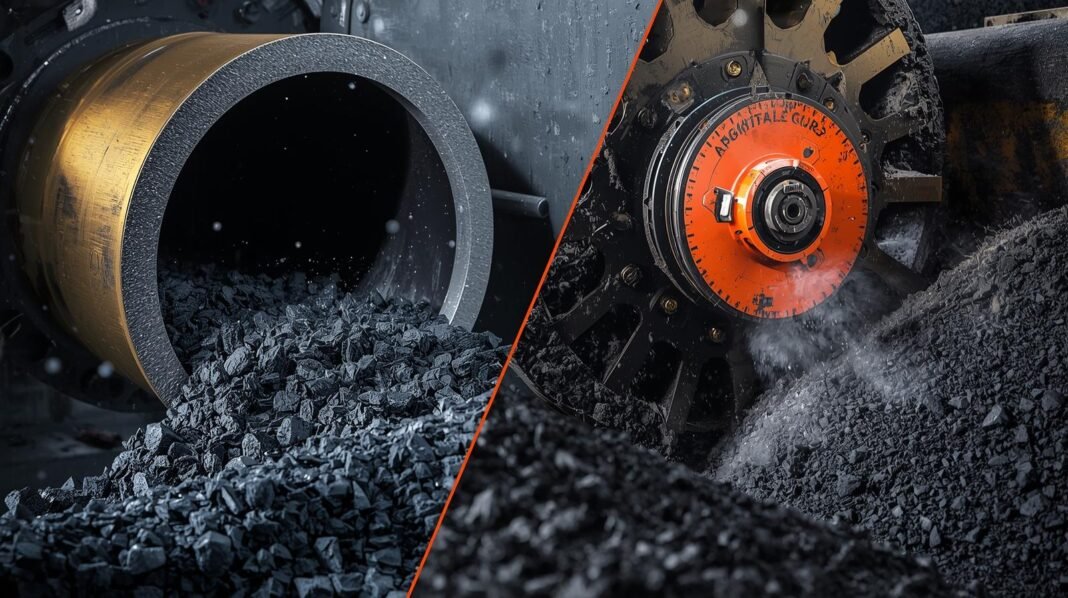
Basalt, a dense volcanic rock formed from rapidly cooled lava, stands as one of the most challenging materials to process in the aggregate industry.
Its exceptional hardness, abrasive nature, and crystalline structure demand careful consideration when selecting crushing equipment.
The choice between cone crushers and impact crushers for basalt processing represents a critical decision that affects not only the quality of the final product but also operational costs, maintenance requirements, and overall plant efficiency.
This comprehensive analysis examines both technologies to help quarry operators and aggregate producers make informed decisions for their basalt crushing operations.
Understanding Basalt’s Unique Properties
Before diving into crusher comparisons, understanding basalt’s characteristics is essential. Basalt typically registers between 5 and 6.5 on the Mohs hardness scale, making it significantly harder than limestone or sandstone.
Its compressive strength often exceeds 300 MPa, and its abrasive nature accelerates wear on crushing equipment.
These properties make basalt an excellent construction material—it produces durable aggregates for concrete, asphalt, and railroad ballast—but also make it demanding to process efficiently.
The rock’s interlocking crystalline structure and low porosity mean it requires substantial force to fracture effectively.
Additionally, basalt’s tendency to produce excessive fines during crushing requires careful process design to maintain desirable gradation curves for construction applications.
Cone Crushers: The Compression Specialists
Cone crushers operate on the principle of compression crushing, where material is squeezed between a moving mantle and a stationary bowl liner. As the eccentric assembly rotates, the mantle gyrates within the crushing chamber, applying tremendous force to trapped rock particles.
How Cone Crushers Handle Basalt
The compression crushing action of cone crushers aligns well with basalt’s physical properties.
The sustained, high-pressure crushing forces effectively fracture basalt’s crystalline structure along natural weakness planes, producing angular, well-shaped particles.
Also Read: The Complete Guide to Basalt Quarry Equipment Selection
Modern cone crushers designed for hard rock applications feature robust construction with reinforced frames, large-diameter mainshafts, and heavy-duty bearings capable of withstanding the stresses generated when crushing abrasive basalt.
The adjustable closed-side setting (CSS) on cone crushers provides precise control over product gradation.
Operators can fine-tune the crushing chamber geometry to achieve specific output sizes, ranging from coarse aggregates at 40-50mm down to fine materials at 6-10mm. This flexibility proves invaluable when producing multiple product sizes from a single basalt quarry.
Advantages of Cone Crushers for Basalt
Superior Product Cubicity: Cone crushers excel at producing well-shaped, cubic particles from basalt. The interparticle crushing action and controlled crushing zone geometry minimize the production of elongated or flaky particles, which are undesirable in most aggregate applications. This results in better concrete workability and superior asphalt compaction characteristics.
Lower Operating Costs: While cone crushers typically have higher initial capital costs, their operating expenses for basalt crushing are generally lower than impact crushers. The compression crushing mechanism generates less wear on critical components when processing hard, abrasive materials. Manganese steel liners, though expensive to replace, last considerably longer in cone crushers than blow bars in impact crushers when processing basalt.
Higher Reduction Ratios: Cone crushers can achieve reduction ratios of 6:1 to 8:1 in a single pass through the crushing chamber. This capability reduces the number of crushing stages required in a processing plant, simplifying the overall circuit design and reducing capital investment in multiple machines.
Energy Efficiency: Compression crushing requires less energy per ton of material processed compared to impact crushing, particularly with hard rocks like basalt. The efficient transfer of crushing force directly to the rock particles minimizes energy waste, resulting in lower power consumption per ton of aggregate produced.
Consistent Gradation Control: The predictable nature of compression crushing produces consistent product gradations with minimal variation. This reliability simplifies quality control and ensures that aggregate specifications are consistently met throughout production runs.
Limitations of Cone Crushers
Despite their strengths, cone crushers have some drawbacks when processing basalt. They generally produce a higher percentage of fines compared to impact crushers, which may necessitate additional screening and recirculation in the plant circuit.
The initial capital cost is typically higher than comparable-capacity impact crushers, and the learning curve for operators can be steeper due to the more complex adjustment mechanisms.
Cone crushers also require careful feeding practices. Uneven feed distribution or irregular material flow can cause unbalanced wear on liners and reduce crushing efficiency. Additionally, they don’t handle tramp metal well—steel contamination can cause significant damage to the crushing chamber and liner components.
Impact Crushers: The High-Velocity Alternative
Impact crushers utilize a fundamentally different crushing mechanism based on high-velocity impacts rather than compression. Material enters the crushing chamber and is struck by rapidly rotating blow bars mounted on a rotor. The rock particles are then thrown against impact plates or curtains, where further fracturing occurs through collision.
How Impact Crushers Process Basalt
Two main types of impact crushers are used in aggregate production: horizontal shaft impactors (HSI) and vertical shaft impactors (VSI). For basalt processing, VSI crushers have gained popularity due to their unique crushing action that combines rock-on-rock and rock-on-metal impacts.
In a VSI crusher, basalt particles are accelerated by a high-speed rotor (typically 50-75 meters per second tip speed) and thrown against an anvil ring or other rock particles.
This creates a crushing environment where basalt fragments collide at extreme velocities, shattering along crystal boundaries and producing angular particles with excellent shape characteristics.
HSI crushers, while effective for softer rocks, face significant challenges with basalt. The extreme abrasiveness and hardness of basalt causes rapid wear on blow bars and impact plates, leading to frequent maintenance and high consumable costs.
For this reason, HSI crushers are less commonly recommended for primary or secondary basalt crushing, though they may find application in tertiary crushing of pre-screened material.
Advantages of Impact Crushers for Basalt
Superior Particle Shape: VSI crushers, in particular, produce aggregates with outstanding shape characteristics. The high-velocity impacts fracture basalt particles along multiple planes simultaneously, creating highly cubical products with excellent angularity. This makes VSI-crushed basalt ideal for premium applications like high-performance concrete and surface course asphalt where particle shape directly affects material performance.
Selective Crushing Capability: Impact crushers preferentially fracture softer inclusions and weathered zones within basalt, helping to eliminate weak particles from the final product. This selective crushing produces more uniform aggregate quality and can actually improve the overall durability of the material.
Lower Fines Production: When properly configured, VSI crushers operating in rock-on-rock mode produce fewer unwanted fines compared to cone crushers. The controlled crushing environment and cascading material bed cushion impacts, reducing over-crushing of smaller particles while still effectively breaking larger fragments.
Simplified Maintenance: Modern impact crushers feature quick-change blow bar systems and easily accessible wear parts. While wear rates on basalt may be higher than with compression crushers, the actual maintenance procedures are often simpler and can be completed more quickly, reducing downtime.
Excellent Liberation: The high-energy impacts in VSI crushers provide excellent liberation of aggregate particles from any remaining adhered fines or dust coatings. This produces cleaner aggregates that may require less washing compared to compression-crushed material.
Limitations of Impact Crushers
The primary drawback of impact crushers for basalt is wear part consumption. Basalt’s hardness and abrasiveness cause accelerated wear on blow bars, rotor tips, and anvil rings.
This results in higher operating costs for consumables and more frequent maintenance intervals. The energy consumption per ton is also typically higher than cone crushers, particularly when processing very hard basalt.
Impact crushers are also more sensitive to feed conditions. They perform optimally with well-graded feed material and can be overloaded if fed too much fine material or poorly distributed feed streams. Additionally, they have lower reduction ratios (typically 4:1 to 6:1) compared to cone crushers, which may require additional crushing stages in some plant designs.
Application-Specific Considerations
The “better” choice between cone and impact crushers for basalt depends heavily on the specific application and product requirements.
For Base Course and Road Construction
When producing basalt aggregates for base course, subbase, or unbound road construction layers, cone crushers often represent the more economical choice.
These applications prioritize cost-effectiveness and consistent gradation over particle shape perfection. The higher throughput capacity and lower operating costs of cone crushers align well with the high-volume, cost-sensitive nature of road construction projects.
For Premium Concrete Aggregates
High-performance concrete applications demand superior particle shape and minimal flat, elongated particles. Here, VSI impact crushers shine, producing basalt aggregates with excellent cubicity that enhances concrete strength, reduces cement requirements, and improves workability.
The premium prices commanded by concrete-grade aggregates can justify the higher operating costs associated with impact crushing.
For Asphalt Production
Asphalt mix design benefits from angular, well-shaped aggregates that provide superior interlock and resistance to rutting. Both cone crushers and VSI crushers can produce suitable material, but VSI crushers have an edge in creating the microtexture and angularity that improves asphalt performance, particularly for high-traffic or demanding applications like airport runways or heavy-duty pavements.
For Railroad Ballast
Railroad ballast requires very specific gradation, particle shape, and durability characteristics.
Cone crushers excel at producing the consistent sizing required for ballast specifications, while VSI crushers can provide the superior particle shape and strength needed to resist degradation under repeated loading.
Many modern ballast production plants use a combination approach, with cone crushers for primary and secondary crushing followed by VSI finishing.
The Hybrid Approach: Combining Technologies
Progressive aggregate producers increasingly recognize that the cone-versus-impact debate presents a false dichotomy.
The optimal solution for many basalt crushing operations involves combining both technologies in a multi-stage crushing circuit that leverages each crusher’s strengths.
A typical hybrid configuration uses cone crushers for primary and secondary crushing stages, where their high reduction ratios, lower operating costs, and robust construction handle the initial fracturing of large basalt feed material.
The tertiary or quaternary stage then employs a VSI crusher operating in rock-on-rock mode to refine particle shape and produce premium-quality finished aggregates.
This approach delivers several benefits. The cone crushers efficiently reduce large basalt fragments to intermediate sizes at low cost, while the VSI crusher focuses on shape enhancement and quality refinement rather than primary size reduction.
The result is a product with both the consistent gradation of compression crushing and the superior particle shape of impact crushing, often at a lower total cost than using either technology alone throughout the entire process.
Economic Analysis: Total Cost of Ownership
When evaluating crushers for basalt processing, looking beyond purchase price to total cost of ownership provides a more complete picture.
Capital Investment: Cone crushers typically require 20-40% higher initial capital investment than comparable-capacity impact crushers. However, this must be weighed against throughput capacity, with cone crushers generally processing more tons per hour in continuous operation.
Operating Costs: For basalt crushing, cone crushers typically show operating costs of $0.15-0.30 per ton, while impact crushers range from $0.25-0.50 per ton. The primary difference stems from wear part consumption, with basalt’s abrasiveness causing rapid wear on impact crusher blow bars and rotor tips.
Maintenance Downtime: Cone crusher liner changes are less frequent but more time-intensive, typically requiring 8-16 hours every 6-12 months depending on basalt characteristics and production volumes. Impact crusher blow bar changes are more frequent (every 1-3 months) but quicker, often completed in 2-4 hours with modern quick-change systems.
Energy Consumption: Cone crushers consume approximately 0.8-1.5 kWh per ton of basalt processed, while impact crushers require 1.2-2.5 kWh per ton. Over the lifetime of the equipment, energy costs can represent a significant portion of total operating expenses.
Product Value: Premium products command higher prices. If VSI crushing allows a producer to sell basalt aggregates into premium concrete markets rather than base course applications, the price differential ($15-30 per ton) can easily justify higher operating costs.
Environmental and Sustainability Considerations
Modern aggregate operations must consider environmental impacts alongside production efficiency. Both crusher types present different environmental profiles when processing basalt.
Cone crushers generate less dust during operation due to the enclosed crushing chamber and lower-velocity crushing action. This reduces fugitive dust emissions and potentially lowers the requirements for dust suppression systems. Their lower energy consumption also translates to reduced carbon emissions from power generation.
Impact crushers, particularly VSI machines, produce more airborne dust due to the high-velocity crushing action.
However, their superior particle shape can actually provide environmental benefits downstream by reducing cement requirements in concrete production (better particle packing efficiency) and improving the longevity of asphalt pavements (reduced rutting and maintenance needs).
Water consumption for dust suppression and aggregate washing varies between installations but is generally comparable for both technologies when proper dust control measures are implemented.
Future Trends in Basalt Crushing Technology
The crushing equipment industry continues to evolve, with several emerging trends affecting basalt processing decisions.
Automation and Optimization: Modern crushers increasingly incorporate automated control systems that continuously monitor and adjust crushing parameters based on feed characteristics, desired product specifications, and wear conditions. These systems optimize both cone and impact crushers to maintain consistent product quality while minimizing energy consumption and wear part usage.
Wear-Resistant Materials: Advances in metallurgy and materials science are producing longer-lasting wear components for both crusher types. New alloy compositions, ceramic composite materials, and surface hardening technologies extend the service life of cone crusher liners and impact crusher blow bars when processing abrasive basalt.
Hybrid Crushing Chambers: Some manufacturers are developing hybrid crushing chamber designs that combine elements of compression and impact crushing in single units. These experimental designs aim to capture the efficiency of cone crushers and the product shaping capability of impact crushers in one machine.
Energy Recovery Systems: Emerging technologies capture and reuse the kinetic energy generated during crushing operations, potentially reducing the energy consumption gap between cone and impact crushers.
Making the Right Choice for Your Operation
Selecting between cone crushers and impact crushers for basalt aggregates requires careful analysis of multiple factors specific to your operation:
Evaluate Your Product Requirements: Start by understanding your target markets and their aggregate specifications. Premium applications with stringent particle shape requirements favor impact crushers, while high-volume, cost-sensitive markets may be better served by cone crushers.
Analyze Your Basalt Characteristics: Obtain detailed geological and geotechnical data on your basalt deposit. Variations in hardness, abrasiveness, and mineralogy significantly affect crusher performance and wear rates. Some basalt formations may be particularly challenging for one crusher type versus another.
Consider Your Entire Plant Design: Crushing equipment doesn’t operate in isolation. Consider how your crusher choice affects the entire production circuit, including screening capacity, recirculation loads, and dust collection requirements. A crusher that seems optimal in isolation may create bottlenecks or inefficiencies elsewhere in the plant.
Calculate Realistic Operating Costs: Develop detailed cost models based on actual operating data from similar basalt operations rather than relying on theoretical specifications. Contact equipment manufacturers for wear part consumption data from comparable installations.
Plan for Market Flexibility: Consider whether your operation needs to produce multiple product types for different markets. The ability to switch between products or adjust specifications can provide competitive advantages and revenue diversification.
Factor in Operator Expertise: Assess your team’s experience and training capabilities. Cone crushers require more sophisticated operational knowledge but reward skilled operators with superior efficiency. Impact crushers are somewhat more forgiving but still require proper feed management and maintenance practices.
Conclusion
Neither cone crushers nor impact crushers can be universally declared “better” for basalt aggregates—the optimal choice depends on your specific operational requirements, product specifications, and economic objectives.
Cone crushers offer superior cost-efficiency, higher reduction ratios, and robust performance for high-volume operations producing aggregates where particle shape requirements are moderate.
Impact crushers, particularly VSI models, excel at producing premium-quality aggregates with outstanding particle shape for demanding applications, though at higher operating costs.
For many modern basalt aggregate operations, the most effective solution combines both technologies in a multi-stage crushing circuit that leverages the strengths of each. This hybrid approach delivers consistent production, excellent product quality, and optimized operating economics.
As crushing technology continues to advance, the performance gap between cone and impact crushers narrows, but their fundamental operational differences ensure that both will remain important tools in the aggregate producer’s arsenal.
Ultimately, the decision should be based on comprehensive analysis of your deposit characteristics, market requirements, and operational capabilities.
Consulting with experienced aggregate processing engineers, conducting pilot tests when possible, and carefully evaluating total cost of ownership rather than just purchase price will lead to the crusher selection that best serves your basalt aggregate operation’s long-term success.
Also Read
The Ultimate Guide to Equipment Maintenance Schedules in Construction
Heavy Equipment Maintenance in 2025: Trends for Fleet Owners

