
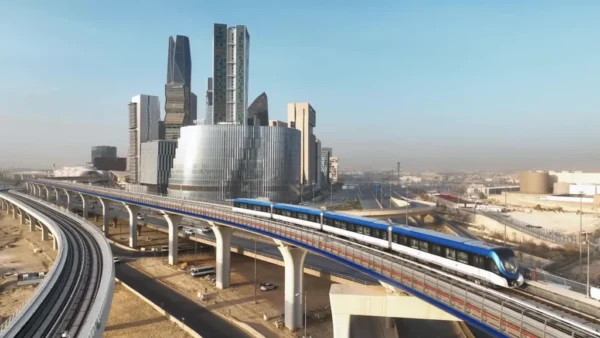
From driverless metros spanning entire cities to historic tunnel projects rescuing America’s busiest transit corridor, 2025 has been a landmark year for global infrastructure.
These five mega-projects showcase the cutting edge of engineering ambition, transforming how millions of people will travel, work, and connect for generations to come.
1. Riyadh Metro: The World’s Longest Driverless Marvel
Location: Riyadh, Saudi Arabia
Status: Fully Operational
The Numbers: 176 kilometers, 85 stations, 6 lines
The Riyadh Metro claimed its place in history by earning Guinness World Records recognition as the world’s longest fully automated, driverless metro network. After opening its doors in late 2024, the system reached full operational capacity throughout 2025, with the Orange Line welcoming its first passengers on January 5, 2025.
This isn’t just another transit system. The Riyadh Metro represents Saudi Arabia’s bold vision for urban transformation.
Six color-coded lines weave through the capital city, connecting business districts, residential neighborhoods, and cultural landmarks with futuristic, air-conditioned stations designed by international architects.
The automated trains glide silently through the desert metropolis, requiring no human operators. Passengers simply board, and sophisticated technology handles everything from acceleration to precise station stops.
For a city long dominated by car culture, the metro marks a revolutionary shift toward sustainable urban mobility.
Why It Matters: The Riyadh Metro demonstrates that massive transit infrastructure can be built rapidly in challenging desert conditions while setting new global standards for automation and scale.
2. Gordie Howe International Bridge: Connecting Two Nations
Location: Detroit, Michigan to Windsor, Ontario
Status: Construction 98% Complete (Opening Early 2026)
The Numbers: Longest cable-stayed bridge in North America, 6 lanes plus pedestrian/cycling paths
Rising majestically over the Detroit River, the Gordie Howe International Bridge reached a major milestone in 2025 with construction hitting 98 percent completion.
Named after the legendary hockey player who embodied both American and Canadian spirit, this architectural marvel will soon become the primary gateway between two of North America’s most important economies.
The bridge’s distinctive cable-stayed design features a single tower rising from the center, supporting the roadway with elegant steel cables that fan outward like a modern sculpture.
Beyond serving as a critical trade route, the bridge includes dedicated lanes for cyclists and pedestrians, recognizing that international connections happen at both commercial and human scales.
Construction completion occurred in fall 2025, though the bridge won’t officially open until early 2026 as engineers conduct extensive systems testing.
When it does open, it will relieve congestion at the aging Ambassador Bridge and provide redundancy for a border crossing that handles 25 percent of all trade between the United States and Canada.
Why It Matters: This project proves that even in an era of political tensions, cross-border infrastructure cooperation can still produce engineering excellence that benefits both nations.
3. Austin-Bergstrom International Airport: Texas-Sized Transformation
Location: Austin, Texas
Status: Multiple Phases Completed in 2025
The Numbers: $20 million International Arrivals expansion, 9% passenger growth
Austin’s explosive growth as a tech hub demanded airport infrastructure to match, and 2025 delivered major upgrades.
The airport unveiled a substantial International Arrivals expansion spanning more than 20,000 square feet, complete with a modernized baggage handling system designed to accommodate the city’s surging international traffic.
The timing couldn’t be better. October 2025 saw passenger traffic spike 9 percent compared to the previous year, validating the expansion investment. But Austin isn’t stopping there.
The Federal Aviation Administration committed $108 million toward further airfield improvements, recognizing the airport’s growing importance as a southern tech corridor gateway.
The renovated international arrivals hall features bright, open spaces with Texas-inspired design elements.
Passengers now move through immigration and customs more efficiently, with digital kiosks and expanded processing areas reducing wait times during peak periods.
Why It Matters: Austin’s airport transformation illustrates how second-tier American cities are investing in world-class infrastructure to compete globally, moving beyond traditional coastal hub dominance.
4. LA Metro “28 by ’28”: Racing Toward the Olympics
Location: Los Angeles, California
Status: Multiple Projects Completed in 2025
The Numbers: Part of $42.9 billion initiative, includes 12.3 new rail miles
Los Angeles is transforming itself from a car-centric sprawl into a transit-connected metropolis, and 2025 marked significant progress toward that goal.
Driven by the urgency of hosting the 2028 Summer Olympics, the “28 by ’28” initiative delivered several major completions this year.
The Gold Line Foothill Extension to Pomona added 12.3 miles of new rail, connecting the San Gabriel Valley with improved access.
The Airport Metro Connector Station at LAX finally realized decades of planning, allowing travelers to reach one of the world’s busiest airports via rail instead of battling legendary LA traffic.
The J Line electrification brought modern, quiet electric trains to communities previously served by diesel light rail.
Perhaps most symbolic is the Rail to Rail Pedestrian and Bike Path, which acknowledges that great transit systems connect to communities at street level, not just through train platforms.
These projects represent just a portion of LA Metro’s ambitious $42.9 billion vision. When complete, the system will offer residents and visitors realistic alternatives to driving, potentially reshaping Southern California’s notorious car culture.
Why It Matters: LA’s transit transformation demonstrates that even cities built around automobiles can reimagine themselves, using mega-events like the Olympics as catalysts for permanent infrastructure improvement.
5. Hudson Tunnel Project: Rescuing America’s Busiest Corridor
Location: Hudson River, New York/New Jersey
Status: 7 of 10 Construction Packages Active in 2025
The Numbers: $16 billion investment, expected to create 95,000 jobs
Deep beneath the Hudson River, one of America’s most critical infrastructure projects accelerated dramatically in 2025.
The Hudson Tunnel Project isn’t glamorous, but it might be the most important mega-project in the country. It will construct new twin rail tubes under the river while rehabilitating the 113-year-old North River Tunnel that Hurricane Sandy severely damaged in 2012.
In February 2025, officials awarded the Manhattan Tunnel Project contract, pushing construction forward on multiple fronts.
Seven of ten construction packages are now active, with workers boring through bedrock, installing ventilation systems, and preparing underground spaces that will serve millions of daily commuters for the next century.
The existing tunnel carries more than 200,000 passengers daily on Amtrak and New Jersey Transit trains.
Any disruption would paralyze the entire Northeast Corridor economy. The new tubes will provide redundancy, allowing full rehabilitation of the old tunnel without service interruptions.
Why It Matters: This project exemplifies infrastructure resilience, demonstrating that maintaining and upgrading aging systems can be just as transformative as building entirely new ones, especially when climate change threatens coastal infrastructure.
The Common Thread: Infrastructure as Economic Investment
These five mega-projects share something beyond their massive scale. Each represents a fundamental bet that infrastructure investment pays dividends far beyond construction jobs and ribbon-cutting ceremonies.
The Riyadh Metro positions Saudi Arabia for a post-oil economy by making its capital city globally competitive.
The Gordie Howe Bridge strengthens economic ties between longtime trading partners. Austin’s airport upgrades accommodate tech sector growth.
LA’s transit expansion reimagines urban mobility. The Hudson Tunnel protects the economic engine of America’s most productive region.
In an era of political polarization and budget constraints, these projects prove that ambition backed by careful planning can still produce infrastructure marvels.
They create jobs, reduce emissions, improve quality of life, and lay foundations for prosperity that will extend decades into the future.
Looking Ahead
As 2025 draws to a close, these five mega-projects offer a preview of what’s possible when governments, engineers, and communities commit to transformative infrastructure.
They face challenges—budget overruns, technical obstacles, political headwinds—but they persist because the alternative is managed decline.
The next generation will judge our infrastructure decisions not by the press releases when projects begin, but by whether trains run on time, whether bridges stand strong, and whether communities thrive because we had the vision to build for the future.
These five marvels suggest we’re getting it right.
Have thoughts on these mega-projects? Share your favorite infrastructure achievement of 2025 in the comments below.
Also Read
Top 3 Construction Trends to Watch in 2026
Winter Construction: Must-Have Equipment and Safety Measures for Cold Weather Success

- The State of Plant Hire in Scotland: On the Road to ScotPlant 2026 - March 11, 2026
- DA Davidson Just Raised Sterling Infrastructure’s Target to $500 — Here Is Why the Bulls Are Still Buying - March 11, 2026
- Atlas Energy Solutions Locks in Power Equipment Deal with Caterpillar to Support Private Grid Expansion - March 11, 2026
