
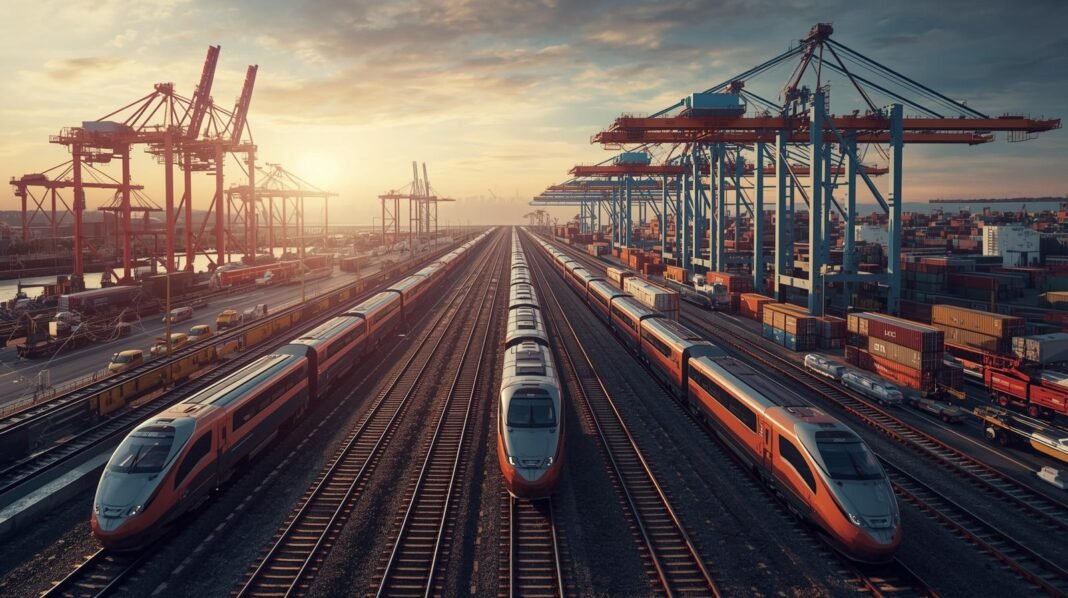
The sound of progress echoes across Africa—from the roar of locomotives on newly laid tracks to the movement of massive container cranes at modernized ports.
Rail and port construction projects valued at billions of dollars are fundamentally reshaping how goods, people, and ideas move across the continent.
These infrastructure investments represent far more than steel and concrete; they’re the arteries of a transformed African economy, driving regional integration and unlocking trade potential that could reshape global commerce.
The Infrastructure Imperative Driving Regional Integration
Africa faces an infrastructure challenge of unprecedented scale. Over 60,000 kilometers of critical road links require upgrading to accommodate anticipated growth in intra-African trade because of the African Continental Free Trade Area (AfCFTA), with upgrading costs estimated at least $24 billion.
While roads currently dominate, carrying approximately 77% of Africa’s freight, the limitations of road-dependent logistics are becoming increasingly apparent.
Poor infrastructure has resulted in a 40% loss in productivity in African countries and up to a 2-percentage point reduction in annual national economic growth.
Road freight tariffs in Africa run double those in the United States, while travel times along critical export corridors stretch three times longer than comparable Asian routes.
For a continent pursuing economic transformation through the AfCFTA—a $3.4 trillion market of 1.3 billion people—these inefficiencies exact unsustainable costs.
Rail and port infrastructure offers transformative solutions. The new Djibouti-Addis Ababa rail line reduced travel time between the port and Ethiopian capital from three days to just 10-12 hours, while the Mombasa-Nairobi rail line similarly slashed transit times. These aren’t marginal improvements—they represent quantum leaps in logistics efficiency that fundamentally alter trade economics.
Major Rail Construction Projects Reshaping Africa’s Trade Map
East Africa’s Standard Gauge Railway Network
The East African Railway Master Plan proposes rejuvenating railways serving Tanzania, Kenya, and Uganda while building new railways to serve Rwanda and Burundi, with objectives to increase efficiency and speed while lowering transport costs.
This ambitious vision creates an interconnected standard gauge network linking the Indian Ocean to Africa’s interior.
Uganda’s rail transformation exemplifies this regional vision. In November 2024, President Yoweri Museveni launched construction of a $2.84 billion, 1,700-kilometer railway linking Uganda’s eastern border to Kampala and connecting to Kenya’s network.
Once completed, the railway will reduce transport costs from $0.155 per tonne-kilometer to just $0.05 per tonne-kilometer while shortening travel time between Mombasa and Kampala from 10-14 days to hours.
Tanzania’s Standard Gauge Railway already connects Dar es Salaam to Dodoma and will eventually extend to Rwanda, Uganda, and Burundi, creating seamless connectivity across the East African Community.
These projects aren’t isolated national initiatives—they’re deliberate building blocks of regional economic corridors designed to multiply trade efficiency through network effects.
The Lobito Corridor: Connecting Oceans and Economies
The Lobito Corridor represents one of Africa’s most strategically significant rail investments. The project entails construction of almost 350 miles of rail line in Zambia, along with hundreds of miles of feeder roads, linking the southern Democratic Republic of Congo and northwestern Zambia to regional and global markets via Angola’s Port of Lobito.
The U.S. government is working to extend the Lobito Corridor all the way to the Indian Ocean through Tanzania, which would reduce trade routes from 45 days to 36 hours and open entirely new markets for agribusiness and other sectors.
With $250 million from the U.S. International Development Finance Corporation and support from the European Union and African financial institutions, the corridor has already carried Congolese copper shipments to Baltimore.
The vision extends beyond mineral exports. When completed, the project will expand an economic corridor connecting all three host countries to the world, potentially lowering costs for business and advancing the shared vision of connected, open-access rail from the Atlantic Ocean to the Indian Ocean.
This infrastructural investment catalyzes establishment of small businesses along railway routes, fostering local economic growth across transportation, logistics, clean energy, critical mineral supply chains, and agribusiness sectors.
West Africa’s Railway Renaissance
West Africa is experiencing a rail construction surge driven by resource development and urban connectivity needs.
The Kano-Maradi rail project, now at 80% completion and scheduled for completion by 2025, runs from Kano, Nigeria, to Maradi, Niger, aiming to boost trade and provide new transport options for local communities.
Guinea’s TransGuinean railway showcases the scale of modern African rail construction. The 600-kilometer railway connecting the Simandou iron ore mine to the future port of Morebaya features 235 bridges and over 24 kilometers of tunnels, with the longest tunnel spanning 11 kilometers.
This engineering feat positions Guinea to become a major iron ore exporter while demonstrating the continent’s capacity to execute complex infrastructure projects.
Senegal’s Dakar Regional Express Train Phase 2 extends rail connections from Dakar city center to Blaise Diagne International Airport, featuring a 55-kilometer track with 14 stations designed to transport 115,000 daily passengers.
These urban rail systems reduce road congestion while improving productivity through faster, more reliable commuter mobility.
Southern Africa’s Cross-Border Integration
The 1,500-kilometer Trans-Kalahari Railway, scheduled to start operations in January 2025, will run from Rasesa in Botswana through Windhoek to Walvis Bay in Namibia, facilitating transportation of 14 million tons of coal and copper annually with potential to increase to 56 million tons by its 30th year.
This project represents Sub-Saharan Africa’s first cross-border transport public-private partnership, demonstrating how regional cooperation unlocks trade opportunities impossible for individual nations.
The approximately $2.7 billion Nacala rail and port initiative linking Mozambique and Malawi constitutes another strategic regional corridor for the sub-region, creating multimodal connectivity that transforms landlocked economies’ market access.
Port Construction: Gateways to Global Trade
West Africa’s Port Expansion Wave
West Africa’s ports are undergoing transformative modernization to handle surging trade volumes. Ghana’s Tema Port Phase 2 expansion, 98% completed with targeted September 2025 commissioning, adds 270,000 square meters of paved yard, expanding the terminal from 100 to 127 hectares and boosting container capacity to around 3.7 million TEUs through a $1.3 billion investment.
Senegal’s port transformation demonstrates strategic vision. DP World began construction of the Ndayane Deepwater Port in December 2024, with the first phase including a terminal capable of accommodating ultra-large container ships along an 840-meter quay, creating capacity to handle 1.2 million TEUs annually.
British International Investment estimates the port will boost Senegal’s GDP by 3% through increased trade flows, potentially adding $15 billion in trade value by 2035.
The Port of Ndayane addresses capacity constraints plaguing Dakar’s existing port, located within densely urbanized areas limiting expansion.
Dakar Port’s 2024-2023 Container Port Performance Index improvement of 104.7 points positions it among Africa’s most significantly enhanced container terminals, reflecting deliberate infrastructure investments and operational reforms under DP World’s concession.
East Africa’s Strategic Port Developments
Djibouti’s Doraleh Container Terminal handled 1,236,769 TEUs in 2024, breaking the 1 million TEU barrier for the first time.
The Doraleh Multipurpose Port, which opened in 2017 at a cost of $580 million, provides dedicated container, roll-on-roll-off, bulk and breakbulk terminals across six existing berths, with another 11 berths planned.
Djibouti’s geographic position—connecting the Red Sea, Indian Ocean, Gulf states and Suez Canal which handles about 30% of global seaborne cargo—creates natural advantages.
Ethiopian trade finances modern terminals that now provide transshipment services for other regional ports, with goods unloaded from large container ships at Djibouti distributed across Eastern Africa by smaller feeder services.
Tanzania and Mozambique are similarly upgrading port infrastructure to support expanding rail networks.
The integrated rail-port approach ensures that enhanced railway capacity isn’t bottlenecked by inadequate maritime facilities, creating seamless multimodal connectivity from interior production centers to global shipping lanes.
North Africa’s High-Capacity Developments
Egypt’s port investments reflect its position as Africa’s largest construction market. Damietta Port achieved an 86.7-point increase in the Container Port Performance Index between 2023 and 2024, demonstrating the potential of targeted port investments.
At the center of this transformation is the Tahya Misr 1 Container Terminal, developed under public-private partnership with advanced container-handling equipment including high-capacity quay cranes and electric Rubber-Tyred Gantry cranes.
Algeria’s $6 billion El Hamdania Port Development represents the country’s first deep-water port with capacity to handle 6.5 million containers and 27.5 million tons of general cargo annually.
These mega-projects position North African ports as critical Mediterranean gateways linking African, European, and Asian trade flows.
The AfCFTA Catalyst: Infrastructure Driving Trade Integration
The African Continental Free Trade Area has fundamentally altered infrastructure investment calculus.
With AfCFTA in absolute terms, over 25% of intra-African trade gains in services would go to transport alone, and nearly 40% of the increase in Africa’s services production would be in transport.
Specific infrastructure demands are staggering. Implementing AfCFTA would double maritime freight from 58 to 131.5 million tonnes, requiring 126 vessels for bulk cargo and 15 vessels for container cargo by 2030.
It would also double road freight from 201 to 403 million tonnes and airfreight from 2.3 to 4.5 million tonnes.
Rail infrastructure offers particular promise. Currently almost 77% of Africa’s freight is transported by road while rail accounts for only 0.3%. With appropriate trade-related infrastructure policies, rail’s share could increase to 7%, along with growth in maritime and air freight demand.
By 2030, projections indicate Africa will require approximately 2 million trucks, over 100,000 rail wagons, 250 aircraft, and more than 100 vessels to support AfCFTA-related trade.
The African Development Bank has invested over $55 billion in the last nine years to develop road corridors, ports, railways, and expand power pools to interlink countries and boost trade, with over $8 billion specifically across 109 cross-border, economic corridors, and infrastructure projects between 2014 and 2024.
Economic Impact: Transforming Trade Competitiveness
Cost Reduction and Efficiency Gains
The economic rationale for rail and port investments extends beyond simple capacity expansion. Rail networks offer cost-effective means to transport bulk commodities and raw materials, enhancing African goods’ global competitiveness.
South Africa’s extensive 20,986-kilometer rail network supports mining, agriculture, and other industries, providing cost-efficient export routes connected with ports.
Poor transportation networks extract heavy tolls. Studies show inadequate transport infrastructure adds 30-40% to costs of goods traded among African countries, hampering private sector development.
The Sub-Saharan Africa Rail Freight Transport Market size is expected to reach $4.77 billion in 2025 and grow at a CAGR of 5.26% to reach $6.19 billion by 2030, reflecting sustained investment in expanding rail infrastructure to improve efficiency, reduce transport costs, and alleviate road congestion.
Rail particularly benefits bulk commodity transport. Compared to road transport, rail offers economies of scale that dramatically reduce per-unit costs over long distances.
For mineral exports—copper from Zambia, iron ore from Guinea, coal from South Africa—rail connectivity to ports determines global market competitiveness.
Job Creation and Economic Multipliers
Infrastructure construction generates immediate employment while operational phases create sustained economic activity.
East Africa’s Standard Gauge Railway projects have created thousands of jobs, fostering skills transfer through international partnerships and public-private partnerships that contribute to long-term economic growth.
During construction, the Ndayane port project will create over 1,800 jobs, and once operational, it’s expected to support 2.3 million jobs across Senegal, including 22,000 tied directly to expanded trade.
These employment impacts ripple through local economies, supporting services, retail, and housing sectors.
Rail and port projects catalyze broader economic transformation. Improved logistics enable manufacturers to access larger markets while reducing input costs.
Agricultural producers gain reliable cold chain logistics for perishable exports. Small and medium enterprises expand operations across borders previously separated by prohibitive transport costs.
Regional Integration and Market Access
For landlocked countries, rail and port infrastructure represents economic lifelines. Fifteen African countries lack direct ocean access, making them dependent on neighbors’ transport corridors.
Tanzania’s Standard Gauge Railway, already connecting Dar es Salaam to Dodoma, will eventually link to Rwanda, Uganda, and Burundi, significantly reducing transport time and costs in the East African Community.
The integration benefits flow bidirectionally. Coastal nations gain expanded hinterlands for their ports, increasing throughput and revenues.
Landlocked nations access multiple port options, reducing vulnerability to single-corridor disruptions and increasing negotiating leverage for competitive logistics rates.
Financing Models Enabling Mega-Projects
Public-Private Partnerships
Greater collaboration between public and private sectors characterizes current trends, with port authorities increasingly concessioning port and terminal operations to private companies.
Investment in port modernization and expansion continues to be dominated by China, with the UAE becoming increasingly prominent.
These PPP structures transfer construction and operational risks to private partners while ensuring public infrastructure benefits.
DP World’s investments across Dakar, Ndayane, and Maputo demonstrate how global port operators bring capital, technical expertise, and operational efficiency to African infrastructure.
The Lobito Corridor showcases multilateral financing coordination. U.S., European Union, and African development finance institutions pool resources while private contractors execute construction.
This blended finance approach diversifies risk while mobilizing capital at scales individual entities cannot achieve independently.
Development Finance Institution Leadership
The African Development Bank, World Bank, and regional development banks provide crucial catalytic capital that attracts commercial investment.
Partial risk guarantees, currency hedges, and credit enhancements make projects bankable despite perceived political and regulatory uncertainties.
In 2024, the African Development Bank Board approved a partial credit guarantee of $696 million to release $3.9 billion for construction of the Central Corridor Standard Gauge Railway connecting Tanzania, Burundi and the DRC.
These leverage ratios—$1 in guarantees unlocking $5+ in total investment—demonstrate DFI catalytic power.
Geopolitical Infrastructure Competition
China’s Belt and Road Initiative, the U.S. Partnership for Global Infrastructure and Investment, and the EU’s Global Gateway Initiative compete to finance African infrastructure, creating opportunities for African governments to secure favorable terms while maintaining strategic autonomy.
Different models offer varying advantages. Chinese financing often includes construction by Chinese firms with technology transfer components. Western initiatives emphasize governance standards and local capacity building.
African governments increasingly blend approaches, selecting optimal structures for specific projects rather than exclusive partnerships.
Overcoming Implementation Challenges
Infrastructure Quality and Maintenance
Construction represents only the first phase; sustained operations require continuous maintenance and upgrading.
South Africa has the most extensive rail infrastructure in Africa at 20,986 kilometers, however rail and port capacity declines remain a severe constraint in domestic and regional trade. Since 2017, commodity exports have consistently dropped due to rail inefficiencies.
Theft of cables, rails, and station infrastructure undermines operational reliability. Transnet’s challenges demonstrate that even well-established rail systems require constant vigilance and investment to maintain service levels.
New African rail projects must incorporate security, maintenance funding, and operational governance from initial planning.
Cross-Border Coordination Complexities
Rail and port corridors crossing multiple jurisdictions face coordination challenges. Different regulatory regimes, customs procedures, gauge standards, and operating protocols can negate infrastructure investments’ efficiency gains.
The East African Railway Master Plan accounts for break of gauge issues and aims for good interoperability within the resulting hybrid railway network combining new standard-gauge railways with rehabilitated narrow-gauge railways.
Break of gauge handling stations with cranes for transshipment and coordinated scheduling enable this multimodal approach.
Skilled Labor and Technical Capacity
Infrastructure operations demand specialized expertise—railway signaling technicians, container terminal operators, logistics planners, maintenance engineers. Africa faces acute skills deficits requiring an additional approximately 5 million skilled professionals including engineers, technicians, and artisans.
Successful projects incorporate training programs and technology transfer. International partnerships with experienced rail and port operators facilitate knowledge sharing while building domestic capability.
Educational institutions increasingly offer specialized logistics and transportation programs aligned with infrastructure development needs.
Technology and Innovation Enhancing Competitiveness
Digital Infrastructure Integration
Modern ports and railways integrate digital technologies that transform operational efficiency.
Port management software, tracking systems, and data analytics optimize berth allocation, reduce dwell times, and improve yard utilization. Real-time visibility enables shippers to plan supply chains with greater precision.
Blockchain applications enhance supply chain transparency and reduce documentation fraud.
Electronic data interchange systems accelerate customs clearance by enabling parallel processing of regulatory requirements. These digital layers multiply physical infrastructure productivity.
Sustainability and Green Logistics
Rail transport inherently offers environmental advantages—emissions per tonne-kilometer run substantially below road transport.
Electrified rail systems powered by renewable energy create zero-emission freight corridors aligned with climate commitments.
Port investments increasingly incorporate renewable energy—solar panels on terminal buildings, shore power for berthed vessels, electric cargo handling equipment.
These sustainability features attract climate-conscious investors while reducing operational costs through lower energy expenses.
Autonomous and AI-Enhanced Operations
Automated container terminals with autonomous vehicles and AI-optimized operations represent the frontier of port efficiency.
While full automation remains rare in Africa, semi-automated systems with human oversight offer transitional approaches that enhance productivity while maintaining employment.
Predictive maintenance using IoT sensors and machine learning extends asset lifecycles while preventing costly breakdowns.
These technologies prove particularly valuable in resource-constrained environments where maximizing existing infrastructure utilization takes priority over greenfield expansion.
Strategic Recommendations for Stakeholders
For Governments and Policymakers
Prioritize regional infrastructure projects over purely national initiatives. The highest returns come from corridors connecting multiple countries, creating network effects impossible for isolated investments.
Harmonize regulations, customs procedures, and technical standards to eliminate non-physical barriers undermining infrastructure investments.
Establish transparent PPP frameworks that balance risk allocation, enable reasonable returns for private investors, and protect public interests.
Successful PPPs require sophisticated government capacity to structure, negotiate, monitor, and enforce contracts—invest accordingly in institutional development.
For Private Sector Investors
Engage early in project preparation to shape infrastructure design and business models. The best investment opportunities emerge during feasibility and structuring phases when contributions to project bankability create positioning advantages.
Partner with local firms possessing market knowledge, regulatory relationships, and community connections. Joint ventures combining international capital and expertise with local insight consistently outperform independent foreign entry.
Think long-term. Rail and port concessions span decades; sustainable success requires patient capital, relationship building, and genuine commitment to market development beyond short-term profit extraction.
For Development Finance Institutions
Increase preparation financing to advance projects from concept to bankability. The International Transport Forum reports that national high-speed rail infrastructure investments can boost GDP by 1-2% within a decade, yet many worthy projects fail at feasibility stage due to insufficient preparation capital.
Structure guarantees and risk mitigation instruments that crowd-in commercial capital rather than substituting for it. Catalytic DFI participation should unlock multiples of private investment, not merely fund projects commercial markets would finance independently.
Coordinate among institutions to avoid duplication while ensuring comprehensive corridor development. The Lobito Corridor’s success stems partly from coordinated multilateral engagement rather than fragmented individual initiatives.
The Path Forward: Infrastructure as Economic Destiny
Africa’s railway sector is undergoing its largest expansion in decades, with over 7,000 kilometers of new lines under construction or planned. Development finance institutions are driving a revival in greenfield rail projects, bridging funding gaps for large-scale infrastructure.
Every major development success story—North America’s industrial rise, Europe’s single market, Asia’s manufacturing boom—has been built on efficient, well-connected railway networks.
In Africa, rail offers more than transport; it’s the backbone of economic corridors linking ports to inland economies, connecting markets across borders, and enabling large-scale, low-cost, low-emission movement of goods and people that drives competitiveness and growth.
The confluence of AfCFTA implementation, unprecedented infrastructure investment, and maturing regional cooperation creates conditions for transformation.
Rail and port construction isn’t merely keeping pace with trade growth—it’s actively catalyzing economic integration that wouldn’t otherwise occur.
Challenges remain formidable. Financing gaps, coordination complexities, maintenance requirements, and skills deficits demand sustained attention. Yet the trajectory is unmistakable.
From the Lobito Corridor connecting oceans to East Africa’s standard gauge network, from West Africa’s expanding ports to Southern Africa’s cross-border railways, infrastructure is knitting the continent together.
For construction finance professionals, investors, policymakers, and development practitioners, Africa’s rail and port transformation represents opportunity at historic scale.
Those who engage thoughtfully—combining rigorous analysis with local partnership, patient capital with operational excellence, commercial objectives with development impact—will participate in reshaping not just infrastructure but the economic future of 1.3 billion people.
The sound of progress echoing across Africa isn’t merely construction noise. It’s the sound of connectivity replacing isolation, efficiency displacing inefficiency, and integration superseding fragmentation.
Rail and port infrastructure doesn’t just boost regional trade—it fundamentally reimagines what’s possible for African economies and their role in global commerce. The construction phase is well underway. The transformation has only just begun.
Also Read
Africa Construction Market: Top Opportunities for Global Investors
Africa Construction Finance: How PPPs Are Funding Major Projects

