
Construction projects across Africa and emerging markets face mounting pressure to deliver faster, more efficiently, and within tighter budgets.
Traditional stationary concrete batching plants, while reliable, often create bottlenecks that slow progress and inflate costs.
The concrete must be transported from distant plants, leading to quality concerns, delivery delays, and increased logistics expenses.
As urbanization accelerates and infrastructure demands grow, contractors are seeking solutions that bring production directly to the job site.
This shift has catalyzed the rise of mobile and modular batching plants, revolutionary systems that transform how concrete is produced on construction sites.
These portable solutions eliminate the dependency on external suppliers, reduce transportation costs, and provide unprecedented flexibility for projects of all sizes.
For contractors managing multiple sites or working in remote locations, mobile and modular batching plants represent not just an alternative but the future of concrete production.
Understanding Mobile & Modular Batching Plants
Mobile and modular batching plants are compact, transportable concrete production systems designed for rapid deployment and on-site operation.
Unlike traditional stationary plants that require extensive foundation work and permanent installation, these systems can be relocated as projects evolve or complete.
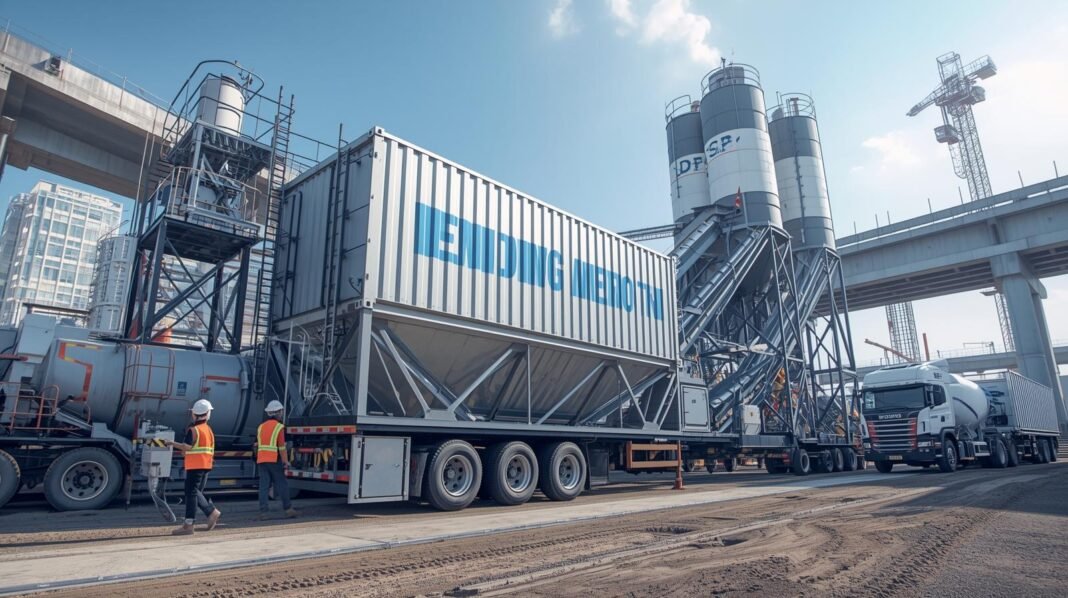
Mobile Batching Plants are self-contained units mounted on wheeled chassis or trailers, allowing them to be towed directly to construction sites.
They typically feature integrated components including aggregate bins, cement silos, water tanks, and mixing systems, all designed for quick setup and operation within hours of arrival.
Modular Batching Plants consist of pre-fabricated components that can be assembled and disassembled efficiently.
While requiring slightly more setup time than mobile units, they offer greater capacity and can be configured to meet specific project requirements. Their modular design allows for customization and scalability, making them ideal for medium to large-scale projects.
Both systems share core components: aggregate storage hoppers, cement silos, weighing systems, water storage and dosing units, mixing systems (drum or twin-shaft mixers), and control panels.
Modern units increasingly incorporate automation technology, enabling precise batching and consistent concrete quality comparable to stationary plants.
Transforming On-Site Production: Key Benefits
Accelerated Setup and Project Execution
Traditional batching plants can take weeks or even months to install, requiring extensive foundation work, assembly, and commissioning.
Mobile batching plants can be operational within 24 to 48 hours of arrival, while modular systems typically require only three to five days for complete installation.
This dramatic reduction in setup time translates directly to faster project commencement and earlier completion dates.
Substantial Cost Savings
The financial advantages of on-site concrete production are compelling. Contractors eliminate or drastically reduce concrete transportation costs, which can account for 20 to 30 percent of total concrete expenses in remote locations.
Ready-mix concrete suppliers often charge premium rates for delivery to distant or difficult-to-access sites.
By producing concrete on-site, contractors gain control over costs and reduce vulnerability to supplier price fluctuations.
Additionally, mobile and modular plants require minimal foundation work compared to stationary installations, reducing initial capital investment.
The ability to relocate equipment between projects maximizes asset utilization and return on investment.
Unmatched Flexibility and Scalability
Construction projects vary dramatically in size, location, and duration. Mobile and modular batching plants adapt to these changing needs with remarkable flexibility.
A single mobile unit can serve a small residential development, then be relocated to a bridge construction project, and later deployed to a road infrastructure site.
This versatility makes them particularly valuable for contractors managing diverse project portfolios.
Modular systems offer scalability advantages, allowing capacity adjustments by adding or removing components. A contractor can start with a basic configuration and expand capacity as project demands increase, avoiding over-investment in excess capacity.
Enhanced Quality Control
On-site production gives contractors direct control over concrete quality. They can adjust mix designs in real-time to meet specific requirements, respond immediately to changing weather conditions, and eliminate quality degradation that occurs during extended transport.
This control is particularly crucial for specialized applications requiring specific concrete properties or for projects in hot climates where concrete can begin setting during transport.
Driving Innovation: Technological Advancements
IoT Integration and Remote Monitoring
The latest generation of mobile and modular batching plants incorporates Internet of Things technology, enabling remote monitoring and control through smartphone apps or web-based dashboards.
Operators can track production volumes, monitor material inventory levels, receive maintenance alerts, and adjust batching parameters from anywhere with internet connectivity.
This connectivity provides project managers with real-time visibility into concrete production, allowing better coordination between batching operations and placement activities.
Historical data logging enables analysis of production efficiency and identification of optimization opportunities.
Intelligent Batching Systems
Modern automated controls ensure precise measurement and mixing of concrete components, maintaining consistency across thousands of batches.
Advanced weighing systems with load cells provide accuracy within 0.5 percent tolerance, while automated water dosing adjusts for aggregate moisture content to maintain correct water-cement ratios.
Some systems feature recipe management software that stores multiple mix designs, allowing operators to switch between formulations with a few button presses.
This capability is invaluable for projects requiring various concrete grades or specialized mixes for different structural elements.
Sustainable Design Features
Environmental considerations increasingly influence equipment design. Contemporary mobile and modular plants incorporate dust suppression systems that minimize cement and aggregate dust emissions during material loading and batching.
Closed-loop water recycling systems capture and reuse wash water, reducing water consumption and eliminating wastewater discharge.
Optimized mixing technology ensures complete ingredient integration with minimal energy consumption, while precise batching reduces material waste. These features help contractors meet environmental regulations and achieve green building certifications.
Real-World Success: Case Studies in Action
Infrastructure Development in Kenya
A major highway expansion project in Kenya deployed a modular batching plant capable of producing 75 cubic meters per hour.
The plant supported simultaneous road construction across multiple sections, producing over 50,000 cubic meters of concrete over eight months.
By establishing on-site production, the contractor reduced concrete costs by 28 percent compared to ready-mix suppliers and maintained strict quality control throughout the project.
The modular design allowed the plant to be relocated three times as construction progressed along the highway corridor.
Remote Mining Site in Tanzania
A mining company developing infrastructure at a remote site in Tanzania faced prohibitive concrete delivery costs due to the location’s distance from urban centers.
A mobile batching plant provided the solution, being transported to the site and operational within two days.
The plant produced concrete for equipment foundations, maintenance facilities, and accommodation blocks. The company reported 40 percent cost savings compared to transported ready-mix concrete, with the added benefit of production flexibility that accommodated the project’s variable daily concrete requirements.
Urban Residential Complex in Nigeria
A high-rise residential development in Lagos utilized a modular batching plant to meet the project’s substantial concrete demands while navigating the challenges of dense urban construction.
The plant’s compact footprint fit within the limited site area, and noise reduction features minimized disruption to neighboring properties.
Throughout the 18-month construction period, the plant produced consistent, high-quality concrete for foundations, columns, slabs, and architectural elements, helping the developer complete the project on schedule despite the city’s traffic congestion that would have complicated ready-mix deliveries.
Navigating Challenges and Considerations
Transportation and Logistics
While mobility is a core advantage, transporting mobile and modular batching plants requires careful planning.
Mobile units need appropriate towing vehicles and may require special permits for road transport, particularly when moving between regions.
Modular plants, though disassembled for transport, still involve multiple truckloads of components, requiring coordination to ensure all elements arrive simultaneously.
Site access must be evaluated beforehand, confirming that roads can accommodate delivery vehicles and that the site has adequate space for plant installation and operation. Some remote locations may require temporary road improvements to enable equipment delivery.
Maintenance Requirements
Mobile and modular plants operate in demanding conditions and require regular maintenance to sustain performance and reliability. Contractors must establish maintenance schedules, ensure availability of spare parts, and train operators in basic troubleshooting.
The advantage of mobile equipment is that it can be returned to a central facility for major overhauls between projects, but routine maintenance must occur on-site.
Manufacturers increasingly offer remote diagnostic services and predictive maintenance capabilities through IoT-connected systems, helping contractors address issues before they cause downtime.
Establishing relationships with local service providers in operating regions can also ensure prompt support when needed.
Operator Training and Skills Development
Effective operation of modern batching plants requires trained personnel who understand batching processes, quality control procedures, and equipment operation.
While automation simplifies many tasks, operators must still understand concrete technology, recognize quality issues, and respond appropriately to system alerts.
Investing in comprehensive operator training pays dividends through improved concrete quality, reduced material waste, and minimized equipment downtime.
Many manufacturers provide training programs as part of equipment purchase, covering both technical operation and maintenance procedures.
The Future of On-Site Concrete Production
Aligning with Urbanization Trends
Africa’s urban population is projected to double by 2050, driving unprecedented construction activity.
This urbanization creates demand for housing, commercial buildings, and urban infrastructure that mobile and modular batching plants are ideally positioned to support.
Their ability to operate in constrained urban sites while minimizing environmental impact makes them essential tools for sustainable urban development.
Supporting Infrastructure Expansion
Governments across emerging markets are investing heavily in transportation infrastructure, energy projects, and industrial facilities.
Many of these projects occur in locations far from existing concrete suppliers, where on-site production offers clear advantages.
Mobile and modular plants enable ambitious infrastructure programs to proceed without the constraint of concrete supply logistics.
Advancing Sustainability Goals
The construction industry faces increasing pressure to reduce environmental impact. On-site concrete production contributes to sustainability by eliminating transportation emissions associated with ready-mix delivery, reducing material waste through precise batching, and incorporating recycling systems that minimize resource consumption.
Future innovations will likely include electric or hybrid power systems, further reducing the carbon footprint of concrete production.
Integration with Digital Construction
The construction industry’s digital transformation is accelerating, with Building Information Modeling, project management software, and IoT sensors creating increasingly connected job sites.
Mobile and modular batching plants will integrate more deeply into these digital ecosystems, automatically adjusting production based on real-time pour schedules, coordinating with placement equipment, and providing data for project analytics and optimization.
Autonomous and Semi-Autonomous Operation
Advancing automation technology points toward increasingly autonomous batching operations.
Future systems may require minimal operator intervention, using artificial intelligence to optimize mix designs based on environmental conditions, automatically managing material inventory and reordering, and coordinating production with downstream concrete placement activities.
These capabilities will further improve efficiency while reducing labor requirements.
Taking the Next Step in Concrete Production
Mobile and modular batching plants represent a fundamental shift in how construction projects approach concrete production.
For contractors seeking competitive advantages through improved efficiency, cost control, and project flexibility, these systems offer compelling benefits that extend far beyond simple portability.
The technology has matured to the point where on-site production quality equals or exceeds that of traditional stationary plants, while the operational advantages make mobile and modular systems the logical choice for an expanding range of applications.
From small residential projects to major infrastructure developments, these plants are proving their worth across Africa’s diverse construction landscape.
As construction demands continue to evolve and projects become more complex, the flexibility and efficiency of mobile and modular batching plants will become increasingly valuable.
Contractors who embrace this technology position themselves to win competitive bids, complete projects faster, and deliver superior results while maintaining profitability.
Ready to explore how mobile and modular batching plants can transform your construction operations?
Discover comprehensive equipment insights, compare leading manufacturers’ solutions, and connect with industry experts who can guide you toward the ideal batching system for your projects.
Visit our platform to access detailed product specifications, request demonstrations, and take the first step toward more efficient, profitable concrete production.
Also Read
How Much Does a Concrete Mixer Pump Cost in Africa?
Used vs. New Concrete Pump Trucks: A Cost-Benefit Analysis for Construction Companies

- U.S. Senators Push for Tariff Probe into Construction Equipment Imports from Mexico - March 30, 2026
- Top Smart Safety Shoes to Watch in 2026 - March 29, 2026
- SASSA Payment Dates for April 2026: What Every Beneficiary Needs to Know - March 29, 2026
