
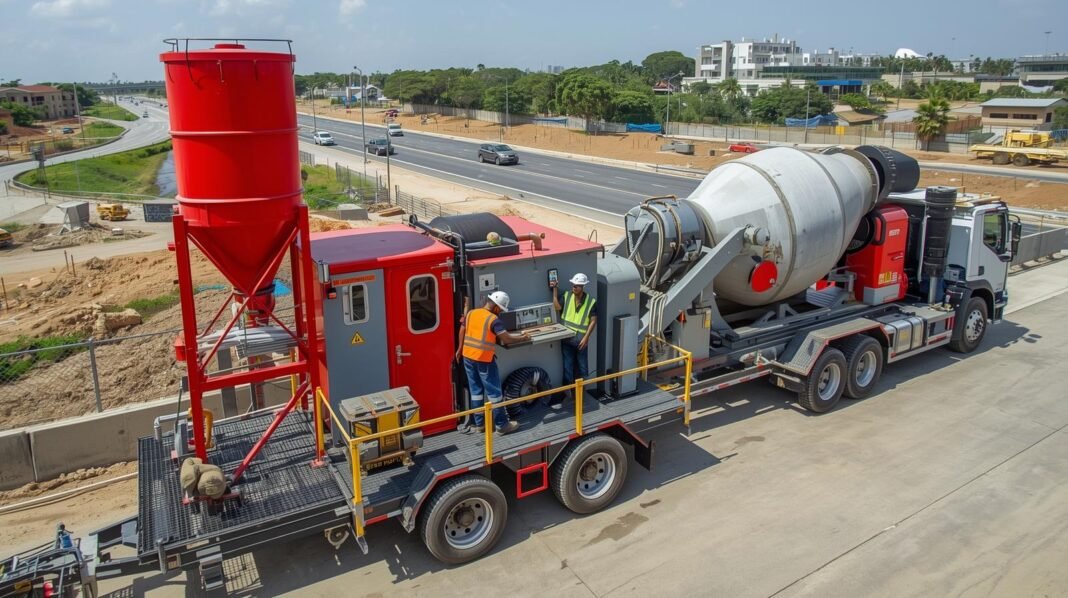
The African construction industry is experiencing unprecedented growth, with infrastructure projects ranging from highways and bridges to residential developments and commercial buildings.
For contractors and construction companies across the continent, investing in a mobile batching plant has become an increasingly attractive option for on-site concrete production. But one critical question remains at the forefront: how much does a mobile batching plant cost in Africa?
This comprehensive guide breaks down the pricing, factors affecting costs, and smart investment strategies for acquiring mobile batching plants across African markets.
Understanding Mobile Batching Plants
A mobile batching plant, also known as a portable concrete batching plant, is a transportable concrete production facility that integrates material storage, weighing, conveying, mixing, and automated control systems into one or more mobile chassis units.
Unlike stationary plants that require permanent installation, mobile units can be towed by truck tractors and relocated between construction sites, making them ideal for projects in remote locations or contractors serving multiple sites.
Current Price Ranges in Africa (2025)
Based on current market data across African countries including South Africa, Nigeria, Kenya, Ethiopia, and Tanzania, mobile batching plant prices vary significantly based on capacity and features:
Entry-Level Mobile Plants (25-35 m³/h)
Price Range: $25,000 – $60,000
These compact units are perfect for small to medium construction projects, including residential buildings, small roads, and township developments. Popular models in this category include:
- YHZS25: Starting from approximately $28,000
- YHZS35/AJY35: Typically $35,000 – $50,000
- HZS35: Around $40,000 – $55,000
Medium Capacity Plants (50-75 m³/h)
Price Range: $60,000 – $120,000
Medium-capacity plants suit contractors handling larger projects such as highway construction, bridge work, and commercial concrete supply:
- YHZS50/AJY50: Generally $52,700 – $75,000
- YHZS60/AJY60: Typically $60,000 – $90,000
- YHZS75: Around $75,000 – $110,000
High-Capacity Mobile Plants (90-120 m³/h)
Price Range: $120,000 – $210,000+
These heavy-duty units are designed for major infrastructure projects, large-scale commercial developments, and high-volume ready-mix concrete businesses:
- YHZS90/AJY90: Approximately $110,000 – $150,000
- YHZS100: Around $130,000 – $180,000
- YHZS120: Typically $150,000 – $210,000
Key Factors Influencing Mobile Batching Plant Costs in Africa
1. Production Capacity
Production capacity remains the primary cost driver. The relationship between capacity and price isn’t linear—a 100 m³/h plant typically costs 4-6 times more than a 25 m³/h unit due to enhanced structural requirements, larger mixers, reinforced conveying systems, and more robust aggregate bins.
2. Level of Automation
Automation significantly impacts pricing:
- Manual Systems: Basic controls with manual batching ($25,000 – $45,000 for small units)
- Semi-Automatic: PLC touchscreen with some automation ($45,000 – $80,000)
- Fully Automatic: Complete PLC/SCADA control, remote monitoring, automatic calibration, and fault diagnostics ($80,000 – $210,000+)
While automated systems increase upfront costs by 20-40%, they reduce material waste by 5-10% per batch, minimize labor costs, and improve concrete consistency—often providing faster return on investment.
3. Equipment Configuration
Configuration choices dramatically affect final pricing:
- Mixer Type: Twin-shaft mixers cost more than single-shaft but offer superior mixing quality and faster cycle times
- Conveying System: Belt conveyors vs. hopper lifts (belt systems typically add $3,000-$8,000)
- Cement Storage: Number and size of silos (30-ton vs. 100-ton capacity)
- Aggregate Bins: Capacity and number of compartments (2-4 bins standard)
- Weighing Systems: Digital load cells with higher precision cost more but reduce waste
4. Brand and Manufacturer
Brand reputation affects pricing across African markets:
- Premium International Brands (ELKON, Liebherr, Schwing Stetter): 20-35% higher pricing but offer superior durability and global support
- Established Mid-Tier Brands (AIMIX, Camelway, MEKA): Competitive pricing with proven reliability
- Local African Manufacturers (ECEM South Africa, JA Plant): Often 10-25% lower costs with local service advantages
5. Additional Features
Optional features that increase costs:
- Dust collection systems: +$3,000 – $8,000
- Water recycling units: +$5,000 – $12,000
- Remote monitoring and IoT integration: +$4,000 – $10,000
- Enhanced environmental compliance systems: +$6,000 – $15,000
- Concrete recycling devices: +$5,000 – $12,000
6. Shipping and Import Costs
For African buyers, international shipping adds significant expenses:
- Container shipping from China: $2,500 – $8,000 depending on destination port
- Container shipping from Europe: $3,000 – $12,000
- Import duties and taxes: Vary by country (typically 5-25% of equipment value)
- Customs clearance: $500 – $2,000
- Inland transportation: $1,000 – $5,000 depending on final site location
Total Setup Costs Beyond Equipment Purchase
The purchase price represents only part of the total investment. African contractors should budget for:
Site Preparation
- Land preparation and leveling: $5,000 – $20,000
- Basic foundations (mobile plants need minimal foundation): $3,000 – $10,000
- Access roads and drainage: $2,000 – $8,000
- Fencing and security: $1,500 – $5,000
Installation and Commissioning
- Professional installation: $3,000 – $12,000 (often included by reputable suppliers)
- Equipment calibration and testing: $1,000 – $3,000
- Operator training: $1,500 – $5,000 (frequently included in package)
Utilities Connection
- Electrical connection and transformer: $3,000 – $15,000 (higher in remote areas)
- Water supply infrastructure: $2,000 – $8,000
- Generator backup (for unreliable power areas): $5,000 – $25,000
Initial Stock and Materials
- Raw materials initial inventory: $10,000 – $30,000
- Spare parts kit: $2,000 – $8,000
- Tools and maintenance equipment: $1,000 – $3,000
Supporting Equipment
- Loader or front-end loader: $25,000 – $75,000 (can be rented initially)
- Concrete mixer trucks: $45,000 – $90,000 each (2-3 typically needed)
- Backup generator: $5,000 – $25,000
Example Total Investment (60 m³/h Plant in Kenya)
- Mobile batching plant equipment: $70,000
- Shipping and import: $8,000
- Site preparation: $12,000
- Installation and training: $6,000
- Utilities connection: $9,000
- Initial materials and spares: $15,000
- Supporting equipment: $80,000
- Total Investment: $200,000
Operating Costs in African Markets
Beyond initial investment, monthly operating costs significantly impact profitability:
Labor Costs (Monthly)
Operating costs vary by location, but generally include:
- Plant operators (2-3 shifts): $800 – $2,500
- Quality control staff: $600 – $1,800
- Maintenance technician: $700 – $2,000
- Administrative staff: $500 – $1,500
- Total monthly labor: $2,600 – $7,800
Energy Costs
Power consumption depends on production volume:
- Grid electricity: $300 – $1,500/month
- Diesel generator backup: $500 – $2,000/month
- Average total energy: $800 – $3,500/month
Raw Materials
Materials represent 50-60% of concrete production costs:
- Cement: Price varies significantly by country
- Aggregates (sand, stone): Local availability affects costs
- Water: Minimal cost but infrastructure investment may be needed
- Admixtures: Specialty chemicals add 2-5% to material costs
Maintenance
- Routine maintenance: $1,500 – $4,000/month
- Replacement parts: $1,000 – $3,000/month
- Equipment servicing: $500 – $1,500/month
Country-Specific Insights
South Africa
South Africa has the most mature market with strong local manufacturers like ECEM and JA Plant. Prices tend to be competitive due to local production capabilities. Import duties are moderate, and supporting infrastructure (spare parts, service technicians) is readily available.
Nigeria
Nigeria represents a massive construction market with growing demand. However, import duties can be higher (15-25%), and logistics to inland locations add costs. Local demand is strong for 35-90 m³/h capacity plants for both commercial and infrastructure projects.
Kenya
Kenya’s construction boom, particularly in Nairobi and Mombasa, drives demand for mobile plants. The Port of Mombasa provides good access for imports. Local suppliers like Enrich Equipment offer various models with competitive pricing and local support.
Ethiopia
Ethiopia’s infrastructure development programs create substantial demand. However, import regulations can be complex, and inland transportation from Djibouti port adds costs. Mini and medium-capacity plants (25-60 m³/h) are most popular.
Smart Purchasing Strategies for African Buyers
1. Right-Size Your Investment
Avoid over-investing in capacity you won’t utilize. A 35 m³/h plant running at 80% capacity is more profitable than a 60 m³/h plant at 40% capacity.
2. Prioritize Reliable Brands
In African conditions with challenging climates and potentially limited technical support, equipment reliability is paramount. Research manufacturer track records in African markets.
3. Consider Local Support Networks
Brands with established service networks in Africa (AIMIX, ELKON, Camelway) provide faster spare parts access and technical support, reducing costly downtime.
4. Evaluate Total Cost of Ownership
Lower purchase prices may mean higher operating costs. Fuel-efficient systems, durable components, and automation can reduce five-year operating costs by 15-30%.
5. Negotiate Comprehensive Packages
Many suppliers offer turnkey solutions including:
- Equipment supply
- Shipping and customs clearance
- Installation and commissioning
- Operator training
- Initial spare parts kit
- Extended warranty
- After-sales support
6. Explore Financing Options
Several manufacturers and local banks offer:
- Installment payment plans
- Leasing arrangements
- Equipment financing at 8-15% interest
- Trade-in programs for upgrading
7. Start with Mobile, Upgrade to Stationary
For contractors uncertain about long-term demand, starting with a mobile plant provides flexibility. Later, you can upgrade to a stationary plant as your business grows, often trading in the mobile unit.
Return on Investment (ROI)
Mobile batching plants in Africa typically achieve ROI within:
- High-demand urban markets: 12-24 months
- Medium-demand regional areas: 18-30 months
- Lower-demand rural locations: 24-36 months
Factors accelerating ROI:
- Eliminating ready-mix supplier markups (typically 20-40%)
- Serving multiple projects with one plant
- Selling concrete to third parties
- Operating near capacity consistently
- Effective maintenance reducing downtime
- Strategic location minimizing transportation costs
Popular Mobile Batching Plant Brands in Africa
International Brands
- ELKON (Turkey): Strong presence across North and East Africa, 135+ country installations
- Liebherr (Germany): Premium quality, popular for large infrastructure projects
- MEKA (Turkey): Growing market share, competitive pricing
- Schwing Stetter (Germany/India): Established reputation in Southern Africa
Chinese Manufacturers
- AIMIX Group: Extensive African experience, competitive pricing, good support network
- Camelway: Strong presence in East Africa, particularly Kenya and Tanzania
- LUTON Machinery: Growing reputation with several installations across Africa
- ACE Group: Specializing in vibration mix technology
Local African Manufacturers
- ECEM (South Africa): Leading South African manufacturer, 23 African countries served
- JA Plant (South Africa): Specializing in plants for remote African conditions
- Blend Plants Africa (South Africa): Innovative E-Series and A-Series mobile units
Maintenance and Longevity
With proper maintenance, mobile batching plants typically last:
- Premium brands: 15-20 years
- Mid-tier brands: 12-18 years
- Budget options: 10-15 years
Key maintenance practices:
- Daily cleaning of mixing drum and conveyor belts
- Weekly lubrication of moving parts
- Monthly calibration checks on weighing systems
- Quarterly comprehensive inspections
- Annual major servicing with manufacturer-approved technicians
Environmental Compliance
African countries are increasingly enforcing environmental regulations. Factor in:
- Dust suppression systems: Required in urban areas
- Water recycling: Mandatory in water-scarce regions
- Noise reduction: Important near residential zones
- Emission controls: Growing requirement, especially in South Africa and Kenya
Final Recommendations
When budgeting for a mobile batching plant in Africa:
- Plan for 125-150% of the equipment cost to cover total setup and initial operations
- Prioritize brands with proven African track records to minimize support challenges
- Choose capacity based on realistic demand rather than aspirational projections
- Invest in automation if operating in areas with skilled labor shortages
- Factor in country-specific costs including duties, shipping, and regulatory compliance
- Build relationships with local suppliers for spare parts and technical support
- Consider climate factors: Tropical regions need enhanced corrosion protection; desert areas require dust control
Conclusion
Mobile batching plant costs in Africa range from $25,000 for basic 25 m³/h units to over $210,000 for high-capacity 120 m³/h automated systems.
However, the equipment purchase represents only 40-60% of total initial investment when accounting for shipping, installation, utilities, and supporting equipment.
For African contractors, the key to successful investment lies not in finding the cheapest option, but in selecting the right capacity, reliable brand, and comprehensive support package that ensures consistent operation in challenging African conditions.
With infrastructure development accelerating across the continent, well-chosen mobile batching plants offer excellent returns, typically paying for themselves within 18-30 months.
Whether you’re a small contractor in Nigeria looking to produce concrete for local projects, or a major infrastructure firm in South Africa managing multiple sites, understanding these cost factors empowers you to make informed decisions that balance initial investment with long-term profitability and operational success.
Ready to invest in a mobile batching plant for your African construction projects? Contact reputable suppliers with established African networks, request detailed quotes including total cost breakdowns, and insist on references from existing African customers to ensure you’re making the smartest investment for your specific needs.
Also Read
How Much Does a Concrete Mixer Pump Cost in Africa?
Used vs. New Concrete Pump Trucks: A Cost-Benefit Analysis for Construction Companies

- South Africa’s April 1 Triple Shock: When the Joke Is on the Consumer - March 26, 2026
- KeNHA’s World Bank Funding Boost: Inside Kenya’s KSh Multi-Billion Expressway Masterplan - March 25, 2026
- SASSA locks in full-year social grant payment schedule — and announces biggest increases in years - March 24, 2026
