African construction is booming. From residential housing in Nairobi to infrastructure projects in Johannesburg, builders across the continent face a common challenge: how to efficiently place concrete without breaking the bank.
While traditional manual methods using wheelbarrows and buckets remain prevalent, they typically achieve only 0.5 cubic meters per hour per worker, creating significant project delays and labor costs.
The good news? Affordable concrete pumping solutions are transforming how African builders work, offering dramatic productivity gains without requiring massive capital investment.
This comprehensive guide explores practical, budget-friendly options tailored to the African construction context.
Why African Builders Need Better Concrete Solutions
The Current Challenge
Rising labor costs and the growing emphasis on shorter construction timelines are pushing African builders to seek more efficient methods.
Traditional bucket-and-crane systems are labor-intensive, slow, and often impractical for projects with access constraints or height requirements.
The African Context
African construction sites present unique challenges that make equipment selection critical:
- Limited electrical infrastructure in rural and remote areas
- Rough terrain and poor road access
- Budget constraints for small and medium contractors
- Skills gaps in equipment operation and maintenance
- Project diversity ranging from single-family homes to multi-story buildings
Budget-Friendly Concrete Pumping Options
1. Concrete Mixer Pumps: The All-in-One Solution
Price Range: USD 20,000 – 33,000
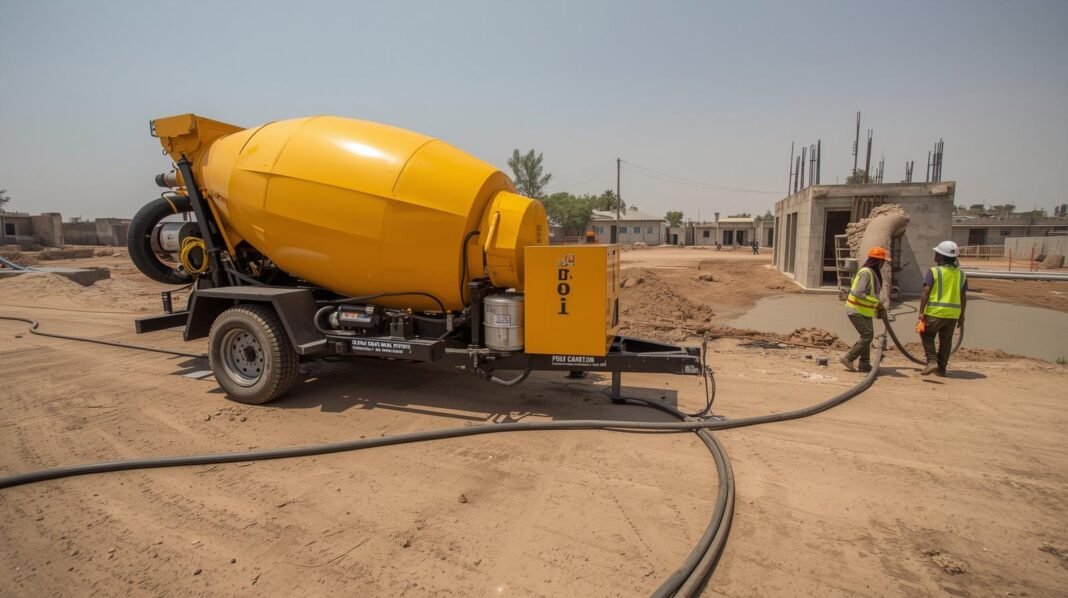
Mixer pumps combine concrete mixing and pumping in a single compact unit, making them ideal for builders who cannot access or afford ready-mix concrete delivery.
Key Advantages:
- No external batching plant needed
- Eliminates ready-mix delivery costs in remote areas
- Typical capacity of 30-40 m³/h
- Available in diesel or electric versions
- Small footprint for tight urban sites
Best For:
- Rural construction projects
- Small residential developments
- Road and drainage work
- Areas without ready-mix suppliers
African Success Stories: In rural KwaZulu-Natal, wheeled mixer pumps enable quick deployment for emergency drainage repairs during rainy seasons. The ability to mix and pump on-site eliminates dependence on ready-mix trucks that may not reach remote locations.
2. Trailer-Mounted Concrete Pumps: Maximum Versatility
Price Range: USD 18,500 – 58,000 (depending on capacity)
Trailer pumps are the workhorses of budget-conscious construction. They’re towed to site, set up quickly, and pump concrete through flexible hoses to precise locations.
Capacity Options:
- Small: 30 m³/h for residential work
- Medium: 40-60 m³/h for commercial projects
- Large: 80-90 m³/h for industrial applications
Key Benefits:
- Lower capital cost than boom pumps
- Horizontal pumping distances of 400-1,200+ meters
- Vertical reach of 120-150 meters
- Easy to transport between multiple sites
- Simple maintenance requirements
Power Options:
- Electric models: Lower operating costs, quieter operation, ideal where grid power is reliable
- Diesel models: Essential for remote sites, power independence, fuel flexibility
Best For:
- Foundations and slabs
- Multi-site contractors
- Projects with good horizontal access
- Budget-conscious operations seeking maximum ROI
3. The SEM Placer Pump: Africa’s Budget Champion
Price Range: A fraction of conventional piston pumps (1/8 to 1/10 the cost)
The SEM concrete placer pump represents one of the most economical solutions, offering capabilities at a fraction of piston pump costs. Manufactured by PMSA, Africa’s leading concrete equipment maker, these pumps are specifically designed for African conditions.
Why It’s Special:
- Simple, robust design built to withstand harsh site conditions
- Low air consumption when used as a pump
- Easy to clean and maintain
- Available on fixed stands or 2-wheel site trailers
- Proven track record across Africa
Applications:
- Dam walls and foundations
- Mine support structures
- Box fronts and concrete plugs
- Marine structure repairs
- Medium-sized projects in remote areas
Real-World Performance: During construction of Botswana’s largest bridge, contractors selected a SEM 500 for its affordability and reliability in a remote area, achieving profitable concrete placing costs without breakdowns.
4. Small Stationary Pumps: Specialized Solutions
Capacity Range: 8-60 m³/h
For specific applications like tunneling, underground work, or confined spaces where mobility is limited, stationary pumps offer targeted solutions.
Features:
- Compact footprint
- Low rebound with minimal operating and maintenance costs
- Ideal for narrow spaces
- Some models include telescopic booms
Best For:
- Underground mining operations
- Tunnel construction
- Confined urban sites
- Specialized applications
5. Rental Options: Try Before You Buy
Don’t have capital for equipment purchase? Rental services are expanding across African cities, offering flexible terms from daily to monthly rates, allowing contractors to:
- Test different pump types for their needs
- Handle occasional large pours without ownership costs
- Avoid maintenance responsibilities
- Access operator support and training
Major cities like Accra, Nairobi, Johannesburg, and Cape Town now have established rental markets.
Choosing the Right Pump for Your Project
Decision Framework
For Small Residential Projects (Single homes, small slabs):
- Consider: Mixer pump (30 m³/h) or small trailer pump
- Budget: USD 18,500 – 25,000
- Why: All-in-one capability, manageable investment
For Medium Commercial Projects (Apartment blocks, schools, warehouses):
- Consider: Electric trailer pump (40-60 m³/h) or wheel-mounted boom pump
- Budget: USD 30,000 – 45,000
- Why: Balance of capacity, mobility, and cost
For Large Infrastructure (Bridges, multi-story buildings, industrial):
- Consider: High-capacity diesel trailer pump (80-90 m³/h)
- Budget: USD 50,000 – 58,000
- Why: Maximum output, continuous operation capability
For Remote/Off-Grid Projects:
- Consider: Diesel mixer pump or diesel trailer pump
- Why: Power independence is non-negotiable
For Multi-Site Operations:
- Consider: Trailer pump on wheels
- Why: Easy mobility between projects maximizes utilization
Cost-Benefit Analysis: Why Invest in Pumping?
Labor Savings
Modern concrete pumps can achieve outputs above 100 cubic meters per hour, compared to manual methods at 0.5 m³ per hour per worker. For a 50 m³ pour:
- Manual method: 100 worker-hours minimum
- With 40 m³/h pump: 1.25 hours plus 2-3 workers
The labor cost savings alone often justify pump investment within a few projects.
Time Savings
Truck-mounted and trailer pumps can be set up and pumping within an hour. Projects that would take days manually can be completed in hours, reducing:
- Site overhead costs
- Equipment rental duration
- Project completion time
- Weather exposure risks
Quality Improvements
Pumped concrete offers:
- Consistent placement without segregation
- Better compaction in reinforced sections
- Reduced water addition (maintaining strength)
- Fewer cold joints in continuous pours
- Professional finish quality
Access to Difficult Areas
Pumps enable construction in locations impossible with manual methods:
- Upper floors of multi-story buildings
- Over obstacles or existing structures
- Confined spaces with limited access
- Long-distance horizontal placements
Making It Work: Practical Considerations
Power Solutions for Off-Grid Sites
Many African construction sites lack reliable electricity. Solutions include:
- Diesel-powered pumps: Independence from grid, fuel availability across continent
- Solar-diesel hybrid systems: Reducing fuel consumption for stationary applications
- Generator backup: For electric pumps in areas with intermittent power
Maintenance and Parts Availability
Choose pumps with:
- Simple hydraulic systems over complex electronics
- Local distributor networks
- Available spare parts inventory
- Training and support services
African distributors emphasize hydraulic systems that can be troubleshot quickly without specialized electronics, critical for minimizing downtime.
Operator Training
Lack of trained operators remains a challenge across Africa. Successful contractors invest in:
- Manufacturer training programs
- On-site supervision during initial projects
- Gradual skill development
- Written operational procedures
Starting Small and Scaling
For builders uncertain about pumping:
- Start with rentals to gain experience
- Partner with established operators on first projects
- Purchase entry-level equipment (mixer pump or small trailer pump)
- Expand capacity as skills and project size grow
- Consider cooperative ownership with other contractors
DIY and Manual Alternatives
Not ready for mechanized pumping? Improve manual methods:
Better Tools for Manual Concrete Work
For projects under 0.5 m³:
- Heavy-duty wheelbarrows with pneumatic tires
- Proper mixing on clean plastic sheeting or in wheelbarrows
- Steel screeds and finishing tools
- Adequate labor planning
Concrete Chutes and Funnels
For vertical pours:
- Site-fabricated chute systems
- Controlled concrete drop height
- Labor-intensive but zero capital cost
Small Mixer Investment
Before full pumping capability:
- Portable petrol or electric mixer (fits in pickup truck)
- Consistent mixing quality
- Reduces manual labor
- Price: USD 500-2,000
Real Success Stories Across Africa
South Africa: Low-Cost Housing at Scale
In Soweto, 33-meter boom pumps fit tight urban spaces while 89 m³/h output accelerates mass housing construction, enabling government-funded housing projects to meet ambitious delivery targets.
Kenya: Rural Road Construction
Diesel trailer pumps with their extended reach (1,500+ meters horizontally) enable road construction crews to position equipment once and pump concrete for extensive stretches, critical where moving heavy equipment repeatedly is impractical.
Ghana: Residential Development
Small contractors in Accra increasingly use mixer pumps for housing estates, eliminating dependence on ready-mix suppliers and controlling concrete quality for consistent results.
Financial Planning for Equipment Purchase
Acquisition Options
- Cash purchase: Best pricing, full ownership, no debt burden
- Equipment financing: 2-5 year terms common, preserves working capital
- Lease-to-own: Try equipment before committing
- Cooperative buying: Pool resources with other contractors
- Used equipment: Significant savings, inspect thoroughly
ROI Calculation
Key factors:
- Equipment cost: Initial investment
- Labor savings per project: Reduced manual labor costs
- Time savings: Earlier project completion, faster turnover
- Project capacity increase: Take on larger projects
- Rental income potential: Rent to other contractors when idle
Most contractors report payback periods of 1-3 years depending on project volume.
Financing Support
Explore:
- Equipment manufacturer financing programs
- Local bank equipment loans
- Development finance institutions
- Trade credit arrangements
- Equipment leasing companies
Maintenance Best Practices
Maximize equipment life and minimize downtime:
Daily Maintenance
- Clean pumps thoroughly after each use (critical for concrete)
- Check hydraulic fluid levels
- Inspect hoses and pipes for wear
- Lubricate moving parts
Weekly Maintenance
- Detailed inspection of wearing parts
- Check bolt tightness
- Test all safety systems
- Document operating hours
Monthly Maintenance
- Replace filters and fluids per schedule
- Inspect electrical systems
- Check structural integrity
- Professional service checkup
Cost Planning
Budget 5-10% of equipment value annually for maintenance and repairs.
Looking Ahead: The Future for African Builders
Africa’s concrete pump market is projected to grow significantly as:
- Urbanization accelerates construction demand
- Infrastructure investment increases
- Labor costs continue rising
- Technology becomes more accessible
- Local manufacturing expands
For builders, this means:
- More competitive pricing
- Better after-sales support networks
- More financing options
- Improved equipment durability for African conditions
Conclusion: Making the Leap
Transitioning from manual concrete placement to mechanized pumping represents a significant decision for African builders. However, the combination of improved productivity, labor savings, quality enhancement, and competitive advantage makes it increasingly essential.
Start Your Journey:
- Assess your project pipeline: Calculate annual concrete volumes
- Evaluate rental vs. purchase: Consider project frequency and size
- Start conservatively: Entry-level equipment builds skills and confidence
- Invest in training: Equipment is only as good as its operator
- Plan for growth: Choose equipment that can scale with your business
The African construction industry is evolving rapidly. Builders who embrace efficient concrete pumping technology position themselves to win larger contracts, complete projects faster, and build more profitable businesses.
Whether you start with a simple mixer pump for rural projects or invest in a versatile trailer pump for commercial work, the journey to mechanized concrete placement begins with that first step. The question is not whether to modernize, but how soon you can start realizing the benefits.
Frequently Asked Questions
What is the alternative to concrete pumping?
Several alternatives exist depending on your project scale and budget:
Traditional Manual Methods:
- Wheelbarrows and buckets: The most common low-tech approach across Africa. Labor-intensive but requires zero equipment investment. Best for small pours under 5 m³.
- Concrete chutes: Gravity-fed systems for vertical or sloped placement. Can be site-fabricated from metal or plastic. Effective for foundations and slabs with good access.
- Bucket and crane: Using a tower crane or mobile crane with concrete skips. Common on multi-story buildings where cranes are already on site for other lifting operations.
Mechanized Alternatives:
- Concrete mixer trucks with chutes: Ready-mix trucks can place concrete directly via extended chutes (3-5 meter reach). Limited reach but no additional equipment needed.
- Conveyor belt systems: Portable conveyors can transport concrete horizontally and at angles. More setup time than pumps but useful for continuous pours with awkward access.
- Concrete placing booms (separate from pumps): Attach to mixer trucks for extended reach without a dedicated pump.
Best Alternative Choice: For most African builders seeking to upgrade from manual methods without full pump investment, a combination of quality wheelbarrows, proper site planning, and adequate labor remains the most practical stepping stone.
How much does a concrete boom pump cost?
Boom pump pricing varies significantly based on boom length, capacity, and whether mounted on truck or trailer:
Entry-Level Boom Pumps:
- Small trailer-mounted booms (13-20 meters): USD 35,000 – 55,000
- Wheel-mounted booms (20-28 meters): USD 45,000 – 65,000
Mid-Range Boom Pumps:
- Truck-mounted booms (28-37 meters): USD 85,000 – 150,000
- Medium reach (37-47 meters): USD 150,000 – 250,000
Large Boom Pumps:
- Long reach (47-52 meters): USD 250,000 – 400,000
- Extra-long reach (52+ meters): USD 400,000 – 600,000+
African Market Considerations:
- Used/refurbished boom pumps can cost 40-60% less than new equipment
- Chinese-manufactured booms offer 30-50% savings compared to European brands
- Trailer-mounted booms cost significantly less than truck-mounted versions with similar reach
- Rental rates typically range from USD 800-3,000 per day depending on boom size
For Budget-Conscious Builders: Most small to medium African contractors find truck-mounted boom pumps prohibitively expensive. Trailer-mounted concrete pumps with separate placing booms or telescopic pipe systems offer similar reach at a fraction of the cost.
What are the alternatives to a boom pump?
If boom pumps exceed your budget or aren’t suitable for your projects, several effective alternatives provide excellent value:
1. Trailer-Mounted Line Pumps (Best Value Alternative)
- Cost: USD 18,500 – 58,000 (significantly cheaper than boom pumps)
- Use flexible hoses or rigid pipes to direct concrete
- Excellent for horizontal distances (400-1,200+ meters)
- Vertical reach: 120-150 meters
- More versatile across different project types
- Lower maintenance costs
2. Static Concrete Pumps with Placing Boom
- Stationary pump with separate articulating boom attachment
- Boom can be repositioned as needed
- Lower cost than integrated truck-mounted systems
- Suitable for sites with space for setup
3. Concrete Mixer Pumps
- All-in-one mixing and pumping solution
- Cost: USD 20,000 – 33,000
- Eliminates need for separate batching plant
- Ideal for remote locations without ready-mix access
4. Pipeline Distribution Systems
- Use trailer pump with fixed pipeline networks
- Excellent for repetitive work (housing estates, industrial floors)
- One-time pipeline installation serves multiple pours
- Reduces setup time for subsequent pours
5. Concrete Conveyors
- Belt conveyor systems for horizontal and inclined placement
- Capacity: 20-100 m³/h depending on size
- Good for long horizontal distances
- Lower operating costs than pumps
6. Tower-Mounted Placing Booms
- Stationary booms mounted on scaffolding or temporary towers
- Manually repositioned between major pours
- Very low cost compared to mobile boom pumps
Most Practical for African Builders: Trailer-mounted line pumps with flexible hose systems offer the best balance of cost, versatility, and performance. They handle 80-90% of typical projects at a fraction of boom pump costs.
How far can a 47 meter concrete pump reach?
A 47-meter boom pump’s reach is more complex than just the boom length suggests:
Vertical Reach:
- Maximum vertical height: Approximately 44-45 meters
- Boom length and vertical height aren’t equal due to boom angle and unfolding geometry
- Practical working height: 40-42 meters to maintain stability and control
Horizontal Reach:
- Maximum horizontal reach: Approximately 40-43 meters (when boom is extended horizontally)
- This assumes the pump is positioned optimally
- Actual reach depends on boom configuration and obstacle clearance
Combined Reach (Most Important): The boom can reach various combinations of height and distance:
- Full height with minimal horizontal extension
- Maximum horizontal reach with minimal height
- Balanced configurations for mid-height, mid-distance placement
Practical Working Envelope: A 47-meter boom typically covers:
- Vertical buildings: 12-14 story buildings comfortably
- Horizontal distance: 35-40 meters from pump position
- Total coverage area: Roughly 5,000-6,000 m² radius from central position
Extended Reach with Hose: After the boom’s end, you can add:
- Flexible end-hose: Additional 3-5 meters of reach
- This provides final positioning flexibility
- Allows reaching around corners or obstacles
African Construction Context: For most African building projects:
- Low-rise residential (2-5 floors): 20-28 meter booms are sufficient and far more affordable
- Mid-rise commercial (6-10 floors): 32-37 meter booms handle most needs
- 47-meter booms: Only justified for high-rise buildings (10+ floors), which are primarily found in major cities like Lagos, Nairobi, Johannesburg, or Cairo
Cost-Effective Alternative: Instead of a 47-meter boom pump (USD 250,000-400,000), many contractors use:
- A 28-meter boom pump (USD 85,000-150,000) plus strategic repositioning
- Trailer pumps with long hose runs for horizontal distance
- Multiple smaller pours from different positions
Bottom Line: While a 47-meter pump can theoretically reach that distance, practical working reach is approximately 40-45 meters vertically or horizontally, with the ability to achieve various combinations in between. For most African construction projects, smaller boom pumps or trailer pumps with hose systems provide better value and sufficient reach.
For more information on specific equipment models, pricing, and financing options, contact local distributors or manufacturers operating in your region. Many offer free consultations, site assessments, and demonstration services to help you make informed decisions.
Also Read
Top 5 Low-Budget Concrete Pumping Solutions for African Builders
Cost of Setting Up a Small Concrete Plant in Africa: A Complete Investment Guide

- South Africa’s April 1 Triple Shock: When the Joke Is on the Consumer - March 26, 2026
- KeNHA’s World Bank Funding Boost: Inside Kenya’s KSh Multi-Billion Expressway Masterplan - March 25, 2026
- SASSA locks in full-year social grant payment schedule — and announces biggest increases in years - March 24, 2026
