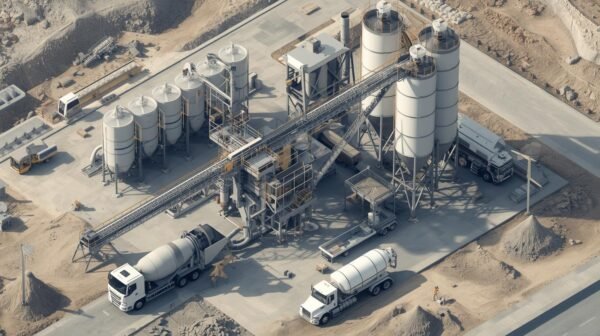
Concrete batching plants are the backbone of modern construction, producing the concrete that builds our cities, bridges, and infrastructure.
Whether you’re a construction professional, project manager, or simply curious about how these industrial facilities operate, understanding concrete batching plants is essential.
This comprehensive guide explores everything you need to know about how these critical systems work, their components, types, and best practices for operation.
What Is a Concrete Batching Plant?
A concrete batching plant is equipment that combines various ingredients to form concrete, including water, air, admixtures, sand, aggregate (rocks, gravel), fly ash, silica fume, slag, and cement. Unlike manual mixing, which can produce inconsistent results, batching plants use automated systems to measure and blend materials with precision, ensuring every batch meets exact specifications.
These sophisticated production facilities serve as centralized hubs where raw materials are stored, measured, mixed, and delivered as fresh concrete ready for construction.
The automation and precision of modern batching plants have revolutionized the construction industry, making large-scale projects faster, more efficient, and more reliable than ever before.
The Core Components of a Concrete Batching Plant
Understanding how a concrete batching plant works begins with knowing its essential components. Each part plays a critical role in the production process:
1. Aggregate Bins and Storage
Aggregate bins are containers that hold sand and gravel essential for the concrete mix, storing these materials separately to ensure a consistent supply for the production process.
Most plants feature multiple bins (typically two to six compartments) to store different sizes and types of aggregates.
This separation is crucial because each aggregate type must be weighed independently according to the specific mix design.
2. Cement Silos
Cement silos are large cylindrical storage units designed to keep cement powder dry and protected from moisture until needed.
These vertical structures can hold substantial quantities of cement, allowing for continuous operation without frequent refilling. Modern silos include dust collection systems to minimize environmental impact and comply with air quality regulations.
3. Weighing Systems (Weigh Hoppers)
Weigh hoppers are devices used to measure precise amounts of sand, gravel, cement, and other materials before they are added to the mixers. Accuracy is paramount in concrete production.
Modern batching plants use digital load cells and computerized control systems to ensure measurements are accurate to within fractions of a percent. This precision guarantees that every batch meets strength and quality specifications.
4. Conveyor Systems
Conveyors are mechanical systems that transport aggregates from the bins to the mixer, automating the movement of materials to improve efficiency and reduce manual labor.
Belt conveyors typically range from 24 to 48 inches wide and are designed to handle heavy loads while minimizing material spillage.
5. Water and Admixture Tanks
Water tanks store the water needed for concrete mixing, often equipped with heating or cooling systems to control temperature.
Admixture tanks hold chemical additives that enhance concrete properties such as workability, setting time, strength, or resistance to freezing. These liquids are measured using volumetric meters or digital scales for precise dosing.
6. Mixing Unit
The heart of the concrete batching plant is the mixer, with many types available including tilt drum, pan, planetary, single shaft, and twin shaft mixers. Each mixer type has specific advantages.
Twin shaft mixers use high-horsepower motors to ensure even mixing and are popular in European markets, while tilt drum mixers are more common in North America and can handle larger batch volumes.
7. Control System
Modern batching plants employ computerized control systems that automate the entire production process.
These systems assist in fast and accurate measurement of input constituents or ingredients. Operators can program multiple mix designs, monitor production in real-time, generate batch tickets, and track inventory from a centralized control panel.
How Does a Concrete Batching Plant Work? Step-by-Step Process
The operation of a concrete batching plant follows a systematic workflow that ensures consistent, high-quality concrete production:
Step 1: Material Storage and Feeding
Raw materials arrive at the plant and are stored in their designated locations. Aggregates (sand, gravel, or crushed stone) are stored in multiple bins according to size and type.
Cement and supplementary cementitious materials are pneumatically conveyed from delivery trucks into silos. Water and liquid admixtures are stored in separate tanks.
Step 2: Batching (Weighing)
The working system can be divided into two parts, with the first part being weighing. Sand and stone are transported to the aggregate blending machine by the loader and need to be weighed according to pre-set proportions.
The control system retrieves the specified mix design and initiates the batching sequence. Each ingredient is carefully measured:
- Aggregates are released from bins onto weigh conveyors or into weigh hoppers
- Cement and fly ash are conveyed via screw conveyors to powder weighing hoppers
- Water and admixtures are metered into their respective weighing systems
The weighing process is simultaneous, improving efficiency and reducing production time.
Step 3: Material Transfer to Mixer
Once all materials reach their target weights, pneumatic gates and valves open to discharge ingredients into the mixer.
The system opens pneumatic doors of weighing hoppers, pneumatic butterfly valves of cement and fly ash weighing hoppers, and pneumatic ball valves of additive weighing hoppers.
Conveyor belts or skip hoists may be used to elevate materials to the mixer depending on the plant configuration.
Step 4: Mixing
The second part of the working system is mixing, where weighed aggregate, cement, and water are transferred to the mixer machine and then mixed.
The mixing duration varies by mixer type and concrete requirements, but typically ranges from 60 to 90 seconds for forced mixers. The mixer blades rotate at controlled speeds to ensure thorough, homogeneous blending of all ingredients.
Step 5: Discharge and Transport
Once mixing is complete, the concrete is discharged from the mixer. Discharge methods vary depending on plant design, with belt conveyors moving concrete from the mixer to trucks or hoppers, skip hoists lifting concrete for high-elevation delivery, and truck-mounted chutes allowing direct loading into concrete mixer trucks.
For ready-mix applications, the fresh concrete is loaded into transit mixer trucks that keep it agitated during transport to prevent premature setting.
Step 6: Cleaning and Preparation
After production, residual materials inside mixers, hoppers, and discharge chutes must be removed to prevent buildup, with mixers flushed to remove hardened concrete and hoppers cleaned to ensure next batch accuracy.
Regular cleaning preserves operational efficiency and prevents material contamination in future batches.
Types of Concrete Batching Plants
Batching plants come in various configurations, each designed for specific applications and operational requirements:
1. Stationary Concrete Batching Plants
Stationary concrete batching plants are designed to produce high-quality concrete with advantages of large output, high efficiency, high stability, and high specification.
These permanent installations feature robust infrastructure, high-capacity storage silos, and sophisticated mixing systems. They’re ideal for:
- Large-scale infrastructure projects (highways, bridges, dams)
- Ready-mix concrete suppliers serving multiple job sites
- Long-term projects requiring continuous concrete supply
- Urban areas with consistent demand
Advantages:
- Highest production capacity (up to 240+ cubic meters per hour)
- Superior quality control and consistency
- Advanced automation and monitoring systems
- Lower long-term operating costs
Disadvantages:
- High initial investment
- Cannot be relocated easily
- Requires significant installation space
- Longer setup time
2. Mobile (Portable) Concrete Batching Plants
Mobile batch plants, also known as portable concrete plants, are very productive, reliable, and cost-effective equipment that allows users to batch concrete at almost any location, then move to another location and batch concrete.
Advantages:
- Quick installation and commissioning
- Easily relocated between job sites
- Lower initial investment
- Reduced transportation costs for concrete
Disadvantages:
- Limited production capacity compared to stationary plants
- Less suitable for very large projects
- May require more frequent setup and breakdown
Ideal For:
- Remote construction sites
- Highway and bridge construction
- Short-term or temporary projects
- Projects requiring on-site concrete production
3. Compact Concrete Batching Plants
Compact plants bridge the gap between mobile and stationary systems, offering moderate capacity in a smaller footprint.
They feature modular designs that allow for relatively quick setup while maintaining good production capabilities. These are excellent for medium-scale projects in urban areas where space is limited.
Dry Mix vs. Wet Mix Plants: Understanding the Difference
Dry Mix Plants (Transit Mix)
Dry mix concrete plants, also known as transit mix plants, weigh sand, gravel, and cement in weigh batchers, discharge all ingredients into a chute leading to a truck, while water is either weighed or volumetrically metered and discharged into the mixer truck. The actual mixing occurs during transportation, requiring 70 to 100 revolutions of the truck drum.
Best For: Projects requiring flexibility in adjusting water content on-site, longer haul distances, and situations where different water-cement ratios may be needed at different pour locations.
Wet Mix Plants (Central Mix)
Wet mix concrete plants combine some or all ingredients including water at a central location into a concrete mixer, with concrete mixed at a single point then simply agitated on the way to the jobsite to prevent setting.
This method produces more consistent concrete in less time, typically five minutes or less.
Best For: Applications requiring maximum consistency and quality, precast operations, high-strength concrete applications, and projects with strict quality tolerances.
Applications of Concrete Batching Plants
Batching plants serve diverse construction needs across multiple sectors:
Infrastructure Development
Infrastructure projects include development and maintenance of essential public works such as roads, bridges, highways, and tunnels, crucial for facilitating transportation, connecting communities, and supporting economic growth.
Large stationary plants provide the continuous supply needed for these massive undertakings.
Residential and Commercial Construction
This category includes construction of homes, apartments, office buildings, shopping centers, and other structures, with key components involving solid foundations, durable floors, and structural elements meeting safety and design standards.
Precast Concrete Production
Precast concrete is processed in a standardized process in factories, and compared with cast-in-place concrete, can be produced, poured, and cured in batches with a safer construction environment, lower cost, and high-quality products.
Central mix plants excel in precast applications due to their ability to maintain tight tolerances batch after batch.
Specialized Projects
Batching plants also serve specialized applications including:
- Water conservancy projects (dams, irrigation channels)
- Marine construction (ports, offshore platforms)
- Airport runways and taxiways
- Industrial flooring requiring special concrete properties
Benefits of Using Concrete Batching Plants
Modern batching plants offer numerous advantages over traditional mixing methods:
Quality Consistency
Batching plants ensure consistent and high-quality concrete production as the mixing process is precisely controlled.
Computer-controlled systems eliminate human error and ensure every batch meets specifications exactly.
Increased Efficiency
With batching plants, construction projects can have a reliable and efficient supply of concrete, reducing delays and improving productivity. Automated systems can produce concrete faster than manual methods while maintaining superior quality.
Customization Capabilities
Batching plants allow for customization of concrete mix designs, enabling production of different types and strengths of concrete to meet specific project requirements. Operators can quickly switch between mix designs to accommodate varying project needs.
Cost Savings
By producing concrete on-site, batching plants eliminate the need for transporting ready-mixed concrete from external suppliers, resulting in cost savings. This also reduces concrete waste and ensures fresher material for better performance.
Environmental Control
Modern batching plants incorporate dust collection systems, water recycling capabilities, and emission controls to minimize environmental impact. Some advanced systems can recycle up to 30-50% of water used in operations.
Maintenance and Safety Best Practices
Proper maintenance is crucial for reliable operation and longevity of batching plant equipment:
Daily Maintenance Tasks
Daily maintenance includes inspecting all safety devices and emergency stop mechanisms to ensure they function correctly, checking guards, alarms, and emergency shut-off switches to prevent accidents and injuries on-site.
Additional daily tasks include:
- Checking belt and chain tension
- Calibrating scales and meters for accuracy
- Inspecting for air leaks in pneumatic systems
- Cleaning mixer and discharge areas
- Monitoring control system for errors
Weekly Maintenance
Weekly maintenance tasks include checking hydraulic fluid and coolant levels, inspecting all hoses and belts for signs of wear, cracks, or leaks, and tightening all bolts and nuts throughout the plant.
Monthly and Seasonal Maintenance
Monthly maintenance should involve thorough examination of conveyors, gear reducers, electrical systems, and dust collection equipment.
Seasonal adjustments include insulating exposed pipes and components to prevent freezing in winter, checking heating systems, and cleaning cooling systems to ensure proper ventilation and prevent overheating in summer.
Safety Protocols
Prioritize safety components with special attention to emergency stop buttons, guardrails, safety interlocks, and warning systems to ensure they’re functioning properly.
Critical safety measures include:
- Ensuring all operators are properly trained and certified
- Maintaining proper electrical grounding on all equipment
- Keeping the plant area clean and free of tripping hazards
- Enforcing strict use of personal protective equipment (PPE)
- Implementing lockout-tagout procedures during maintenance
- Restricting access to authorized personnel only
- Maintaining clear emergency procedures and escape routes
Choosing the Right Concrete Batching Plant
Selecting the appropriate batching plant depends on several factors:
Project Requirements
- Scale and Duration: Large, long-term projects benefit from stationary plants, while temporary or smaller projects suit mobile units
- Production Volume: Calculate daily concrete needs to determine required capacity
- Quality Specifications: High-performance concrete may require wet mix plants with advanced control systems
Site Considerations
- Location Accessibility: Remote sites may necessitate portable plants
- Available Space: Compact or mobile plants work better in confined areas
- Infrastructure: Consider access to utilities (electricity, water) and delivery routes
Financial Factors
- Initial Investment: Balance upfront costs against long-term benefits
- Operating Costs: Factor in labor, maintenance, and energy consumption
- Return on Investment: Calculate potential savings from on-site production versus purchasing ready-mix concrete
Environmental Compliance
Ensure the plant meets local regulations regarding:
- Dust and particulate emissions
- Noise levels
- Water usage and wastewater management
- Proximity to residential areas
Future Trends in Concrete Batching Technology
The concrete batching industry continues to evolve with technological advancement:
Automation and Smart Systems
Modern plants increasingly feature fully automated operations with remote monitoring, predictive maintenance alerts, and cloud-based data management.
Sustainability Initiatives
Future batch plants are expected to become even more efficient, potentially incorporating automation and smart technology to streamline operations, with growing emphasis on making these plants more environmentally friendly through innovations aimed at reducing waste and lowering emissions.
Advanced Mix Designs
Integration of recycled materials, supplementary cementitious materials, and specialty admixtures enables production of more sustainable, higher-performance concrete.
Conclusion
Concrete batching plants are sophisticated systems that form the foundation of modern construction.
By precisely measuring and mixing raw materials, these facilities ensure consistent production of high-quality concrete that meets exact project specifications.
Whether you’re considering investing in a batching plant, managing one, or simply understanding the construction process, knowledge of how these systems work is invaluable.
From the basic components like aggregate bins and mixers to the complex automated control systems that orchestrate production, every element works in harmony to deliver the concrete that builds our world.
By choosing the right plant type, maintaining equipment properly, and following safety protocols, construction professionals can maximize efficiency, ensure quality, and achieve project success.
As technology continues to advance, concrete batching plants will become even more efficient, environmentally friendly, and capable of producing innovative concrete solutions for the construction challenges of tomorrow.
Ready to learn more about concrete batching plants or considering an investment? Consult with industry experts to determine the best solution for your specific project needs and ensure you’re equipped with the knowledge to make informed decisions in concrete production.
Also Read
Mobile & Modular Batching Plants: The Future of On-Site Concrete Production
How Much Does a Mobile Batching Plant Cost in Africa?

- SODECA Highlights Industrial Ventilation Technology at Mega Clima Expo Kenya 2026 - October 14, 2026
- How They Were Built: Inside the Engineering of the Lesotho Highlands Water Project - October 11, 2026
- Africa’s Water Reuse Opportunity: Building the Infrastructure for a Water-Secure Future - September 28, 2026