
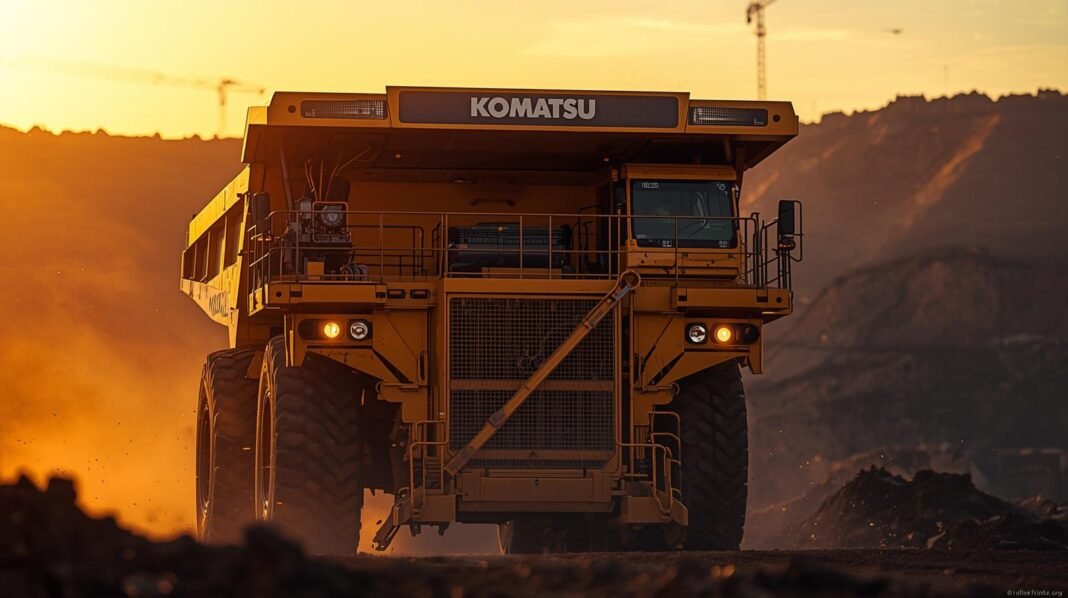
Africa does not just sit on mineral wealth — it sits on the minerals the modern world cannot function without.
Cobalt for EV batteries, copper for clean energy grids, platinum for hydrogen fuel cells, lithium for energy storage.
Together, the continent accounts for roughly 30 percent of global mineral resources, yet for decades its mines have often been underserved by the advanced automation technologies reshaping operations in Australia, Chile, and North America.
In 2026, Komatsu — one of the world’s most powerful mining equipment manufacturers — is working to change that equation decisively.
From the platinum-rich open pits of South Africa’s Bushveld Complex to the copper belts of Zambia and the Democratic Republic of Congo, Komatsu’s push to deploy its autonomous haulage technology across African mine sites represents one of the most significant industrial bets of the year.
And as global demand for critical minerals intensifies, the stakes could not be higher.
The FrontRunner System: Proven Globally, Eyeing Africa
Komatsu’s Autonomous Haulage System — marketed as FrontRunner — is not a prototype. Launched commercially in 2008, it was the world’s first commercial autonomous haulage application, and it has been refining itself ever since.
Today, more than 875 autonomous trucks operate globally under the FrontRunner platform, having collectively moved more than 10 billion metric tonnes of material across 22 mine sites in five countries. The system’s safety record has been, in itself, one of its most compelling commercial arguments.
Designed primarily for ultra-class vehicles such as Komatsu’s 980E haul truck — capable of carrying 363 metric tonnes per load — the FrontRunner system uses GPS positioning, onboard sensors, and real-time fleet coordination to enable continuous, driverless operation.
Autonomous haul trucks do not take breaks, do not suffer fatigue, and do not require the costly safety infrastructure needed when humans operate in hazardous pit environments.
Hermann Hollhumer, General Manager of Mining Operations at Komatsu South Africa, has been characteristically direct about the company’s intentions on the continent: “We look forward to deploying these solutions in Africa.”
Those words carry weight. Africa hosts 16 of Komatsu’s branches and 21 depots across the Southern African region, with operations in South Africa, Namibia, Botswana, and Mozambique — and dealers stretching into Zimbabwe, Madagascar, Mauritius, Malawi, and Zambia.
Why Africa, Why Now
The timing of Komatsu’s Africa push is not accidental. Three forces are converging in 2026 that make the continent’s mines uniquely attractive for autonomous technology deployment.
First, the critical minerals boom. According to the African Energy Chamber’s State of African Energy 2026 Outlook, the continent’s reserves of cobalt, lithium, copper, and platinum group metals place it at the heart of global supply chains for renewable energy deployment and electric vehicle adoption.
The DRC alone holds an estimated 6 million metric tonnes of cobalt reserves — more than half the world’s total. Zambia’s copper output is targeting 1 million tonnes in 2026, rising to 1.2 million tonnes in 2027. The mines are scaling up rapidly, and they need smarter equipment to match.
Second, safety imperatives. Open-pit and underground mining remains among the most dangerous industrial activities in the world, and the pressure on African mines to meet international safety standards has never been more intense.
Komatsu’s autonomous technology removes operators from high-risk environments entirely — including blast zones, unstable pit walls, and areas where vehicle collision risk is elevated. Complementary technologies like dozing-detection systems and collision avoidance interfaces add further layers of protection for any human workers remaining on site.
Third, competitive pressure. The global mining automation market is growing at 8.2% annually in 2026, projected to reach $6.36 billion by 2030. African mine operators who fail to adopt automation risk falling behind on cost-per-tonne metrics as rivals in Australia and South America operate with leaner, technology-enabled fleets.
The economics of autonomous haulage — 24/7 productivity, reduced fuel consumption, predictive maintenance that slashes unplanned downtime — are becoming impossible to ignore.
Beyond the Haul Truck: A Fully Autonomous Mine Vision
Komatsu’s ambitions extend well beyond self-driving haul trucks. The company has articulated a vision of a fully autonomous mine — a coordinated ecosystem where autonomous excavators, dozers, drilling rigs, water trucks, road graders, and even light passenger vehicles operate in synchronised harmony.
This vision is anchored by an interoperability strategy designed to allow different machine types and brands to communicate seamlessly within a single mine environment.
One telling example: Komatsu and Toyota are jointly developing an autonomous light vehicle integration, so that the Toyota pickup trucks that typically ferry personnel around mine sites can be synchronised with Komatsu’s autonomous haul fleet.
When human-driven light vehicles share haulage roads with autonomous haul trucks, those trucks must slow or stop as a safety precaution — a costly productivity drain. The joint system resolves this by giving light vehicles the same autonomous coordination as the heavy fleet.
On the equipment innovation front, Komatsu has achieved another milestone relevant to African operations: successfully operating an autonomous haul truck while connected to a dynamic trolley line.
The trolley assist system delivers electric power to trucks on uphill gradients, reducing carbon emissions and extending engine life — a significant advantage in Africa’s energy-intensive open-pit environments where fuel logistics are often challenging.
The company’s Intelligent Machine Control (IMC) system, already deployed on excavators and dozers, automates complex earthmoving tasks with a precision that manual operation rarely achieves consistently.
Combined with KOMTRAX — Komatsu’s telematics and fleet management platform — mine operators gain real-time visibility over machine health, fuel usage, location, and maintenance needs across their entire equipment fleet.
South Africa: The Strategic Proving Ground
South Africa remains Komatsu’s most developed African market and the most likely first destination for full AHS deployment on the continent.
The country’s Mogalakwena platinum group metals mine — one of the largest open-pit PGM operations in the world — exemplifies the kind of large-scale, high-tonnage operation where autonomous haulage delivers maximum economic benefit.
Komatsu’s equipment base at South African mines already incorporates significant semi-autonomous features: dozing-detection systems that alert operators when fatigue is detected, collision avoidance technology, remote operation capability for high-risk tasks, and Immersive Technologies simulator training — the last of which allows mine personnel to practice emergency scenarios in a safe digital environment before facing real-world hazards.
The continent’s mining services sector is also stepping up. Corica Mining Services, an African-owned contractor, has publicly aligned itself with Komatsu’s automation trajectory.
“We see their investment and progress in autonomous driving machines and digital technologies,” Corica’s leadership has stated, “and we are ready to take the lead in bringing these technologies to the forefront of African mining sites.”
It is a sentiment that reflects a broader shift in local industry confidence about Africa’s readiness to absorb advanced mining automation.
Underground: The GHH Acquisition Opens New Doors
Komatsu’s Africa ambitions are not confined to surface mining. In July 2024, the company acquired GHH Group GmbH, a specialist in underground mining and tunnelling equipment, with an explicit objective of broadening its reach across Europe, Africa, and India.
The acquisition adds hard rock Load-Haul-Dump (LHD) loaders, underground trucks, and development drill rigs to Komatsu’s underground capability — equipment types that are critical for the DRC’s copper and cobalt mines, many of which operate at depth.
Combined with Komatsu Mining — the brand built from the 2017 Joy Global acquisition — the company now offers what it describes as a genuinely end-to-end hard-rock and soft-rock mining portfolio, from surface drill rigs and haul trucks to underground longwall systems and continuous miners.
For African mine operators running complex, multi-level operations, this breadth matters: it reduces integration complexity and concentrates after-sales support responsibility in one relationship.
The Challenges That Remain
Komatsu’s Africa roadmap is compelling, but it is not without friction. Several structural challenges must be navigated before autonomous mining becomes routine across the continent.
Connectivity and infrastructure: Autonomous haulage systems depend on robust, low-latency communications networks.
Many African mine sites — particularly in remote areas of the DRC, Zambia, or West Africa — lack the fibre, 4G/5G LTE, or satellite infrastructure that AHS requires to function reliably. Investment in digital infrastructure must precede or accompany equipment deployment.
Skills and workforce transition: Automation displaces traditional operator roles while creating demand for new skills: system controllers, data analysts, maintenance technicians, and remote operations specialists.
African mining communities — many of which depend heavily on mine employment — will require active investment in reskilling and workforce transition programmes to avoid social disruption.
Regulatory environments: Mining regulations across Africa vary enormously in their readiness to accommodate autonomous operations.
South Africa, for example, has a sophisticated regulatory framework through the Mine Health and Safety Act — but adapting that framework for fully driverless operations will require engagement between technology providers, mine operators, and government agencies.
Other jurisdictions are at earlier stages of that dialogue.
Capital investment cycles: Large-scale AHS deployment requires significant upfront capital — not just for the trucks themselves, but for the control infrastructure, mapping systems, and operational transition costs.
For junior and mid-tier African mining companies operating with tighter balance sheets, the economics of full AHS deployment may require innovative financing structures or phased adoption pathways.
What 2026 and Beyond Looks Like
The trajectory is clear, even if the precise timeline remains fluid. Komatsu is investing in the African market infrastructure — branches, parts distribution, technical training, telematics support — that will be needed to sustain autonomous fleet operations at scale.
The company’s parts distribution centre in Germiston, Johannesburg, and its component remanufacturing facility are the kinds of logistical foundations that make long-term autonomous fleet commitments viable.
As African governments revamp mining policies to attract investment — with South Africa, Senegal, Ghana, and Zambia among those updating frameworks in 2025-2026 — the regulatory pathway for advanced automation is slowly clearing.
The African Mining Week conference in Cape Town, scheduled for October 2026 under the theme “Mining the Future: Critical Resources, Sustainability and Community Development,” will likely see autonomous technology feature prominently in discussions about how Africa’s mining industry scales responsibly.
The minerals beneath African soil are no longer just a geological fact — they are a geopolitical priority.
The US, EU, and China are all competing to secure supply chains anchored in African extraction.
Komatsu, sitting at the intersection of equipment supply and autonomous technology, is uniquely positioned to determine how efficiently and safely those minerals move from pit to processing plant.
Also Read
Next-Gen Excavators Heading to Steinexpo: Efficiency, Automation & Power
The State of Plant Hire in Scotland: On the Road to ScotPlant 2026

- How Komatsu Is Building the Future of Autonomous Mining in Africa in 2026 - March 25, 2026
- SASSA confirms COVID-19 SRD payment dates for April 2026 - March 24, 2026
- US Construction Costs Are Surging — And the Worst Is Still Ahead - March 23, 2026
