When markets bleed this badly, most investors run. But history rewards those who pause, look past the panic, and ask a harder question: what actually changed?
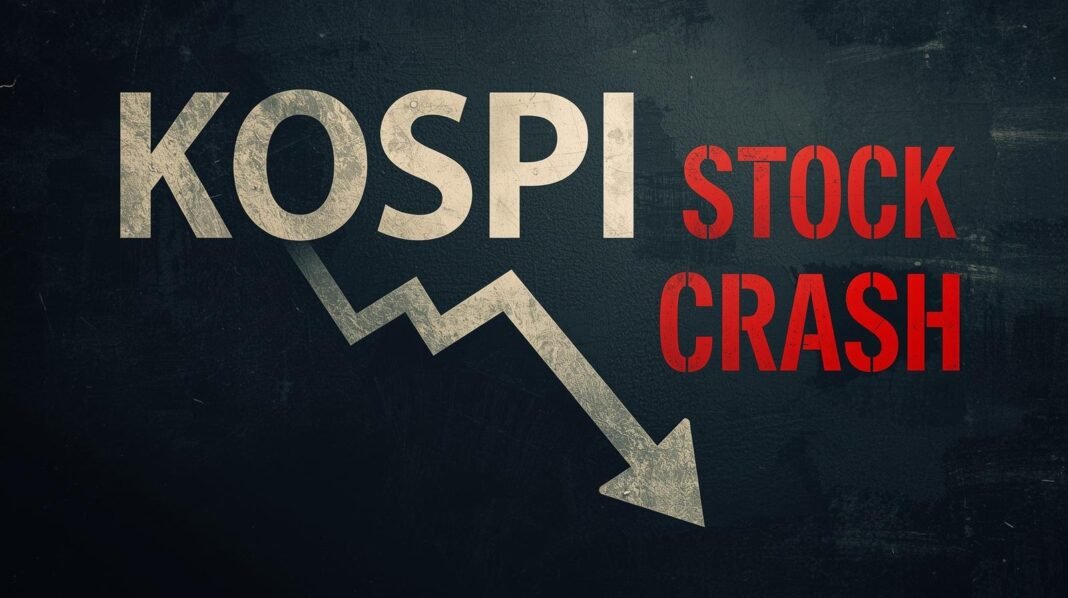
In two devastating sessions — March 3 and 4, 2026 — South Korea’s KOSPI index shed roughly 19% of its value, marking the worst two-day crash since 2008. Billions were wiped off the board. Circuit breakers fired. Headlines screamed.
And yet, if you look carefully at what drove this sell-off versus what will drive South Korea’s economy over the next three to five years, the case for a contrarian position has rarely been more compelling.
This is not a call to blindly buy the dip. It is an invitation to think clearly while others are not.
What Just Happened: The Crash in Numbers
The scale of the sell-off is hard to overstate. On Tuesday, March 3, the KOSPI plunged 7.24% to close at 5,791.91, erasing roughly $270 billion in market value in a single session — the largest one-day wipeout since the August 2024 yen carry-trade meltdown.
The following day, Wednesday March 4, the index plummeted a further 12.1% to close at 5,093.54, its steepest single-day decline in history.
Index heavyweights were hit hardest. Samsung Electronics fell nearly 12%, SK Hynix dropped around 10%, and Hyundai Motor shed over 16%.
Together, Samsung and SK Hynix constitute almost 50% of the KOSPI by market capitalisation — meaning when those two names crater, they take the entire index with them.
Both the KOSPI and the smaller KOSDAQ exchange hit the 8% circuit breaker threshold on Wednesday, triggering a 20-minute trading halt.
Foreign investors sold more than 1 trillion won worth of South Korean stocks in Wednesday’s morning session alone, while local brokers began pulling margin services as retail investors faced margin calls on leveraged positions.
Just weeks earlier, this same market had hit an all-time high above 6,347 and surpassed the 6,000 level for the first time in history.
Year-to-date gains before the crash sat near 45-50%. Over the previous 12 months, the KOSPI had surged more than 129%. The speed of the reversal is breathtaking — but speed, notably, is not the same as permanence.
Why It Crashed: Geopolitics, Not Fundamentals
Here is the most important thing to understand about this crash: it was not caused by anything wrong with South Korea’s economy.
The trigger was the escalation of the US-Iran conflict following joint US-Israeli strikes on Iranian targets — a development that prompted Iran to threaten to block the Strait of Hormuz, the maritime chokepoint through which roughly 20% of the world’s oil supply passes. Brent crude surged sharply on fears of a prolonged supply shock.
For South Korea, the geography of this crisis is particularly painful. The country imports about 98% of its fossil fuel needs from overseas, with roughly 70% of its crude arriving from the Middle East, much of it transiting through the very strait now under threat.
South Korea imports approximately 2.76 million barrels of oil daily through that passage. When Iran threatens to close it, South Korean markets feel the consequences more acutely than almost anywhere else on earth.
This geopolitical shock compounded an existing vulnerability. A significant portion of the crash traces back to forced selling. Retail investors had borrowed heavily to ride the rally, many putting down only 30–40% as a margin deposit.
As the market turned, those leveraged positions unwound fast, amplifying the downward move well beyond what the underlying news alone would justify.
As Dave Mazza, chief executive of Roundhill Investments, put it: the sell-off “reads like a positioning unwind more than a Korea-specific fundamental break.”
Daniel Yoo, global market strategist at Yuanta Securities, added that the drop “should be viewed as a correction after a strong rally rather than a fundamental shift in the market’s outlook, adding that stability was likely to return once oil prices settle.”
In short: the market overcorrected. The Strait of Hormuz threat, the margin call cascade, the holiday-induced pent-up selling — these manufactured a crisis that exceeded the actual shift in South Korea’s economic trajectory.
The Bull Case: Why the Story Hasn’t Changed
1. The AI Memory Supercycle Is Still Happening
Before the geopolitical noise, the reason the KOSPI hit all-time highs was straightforward: Samsung Electronics and SK Hynix are the two dominant global suppliers of the memory chips that power artificial intelligence — and demand for those chips is exploding.
The global semiconductor market is projected to approach $975 billion in 2026, growing more than 25% year-over-year, with the memory segment growing at an even faster clip of around 30%, according to World Semiconductor Trade Statistics.
Bank of America has described 2026 as “a supercycle similar to the boom of the 1990s,” forecasting global DRAM revenue to surge 51% and NAND by 45% year-over-year.
SK Hynix had already booked its entire memory chip capacity for 2026 before this crash happened. Samsung and SK Hynix reportedly hiked prices for high-bandwidth memory (HBM) by nearly 20% for 2026 deliveries as AI accelerator demand outstripped supply.
In October 2025, both companies signed a letter of intent with OpenAI to supply 900,000 DRAM wafers per month for its Stargate project.
Samsung is looking to expand production capacity by around 50% in 2026, while SK Hynix announced plans to increase infrastructure investment by more than four times its previous figure.
None of those contracts were cancelled on March 4, 2026. None of those hyperscalers reduced their AI buildout plans because of an oil price spike. The demand curve for HBM chips does not bend because of events in the Strait of Hormuz.
2. The Crash Was an Exogenous Shock, Not a Structural One
Markets make a crucial distinction between two types of crises: those that reveal underlying rot in an economy, and those that represent external shocks to a fundamentally sound one.
The 2008 financial crisis was the former — it exposed the leverage and fragility baked into the global financial system.
South Korea’s March 2026 crash is the latter. As Lorraine Tan, Asia director of equity research at Morningstar, acknowledged, the drop was “partly driven by profit taking after a strong runup amidst a risk-off environment.”
The AI tailwinds, the memory demand explosion, the expanding capacity of Samsung and SK Hynix — none of these fundamentals disappeared.
South Korea’s oil stocks cover about seven months of supply, providing a meaningful buffer against short-term disruption. If the Iran conflict stays contained and oil settles below $85 per barrel, analysts expect a sharp rebound.
Even a sustained $100 oil scenario would shave an estimated 0.3 percentage points off 2026 GDP growth — painful, but manageable for an economy with the structural momentum South Korea currently possesses.
3. History Consistently Rewards Buyers After Panic Sell-Offs
The KOSPI has been here before. After collapsing below 1,000 in 2008 during the global financial crisis, it recovered to the 2,000 level by 2010.
After the COVID-19 pandemic drove the index to a low of 1,771 in March 2020, retail investors — dubbed “ant warriors” by the Korean press — scooped up undervalued shares aggressively. The KOSPI went on to log the best performance among G20 peers that year and crossed the 3,000 level in January 2021, its fastest milestone in decades.
The pattern is consistent: panic-driven crashes in a fundamentally strong market create entry points that long-term investors later struggle to believe they almost missed.
4. South Korean Authorities Have Tools — and Are Using Them
South Korean financial authorities did not sit idle. Contingency plans were activated immediately, including a market stabilization fund of over 100 trillion won (approximately $68 billion) designed to support markets during sharp declines, financed by securities firms, banks and other financial institutions.
Circuit breakers bought time to prevent a total collapse. The Bank of Korea has policy room to act if conditions deteriorate further.
This is not a government caught off-guard by systemic failure. It is one managing an external shock with established tools.
The Risks: What Could Keep the Bear Case Alive
Intellectual honesty demands that the bear case be stated clearly.
Oil price escalation is the single biggest risk. If the Iran conflict drags on and the Strait of Hormuz remains blocked for weeks or months, the scenario changes materially.
South Korea’s net oil imports represent 2.7% of GDP, and a sustained $100+ oil environment would pressure inflation, corporate margins, and consumer spending simultaneously.
Currency pressure compounds the problem. The Korean won weakened to 1,466 per dollar during the crash, amplifying the cost of imported energy and accelerating foreign capital outflows. A further depreciation loop would hurt earnings for import-heavy sectors.
Leverage hangover. A large chunk of the sell-off was driven by margin calls on retail investors who borrowed heavily during the bull run.
If further forced selling continues in the coming days, the market has not yet found a floor, and the 5,500–5,600 range represents the next key technical support level to watch.
Concentration risk is real. With Samsung and SK Hynix making up nearly half the KOSPI by weight, the index has limited diversification.
If AI spending were to slow — whether due to energy costs at data centres, regulatory changes, or a technology slowdown — these two stocks would drag the entire index lower.
These are genuine risks and they deserve respect. The question is not whether they exist, but whether they are already priced in after a crash of this magnitude.
How to Position: A Framework for Contrarian Investors
If you believe — as the evidence suggests — that this crash is primarily a positioning unwind amplified by geopolitical shock, and not the beginning of a structural Korean bear market, there are several ways to consider acting on that thesis.
Watch the oil price, not the headlines. The recovery thesis pivots on whether the Iran conflict de-escalates and oil prices stabilise. Brent crude settling below $85 is the key signal to watch. Every day of relative calm in the Strait of Hormuz is a data point in the bull case.
The EWY ETF offers broad KOSPI exposure. The iShares MSCI South Korea ETF (EWY) tracks the broad South Korean market and provides accessible exposure for investors who want to capture a potential recovery without individual stock risk.
Samsung and SK Hynix are the two names that matter most. Given that they constitute nearly half the index and are the primary drivers of the AI memory supercycle thesis, any serious Korea bull position runs through these two stocks.
Both are now trading well off their all-time highs — despite their order books and production plans remaining fundamentally unchanged.
Consider phased entry rather than a single bet. Given ongoing geopolitical uncertainty, dollar-cost averaging into a position over several weeks reduces the risk of catching a falling knife if the conflict escalates further.
The 5,500–5,600 KOSPI level represents a natural area of technical support to watch for stability.
Korea’s defence stocks are a separate, asymmetric play. Notably, while the broader market crashed, defence-related stocks surged — Hanwha Aerospace climbed nearly 20% and Korea Aerospace Industries rose over 3% as the market priced in stronger military demand.
For investors seeking exposure to the geopolitical dimension of this conflict, South Korea’s defence sector offers a counter-cyclical angle within the same country thesis.
The Bottom Line
South Korea’s KOSPI just suffered its worst two-day crash since 2008. Panic has swept the market. Margin calls have forced selling that has nothing to do with economic reality. Foreign investors have fled. The headlines are brutal.
And yet the AI memory supercycle has not ended. Samsung and SK Hynix still supply the chips that power the world’s most significant technological infrastructure buildout in decades.
Their order books remain full, their production expansions are proceeding, and global hyperscalers have not cancelled their buildout plans because of events in the Persian Gulf.
History does not guarantee that the KOSPI rebounds from here.
But history does consistently show that the best buying opportunities tend to look exactly like this moment: an economy with strong fundamentals, temporarily overwhelmed by fear, offering prices that would have seemed impossible two weeks ago.
The crash may not be over. But the opportunity may be just beginning.
Also Read
Why Comfort Systems’ Real Value Isn’t the Stock Price — It’s MEP Consolidation
US Building Codes and Regulations Every Contractor Should Know

- Mega Machines: Meet the Biggest Wheel Loaders Ever Built - June 27, 2026
- How They Were Built: Inside the Burj Khalifa - June 26, 2026
- Inside Nairobi’s Le’Mac Tower Auction: Which Properties Are Being Sold and Why? - June 26, 2026
