

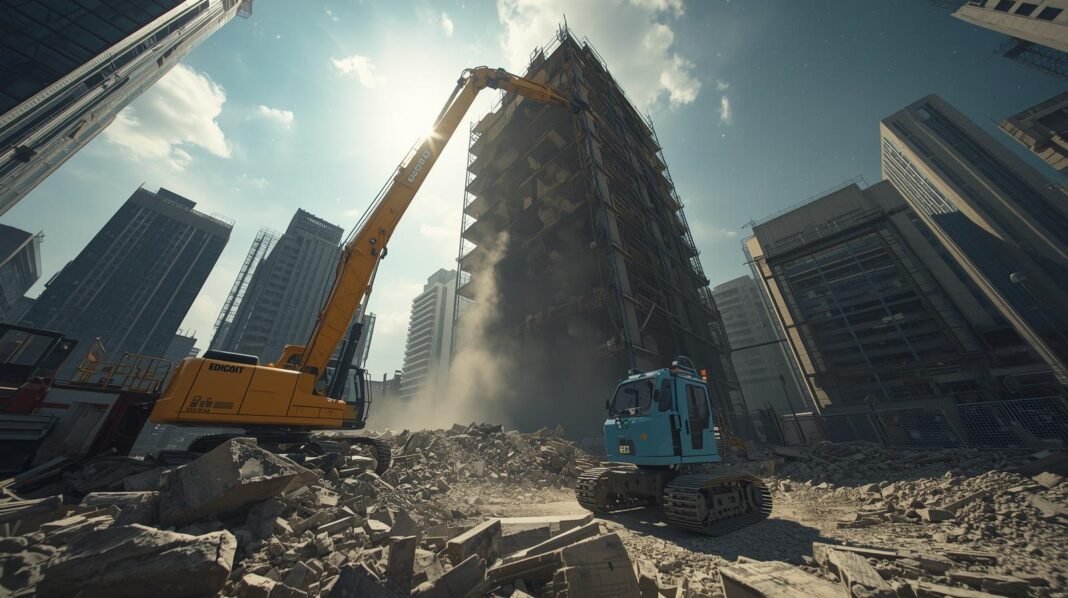
The demolition industry stands at a technological crossroads. What was once dominated by wrecking balls and manual labor has transformed into a sophisticated field where precision robotics and towering high-reach excavators are redefining what’s possible.
This evolution isn’t merely about replacing old methods with new machines—it represents a fundamental shift in how we approach urban deconstruction, safety protocols, and environmental responsibility.
The Rise of High-Reach Excavators: Engineering Vertical Dominance
High-reach excavators have emerged as the workhorses of modern demolition, particularly in dense urban environments where traditional methods fall short.
These specialized machines, equipped with extendable booms reaching heights of 100 feet or more, have fundamentally changed the economics and safety profile of tall structure demolition.
The engineering behind these machines represents a careful balance of reach, stability, and precision.
Modern high-reach excavators feature multi-section booms with hydraulic cylinders that can extend to demolish buildings up to 30 stories or higher, depending on the configuration.
The counterweight systems have become increasingly sophisticated, utilizing computer-controlled ballast adjustments that maintain stability as the boom extends to extreme heights.
What makes these machines particularly valuable is their attachment versatility. Operators can switch between hydraulic shears capable of cutting through steel beams, crushers that pulverize concrete, and pulverizers that can separate rebar from concrete in a single operation.
This adaptability reduces the need for multiple machines on site, lowering costs and improving project timelines.
The operational advantages extend beyond mere height. High-reach excavators enable top-down demolition, a methodologically superior approach that minimizes structural instability risks.
By systematically dismantling structures from the roof downward, contractors can better control debris fall patterns, reduce dust generation, and maintain structural integrity throughout the demolition process.
This contrasts sharply with explosive demolition, which requires extensive pre-weakening, evacuations, and carries inherent unpredictability.
Robotic Demolition: Precision in Hazardous Environments
While high-reach excavators dominate outdoor applications, robotic demolition machines have carved out an indispensable niche in confined spaces, interior demolition, and hazardous material environments.
These compact, remotely operated machines represent a quantum leap in worker safety and operational precision.
Modern demolition robots, ranging from small 500-kilogram units to larger 15-ton machines, can navigate through standard doorways, operate in low-clearance areas, and work in atmospheres too dangerous for human entry.
Their remote operation capability—often at distances exceeding 300 meters—allows operators to dismantle structures containing asbestos, lead paint, radioactive materials, or unstable structural elements without direct exposure.
The technological sophistication of contemporary demolition robots extends far beyond simple remote control.
Advanced models incorporate force feedback systems that allow operators to “feel” resistance through their controls, preventing equipment damage and enabling more nuanced work.
Integrated cameras with multiple viewing angles provide situational awareness that rivals or exceeds direct line of sight, while onboard sensors monitor environmental conditions including air quality, structural vibrations, and temperature.
These machines excel in selective demolition scenarios where preservation of adjacent structures is paramount.
In renovation projects within occupied buildings, robots can systematically remove specific walls, floors, or structural elements with minimal vibration and noise transmission.
Their precision reduces collateral damage that would otherwise require costly repairs, making them economically advantageous despite their higher hourly operational costs compared to conventional equipment.
Data-Driven Demolition: The Integration of Digital Technologies
The convergence of demolition machinery with digital technologies has created new paradigms in project planning and execution. Building Information Modeling, originally developed for construction, has found powerful applications in demolition planning.
Contractors now create detailed 3D models of structures slated for demolition, identifying load-bearing elements, hazardous materials locations, and optimal deconstruction sequences before equipment ever arrives on site.
This digital pre-demolition phase dramatically reduces unexpected complications. Laser scanning and photogrammetry technologies create millimeter-accurate digital twins of existing structures, revealing hidden structural elements, utility conflicts, and spatial constraints that would otherwise emerge as costly surprises during active demolition.
When combined with structural analysis software, these models can predict how buildings will respond to sequential element removal, allowing engineers to proactively address potential collapses or uncontrolled failures.
Machine telematics represent another data revolution in demolition operations. Modern high-reach excavators and robotic systems continuously transmit operational data including fuel consumption, hydraulic pressure, attachment forces, boom angles, and maintenance requirements.
This real-time data stream enables predictive maintenance scheduling that prevents costly breakdowns, optimizes equipment utilization across multiple job sites, and provides objective productivity metrics that inform bidding and project management decisions.
Some advanced operators have begun integrating artificial intelligence into their operational workflows.
Machine learning algorithms analyze historical demolition data to identify patterns correlating with optimal productivity, safety incidents, or equipment failures.
While still in early adoption stages, these systems show promise for real-time operational recommendations, such as suggesting alternative demolition sequences when sensors detect unexpected structural behaviors or environmental conditions.
Environmental Implications: Sustainability Through Technology
The environmental profile of demolition has improved markedly with technological advancement, though challenges remain.
High-reach excavators and robotic systems enable more precise material separation at the point of demolition, significantly improving recycling rates.
Where traditional wrecking ball demolition created largely unsorted rubble requiring extensive manual processing, modern equipment can systematically separate concrete, steel, wood, and other materials during the demolition process itself.
This on-site sorting capability has substantial environmental implications. Concrete can be crushed and reused as aggregate, steel can be efficiently recycled, and wood can be diverted from landfills.
Industry data suggests that well-planned demolition projects using modern equipment can achieve material recovery rates exceeding 90 percent, compared to historical averages below 50 percent for conventional methods.
Dust and noise pollution, long-standing community concerns around demolition sites, have also seen technological mitigation.
Modern high-reach excavators frequently incorporate integrated water suppression systems that inject fine water mists directly at cutting points, capturing dust particles before they become airborne.
Sound-dampening attachments and low-noise hydraulic systems reduce noise emissions, particularly important in urban settings where demolition must occur near residential areas, hospitals, or schools.
The carbon footprint of demolition operations has become an industry focus, driven by both regulatory requirements and client demands.
Electric and hybrid demolition robots eliminate on-site diesel emissions, making them particularly valuable for interior demolition in occupied buildings.
While high-reach excavators remain predominantly diesel-powered due to their substantial energy requirements, manufacturers have introduced fuel-efficient engines and hydraulic systems that reduce consumption by 20 to 30 percent compared to older generation equipment.
Economic Analysis: Cost Dynamics and Market Forces
The economics of demolition technology adoption present complex trade-offs between capital investment, operational efficiency, and risk mitigation.
High-reach excavators represent substantial capital expenditures, with specialized units costing between $500,000 and over $2 million depending on reach height, attachment packages, and technological features.
Demolition robots similarly range from $100,000 for basic units to $500,000 for advanced models with extensive attachment options.
Despite these upfront costs, the total cost of ownership frequently favors advanced equipment when analyzed over project lifecycles.
High-reach excavators eliminate or substantially reduce scaffolding requirements, cutting both material costs and labor hours for installation and dismantling.
Their productivity advantages—often measured at two to three times the output of conventional demolition methods—compress project timelines, reducing overhead costs and allowing faster site turnover for redevelopment.
Safety improvements generate less visible but equally significant economic benefits. Reducing worker exposure to fall hazards, structural collapses, and hazardous material contact translates to lower insurance premiums, fewer lost-time incidents, and reduced liability exposure.
In regions with stringent occupational safety regulations, the ability to conduct demolition with minimal personnel in hazardous zones can determine project feasibility.
The market has responded with increasingly sophisticated financing and equipment-sharing models.
Equipment rental and leasing have expanded, allowing smaller demolition contractors to access advanced technology without capital barriers.
Equipment-as-a-service models, where manufacturers retain ownership while providing operators, maintenance, and technical support, have emerged as alternatives that shift technology risk away from contractors.
Regulatory Evolution and Safety Standards
The regulatory landscape governing demolition has evolved in parallel with technological capabilities, creating feedback loops that simultaneously enable and mandate advanced equipment adoption.
Occupational safety administrations worldwide have progressively tightened restrictions on worker exposure to demolition hazards, particularly regarding fall protection, structural collapse risks, and hazardous material contact.
These regulatory pressures have accelerated high-reach excavator and robotics adoption by making traditional methods economically unviable for certain project types.
When regulations require extensive scaffolding, fall protection systems, and personal protective equipment for manual demolition at height, the cost and time advantages of high-reach equipment become compelling.
Similarly, requirements for respiratory protection, environmental monitoring, and exposure limits in hazardous material environments make remotely operated robots not merely preferable but often the only compliant option.
The regulatory framework has also adapted to address risks specific to advanced demolition technologies.
Standards now specify operator training requirements, certification programs for equipment operation, and protocols for remote-controlled equipment operation in shared workspaces.
These evolving standards reflect industry maturation and recognition that advanced equipment, while generally safer, introduces distinct hazard profiles requiring specific competencies and operational protocols.
Environmental regulations have proven equally influential in shaping technology adoption. Dust emission limits, noise restrictions, and waste diversion mandates create compliance requirements that older equipment and methods struggle to meet.
Modern demolition technology, with integrated dust suppression, noise reduction, and material sorting capabilities, often represents the path of least resistance for regulatory compliance, particularly in environmentally sensitive urban contexts.
Workforce Transformation: Skills and Training Requirements
The technological transformation of demolition has fundamentally altered workforce requirements, creating both opportunities and challenges for industry participants.
The archetype of the demolition worker as primarily providing manual labor has given way to a need for equipment operators with technical sophistication comparable to heavy construction machinery operators.
Operating high-reach excavators demands spatial reasoning capabilities beyond conventional excavator operation.
Operators must mentally track boom position in three-dimensional space while accounting for delayed control response over extended hydraulic lines, wind loading on long booms, and dynamic loading as attachments engage materials at extreme distances from the machine’s center of gravity.
Skill development typically requires 6 to 12 months of supervised operation before operators achieve proficiency on the tallest-reach machines.
Robotic demolition introduces an even steeper learning curve. Operating purely through camera feeds and control interfaces eliminates the physical and visual cues operators normally rely upon.
Depth perception, force estimation, and spatial awareness must be developed through screen-mediated interfaces.
Effective operators develop the ability to interpret subtle visual cues about material resistance, structural stability, and equipment stress that substitute for direct sensory feedback.
The industry has responded with formalized training programs, certification standards, and apprenticeship models that professionalize demolition equipment operation.
Manufacturers increasingly offer comprehensive training as part of equipment sales or rental packages, recognizing that operator competency directly impacts equipment productivity, maintenance costs, and safety outcomes.
Vocational schools and industry associations have developed curricula combining classroom instruction on demolition engineering principles with simulator-based training and supervised field experience.
This workforce evolution creates economic stratification within the demolition industry.
Contractors who invest in equipment and operator development can access higher-value projects with correspondingly better margins, while those relying on traditional methods face increasing competitive pressure and relegation to smaller, less complex work.
The productivity differential between skilled operators on advanced equipment and conventional methods has widened to the point that labor cost differentials become secondary considerations in competitive bidding.
Future Trajectories: Emerging Technologies and Industry Direction
The trajectory of demolition technology suggests several emerging developments likely to further transform industry practices over the coming decade.
Autonomous and semi-autonomous operation represents the most potentially disruptive advancement currently in development stages.
Prototype systems have demonstrated autonomous concrete breaking, where artificial intelligence systems analyze material conditions and select optimal attachment positions and forces without human input for each individual operation.
Full autonomy faces substantial technical and regulatory hurdles, particularly regarding safety assurance in dynamic, unpredictable demolition environments.
However, semi-autonomous systems that handle repetitive tasks while keeping human operators in supervisory roles appear more immediately viable.
Such systems could improve productivity on large-scale demolition projects while reducing operator fatigue during extended operations.
Electric and alternative fuel technologies will likely address the carbon intensity of demolition equipment.
Battery-electric high-reach excavators face energy density challenges—the power requirements for hydraulic systems lifting multi-ton attachments to extreme heights strain current battery technologies.
Hybrid systems combining diesel generators with electric drive and hydraulic systems offer intermediate solutions, while hydrogen fuel cells present longer-term possibilities for zero-emission operation.
Advanced sensing and real-time structural analysis represent another frontier.
Integrating LIDAR, ground-penetrating radar, and acoustic emission sensors into demolition equipment could provide continuous structural integrity monitoring during demolition, alerting operators to unexpected weaknesses or instabilities before they precipitate uncontrolled failures.
Machine learning systems trained on thousands of demolition projects could identify subtle patterns indicating structural risks invisible to human observation.
The integration of demolition planning with broader urban development workflows suggests increasing sophistication in how demolition fits within construction project lifecycles.
As-built scanning of structures slated for demolition could directly inform design of replacement structures, identifying foundation elements suitable for reuse, quantifying available recycled materials for incorporation into new construction, and optimizing site logistics by coordinating demolition sequences with construction staging requirements.
Conclusion: Technology as Industry Evolution Catalyst
The transformation of demolition through high-reach excavators and robotics represents more than incremental equipment improvement—it constitutes fundamental industry evolution toward greater safety, environmental responsibility, and economic efficiency.
These technologies have made previously impossible projects feasible, enabled demolition in contexts where traditional methods would be prohibited, and elevated demolition from a crude destructive process to a precise deconstruction discipline.
The pace of this transformation will likely accelerate as digital technologies, automation, and environmental pressures converge.
Demolition contractors who embrace technological advancement position themselves for market leadership, while those clinging to traditional methods face increasing competitive and regulatory pressures that may ultimately prove existential.
For the broader construction industry and urban development community, these advances in demolition technology enable more ambitious redevelopment projects, faster urban renewal cycles, and more sustainable building lifecycle management.
The ability to safely, efficiently, and cleanly dismantle existing structures removes a significant friction point in urban evolution, allowing cities to adapt their built environments more responsively to changing economic and social needs.
The future of demolition is not merely about bigger machines or more sophisticated robots, but about reimagining how we respectfully and efficiently return built structures to their constituent materials, reclaiming urban space for new purposes while minimizing environmental impact and human risk.
In this vision, demolition becomes not the violent end of a structure’s life but a carefully orchestrated transition enabling urban renewal and sustainable resource cycles.
The technologies emerging today are the foundation upon which this more sophisticated approach to urban transformation will be built.
Also Read
New vs Used Heavy-Duty Trucks: What Works Best in Africa?
Fuel Efficiency Challenges for Heavy Trucks in African Terrain

- From Operator to Algorithm: Bedrock Puts Autonomous Excavators to Work on Live Construction Sites - September 7, 2026
- Built For The Rough Stuff: Inside Titan’s new ForestEDGE™ Tyre Line - September 4, 2026
- South Africa Has R395 Billion in Infrastructure Projects — But Can the Industry Deliver Them? - August 26, 2026
